
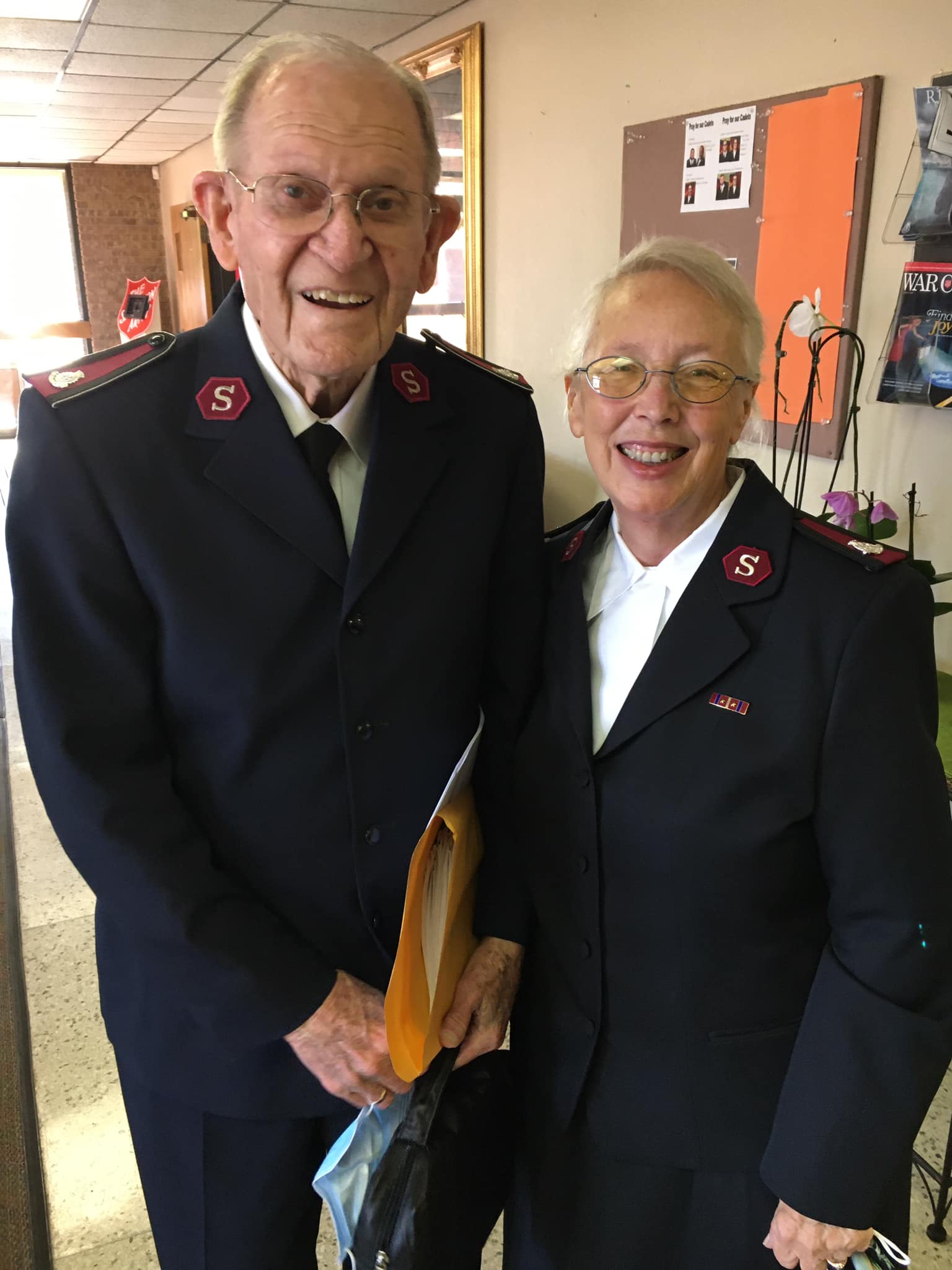
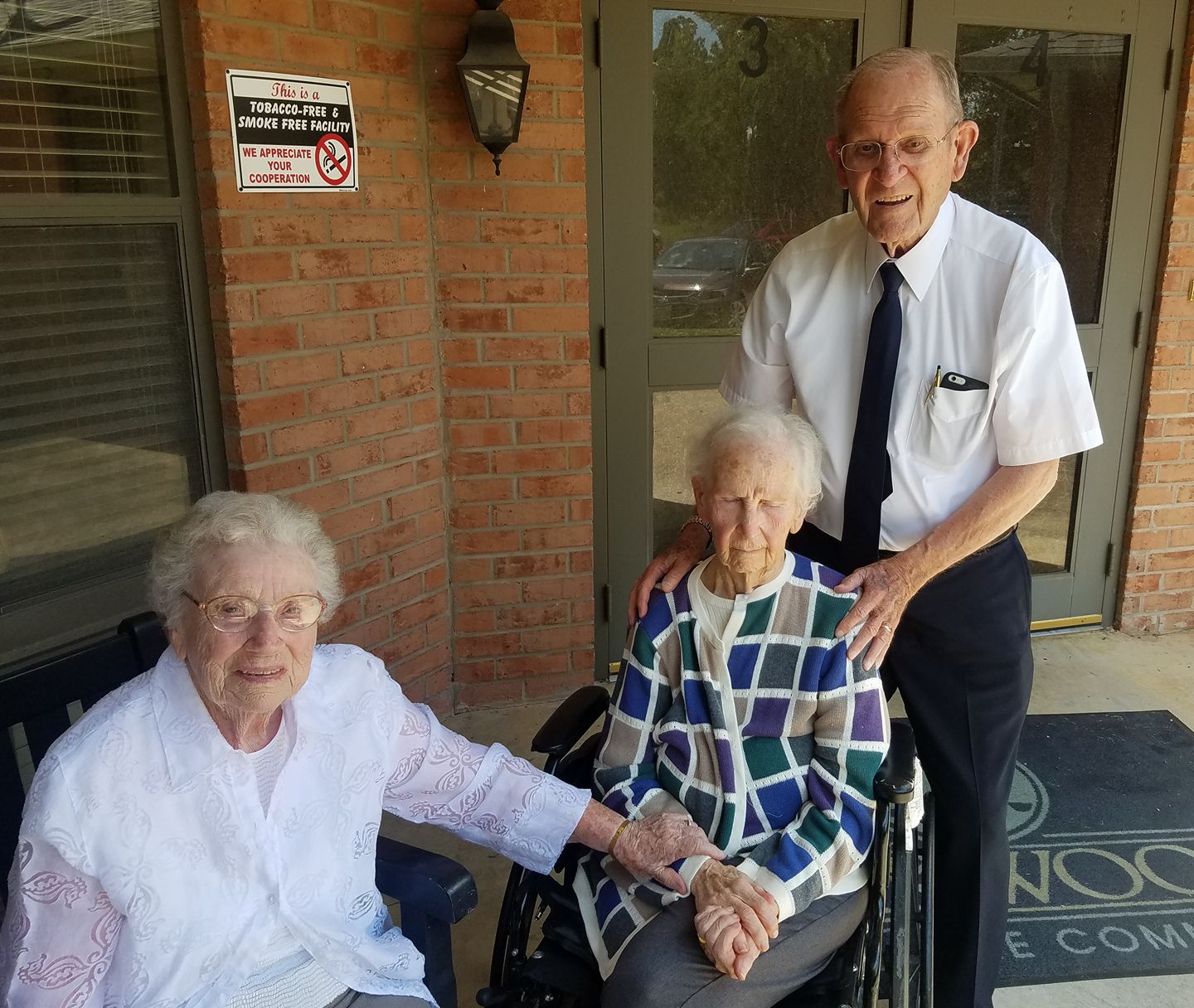



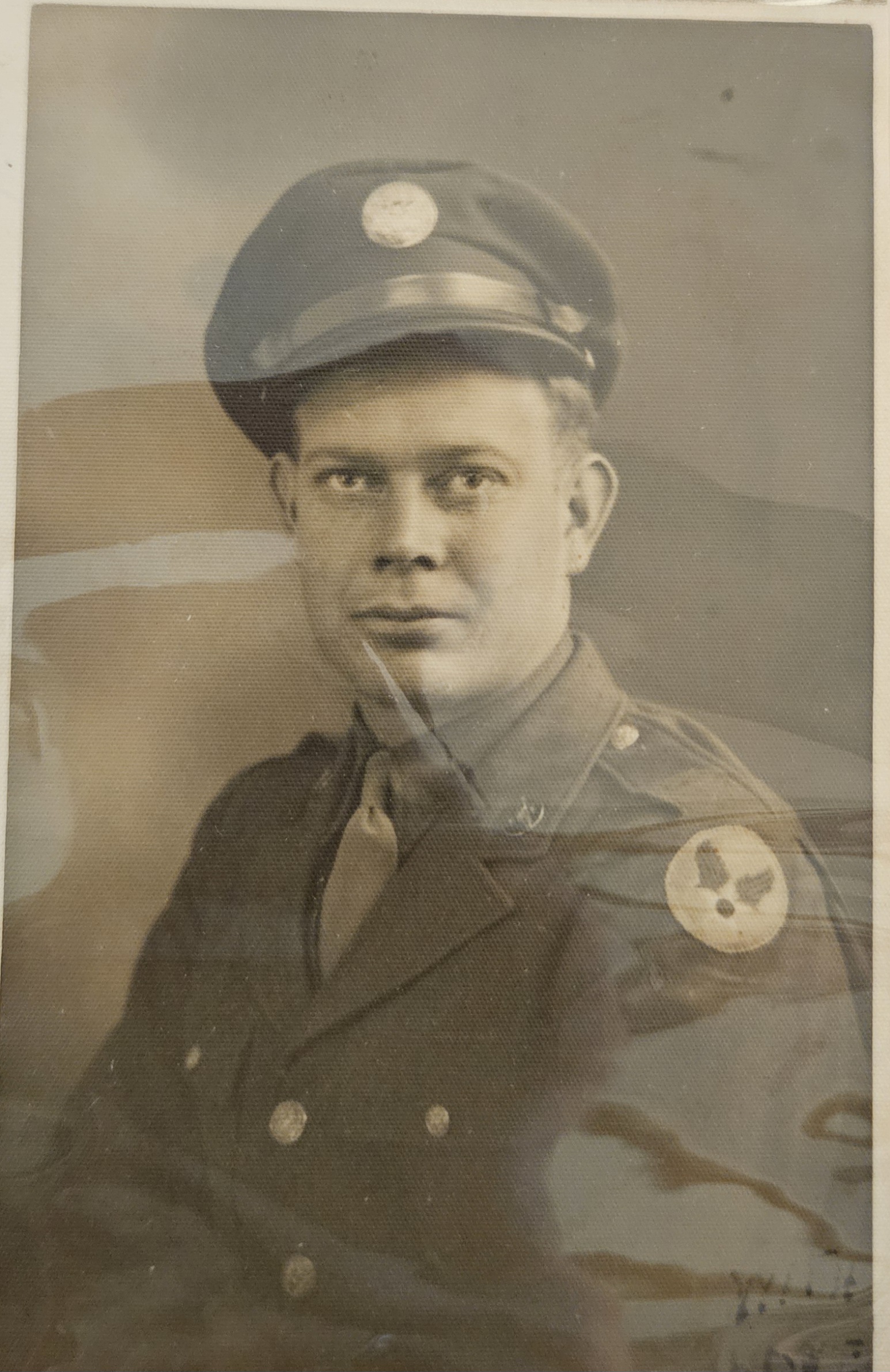
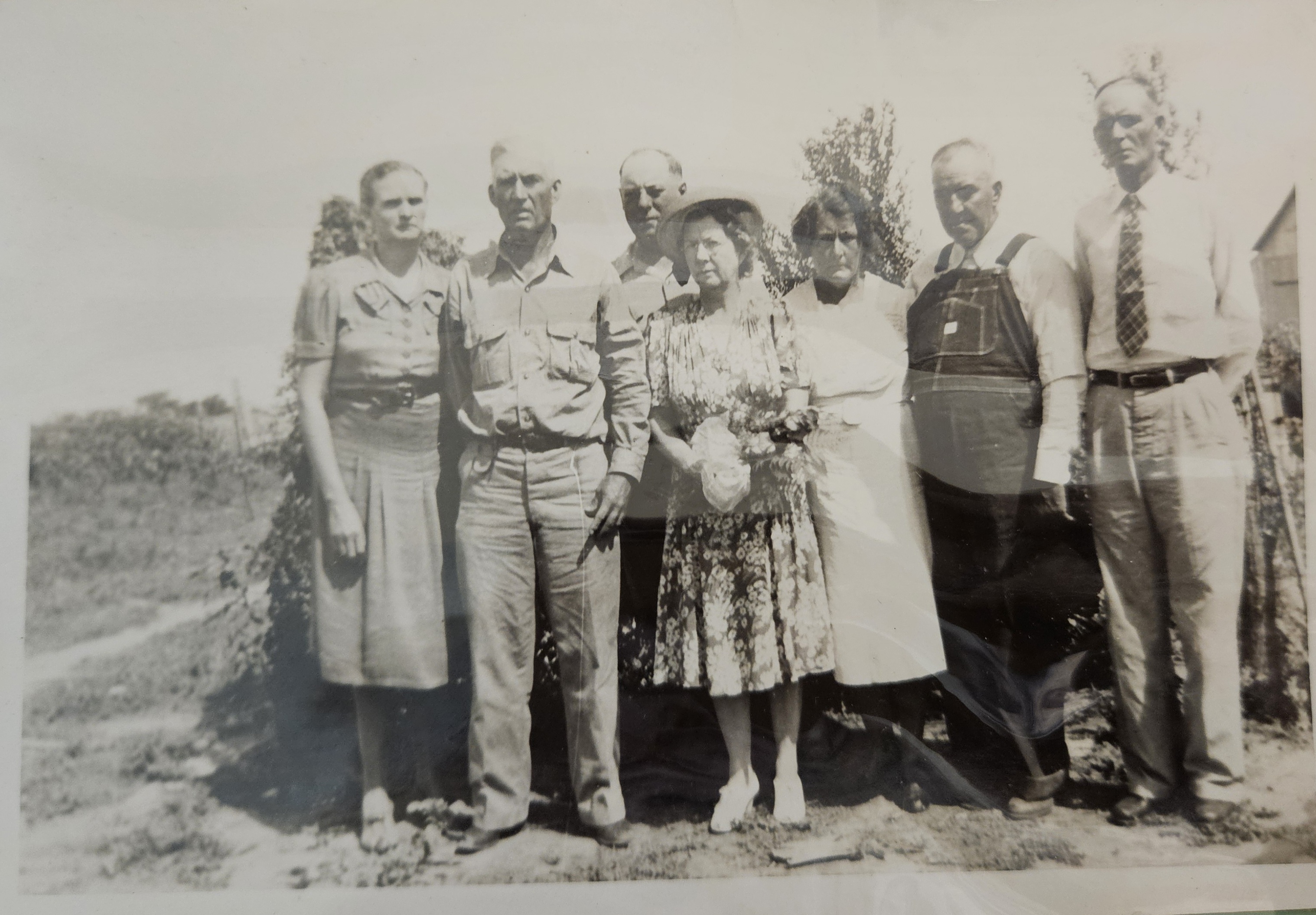
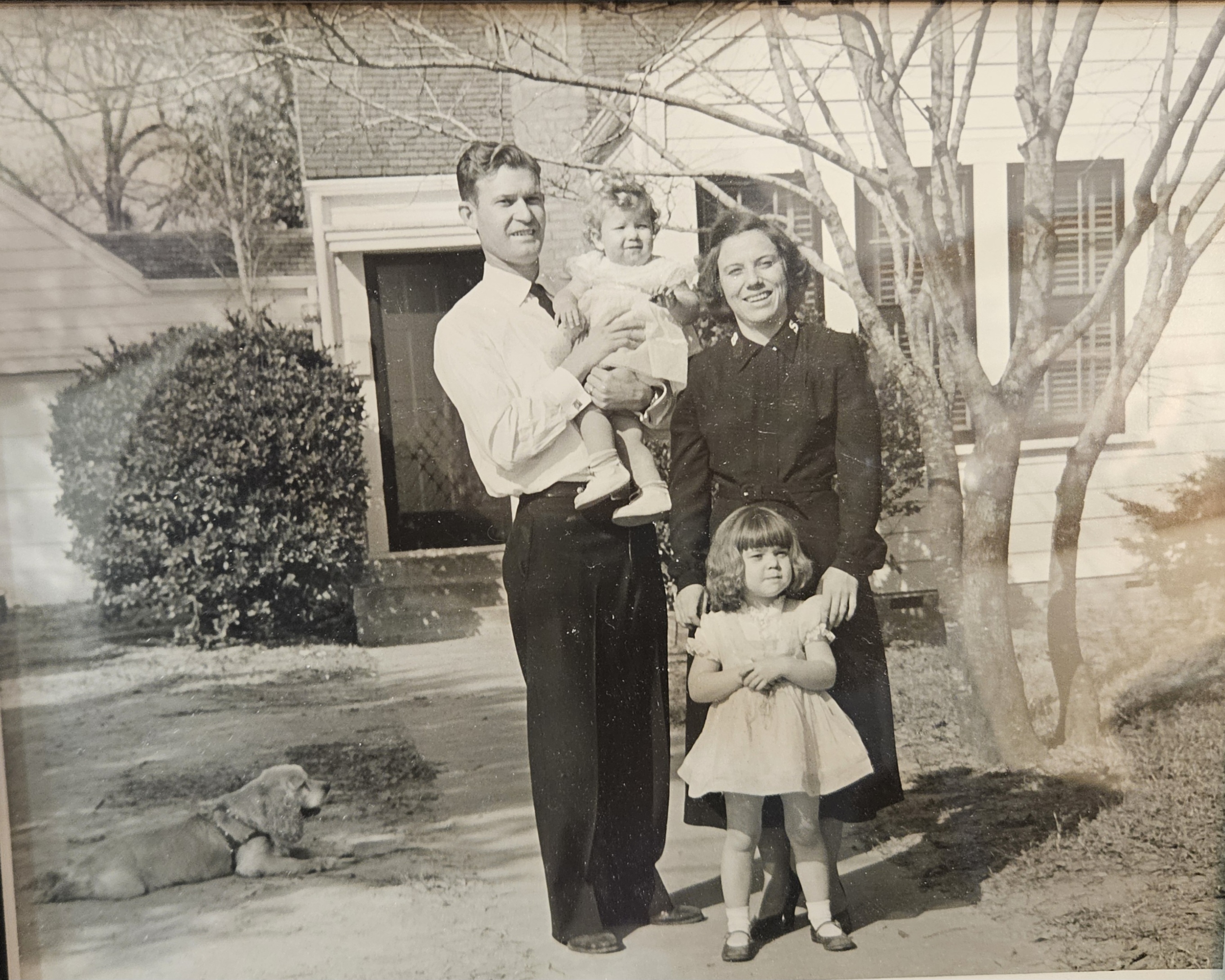
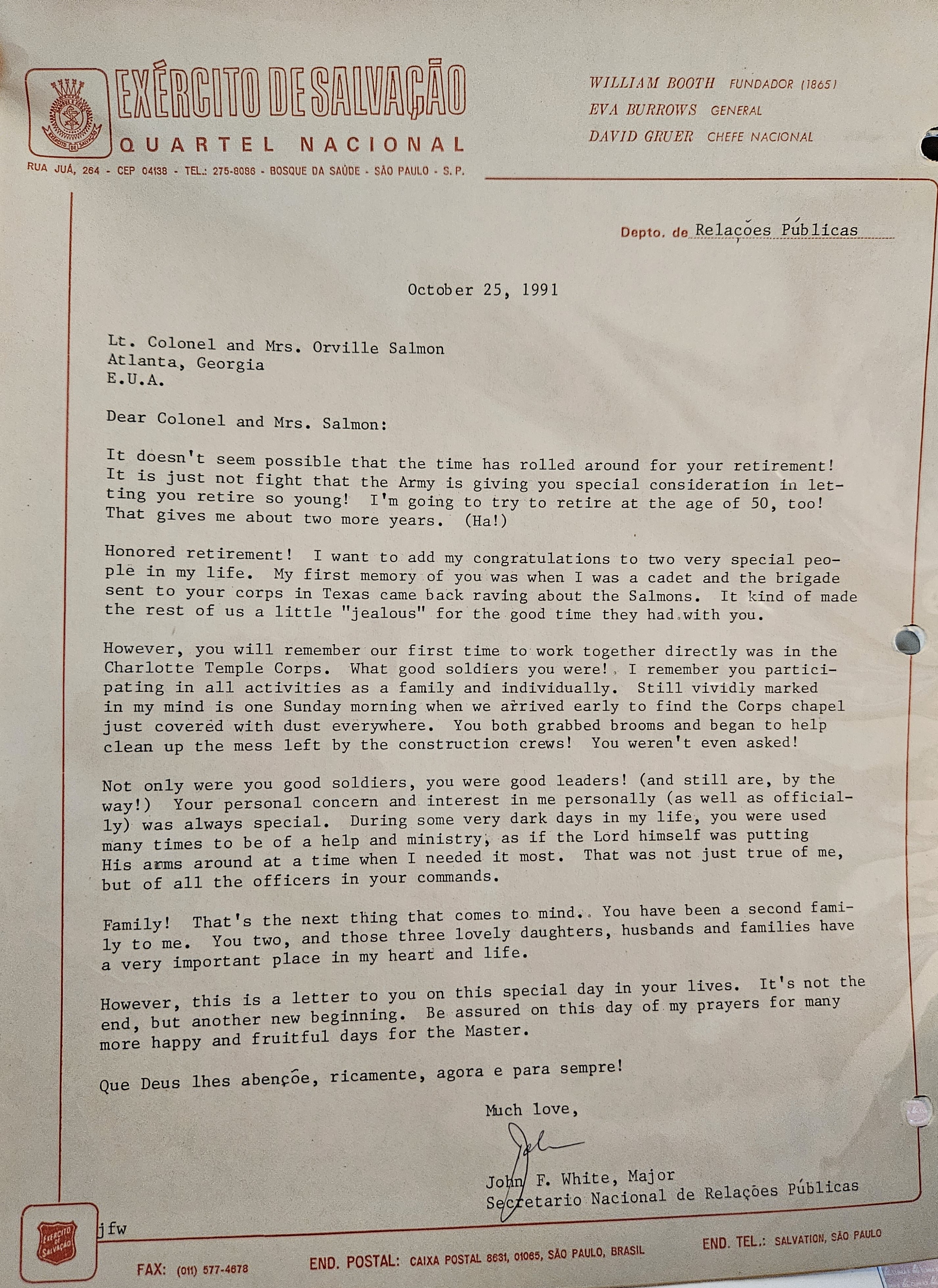



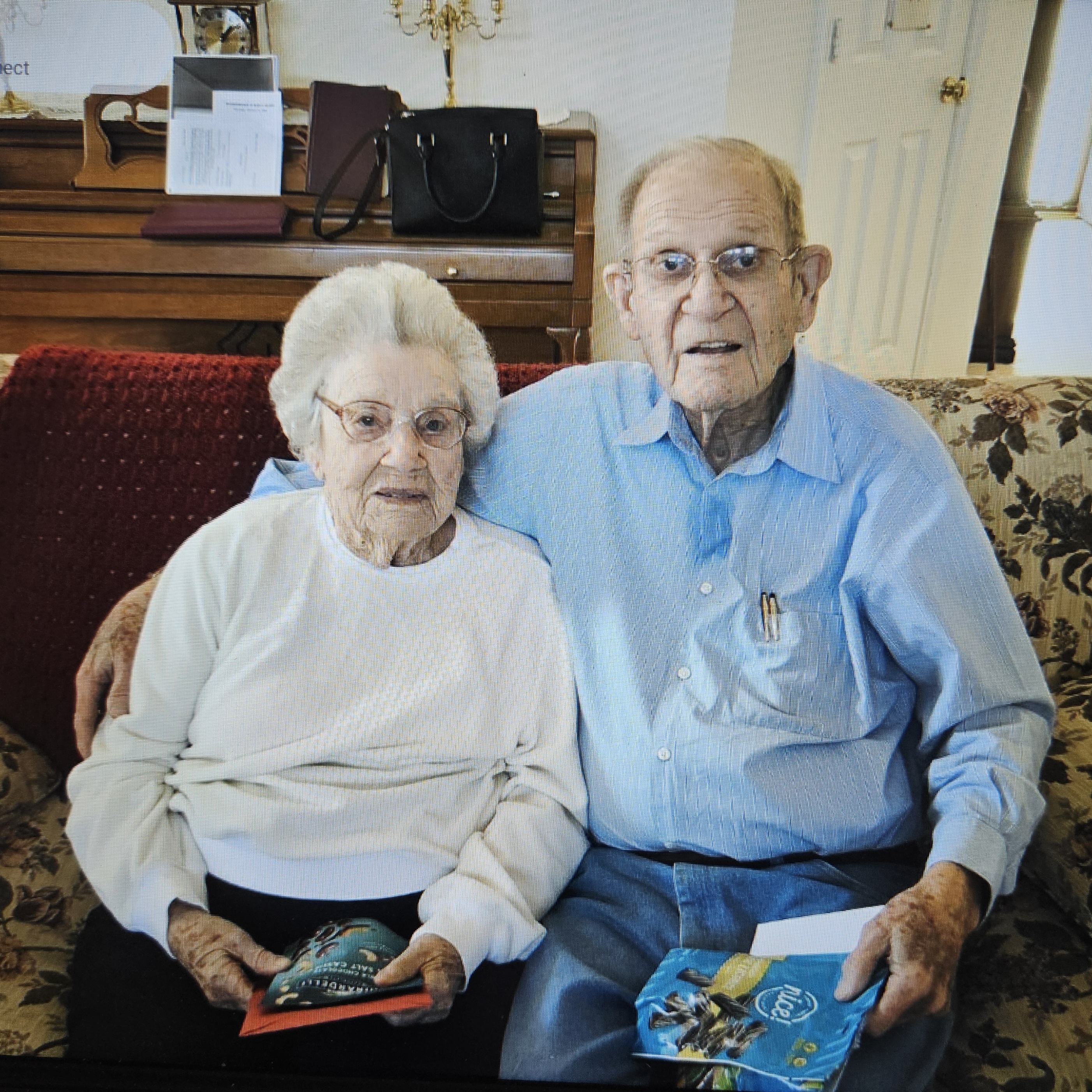
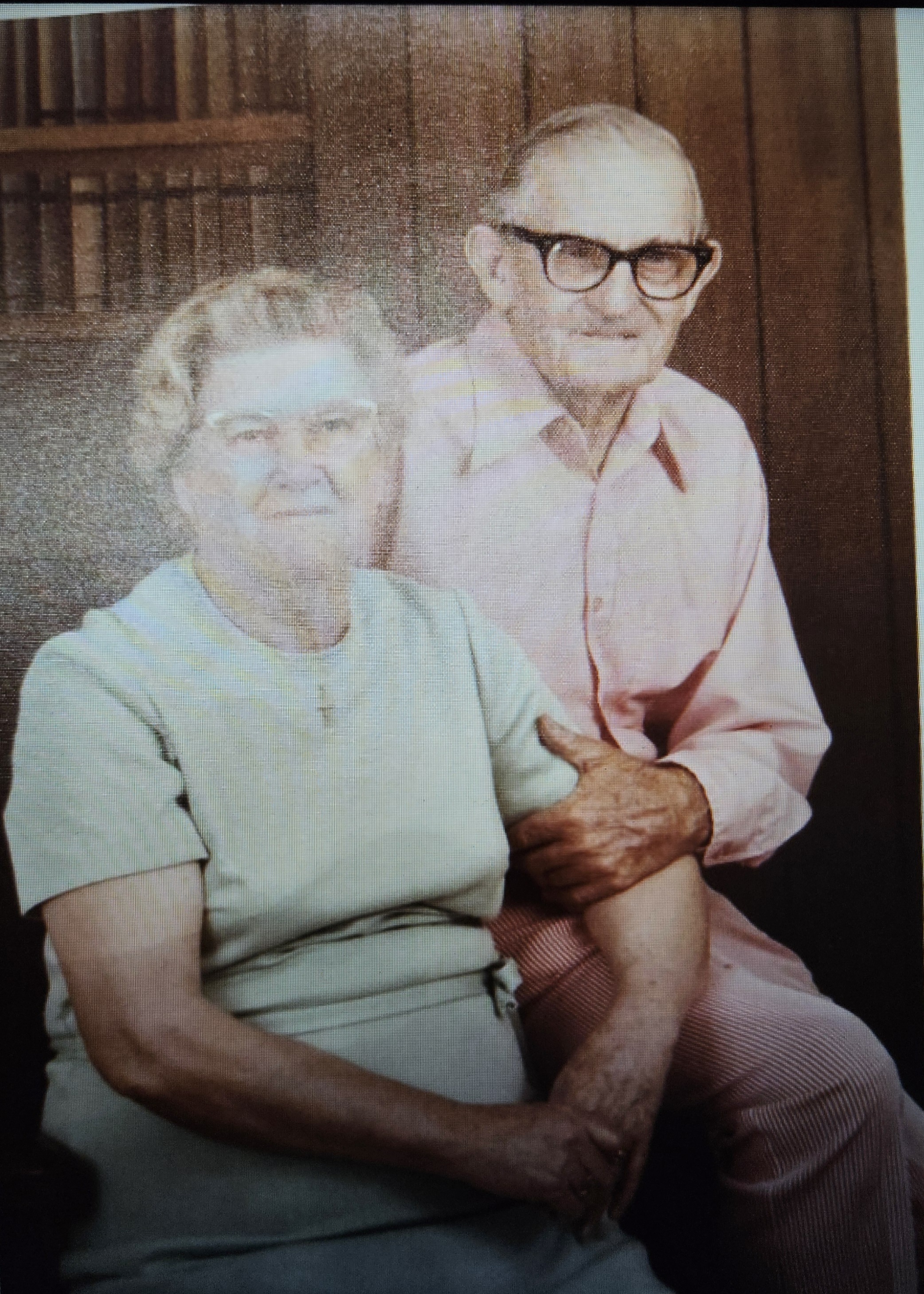
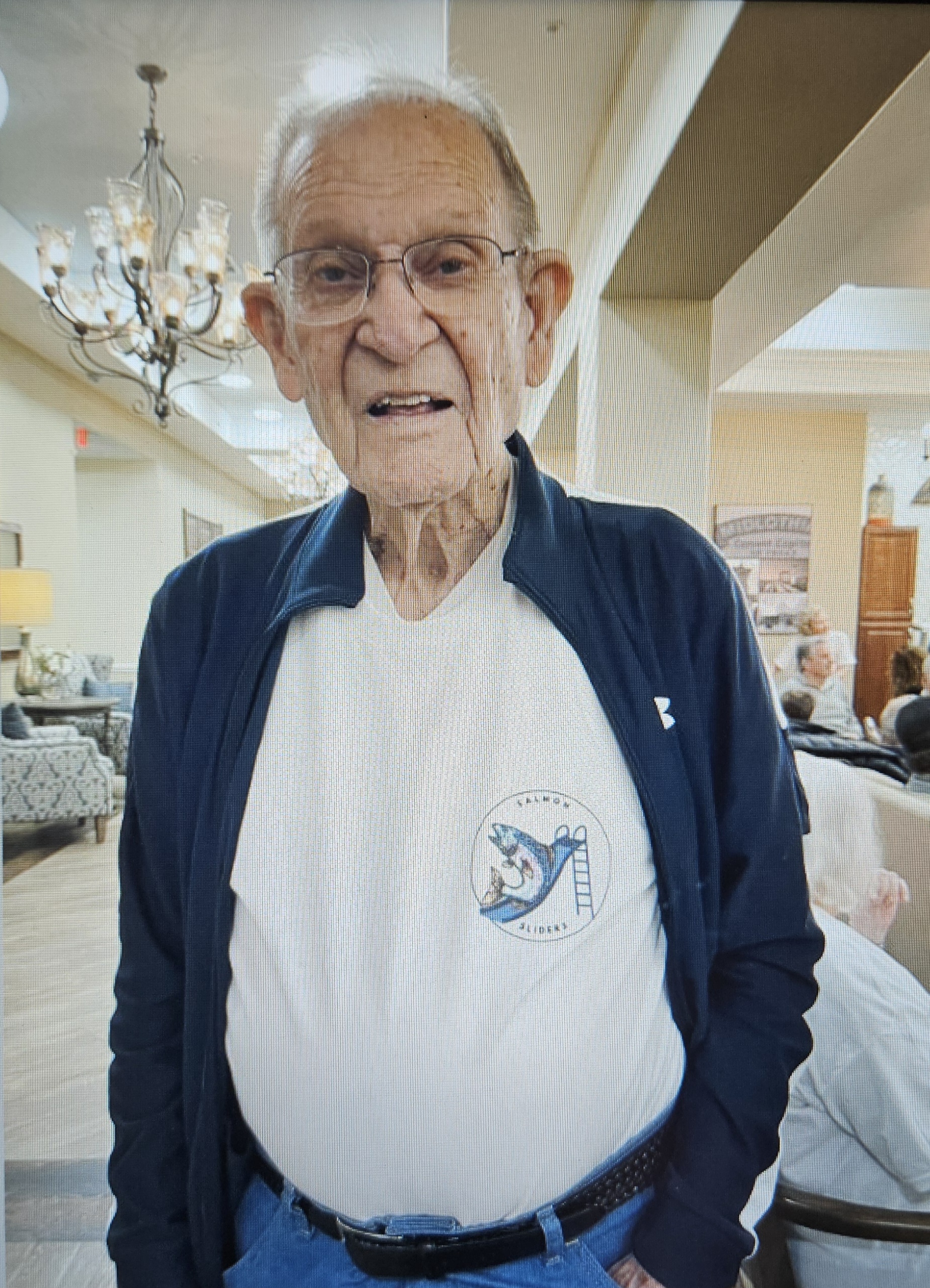
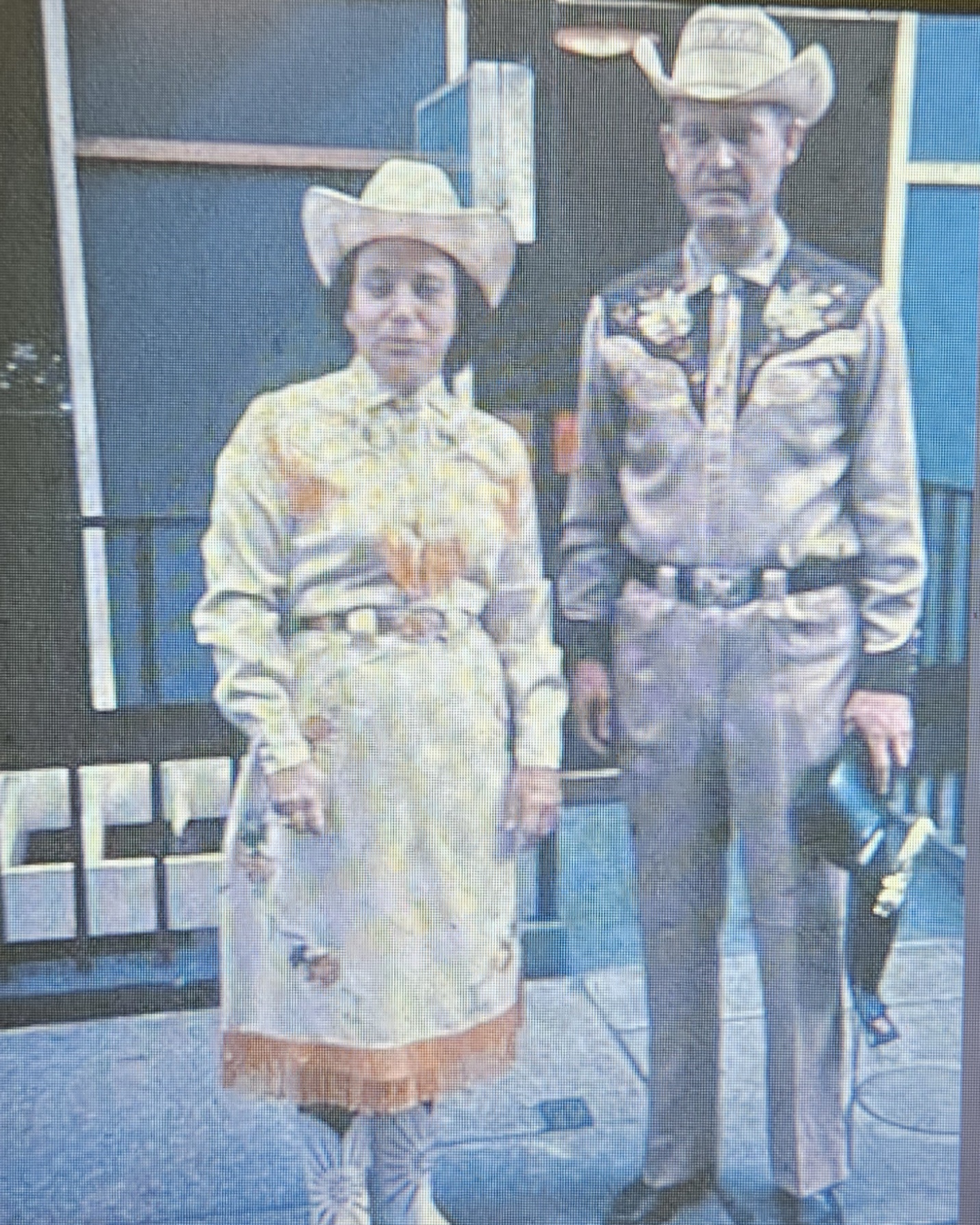

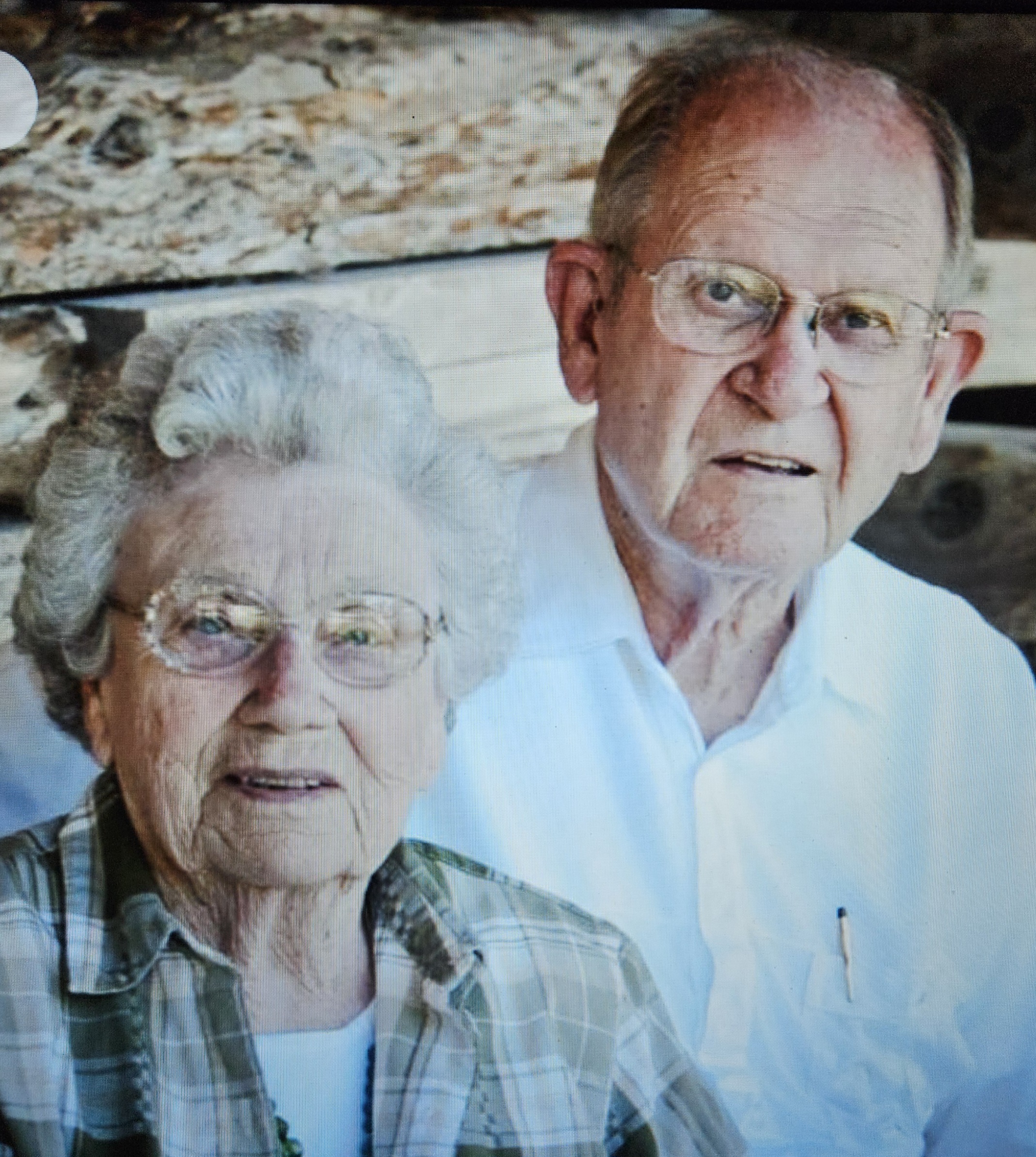
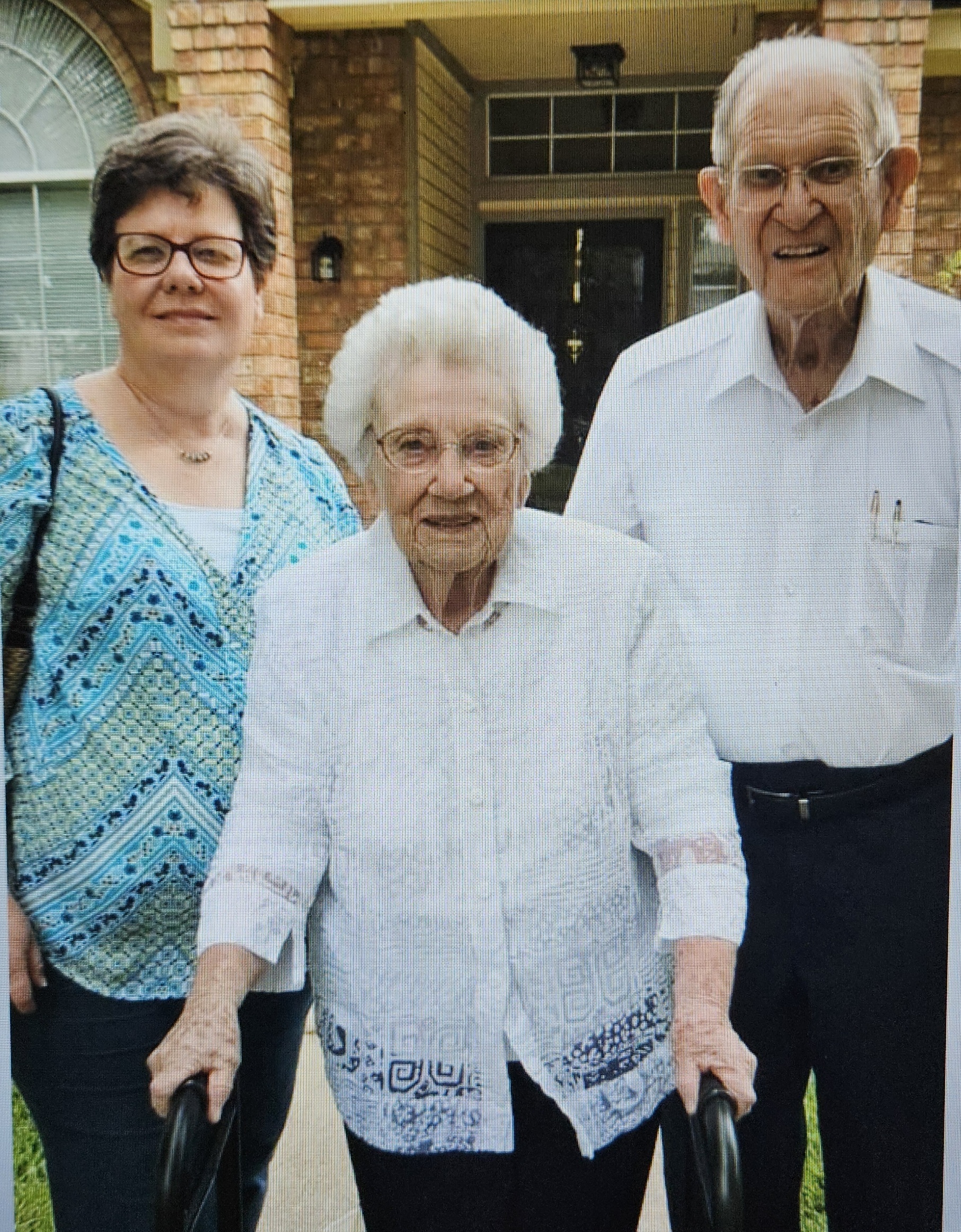
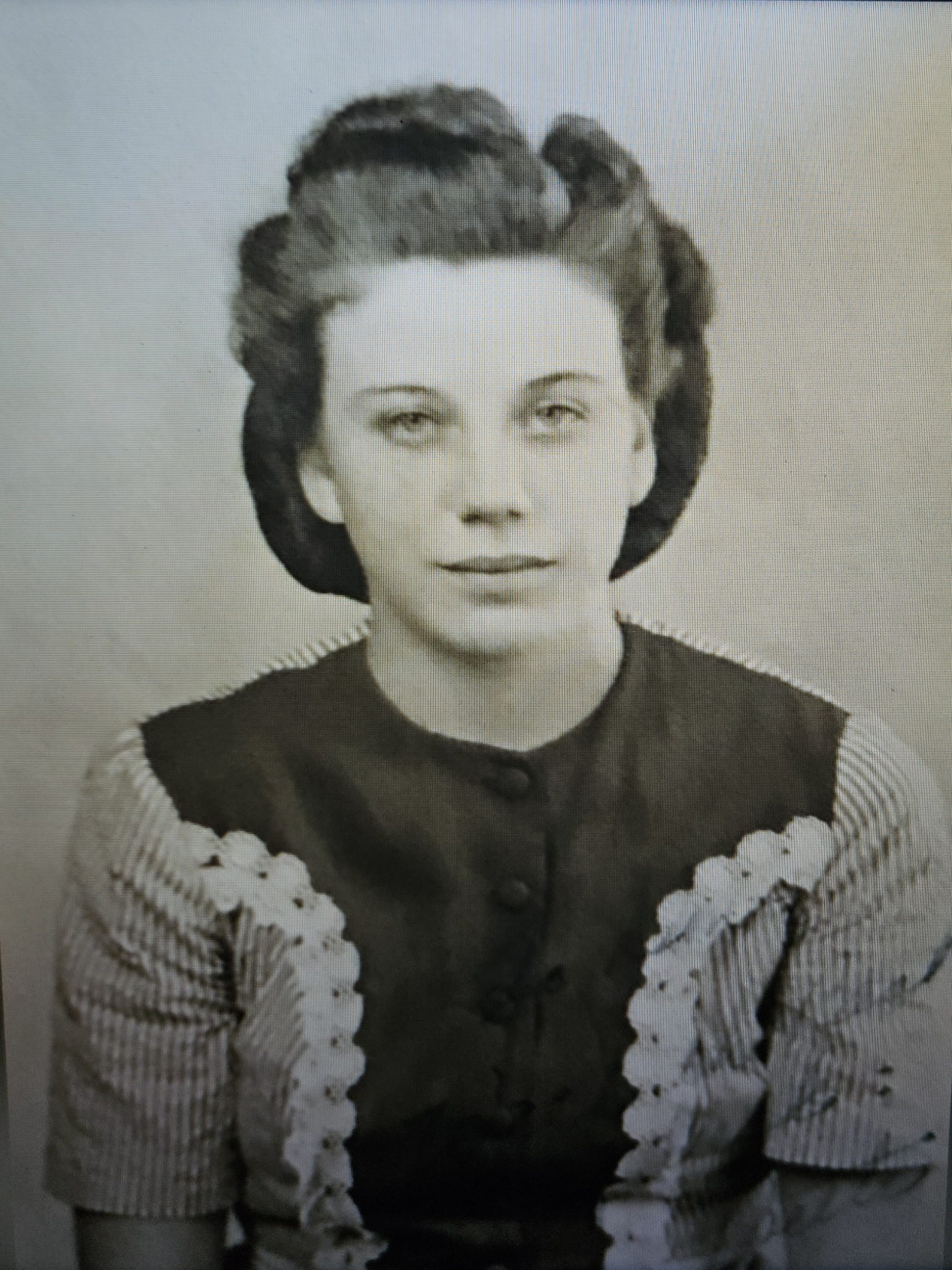

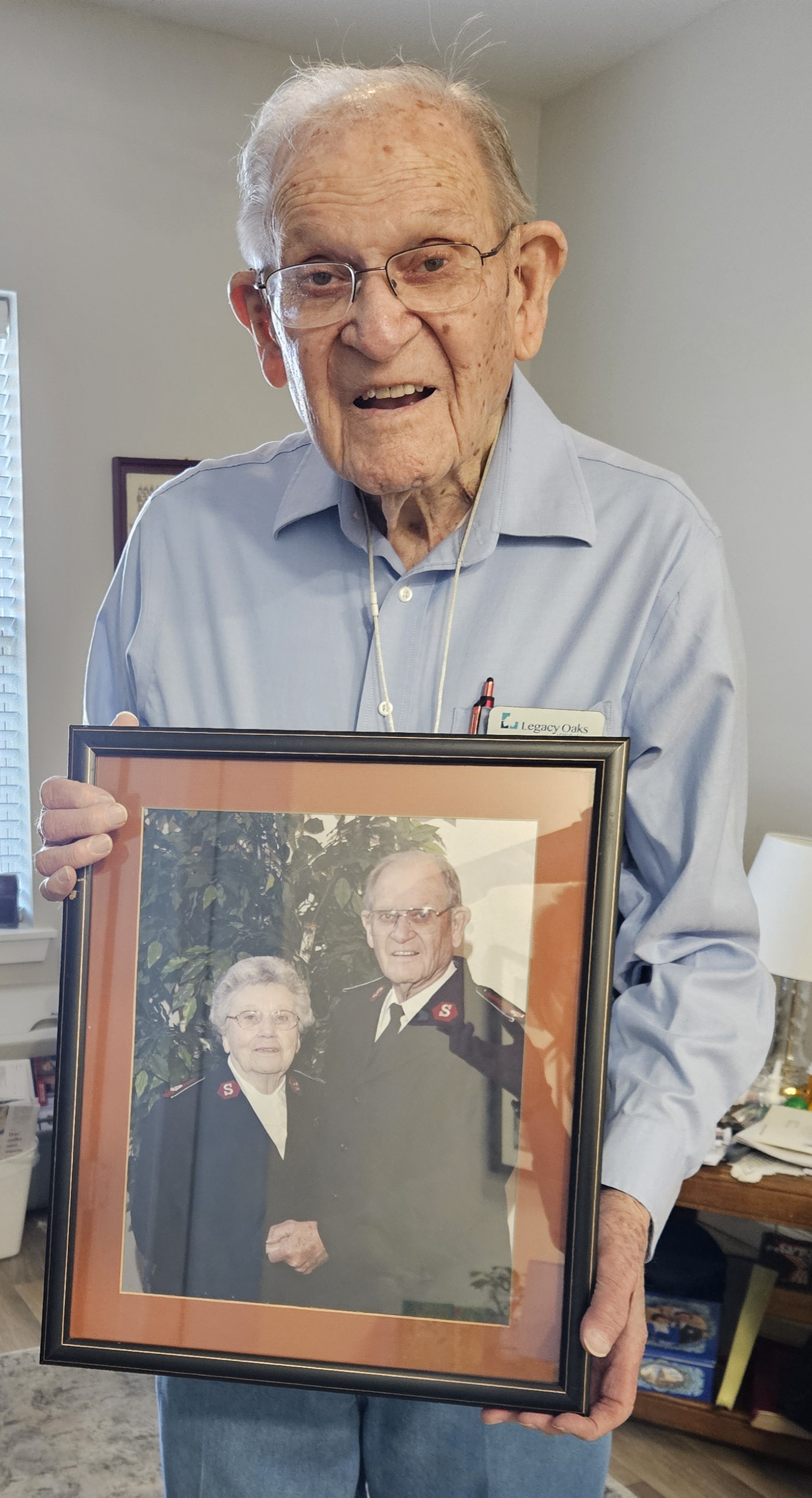
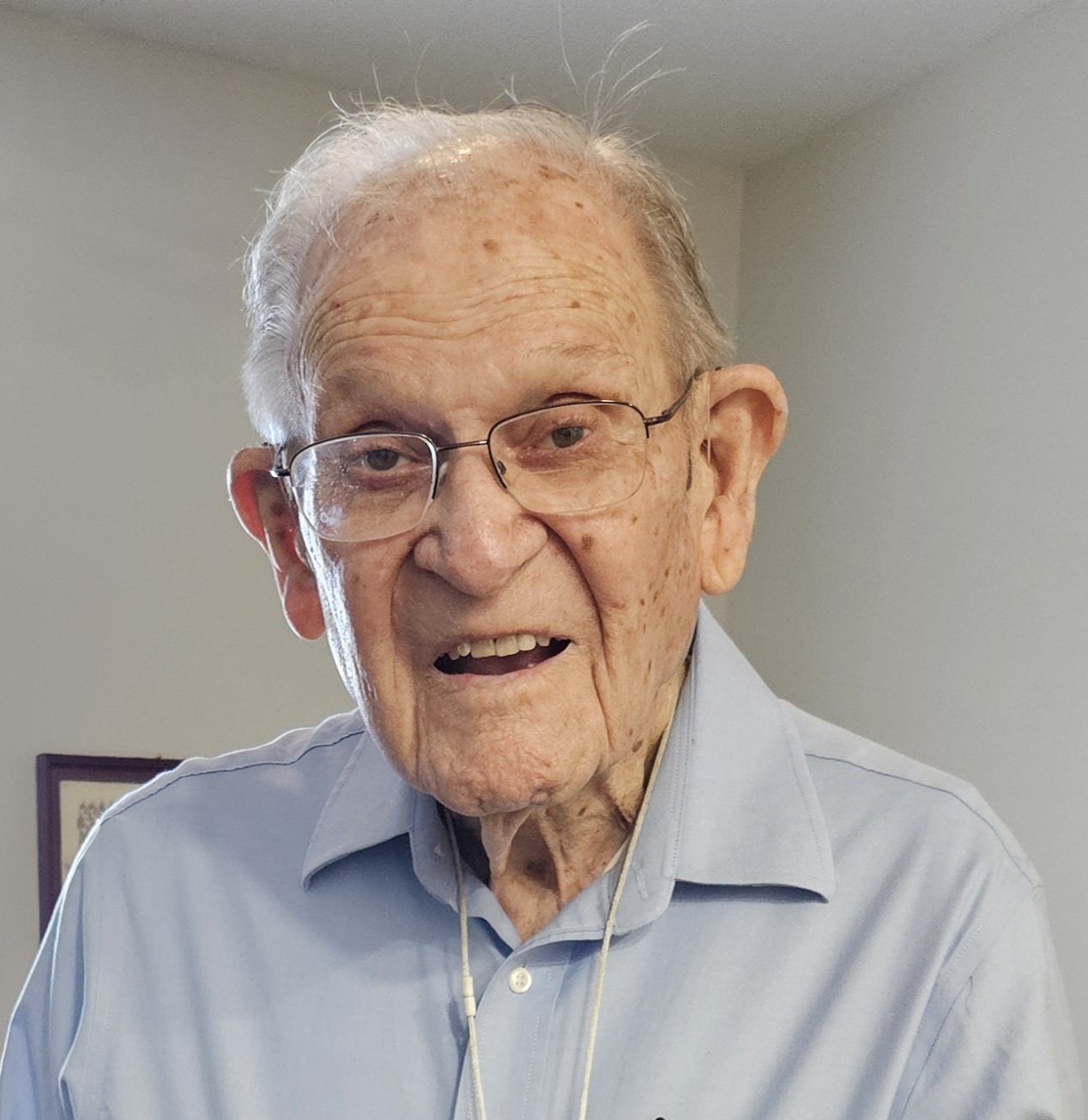
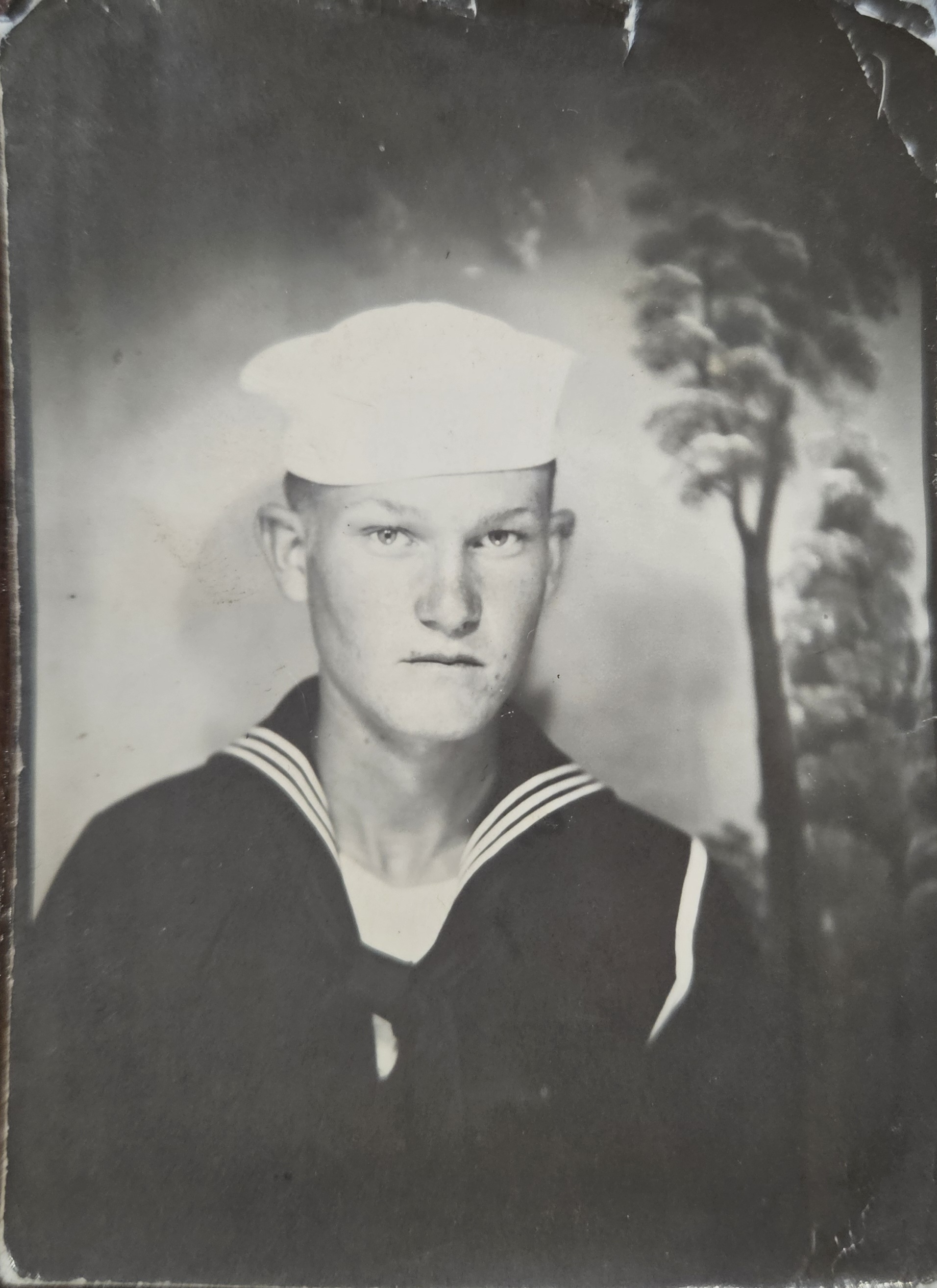
Orville Salmon grew up on a small farm in Bryan County, Oklahoma, where life followed the rhythm of the land. His family cultivated cotton, corn, and sweet potatoes, and his mother was an expert in the art of preservation. Throughout the year, and especially during the harvest season, the Salmons hosted neighbors for lively canning bees. Together, the community once put up more than 300 jars of fruits and vegetables, ensuring the family was well-provisioned for the winter ahead.
Every farm had a storm shelter because tornadoes were a constant threat, and Sundays meant hitching up the wagon and riding into town for church. Money was scarce, so when the community gathered, families would butcher a steer and cook the meat in a pressure cooker so everyone had something to eat.
One of Orville’s favorite desserts was a simple, sweetened rice pudding—comforting and familiar. He attended school in Bryan County and remembered riding to the schoolhouse on a bus, grateful for the chance to learn.
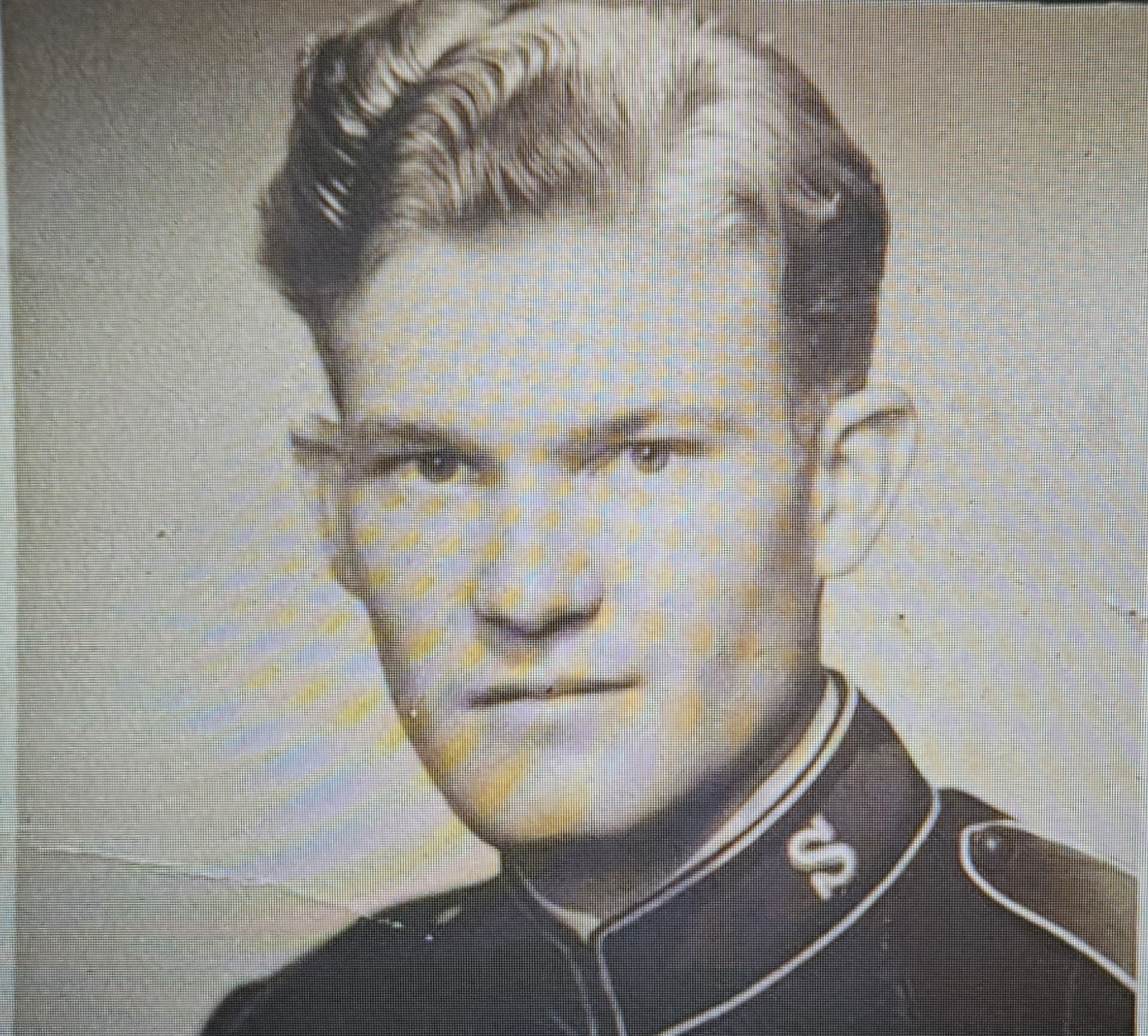
Orville’s connection to The Salvation Army began in 1939 while he was living in Lubbock. The Salvation Army held street services downtown, where uniformed soldiers sang hymns and shared the word of God. Their music drifted through the streets, and something about it stirred him. He felt drawn to their mission and began attending their gatherings.
Though he would soon leave for war, that early spark of faith and service would eventually grow into a lifelong commitment, shaping decades of ministry and leadership.
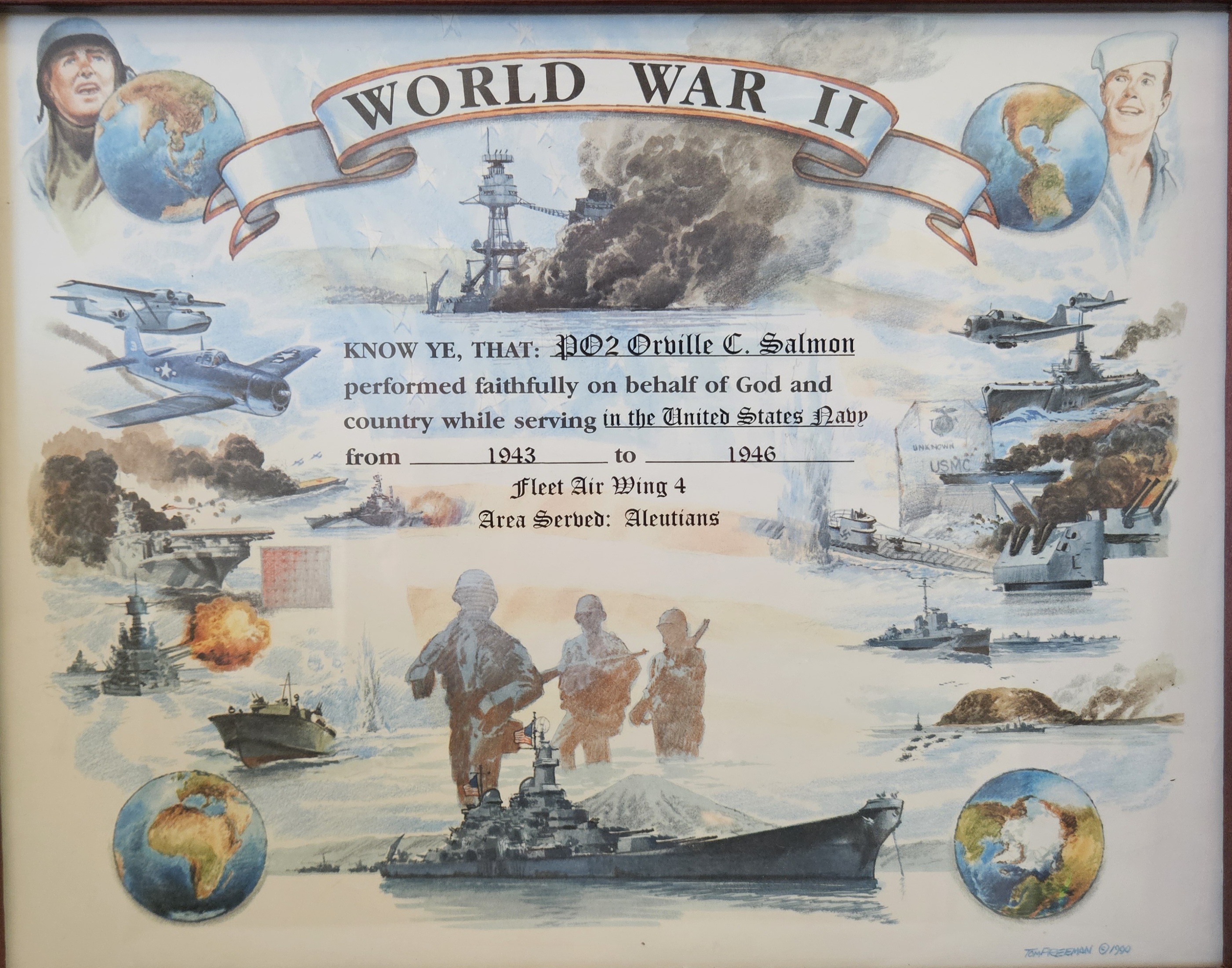
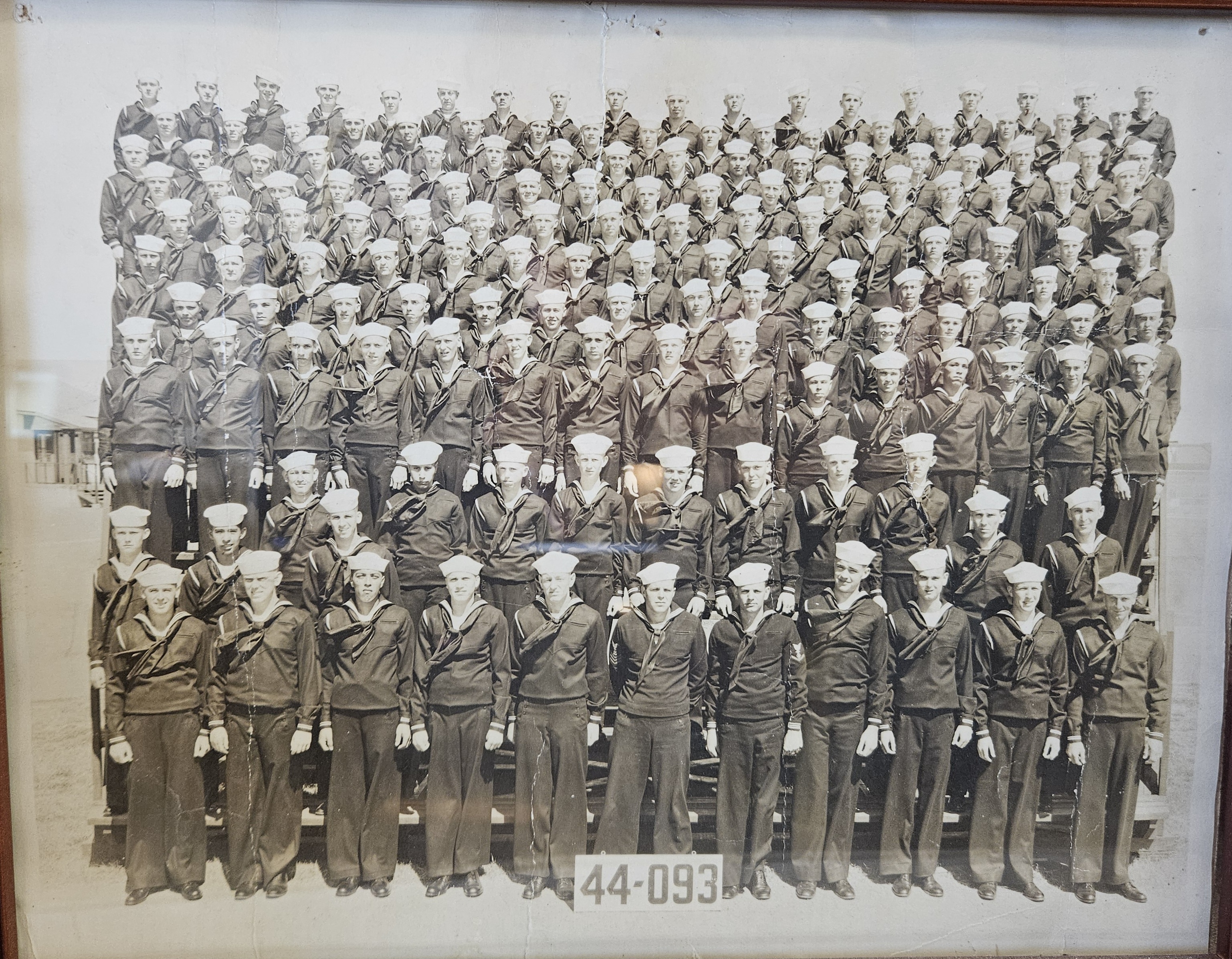
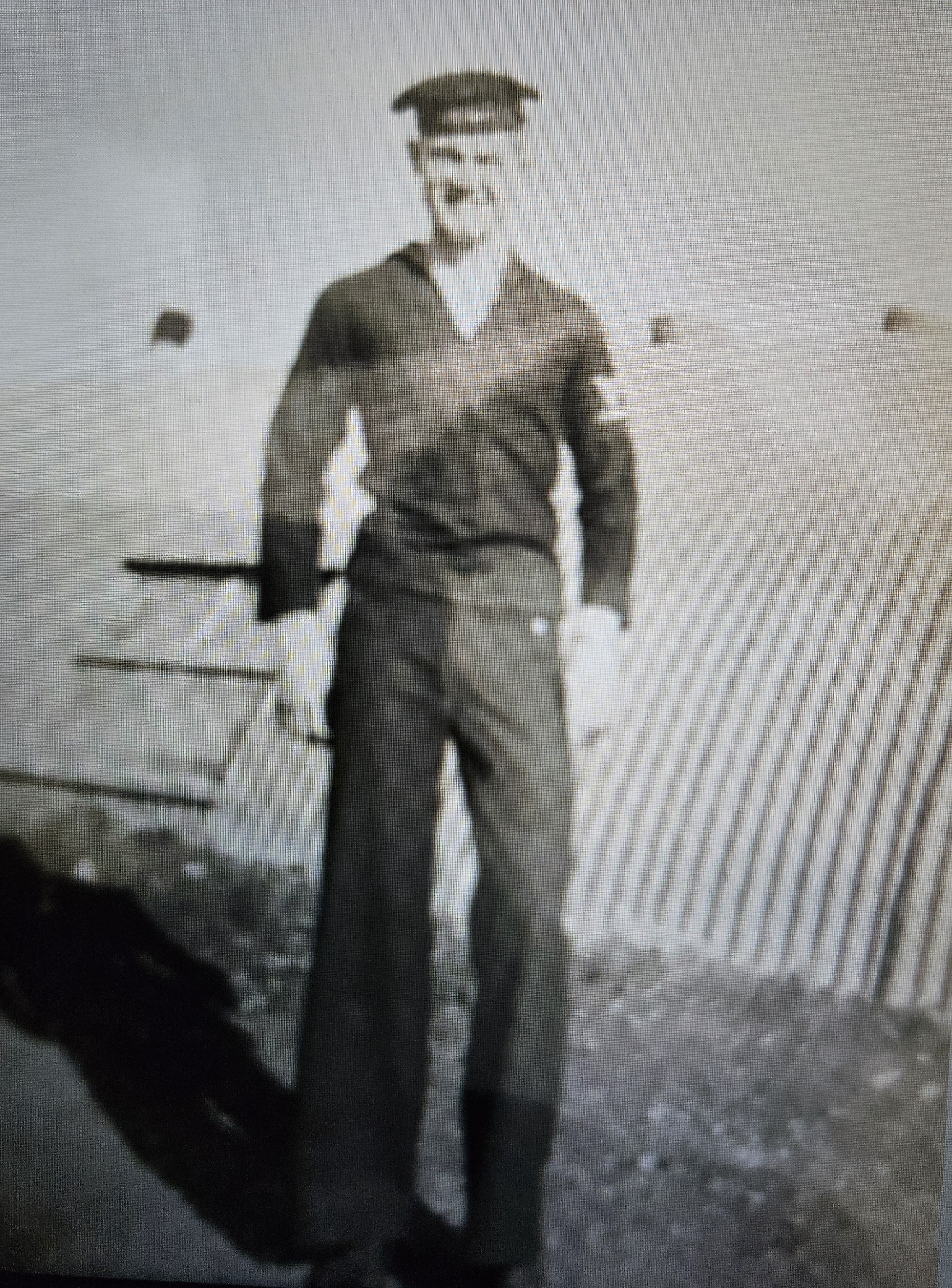
Five of Orville’s friends dropped out of school to join the Navy after the attack on Pearl Harbor. Wanting to serve as well, Orville enlisted with his parents’ written permission—an agreement that he would be gone for two and a half years before returning home. He completed basic training in San Diego and was then assigned to Base Attu in the Aleutian Islands as a mechanic on PBY Catalina surveillance aircraft.
Before reaching the Aleutians, he spent three weeks on Treasure Island and then traveled to Seattle to meet the rest of his group. From there, they boarded a troop ship bound for the far North Pacific. Orville joined his squadron at Adak Naval Air Station, a major Army Air Corps installation that later transitioned to the U.S. Air Force.
The Aleutians were harsh, isolated, and strategically vital—fog, wind, and cold defined daily life—but Orville served with steadiness and skill, maintaining the aircraft that patrolled some of the most dangerous waters of the war.
Attu was the westernmost island in the Aleutian chain, far off the Alaskan coast and closer to Asia than to the continental United States. During World War II, the Aleutians became strategically crucial after the Japanese military seized Attu, Kiska, and Agattu Islands marking the only occupation of American soil during the war. The islands’ harsh weather, isolation, and proximity to enemy forces made every duty assignment dangerous.
Because of the recent battles, guard duty was a constant and critical responsibility. The year before Orville arrived, Japanese forces had occupied Attu and tunneled deep into one of the mountains, camouflaging the entrance. Under the cover of darkness, Japanese soldiers launched a surprise attack that nearly wiped out an entire battalion of American troops.
The U.S. Army counterattacked, pushing the Japanese back into their foxholes. Heavy snow quickly buried the fallen, leaving the battlefield frozen in time.
When summer came and the snow melted, the ground revealed a haunting landscape—discarded rifles, helmets, equipment, and the remains of both American and Japanese soldiers. The men stationed there believed these items were sacred reminders of the cost of the battle. They were strictly forbidden to take or disturb anything, and the decision was made to gather the equipment and store it respectfully in a military warehouse.
Orville often said this was why they were always on guard. The memory of the battle was still fresh, and the threat of renewed attack felt real.
After the fighting ended, U.S. Navy and Army engineers began rapidly constructing new infrastructure on Attu. The partially completed Japanese airfield was abandoned because the deep tundra made it unusable. Instead, new runways were built at Alexai Point, and a PBY seaplane base was established at Casco Cove, using metal landing mats to create a functional surface in the unforgiving terrain.
For months, the buildings were buried under snow. The men relied on heating oil for warmth, and the drifts grew so high that they often had to slide down into the buildings rather than walk through the doors. At times, the only way to navigate the base was by following the power lines, which stood above the snowpack like guide rails in a white wilderness.
The long swings between daylight and darkness on Attu created challenges the men never expected. Weeks of continuous daylight made sleep difficult, and the constant brightness added to the strain of living in such an isolated, unforgiving place. Food was another hardship. Mutton became the primary dinner staple, and although it was tolerable at first, Orville quickly grew tired of it. He later joked, “I hope I never have to eat it again.”
His assignment as a PBY crewman and aircraft metalsmith meant repairing damage caused by relentless patrols along the northern Japanese coastline. The Army feared the Japanese might attempt to reoccupy the islands, and at one point observers reported a large number of barges moving toward the Aleutians. Navy pilots and Army personnel stayed on constant alert. Most weeks, Orville focused on maintaining the PBYs, which typically flew two long surveillance missions per week.
The weather was always a threat—conditions could shift from clear to deadly in less than two hours.
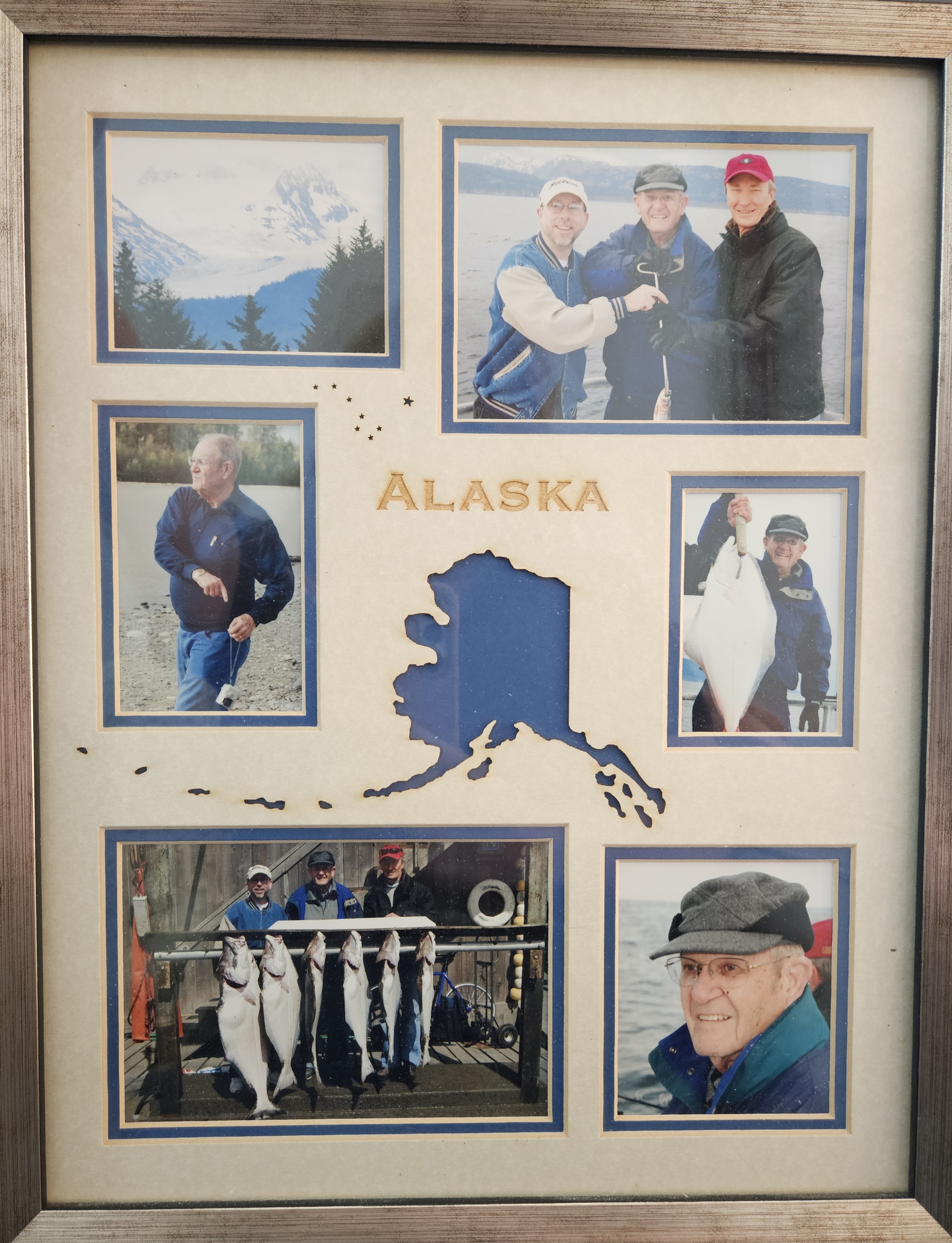
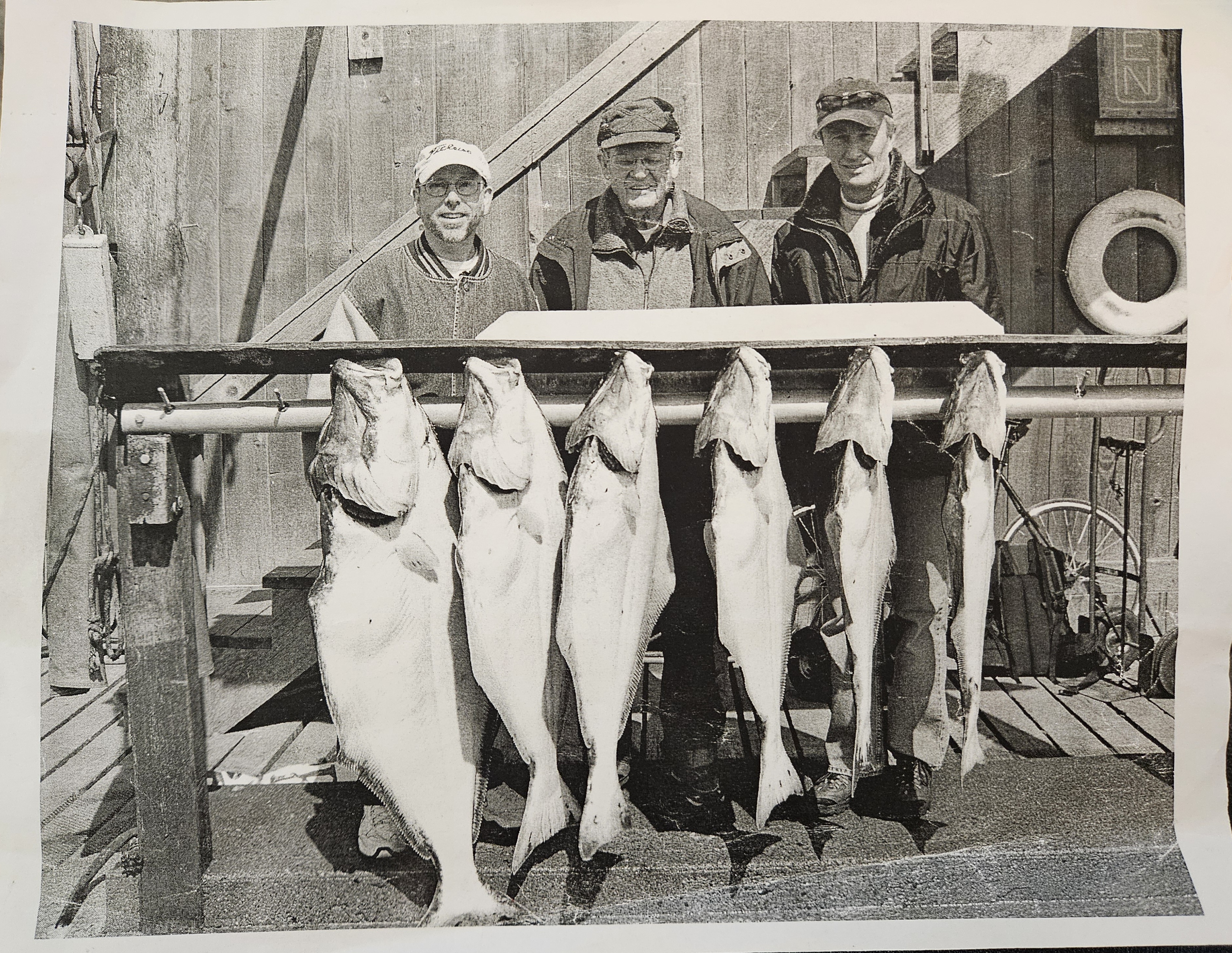
When he had rare moments of free time, Orville fished for salmon in a river that flowed from the mountains. During spawning season, the river was so thick with fish that he could toss a pebble and hit one. The waterway, nearly a hundred yards wide, ran close to the hangar and repair shops, offering a brief escape from the monotony and tension of island life.
Letters were his lifeline. He wrote constantly to his mother and father, and mail call was the highlight of every week.
All letters arrived unsealed and heavily censored, with locations and sensitive details blacked out, but they were still a precious connection to home.
Recreation was scarce. Orville didn’t recall card games, classes, or organized activities to pass the time. Life on Attu was often monotonous, broken only by work, weather, and the ever-present sense of danger. But the men found small ways to keep their hands and minds busy.
As skilled metalworkers, they discovered they could repurpose discarded artillery shell casings into art pieces—polished picture frames, decorative objects, and keepsakes. These handmade items became highly valued; sailors from visiting ships often bought them for raffles, sometimes paying as much as $100 for a single casing
When Orville was asked why he chose the Navy, he answered with a grin: “I don’t like marching.” Every Army recruitment film he saw showed long lines of soldiers marching in formation, and he knew instantly that wasn’t for him.
He loved the water, so the Navy felt like the natural choice.
In the early years of his service, the base had very few operational aircraft because many had been sent to the aircraft graveyard in Arizona. Over a six‑month period, 150 men were assigned to overhaul every plane on Whidbey Island off the Washington coast, restoring them to top condition.
Once repaired, the aircraft were flown to Slatington Airport north of Philadelphia in the Lehigh Valley and parked in a boneyard. Near the end of his Navy career, Orville remembered the development of a small aircraft capable of taking off from short runways using a single‑use jet‑assist package—a kind of miniature jet booster.
He was honorably discharged as an Aviation Metalsmith Second Class (AM2).
In 1968, Orville attended the International Congress at Royal Albert Hall in London. He was thrilled to find himself standing only a few feet from Queen Elizabeth II as she greeted the guests. In 1972, he graduated from the International College of Salvation Army Officers, a milestone that deepened his lifelong commitment to ministry.
One of his fondest memories from that period was hearing the Black Guard Band, a military ensemble from Wales. Because Orville’s band leader shared a personal acquaintance with one of the musicians, the connection between the two groups was uniquely meaningful. He was particularly delighted during the changing of the Guard, as tourists and locals lined the gates to watch the musical performance. There, the Salvation Army and the Black Guard Band played jointly, alternating selections curated by the Welsh ensemble before both groups convened in the courtyard to enjoy refreshments together.
Orville adjusted easily to life in London. He had no trouble driving on the opposite side of the road and enjoyed traveling through the countryside. A favorite trip was to Scotland to visit Loch Ness, though he admitted he never caught a glimpse of Nessie. He also loved dining at the traditional Carvery, where meals were served buffet‑style with hearty British roasts.
As his Salvation Army career grew, Orville became Program Director for the 16 Southern States, overseeing more than 400 centers of activity. During one assignment in Texas, he served on an advisory board of 24 to 48 men and women in San Angelo, helping determine funding priorities for community services.
One board member, a sheep herder named Cecil, invited him to dinner for lamb chops. Cecil spoke about the challenges of raising sheep as oil fields expanded and damaged grazing land. He was also a close friend of the governor, who enjoyed gambling. Because Cecil was an Adventist and didn’t believe in keeping gambling winnings, he brought the money to Orville for safekeeping—a gesture that amused Orville for years.
He also recalled a humorous moment that occurred during Easter, a memory he cherished as part of the rich tapestry of stories gathered throughout his life of service.
One Easter, Orville remembered with a smile that the local church would dye a lamb, a tradition that struck him as both unusual and memorable.
The history and mission of The Salvation Army were always deeply important to him. He believed that its unwavering devotion to social services—feeding the hungry, sheltering the homeless, supporting families, and offering spiritual care—was one of its greatest callings. Throughout his decades of ministry, he watched these programs grow, adapt, and meet the needs of countless communities.
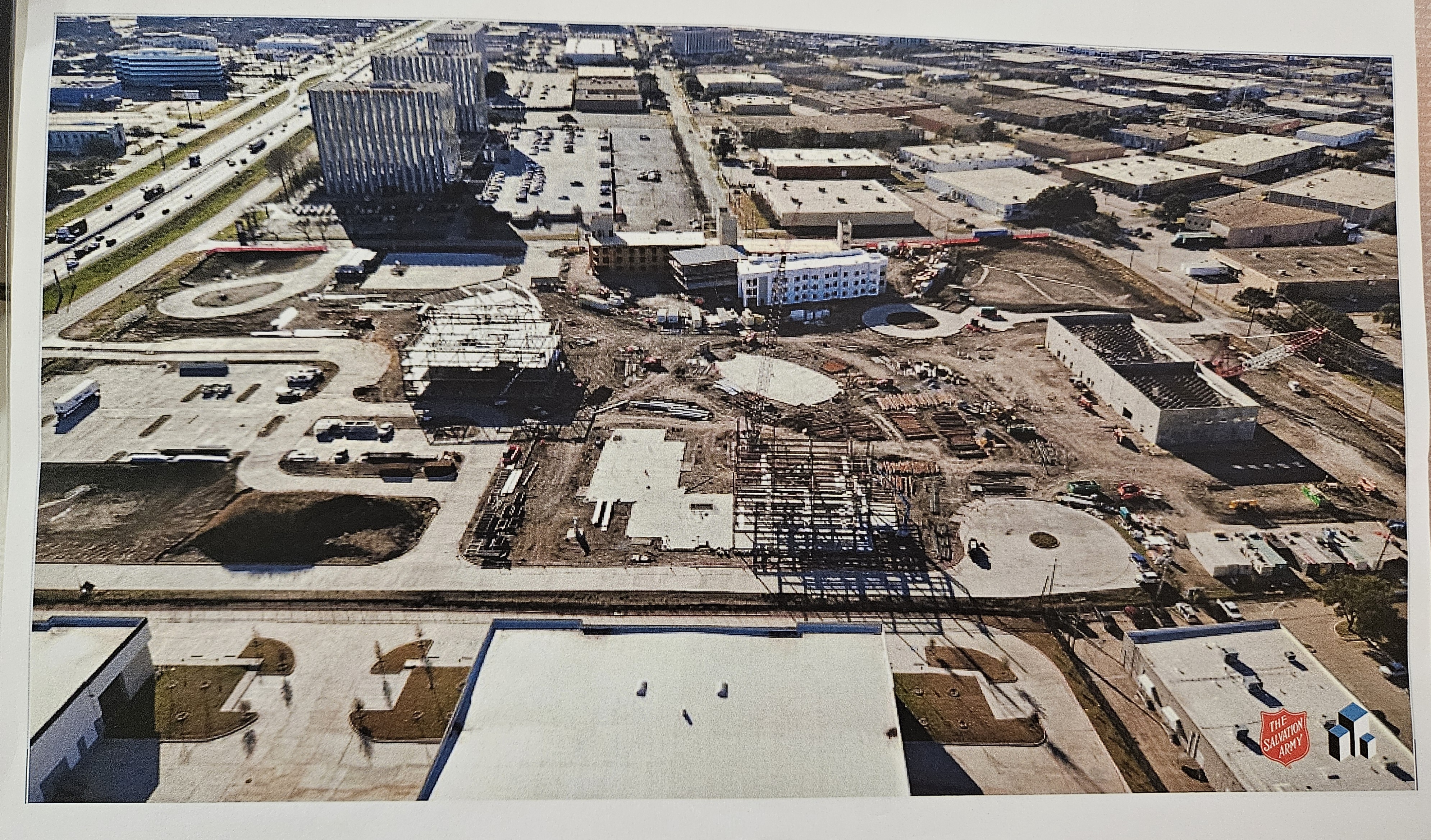
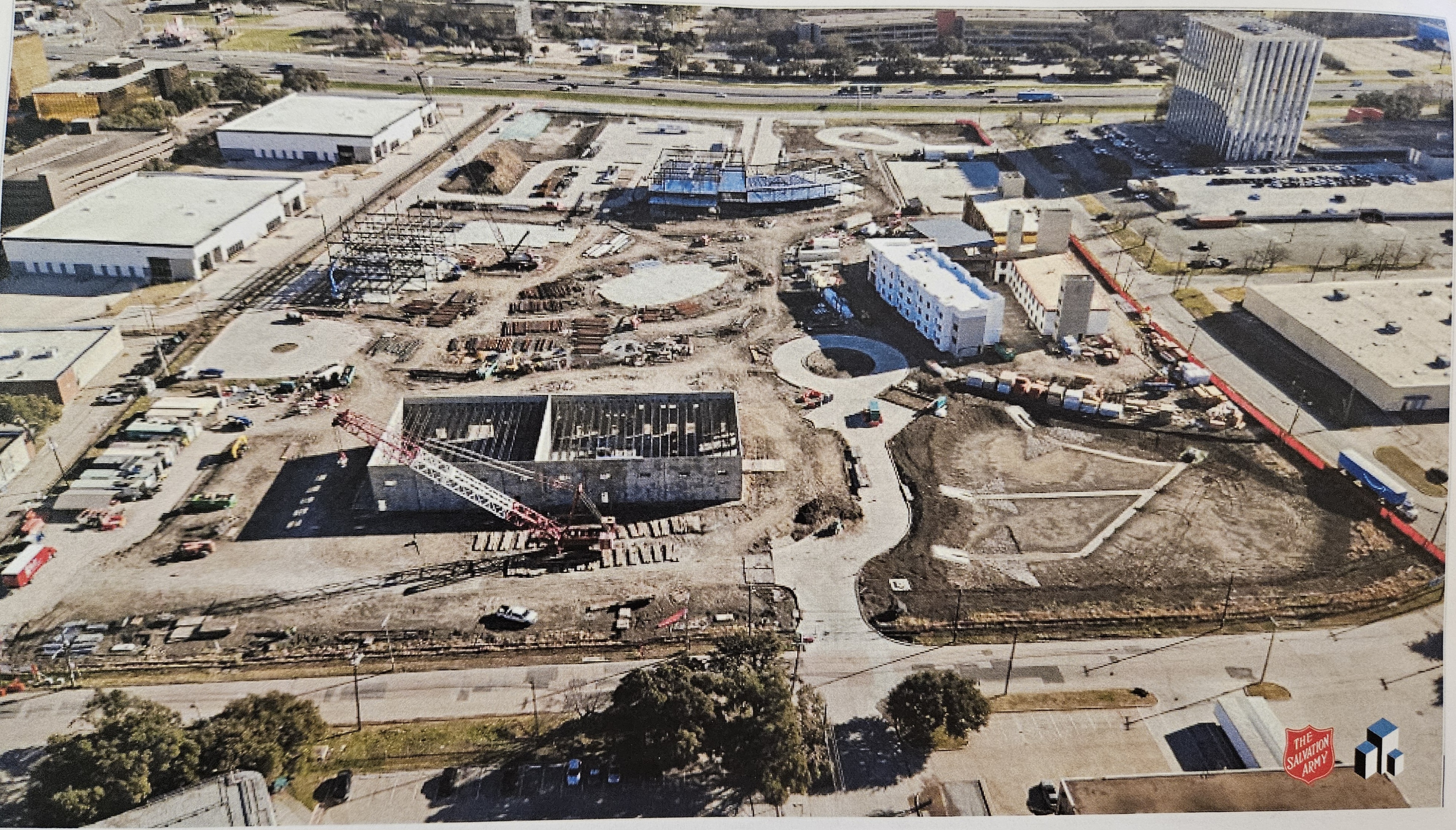
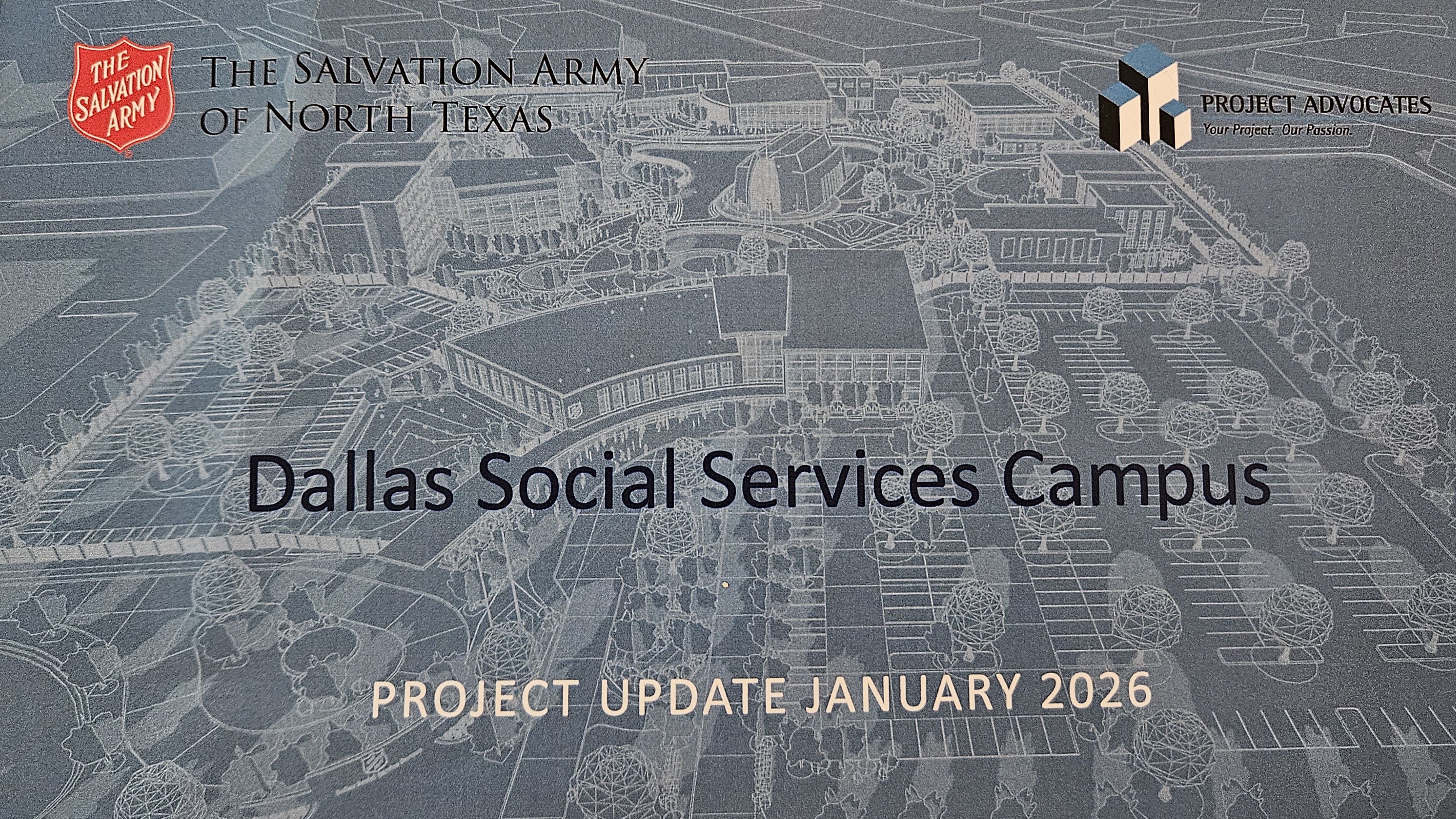
In his later years, Orville was especially excited about the development of the new Dallas Social Services Campus, built on twenty acres where the former Mary Kay headquarters once stood. He saw it as a powerful expansion of the Army’s ability to serve the city—an investment in people, dignity, and hope. To him, it represented the future of the organization he loved: stronger, more compassionate, and better equipped to meet the needs of the most vulnerable.
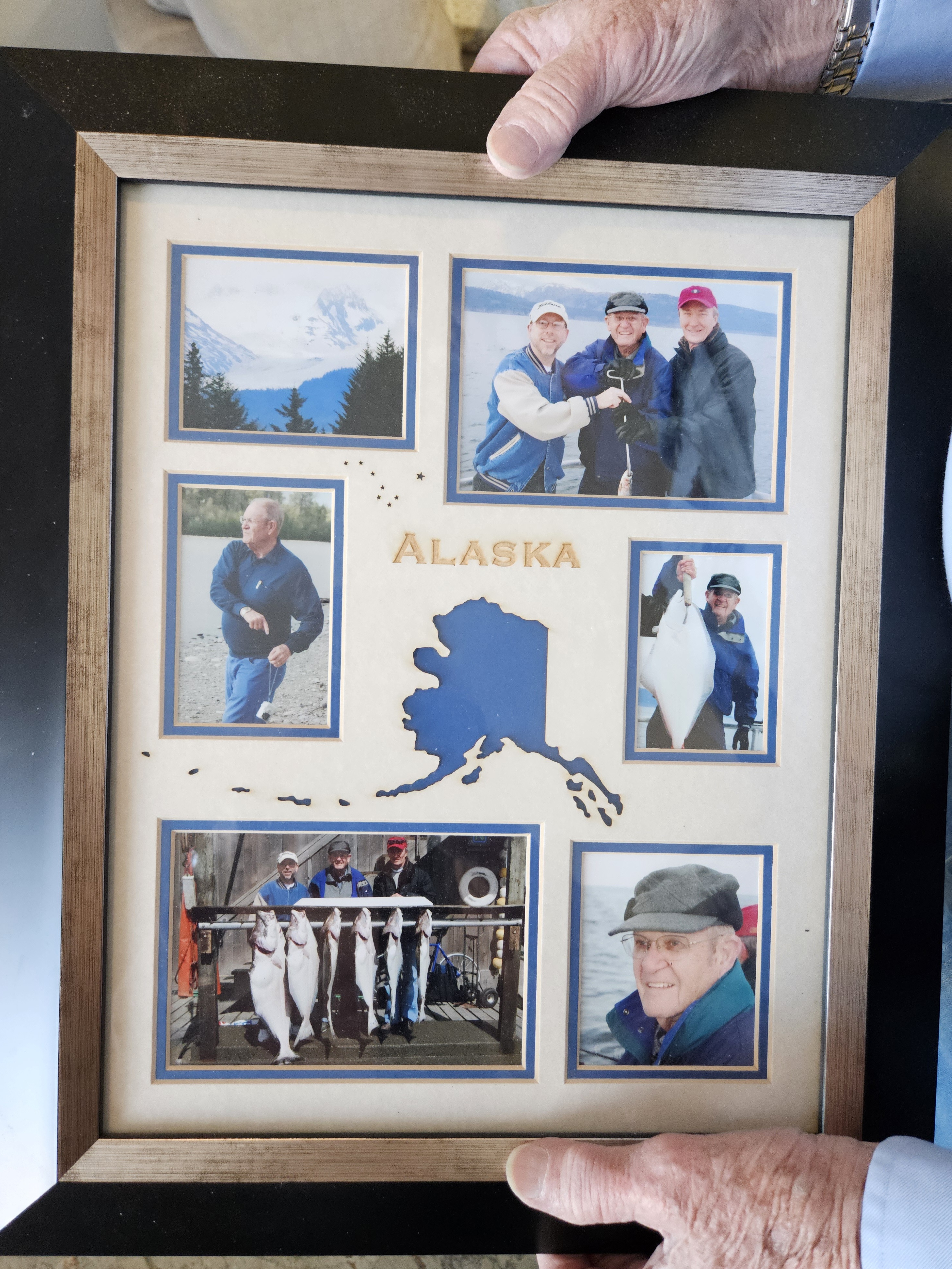
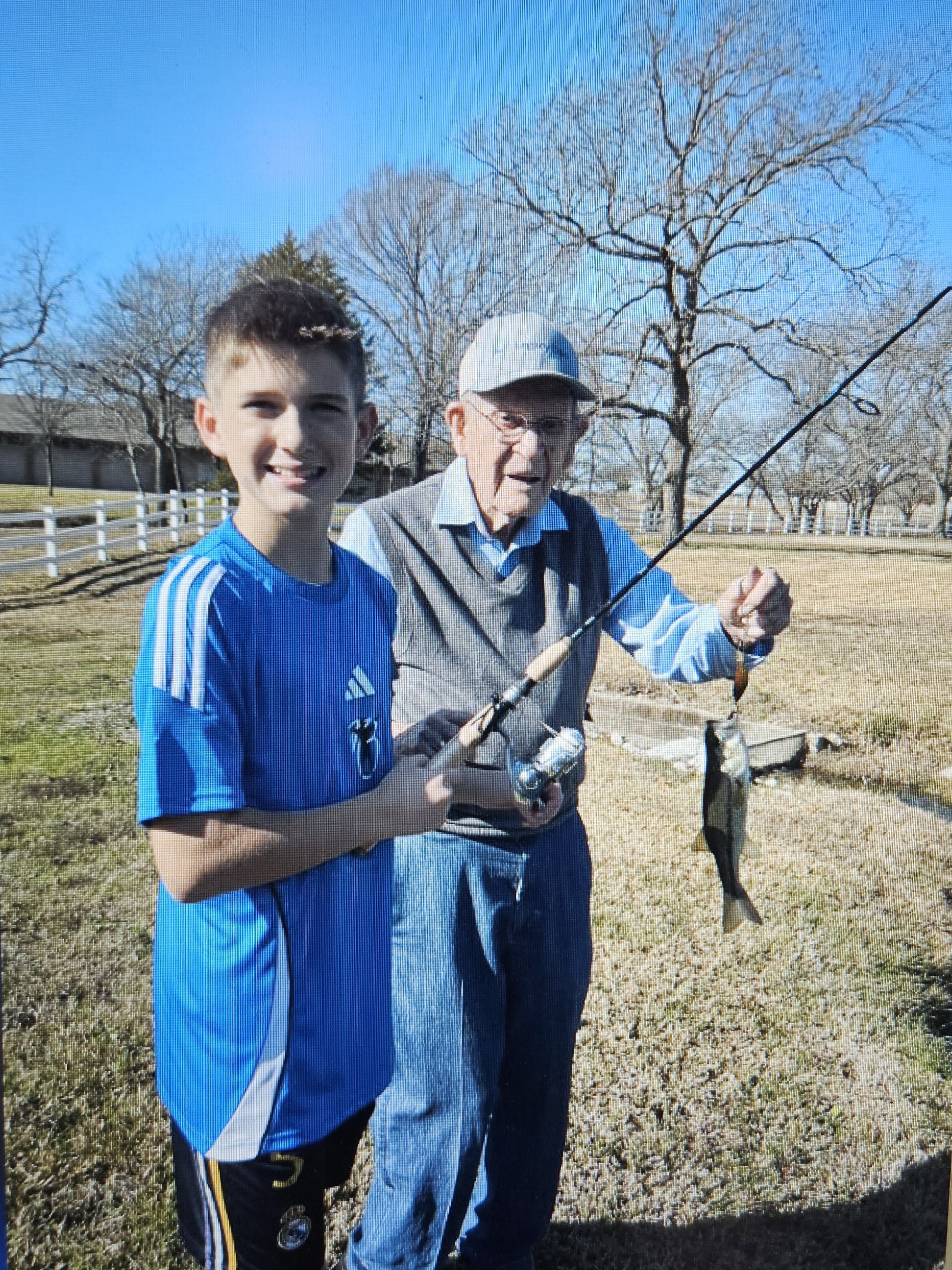
Orville loved fishing, and during one of his Salvation Army trips he had the unforgettable experience of casting a line into the Sea of Galilee. He was fascinated to learn that the most common fish in those waters were catfish and the St. Peter’s perch, a detail that delighted him as both a fisherman and a man of faith.
Over the years, Orville visited Israel six times, thanks to a special program he developed that allowed every Salvation Army officer in the Southern Region to spend a week in the Holy Land.
The program required seven years of service and excellence in one of several categories that recognized officers who were strong starters, innovators, or “go‑getters.”
The initiative began in 1980, when Orville led a group of 120 officers on an educational tour supported by the Salvation Army College. The trip included a three‑hour course on the life of Jesus, grounding the experience in both history and spiritual reflection.
When political tensions made travel to Jerusalem unsafe, Orville offered an alternative pilgrimage that followed the journeys of Paul through Asia Minor and into Athens, Greece. He wanted every officer to experience Scripture in context—whether in Israel or along the ancient missionary routes of the early church.
Some moments from these tours stayed with him forever. Standing at the traditional site of the Sermon on the Mount and the Feeding of the 5,000, he felt a depth of spiritual connection that no photograph or television portrayal could match.
Another cherished memory came when TAM University Tours offered participants the chance to take part in a Lord’s Supper experience, complete with the seven fruits and vegetables that would have been served in biblical times. Reclining on pillows and cushions, sharing that sacred meal, Orville said the experience was “incredible.”
As much as he loved leading the Israel tours, he admitted that after six trips the routine began to feel familiar. He eventually passed the responsibility to other officers, freeing time for new adventures with his wife. Together they traveled widely—fishing in Canada, exploring Panama, visiting South America, relaxing in Cancun, and marveling at the beauty of Switzerland.
During a fishing trip off Port Aransas, Texas, Orville and his group traveled nearly fifty miles into the Gulf of Mexico when they spotted a large mass of bright green floating on the water. A cargo boat carrying green bananas had sunk, and the fruit was drifting across the surface. Not wanting to miss the moment, the crew hauled several bunches aboard—an unexpected and memorable surprise in the middle of the Gulf.
Another unforgettable moment came years later while Orville and his wife were traveling through Switzerland to visit the Matterhorn and the town of St. Bernard, famous for the iconic St. Bernard dogs. Along the way they took a wrong turn and unknowingly entered a tunnel that stretched twenty‑six miles through a mountain. Driving at nearly eighty miles an hour, they emerged not in Switzerland—but in Italy.
The accidental detour became one of their favorite travel stories.
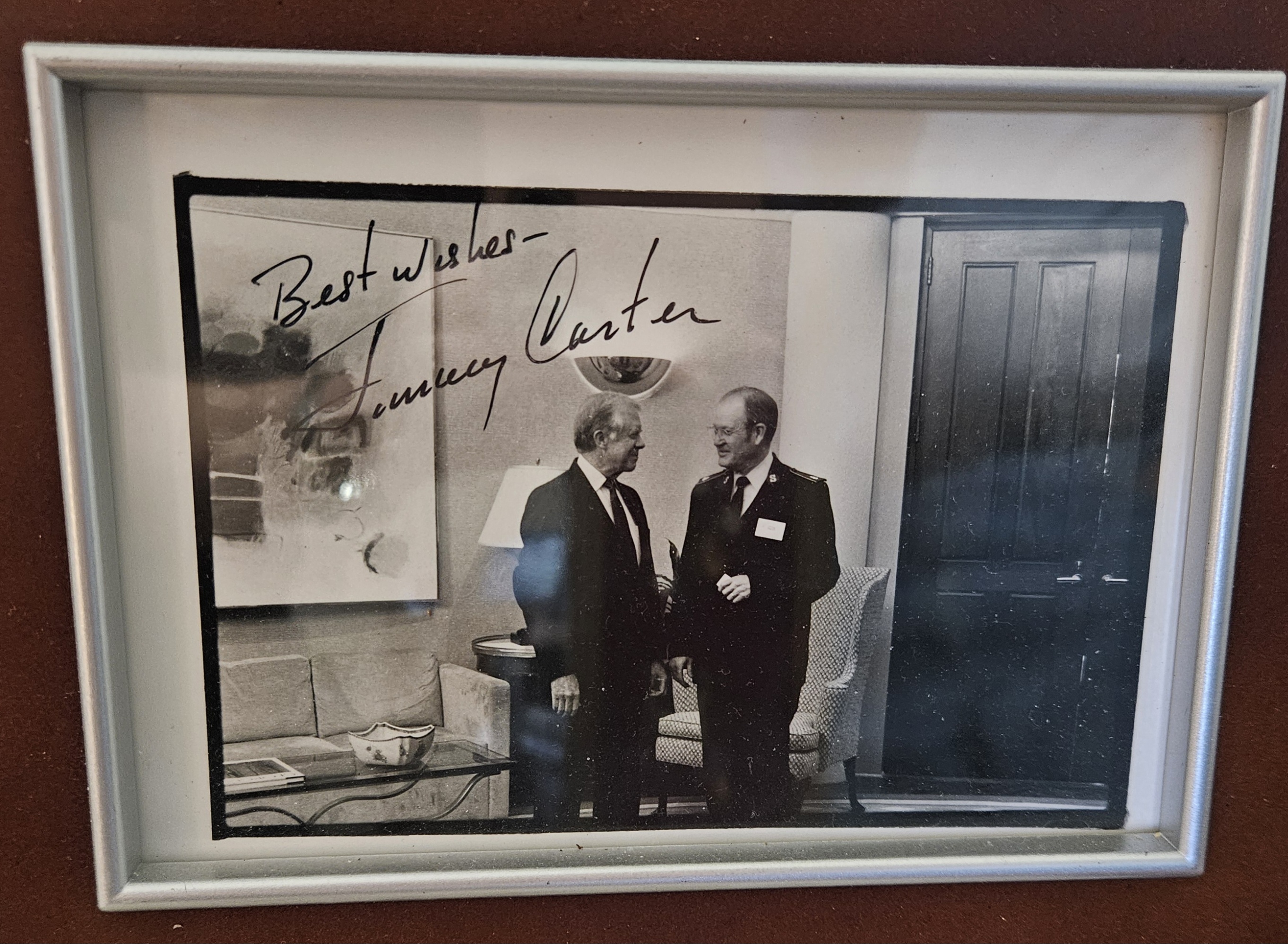
Orville also treasured his friendship with President Jimmy Carter. He met the former president many times at meetings held in the Jimmy Carter Library in Atlanta. Orville admired Carter deeply, saying, “He was the last Democrat I ever voted for,” and fondly calling him “a good old Georgia boy.” He remembered that Carter continued to teach Sunday School at a local Atlanta church, a gesture of humility Orville respected.
Their relationship allowed Orville to use the Carter Library for many Salvation Army officer meetings, and Carter participated whenever his schedule allowed—though his time was often limited, especially while caring for his ill wife.
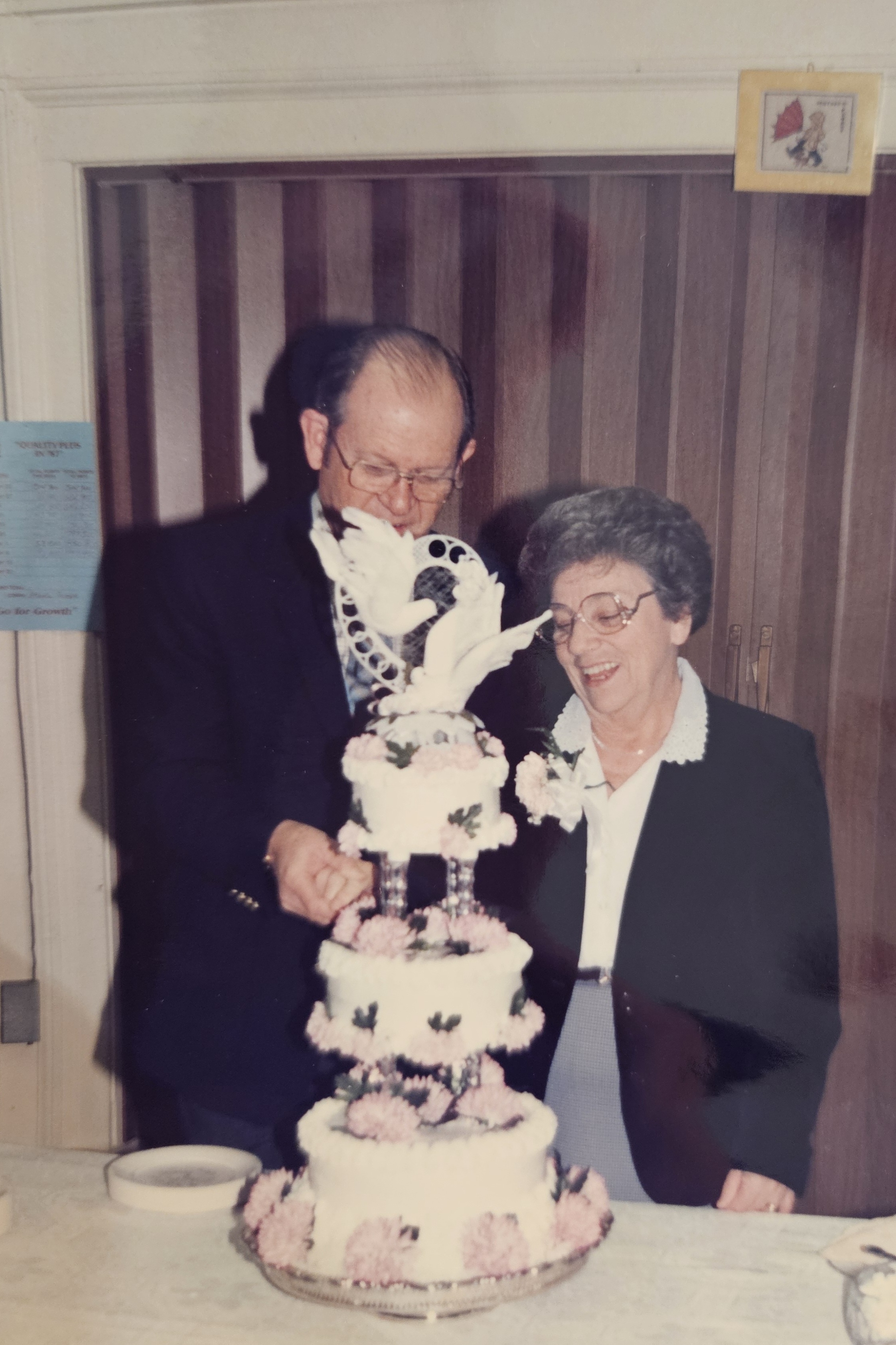
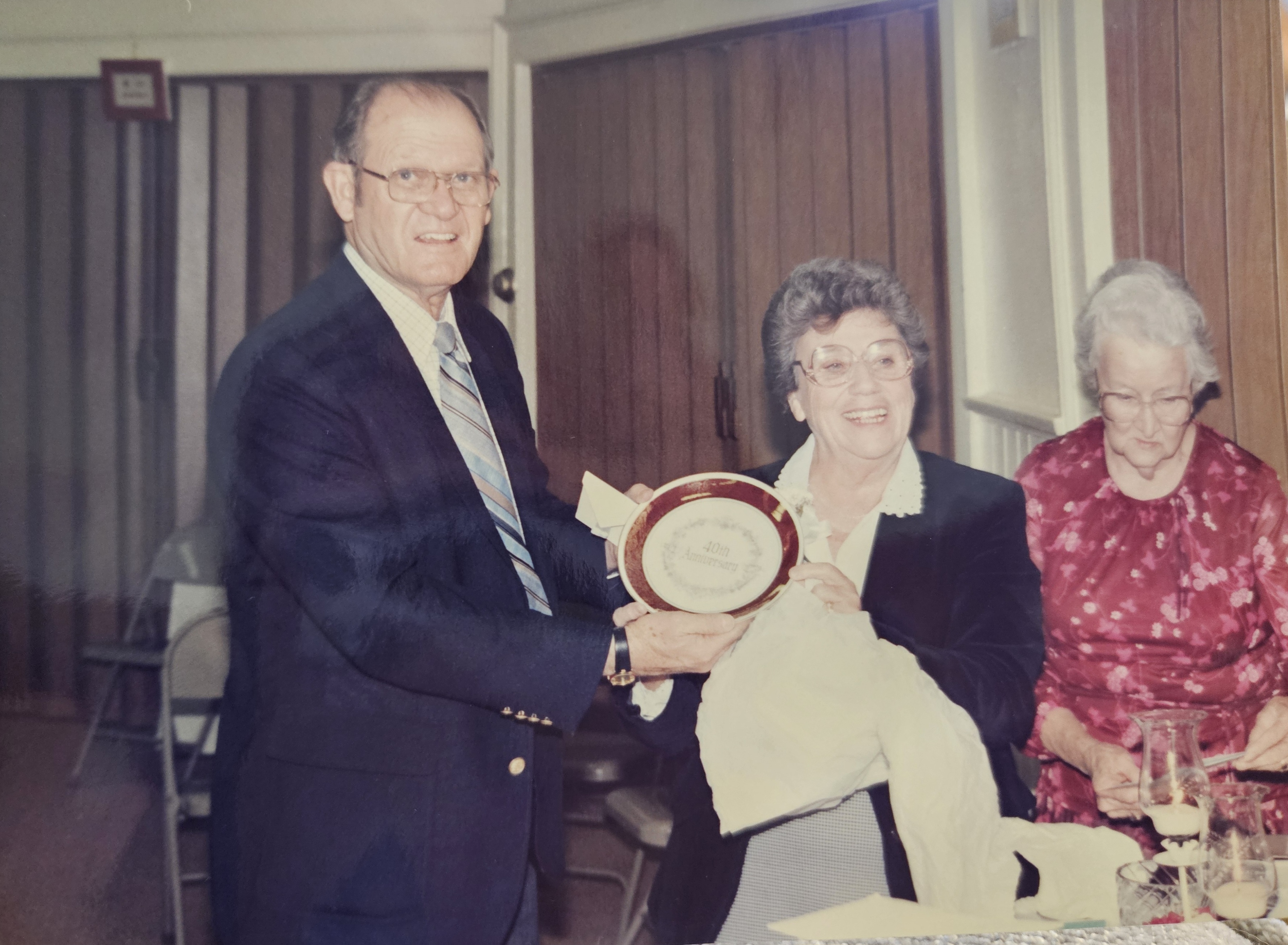
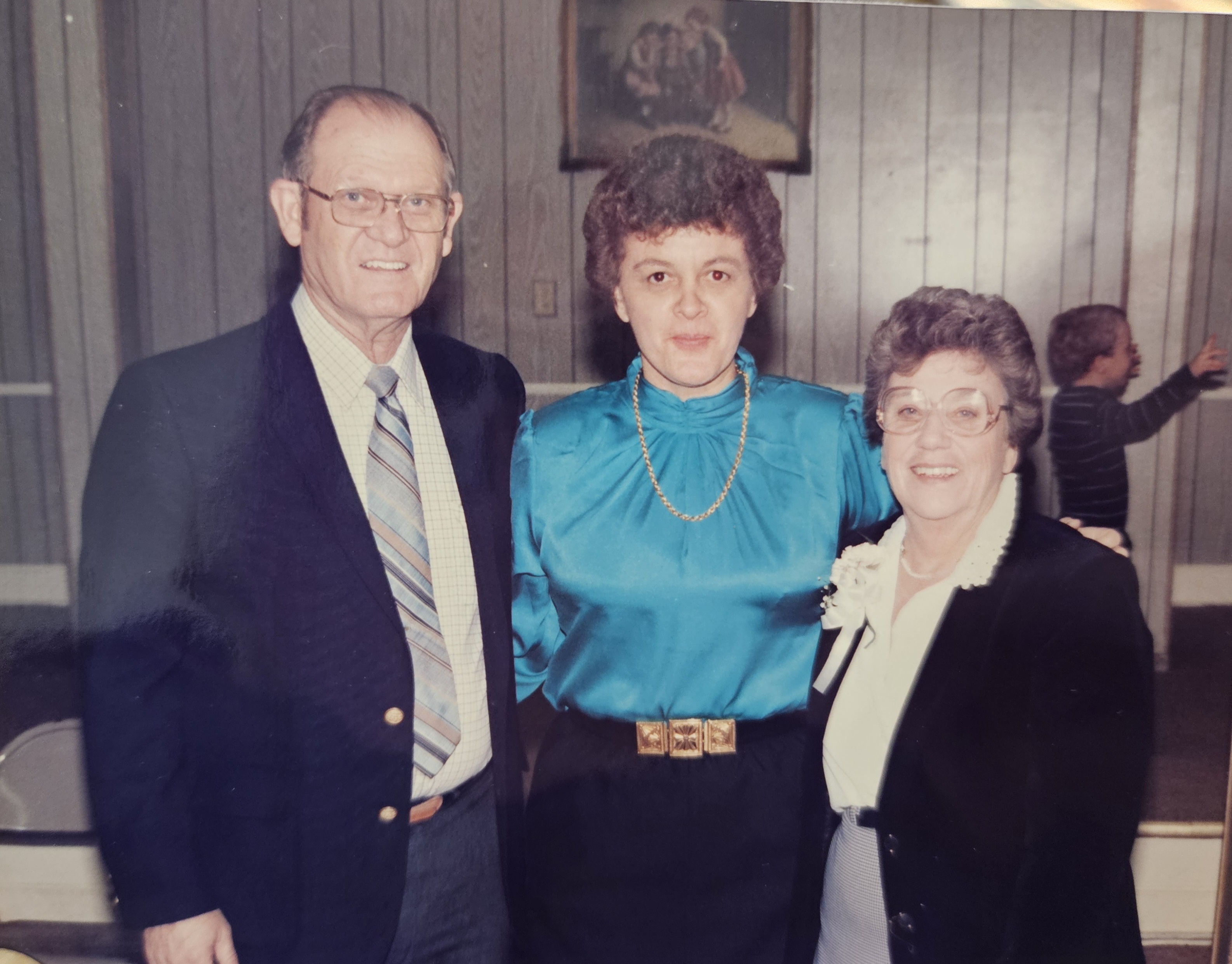
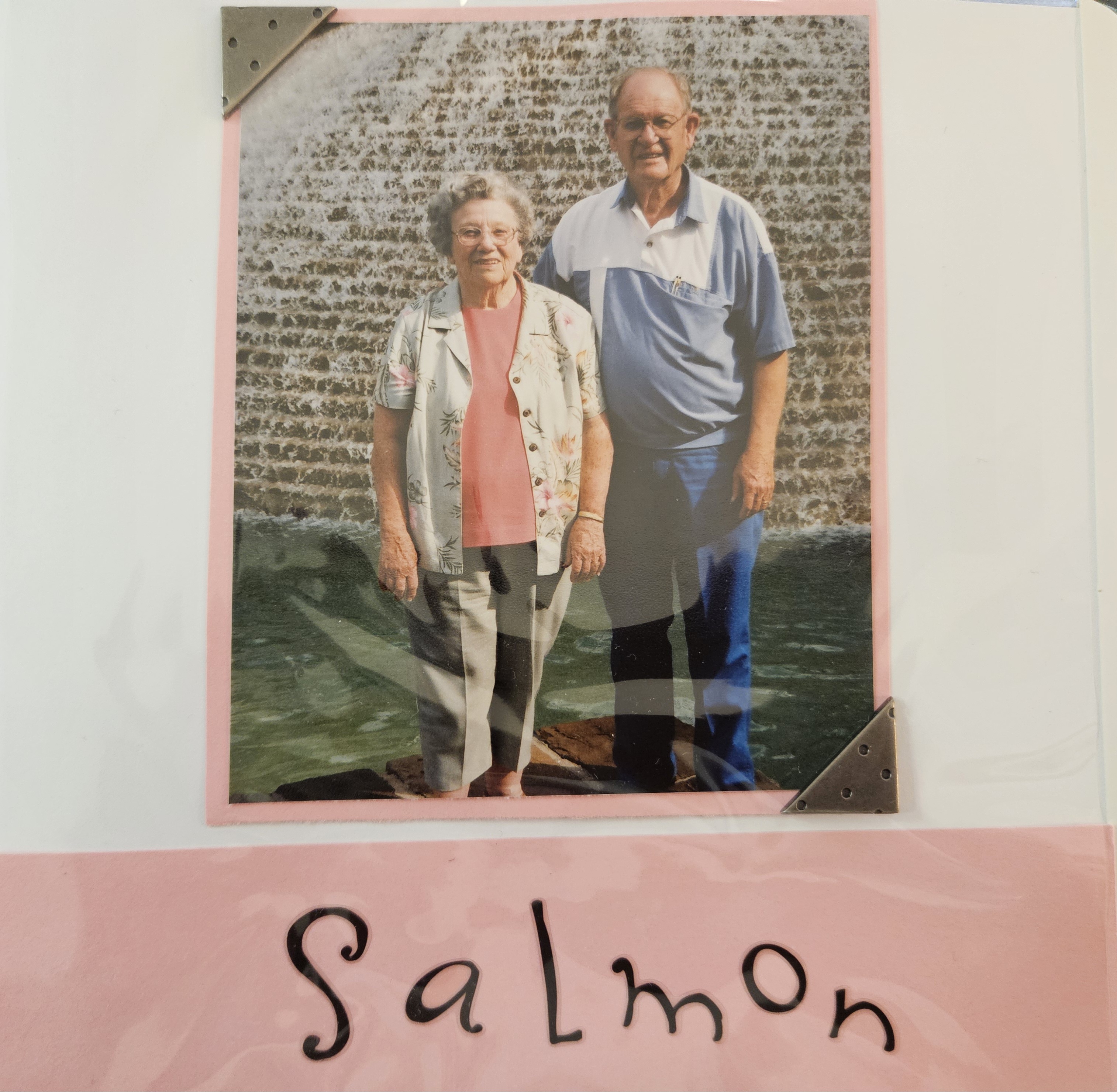
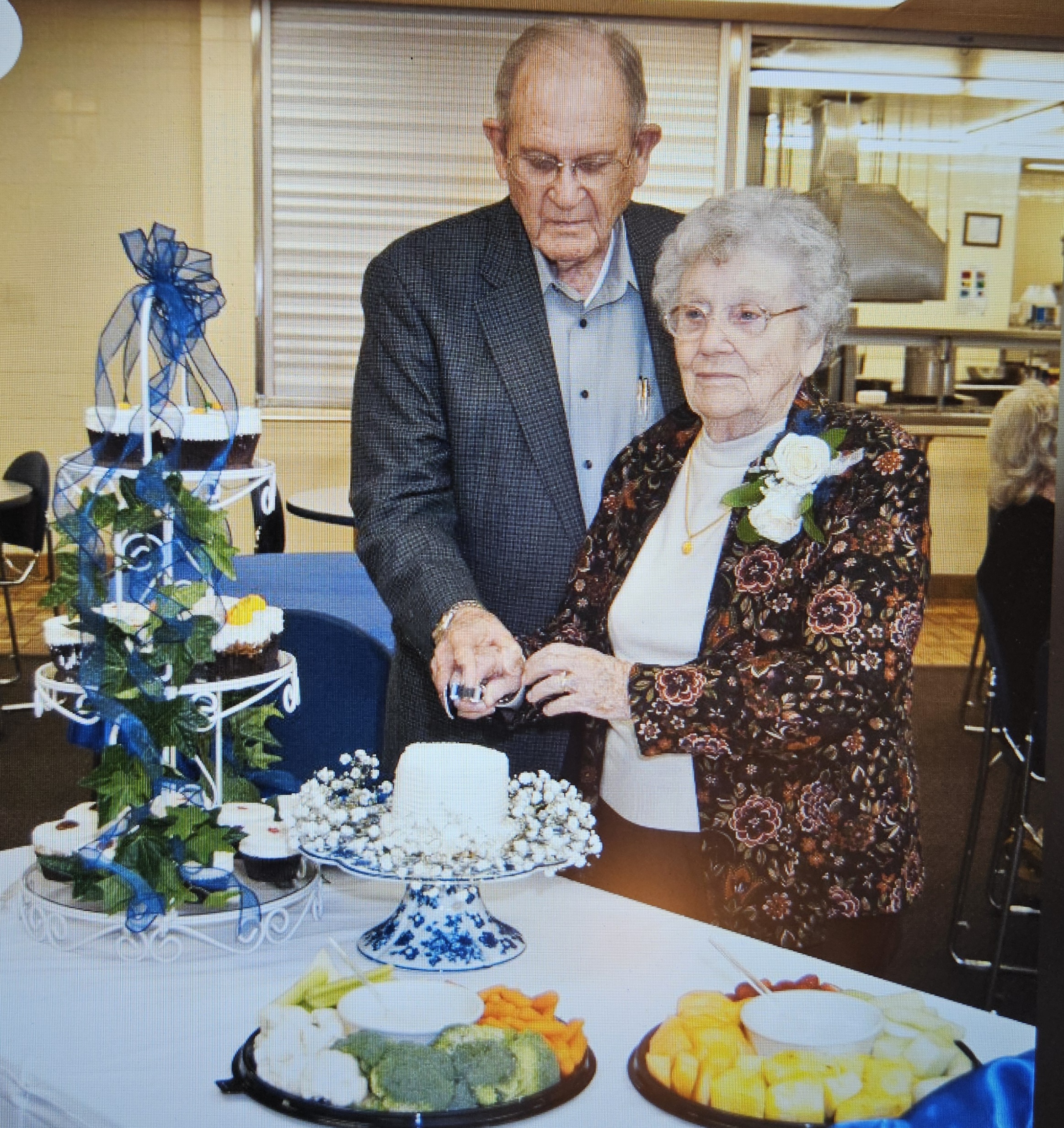
Orville and his wife married in 1947 and celebrated 65 years together. She was originally from Wales and passed away on October 9, 2020. Their marriage was filled with love, partnership, and countless adventures—from ministry to travel to the simple joys of daily life. Orville often reflected on how blessed they had been to share such a rich and meaningful journey.
When asked what wisdoms he had learned during his life, Orville responded,
”Just live your life well without a lot of fanfare. And don’t bother much about the flare because it only lasts a few moments. Be a good servant to others and remember what you see is what you get.”
His favorite scripture is from Ephesians 6 talking about putting on the whole Armor of God to protect you against the fiery darts of the enemy. Orville also shared, “it was important not to be a partial Christian. You have to be a whole Christian or not a Christian at all.”
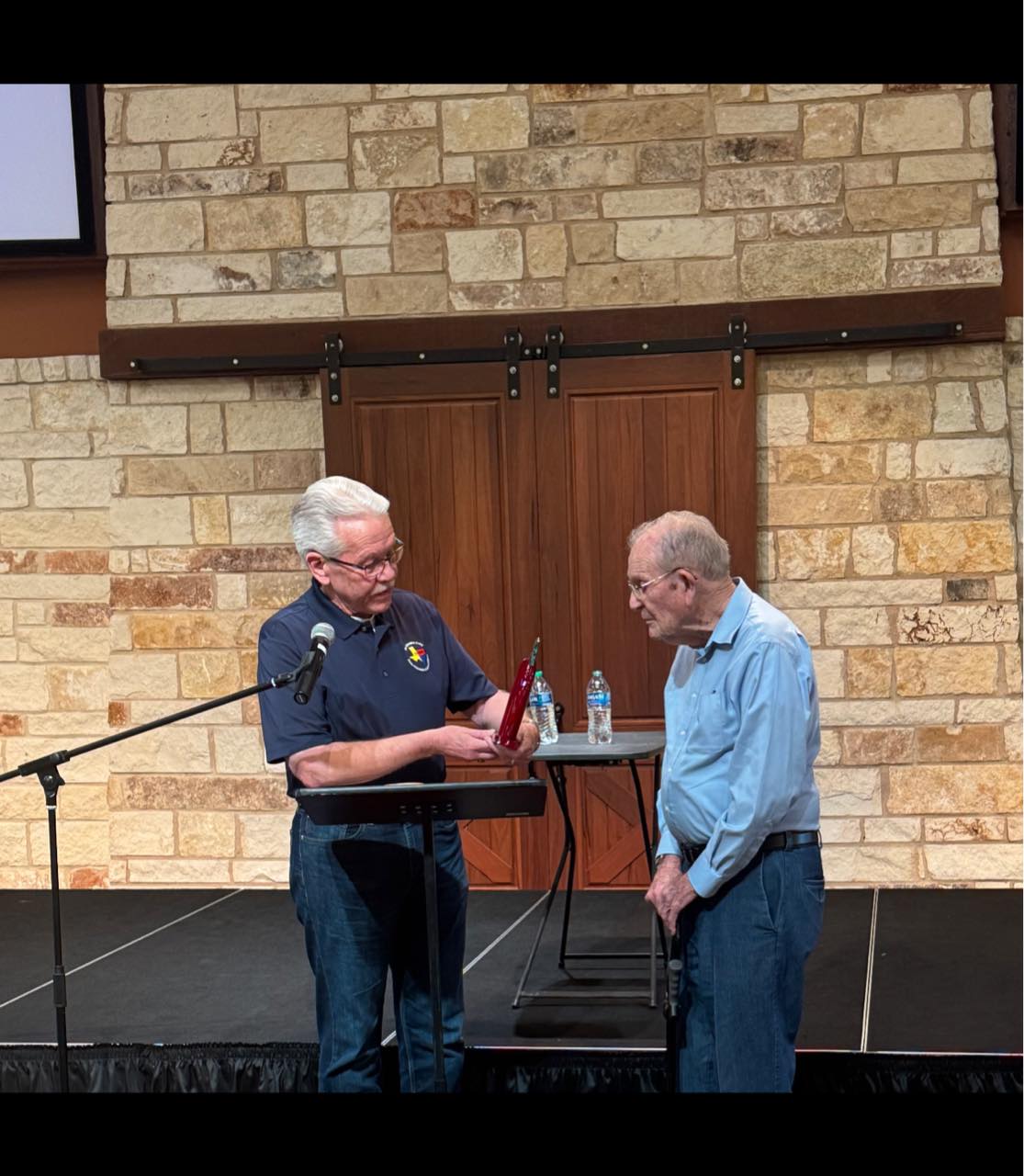
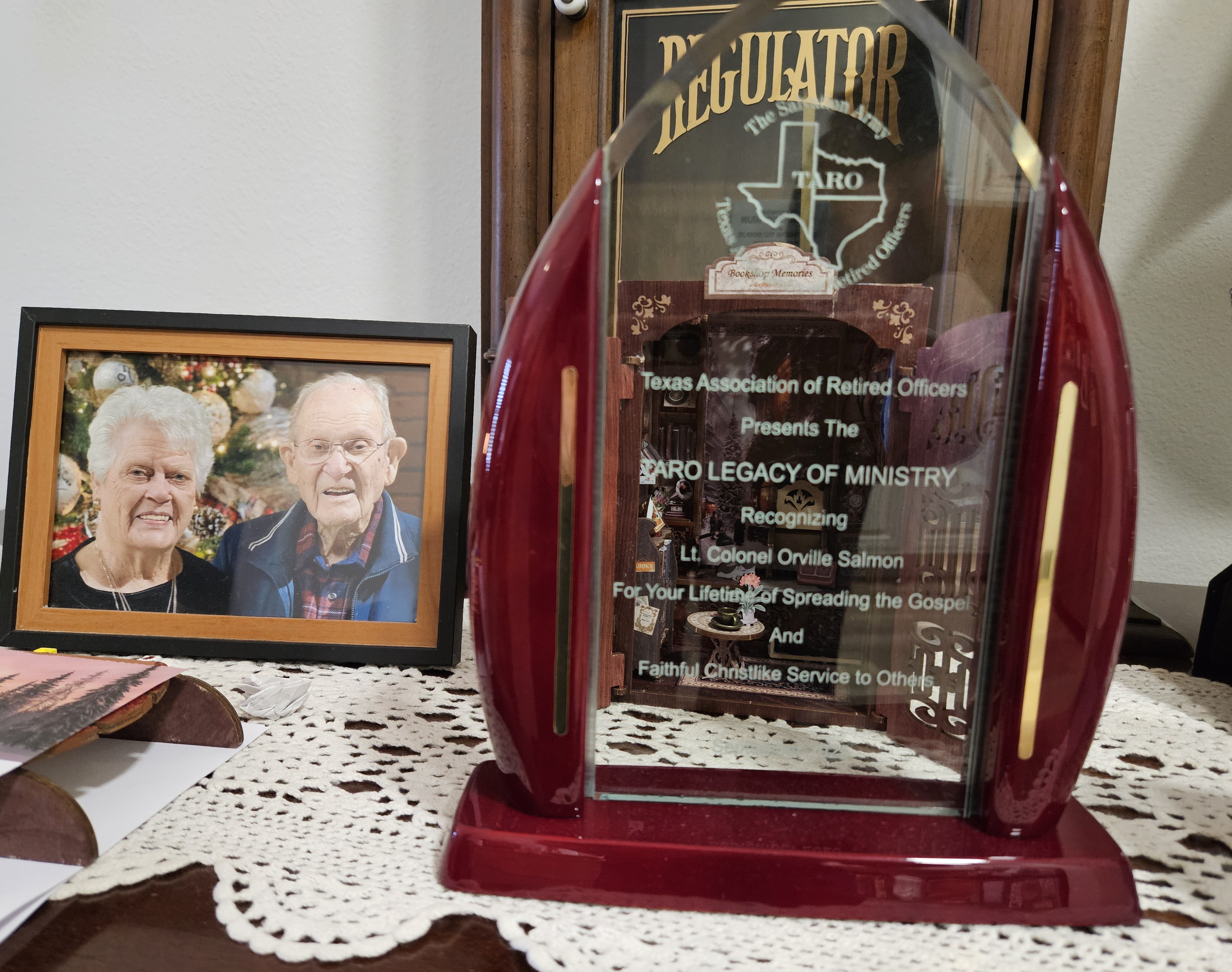
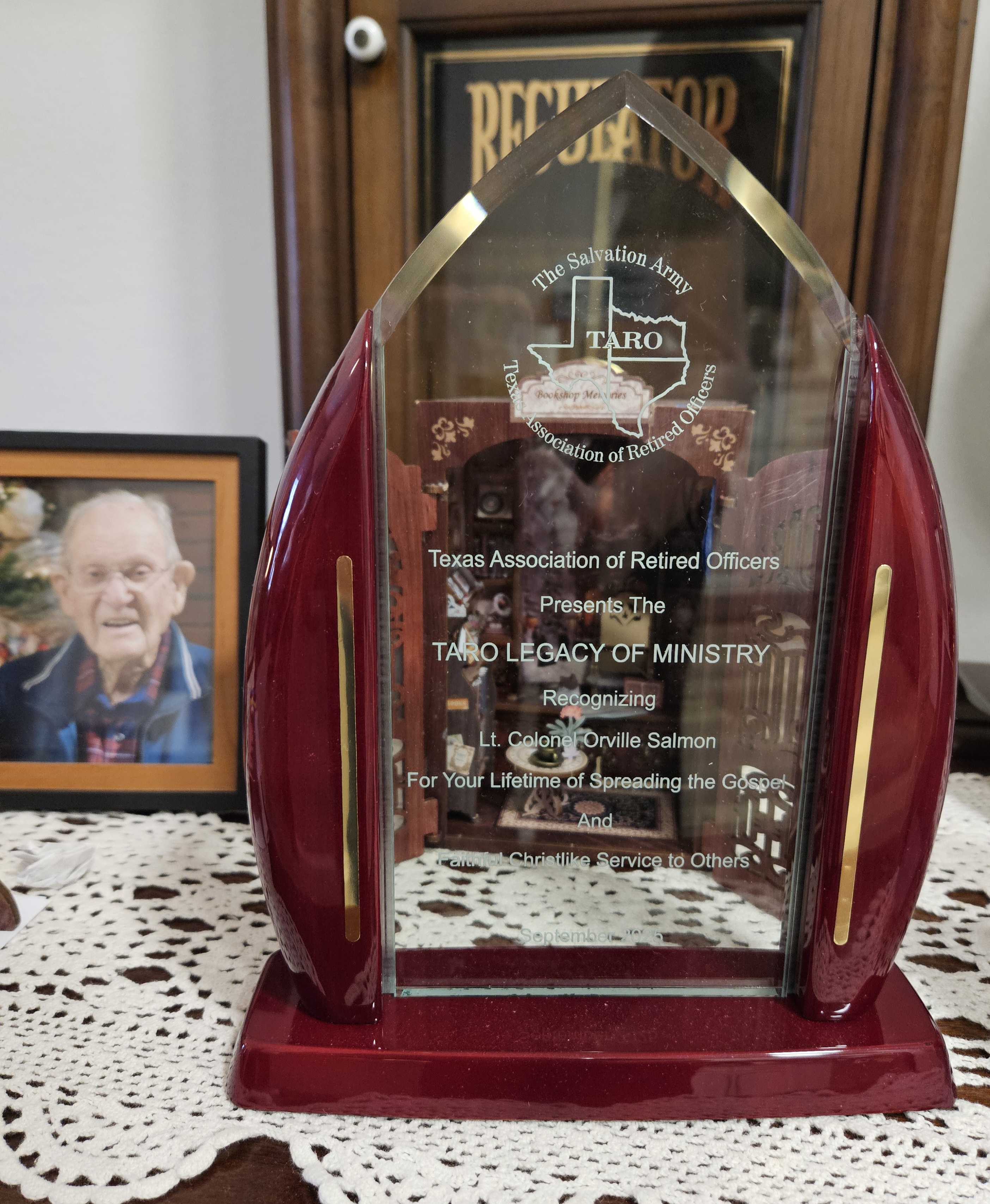
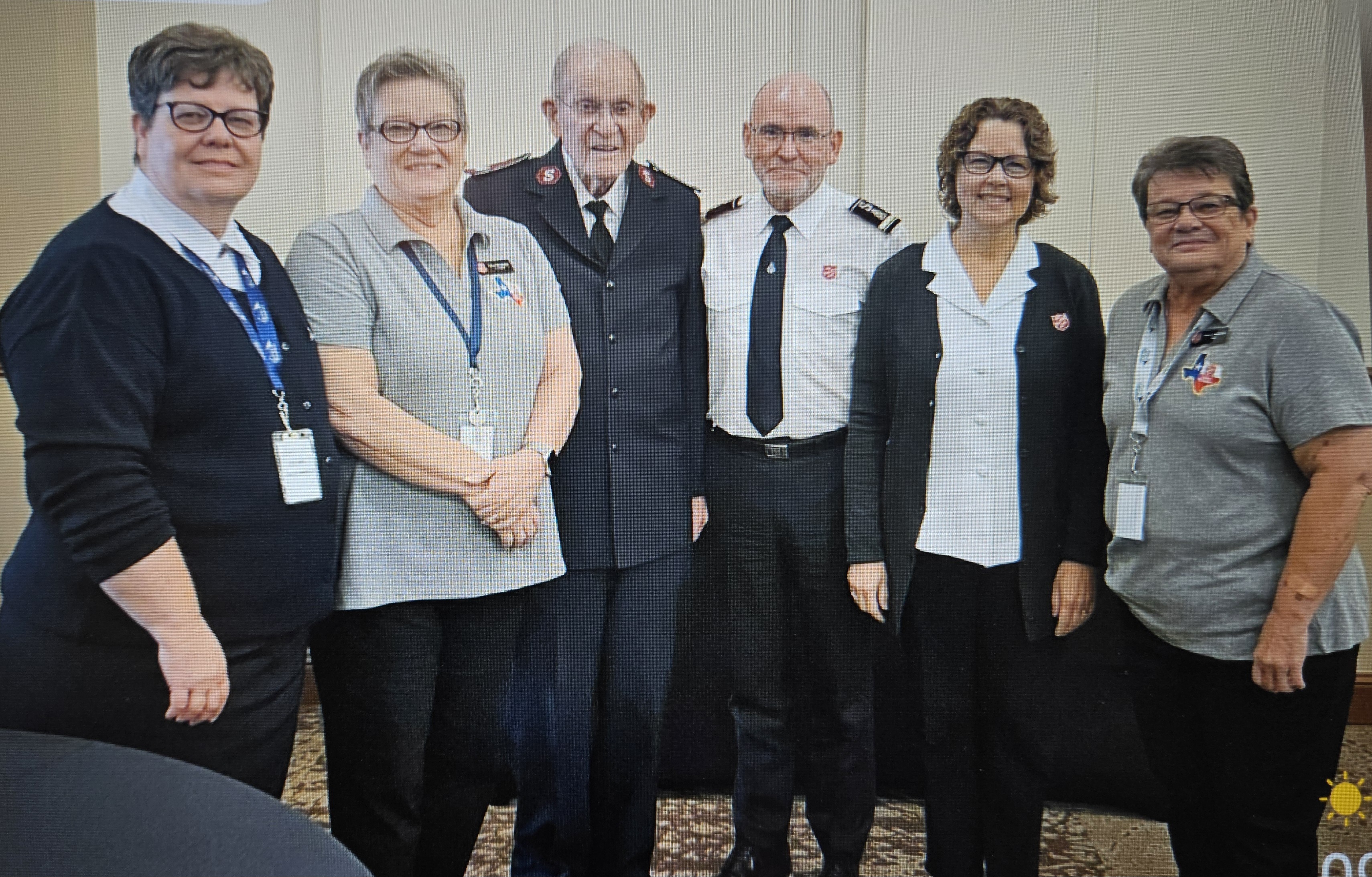
In reflection Orville said he had lived a wonderful life and most recently was honored with a plaque from the Association of Retired Salvation Army Officers.
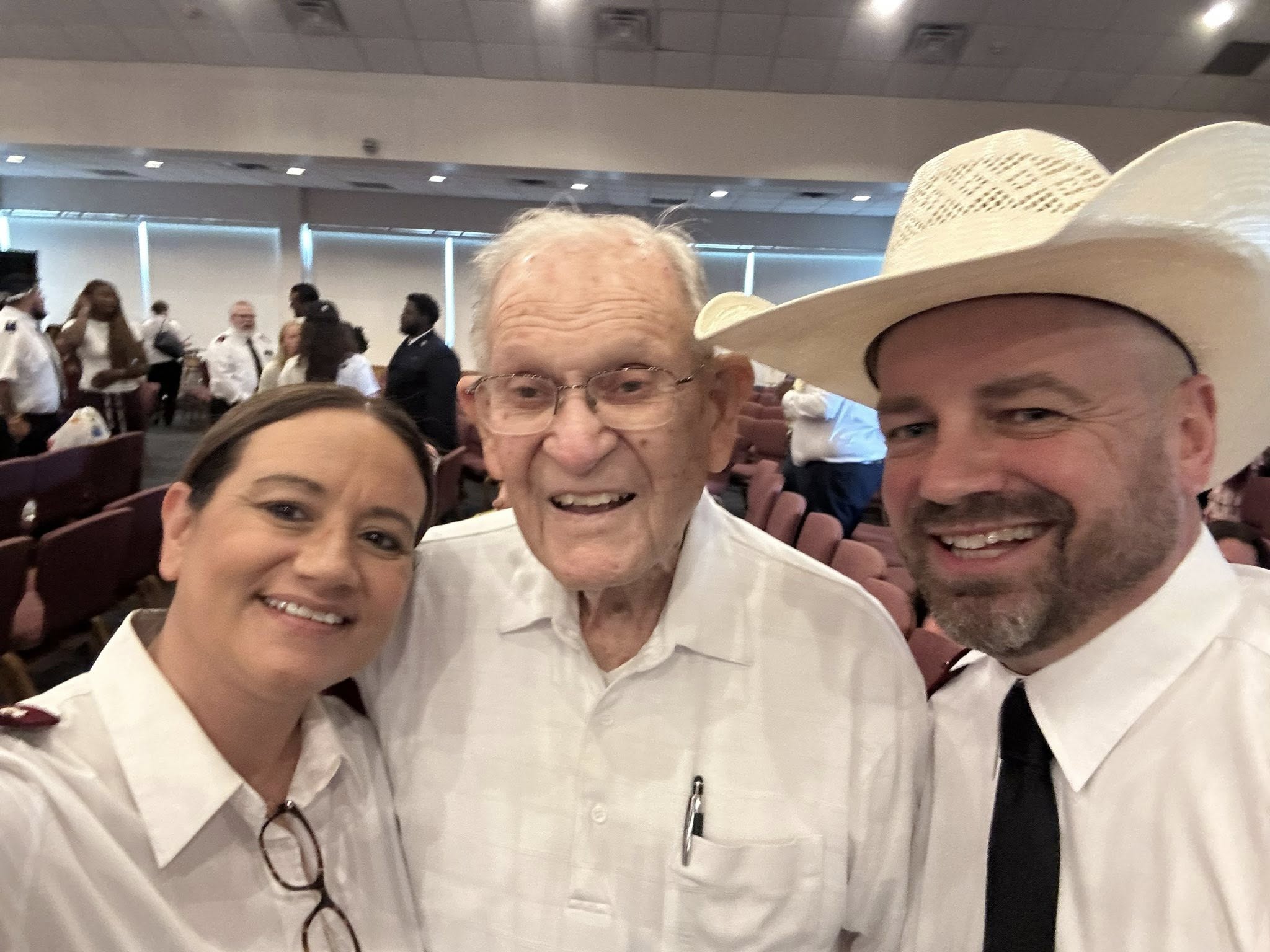
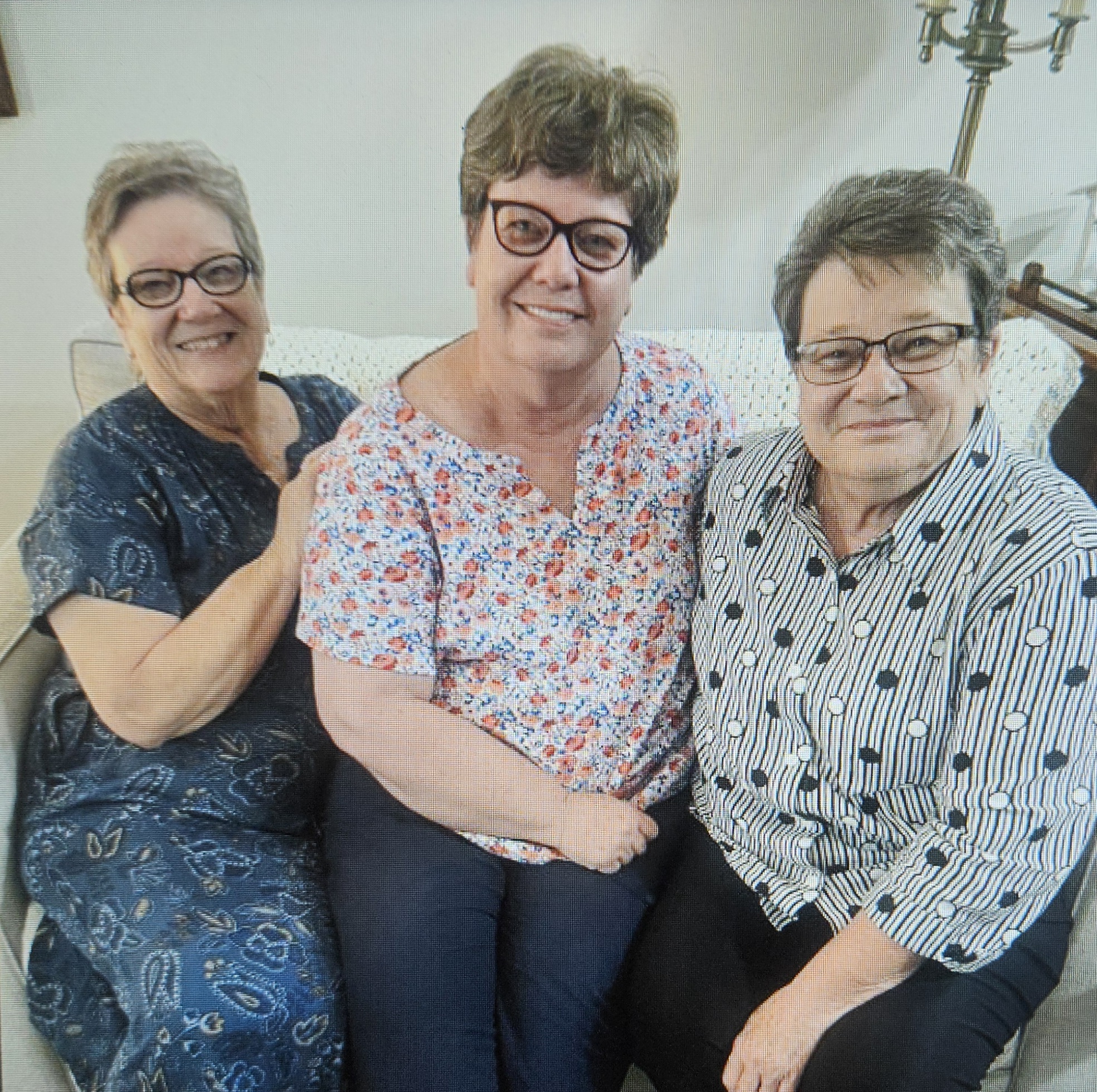
Orville’s daughters are continuing their legacy with the Salvation Army. His oldest daughter Bettie Jon graduated from the School For Officers Training, Suffern, NY in 1975 and has served the Salvation Army as an Officer for 50 years.
His daughter Debra graduated in 1976 and served with her husband in Sri Lanka, while his youngest daughter Paula and her husband served as Officers in Moscow directing activities in Russia, Moldavia, Ukraine, and the Republic of Georgia.
Supplemental Information
Bryan County, Oklahoma in 1926
In 1926, Bryan County carried the steady rhythm of a rural Oklahoma community shaped by land, labor, and lineage. Cotton remained the county’s dominant crop, and its fields stretched across the countryside in long, pale rows that rose and fell with the seasons. The Red River formed the county’s southern boundary, a waterway that had witnessed the long presence of the Choctaw Nation and the gradual arrival of settlers who built farms, churches, and schools across the landscape. Durant stood as the county’s center of commerce with its courthouse square, brick storefronts, and the Missouri Kansas Texas Railroad bringing freight, mail, and the wider world into southeastern Oklahoma. Rural communities such as Caddo, Colbert, Bokchito, Achille, Bennington, Kenefic, Mead, Silo, Armstrong, Blue, Kemp, and Hendrix lived in close relationship with one another, connected by unpaved roads that were dusty in summer and muddy in winter.
Daily life in Bryan County was shaped by work. More than seventy percent of residents depended on agriculture, so mornings began early with the demands of cotton, corn, livestock, and the small businesses that supported rural labor. Electricity and radio were spreading but not yet universal, especially outside Durant, and many homes still relied on kerosene lamps and wood stoves. Automobiles were becoming common, yet horse‑drawn wagons remained part of the county’s landscape. Schoolhouses dotted the rural districts, often one‑room buildings where attendance rose in winter and fell in spring as boys left to help with planting.
Community life centered on churches. Baptist, Methodist, and Church of Christ congregations shaped the county’s social fabric, and Choctaw churches continued traditions that predated statehood. Revivals, homecomings, and school programs filled the calendar, and these gatherings created the sense of belonging that defined Bryan County. Newspapers such as the Durant Weekly News and the Bryan County Democrat recorded the county’s daily life with remarkable detail, preserving births, deaths, marriages, school events, church meetings, and small personal notes about residents traveling or visiting relatives.
The truth of Bryan County in 1926 lies in its steadiness. It was a place where people knew one another, where the land dictated the pace of life, and where modern conveniences arrived slowly but surely. It was rural, communal, and deeply rooted in tradition, yet it stood on the threshold of change as automobiles, electricity, and radio began to reshape daily experience. This was the world anyone living there would have known, a landscape defined by work, faith, and familiarity, carried forward by the quiet dignity of ordinary life.
Bryan County in Hard Times: The Great Depression’s Grip on Rural Oklahoma
When the Great Depression reached Bryan County after 1929, it struck a region already dependent on agriculture and already vulnerable to falling crop prices. Cotton was the county’s economic backbone, and when cotton collapsed, Bryan County collapsed with it. The price of a pound of cotton fell so sharply that many farmers could not earn enough to cover seed, tools, or land rent. This is documented in Oklahoma agricultural reports from the early 1930s, which show cotton prices dropping to levels that made profit nearly impossible.
Families across Durant, Caddo, Colbert, Bokchito, Achille, Bennington, Kenefic, Mead, Silo, Armstrong, Blue, Kemp, and Hendrix felt the strain. Rural households saw income disappear almost overnight. Many farmers who had borrowed money during the prosperous 1920s found themselves unable to repay loans, and foreclosures increased across southeastern Oklahoma. Bank failures in the region wiped out savings with no federal protection, leaving families with nothing but land, livestock, and whatever food they could grow.
Daily life became a practice of survival. Families planted larger gardens, raised more chickens, and relied heavily on barter. Shoes were repaired instead of replaced. Clothing was patched repeatedly. Meals were smaller. Electricity, where available, was used sparingly. Many rural homes still lacked electricity entirely, so the Depression deepened existing hardships rather than creating new ones. People walked long distances to save fuel. Medical care was postponed because families could not pay.
Durant’s businesses struggled as well. Stores extended credit to customers who could not pay, and many eventually closed. The Missouri Kansas Texas Railroad continued to run through the county, but freight shipments declined as national commerce slowed. Newspapers such as the Durant Weekly News recorded the era with stark honesty, noting community relief efforts, church food drives, and the growing number of families seeking help.
Community institutions became lifelines. Churches organized meals, clothing drives, and support networks. Schoolhouses provided stability for children even as attendance fluctuated when boys stayed home to help with farm labor. Neighbors shared food, tools, and labor because survival depended on cooperation. Oral histories from Bryan County families describe the Depression not only as economic hardship but as a time when community bonds strengthened out of necessity.
Federal relief arrived slowly but made a measurable difference. New Deal programs brought work crews to Bryan County to improve roads, build public structures, and support agricultural recovery. The Civilian Conservation Corps and Works Progress Administration provided wages that kept families afloat. These programs did not end the Depression, but they stabilized the county enough to prevent widespread displacement.
The Depression in Bryan County did not truly end until World War II created full employment and revived agricultural demand. By the early 1940s, the county’s economy began to recover, but the memory of the Depression remained deeply rooted in families who had endured its long years.
Foods in Bryan County and Surrounding Communities During the Great Depression
Food in Bryan County and the communities surrounding it came from the land, from gardens, from livestock, and from whatever families could gather or trade. When cotton prices collapsed and wages disappeared, people relied on the practical knowledge that had sustained rural Oklahoma for generations. Families planted large gardens with beans, peas, okra, squash, tomatoes, onions, and potatoes. These vegetables formed the foundation of daily meals because they were dependable, inexpensive, and could be canned for winter. Corn remained essential. It became cornbread, hominy, grits, and cornmeal mush, and many families ate cornbread at nearly every meal because it was filling and required only cornmeal, salt, and a little fat.
Livestock provided meat when families could afford to butcher. Chickens were common, so eggs were a steady source of protein. Hogs were central to rural survival, and pork became the most reliable meat in Bryan County and its neighboring communities. Salt pork, bacon ends, and lard flavored vegetables and beans. Beef was less common because cattle were valuable, but families sometimes shared meat after a community butchering. Beans were indispensable. Pinto beans, navy beans, and black‑eyed peas were inexpensive, nutritious, and easy to store, and many families ate beans several times a week.
Wild foods supplemented the table. Families gathered pecans along the river bottoms, hunted rabbits and squirrels, and fished in local creeks. These foods were not luxuries. They were necessary. Oral histories from southeastern Oklahoma describe children gathering wild berries, women shelling pecans for winter, and men fishing to stretch meals when money was gone. Canning was a lifeline. Women filled jars with tomatoes, peaches, green beans, pickles, and preserves. A pantry lined with jars meant security. Without them, winter was harder. Many families traded canned goods with neighbors, strengthening the community bonds that helped Bryan County endure the Depression.
Flour, sugar, and coffee were purchased when possible, often on credit from local stores in Durant, Caddo, Bokchito, and Colbert. Biscuits, gravy, and simple cakes appeared on tables when families had enough flour. Coffee was stretched thin, reused, or replaced with roasted chicory or grain when money ran out. Relief programs eventually brought commodities such as cheese, canned beef, and flour. These arrived later in the Depression and were distributed through local agencies and churches. They did not replace homegrown food, but they eased the strain.
The truth is clear. Food in Bryan County and its surrounding communities during the Great Depression was plain, practical, and rooted in the land. Families survived through gardens, livestock, wild foods, and the quiet strength of neighbors who shared what they had.
Strength on the Home Front: How WWII Transformed Oklahoma’s Families and Women
WWII reshaped family life across Oklahoma with a force that reached into every home, every church, and every rural community. When young men left for military service, families felt the absence immediately. Sons, brothers, and husbands boarded trains at depots in Durant, Oklahoma City, Tulsa, Ardmore, and countless small towns, leaving behind farms, factories, classrooms, and familiar routines. Their departure created a quiet ache that settled into daily life, yet it also awakened a sense of duty that Oklahoma families carried with steady resolve.
Women became the center of the home front. Across Bryan County and throughout Oklahoma, women stepped into roles that had once belonged to men and carried them with strength that defined the era. They managed farms, kept livestock fed, planted and harvested crops, and maintained the daily operations that sustained rural life. They worked in local businesses, kept books, operated machinery, and filled essential positions in stores, schools, and community offices. In cities, women entered aircraft plants, uniform factories, and military supply shops, becoming welders, riveters, inspectors, and assembly workers. Their labor ensured that Oklahoma continued to function while so many men were away.
Families lived with ration books that governed sugar, meat, gasoline, and shoes. They saved scrap metal, rubber, and paper for collection drives. They listened to radio broadcasts that carried news from distant battlefields. They read letters aloud at kitchen tables, holding on to every word from loved ones overseas. Mothers carried both pride and worry. Children learned responsibility early. Grandparents helped keep households steady. The entire family structure shifted to meet the demands of wartime life.
Women also became leaders in community resilience. They organized sewing circles that produced garments for servicemen. They prepared care packages. They led prayer groups. They supported neighbors who struggled with loneliness, fear, or financial strain. Their presence held families together and strengthened the bonds that carried Oklahoma through the long years of conflict.
When WWII ended, families felt the change as sharply as they had felt the beginning. Trains brought men home, some whole, some wounded, all changed by what they had seen. Women who had carried farms, businesses, and households now helped rebuild the rhythms of peacetime. The GI Bill opened doors to education, home ownership, and new careers, and families began to imagine futures that had once seemed impossible during the Depression.
The truth is clear. WWII reshaped Oklahoma families by separating them, strengthening them, and ultimately transforming them. It empowered women, deepened community bonds, and altered the course of family life across the state. It was a turning point felt in every household, carried by the quiet courage of those who stayed and the determined service of those who left.
Patriotism on the Oklahoma Home Front
Before WWII, patriotism in Oklahoma was shaped by hardship and resilience. Families had endured the long strain of the Great Depression. Farms struggled with low prices. Cotton brought little income. Rural households depended on gardens, livestock, and careful preservation of food. Women carried the daily burden of survival. They managed households, tended gardens, preserved produce, and kept families steady through years of scarcity. Communities relied on shared labor, church support, and neighborly cooperation. Patriotism lived quietly in the belief that families could endure difficulty together and remain loyal to one another and to their state.
During WWII, patriotism became visible in every part of Oklahoma life. When men left for military service, families responded with a sense of duty that reached far beyond individual households. Women became the center of the home front. They managed farms, kept livestock fed, planted crops, and maintained the daily operations that sustained rural communities. In cities, women entered aircraft plants and military supply factories. They became welders, riveters, inspectors, and assembly workers. Their labor directly supported the national war effort and became one of the most powerful expressions of Oklahoma’s patriotism.
Families lived with ration books that governed sugar, meat, gasoline, and shoes. They accepted these limits as part of their contribution to victory. Children gathered scrap metal, rubber, and paper for collection drives. Churches organized prayer services for servicemen and prepared care packages for military camps. Communities held war bond drives, and Oklahoma consistently ranked among the strongest states in participation. Patriotism was measured not only in emotion but in disciplined action.
Radio broadcasts carried news from distant battlefields. Letters from soldiers were read aloud at kitchen tables. Every name printed in local newspapers carried weight. Patriotism became a shared identity that united farms, towns, and cities across Oklahoma.
Native American communities contributed with extraordinary devotion. Many enlisted at high rates, and their families supported the war with cultural pride and community strength. Their service added a profound dimension to Oklahoma’s wartime identity.
Patriotism on the Oklahoma home front lived in the steady courage of families who endured hardship, in the determined labor of women who carried the weight of farms and communities, and in the unity that bound towns and rural counties together through every year of WWII. It was expressed through sacrifice, through disciplined action, and through a shared belief that their efforts mattered. When the conflict ended, Oklahoma’s families emerged with deeper bonds, renewed hope, and a lasting pride in what they had given. Their devotion shaped the identity of the state and left a legacy of strength that continues to honor every generation that followed.
History of Attu Island
Strategically, Attu’s location is critical. It sits aside the great-circle route between North America and Asia, controlling access to the Northern Pacific and the approaches to the Arctic.
This geography would later make it a focal point for both Japanese and American military strategists.
Attu Island is the largest of the Near Islands stretching 35 miles long and 20 miles wide, It lies 1,100 miles from Alaska and 550 miles from Russia. It is the western most point of North America.
The terrain is blanketed by tundra and muskeg, which forms a spongy, waterlogged carpet that makes movement difficult for humans and vehicles. The climate is notoriously harsh and unpredictable. Attu is often shrouded in dense fog, battered by
gale-force winds, and sudden shifts from clear skies to rain squalls. The combination of cold, wet, and windy conditions makes survival and military operations exceptionally challenging.
Following the Doolittle Raids on Tokyo in April 1942, Japanese Military leaders became acutely aware of the vulnerability of the home islands to attacks launched from the North Pacific.
The Aleutians, particularly Attu and Kiska, were seen as potential bases for American bombers and as a possible invasion route to Japan via the Kuril Islands.
On June 7,1942, the day after the invasion of Kiska, Japanese forces under Major Matsutoshi Hosumi landed unopposed at Holtz and quickly moved to occupy the village of Chichagof Harbor.
The occupation of Attu and Kiska shocked the American public, marking the first since the war of 1812 that foreign troops had seized U.S. territory. The psychological effect was the demand for the recapture of the islands.
On May 11,1943 under appalling weather conditions, dense fog, and freezing rain and snow, the American forces launched a slow and costly attacks. After two weeks of grinding advance, American forces pushed the Japanese forces into a pocket around
Chichagof Harbor.
With no hope of reinforcements or evacuation, Colonel Yamasaki ordered his wounded to commit suicide and led a banzai charge on May 29th that penetrated deep into American positions, resulting in fierce, hand to hand combat. Eventually the exhausted Japanese soldiers were overwhelmed.
The Battle of Attu was one of the costliest in the Pacific, second only to Iwo Jima in terms of percentage of casualties. American losses included 549 killed, 1,148 wounded, and over 2,100 evacuated for frostbite and other non-battle. Japanese casualties exceeded 2,300 killed.
In conclusion the legacy of Attu is preserved not only in the physical remnants of war – craters, bunkers, and abandoned airfields – but also in the memories of the people who lived on the island and fought and died for their existence.
The island’s geography dictated its fate, drawing the attention of empires and
shaping the experiences of all who set foot on its shores.
His Service (1944 to 1946)
Aviation Metalsmith Second Class — What He Actually Did As an Aviation Metalsmith Second Class (AM2), Orville Salmon belonged to one of the most technically demanding aviation ratings of the WWII era.
His responsibilities would have included:
- repairing and maintaining aircraft metal structures.
- working on fuselage frames, wings, control surfaces, and landing gear.
- performing welding, riveting, and sheet‑metal fabrication.
- ensuring aircraft were safe and mission‑ready in extreme conditions.
- troubleshooting structural damage from weather, corrosion, or hard landings.
- supporting flight operations in a region where aircraft were essential for patrol, reconnaissance, and supply.
This was skilled, hands‑on, mission‑critical work. Aircraft in the Aleutians took a beating — and men like Salmon kept them flying.
Why This Rating Mattered
During WWII, naval aviation was essential for patrol, reconnaissance, and defense. Aircraft operating in the Aleutian Islands faced brutal winds, freezing temperatures, salt corrosion, and constant mechanical strain.
Aviation Metalsmiths were the backbone of keeping these aircraft in the air.
Their work directly supported:
- anti‑submarine patrols.
- weather reconnaissance.
- coastal defense.
- supply and transport missions.
- post‑war stabilization operations.
The AM2 Legacy- Aviation Metalsmiths were known for their precision, endurance, and technical mastery. Their work saved lives, sustained missions, and ensured the Navy’s aviation forces remained ready in every theater of the war.
AM2 Orville Cleatous Salmon served with distinction in this demanding and essential role.
The Aleutian Islands — One of the Harshest Duty Stations in WWII
Serving in the Aleutians was not ordinary Navy duty. It was one of the most isolated, brutal, and strategically important assignments of the war.
Conditions he endured:
- freezing temperatures.
- hurricane‑force winds.
- fog so thick aircraft disappeared into it.
- volcanic ash that damaged engines and metal surfaces.
- months of darkness in winter.
- isolation from the mainland.
- limited supplies and constant maintenance challenges.
Aircraft corroded rapidly. Metal cracked. Rivets loosened. Weather destroyed equipment.
Aviation metalsmiths were the backbone of keeping operations alive.
Why the Aleutians mattered
Even after the Japanese were pushed out in 1943, the Aleutians remained a critical:
- air defense zone.
- patrol and reconnaissance hub.
- weather station network.
- early‑warning line for the North Pacific.
From 1944 to 1946, the U.S. Navy maintained a strong presence to secure the region and support post‑war stabilization.
Lt. Salmon served during this transition period, when the mission shifted from wartime operations to post‑war security and demobilization — a period requiring discipline, technical skill, and steady leadership.
-
- Intelligence & Discipline.
- Technical Mastery.
- Proven Leadership.
- Unwavering Reliability.
Environmental Hardships
The Aleutian Islands are infamous for their extreme weather—dense fog, high winds, freezing temperatures, and frequent storms. The terrain is rugged, with craggy mountains, muskeg, and scant vegetation. These conditions made military operations and daily life extraordinarily challenging. Soldiers and sailors faced constant exposure to the elements, leading to high rates of non-combat casualties from frostbite, trench foot, and hypothermia.
The ground itself was often a freezing, swampy muck, making it nearly impossible to dig defensive positions or move heavy equipment. “Williwaws”—sudden, violent gusts of wind—could exceed 100 miles per hour, tearing down tents and flipping aircraft. Fog, known locally as “Adak Smog,” was so persistent that it often grounded flights and obscured enemy positions.
Battlefield Preservation and Legacy
Kiska remains a unique battlefield, with little postwar alteration. The island is managed as part of the Alaska Maritime National Wildlife Refuge and is designated a National Historic Landmark. Artifacts, fortifications, and unexploded ordnance remain as silent witnesses to the campaign. Preservation efforts balance historical significance with environmental protection.
After the war, Amchitka served as a communications and refueling base before being abandoned in 1950. In the 1960s and 1970s, the island was used for underground nuclear tests, including the massive Cannikin test in 1971. Environmental monitoring and cleanup efforts continue, and the island is now part of a restricted access wildlife preserve.
Daily Life and Living Conditions
Soldiers and sailors contended with cold, damp conditions, and the ever-present threat of “williwaws”—sudden, violent windstorms. The need for fresh water led to the creation of reservoirs and the careful placement of facilities near streams. The road network followed the island’s contours, resulting in indirect connections between different parts of the base.
Recreation and morale were supported by facilities such as theaters, recreation centers, and newsletters like The Adakian, edited by Dashiell Hammett. Despite these efforts, the psychological toll of isolation and harsh conditions was significant. Oral histories recount inventive ways soldiers coped, from melting snow for washing to distilling “tundra juice” from potatoes and grape jelly.
Medical Facilities and Health
An underground hospital, constructed by the Seabees, provided critical medical care under arduous conditions. The facility was designed to withstand enemy air strikes and the harsh environment. Medical staff contended with cases of frostbite, trench foot, and exposure, as well as combat injuries.
Health, Medical Care, and Non-Combat Casualties
Non-combat casualties were significant throughout the campaign. In Attu, over 2,100 men were evacuated for disease and exposure. Trench foot, frostbite, and hypothermia were common, exacerbated by inadequate cold-weather gear. Medical facilities were limited, and evacuation of the wounded was complicated by weather and terrain. The harsh environment tested the resilience and endurance of all personnel.
Units and Branches Present: Army, Navy, Air Forces, Coast Guard
The Aleutian campaign was one of the most complex joint operations of World War II, fought in some of the harshest conditions on earth. Multiple branches of the U.S. military — along with Canadian forces — worked together across a vast, unforgiving frontier of fog, wind, and volcanic islands.
U.S. Army Ground operations were led by units such as the 7th Infantry Division and the 17th, 32nd, and 4th Infantry Regiments. Specialized forces, including the 7th Provisional Scout Battalion (Castner’s Cutthroats) and the 13th Combat Engineer Battalion, carried out reconnaissance, engineering, and assault missions on Attu, Kiska, Adak, and Amchitka. Their work formed the backbone of the island‑to‑island campaign.
U.S. Navy The Navy’s Task Force 8 — supported by battleships, cruisers, destroyers, submarines, and seaplane tenders — provided the essential naval blockade, fire support, and transport that made the campaign possible. The Navy also operated seaplane bases and contributed to intelligence and patrol operations across the Aleutian chain.
U.S. Army Air Forces The Eleventh Air Force conducted bombing runs, reconnaissance flights, and fighter missions from bases at Elmendorf, Umnak, Adak, Amchitka, and Shemya. Their operations were carried out in some of the most treacherous flying conditions of the war, where weather often proved as dangerous as the enemy.
U.S. Coast Guard The Coast Guard maintained LORAN (long‑range navigation) stations, provided critical navigational support, and assisted in evacuation and rescue missions. Their presence ensured safe passage for ships and aircraft operating in the region’s unpredictable seas and skies.
Canadian Forces More than 5,000 Canadian troops joined the Kiska operation, including the 13th Canadian Infantry Brigade and the elite 1st Special Service Force — a Canadian‑American commando unit trained specifically for winter and mountain warfare. Their participation underscored the campaign’s international cooperation.
Postwar Use and Legacy
After the war, Adak remained the primary U.S. base in the Aleutians, playing a strategic role during the Cold War as a communications and anti-submarine warfare hub. Many World War II-era structures and artifacts remain, offering tangible connections to the island’s wartime legacy.
Postwar Aftermath
Cleanup, Remains Recovery, and Memorialization- After the war, efforts were made to recover remains and clean up military debris. Memorials were established to honor those who served and died in the Aleutians, including the Japanese Peace Monument on Attu and the cenotaph at Fort Richardson National Cemetery. In 2024, a joint U.S.-Japan mission recovered two sets of remains from Attu, marking the first such effort in over 70 years. Environmental regulations and the island’s harsh conditions have complicated recovery efforts, but the commitment to honoring the fallen endures.
New Beginnings for Oklahoma’s Families
After the war, families stepped into a new era. Trains brought men home, some whole, some wounded, all changed by what they had endured. Women who had carried the responsibilities of the home front helped rebuild the rhythms of peacetime. The GI Bill opened doors to education, home ownership, and new careers. Communities grew. Families purchased homes. Veterans attended colleges across the state. Patriotism remained visible in celebrations, memorial services, and the quiet pride carried by households who had given so much. Life after the war was shaped by gratitude, rebuilding, and the hope of new beginnings.
It was living with quiet worry that never fully left the room. Mothers kept working, kept praying, kept writing letters, but the fear for sons and husbands stayed close. Women learned to sleep lightly because every knock on the door carried possibility. Families watched the mail with hope and dread. A letter meant life. Silence meant uncertainty.
It was learning new skills because necessity demanded it. Women repaired fences, drove tractors, balanced accounts, and made decisions that had once belonged to men. They discovered strength they had always possessed but had never been asked to use so completely. Young girls stepped into adult responsibilities. Older women carried heavier burdens than ever before. The home front became a place of constant adaptation.
It was living with rationing that shaped every meal and every trip. Families saved sugar for special occasions. They stretched meat with creativity. They planned trips carefully because gasoline was limited. Shoes were repaired again and again. Every choice felt connected to the war effort, and families accepted these limits with pride rather than resentment.
It was listening to the radio as if it were a lifeline. News from Europe and the Pacific shaped the mood of entire communities. Families gathered around the radio with hands folded, hearts tight, and ears tuned for any mention of units from Oklahoma. The radio became a companion, a messenger, and sometimes a source of comfort.
It was watching communities grow closer. Neighbors helped one another with harvests, repairs, and childcare. Churches became centers of encouragement. Schools organized drives and patriotic lessons. Towns held gatherings to support families with loved ones overseas. Patriotism was not only national. It was local. It was personal.
It was feeling pride that outweighed fear. Families believed their sacrifices mattered. Women believed their labor made a difference. Children believed their scrap drives helped soldiers. Patriotism was not a slogan. It was a lived experience that shaped every day.
It was stepping into a new world after the war ended. Men returned changed. Women returned to roles that felt familiar but now carried new meaning. Families rebuilt routines with gratitude and caution. Communities honored the fallen. Veterans pursued education and new careers. Women carried the confidence of what they had accomplished. Life did not return to what it had been. It moved forward with new strength.
History of the Salvation Army
The Salvation Army stands as one of the most influential religious and humanitarian organizations to emerge from Victorian England, renewed for its distinctive military structure, commitment to social reform, and global reach.
Founded in 1865 by William Booth, the Salvation Army has, for over 160 years, combined evangelical fervor with practical compassion, transforming the lives of millions across continents.
William Booth was born on April 10, 1829, in Nottingham, England, into a family that experienced both relative prosperity and subsequent hardship when his speculative building business suffered severe losses.
The hardships William and his family experienced instilled in Booth a deep empathy for the marginalized and a first hand understanding of the structural and social barriers facing the poor.
Booth’s spiritual journey began in earnest during his teenage years. He attended the Broad Street Wesley Chapel, a Methodist congregation, and underwent a religious conversion at the age of 15.
Influenced by the revivalist preaching of American evangelist James Caughey and the
Methodist tradition of John Wesley, Booth developed a theology centered on personal salvation, sanctification, and the imperative of social action.
Booth’s early experiences in the slums of Nottingham and London, combined with his theological convictions, led him to reject the insularity of traditional church ministry.
He was deeply troubled by the indifferences of established churches to the plight
of the poor and their exclusion from religious life.
The genesis of the Salvation Army can be traced to the summer of 1865, when William and his wife Catherine began preaching in the East End of London, an area notorious for its poverty, crime, and social decay. Recognizing the need for a sustained and organized effort, the Booths established the East London Christian Mission in 1865.
Their aim was to bring the message of salvation to those neglected by society and the church. The Mission quickly distinguished itself from other evangelical efforts
through its willingness to meet and help people where they were by holding services in tents, theaters, dance halls, and the open air.
By the late 1870’s, the Christian Mission had grown rapidly, but Booth recognized the need for a more disciplined and unified organization. In 1878, Booth replaced the phrase “volunteer army” with “Salvation Army” a new era of militant Christianity.
The adoption of military terminology, ranks, uniforms, and organizational structure was both symbolic and practical. Converts became “soldiers”, evangelists were designated as “officers” and Booth assumed the title “General”.
The Army’s thrift stores, salvage depots, and recycling programs provided
employment and funded social services, while also promoting environmental stewardship.
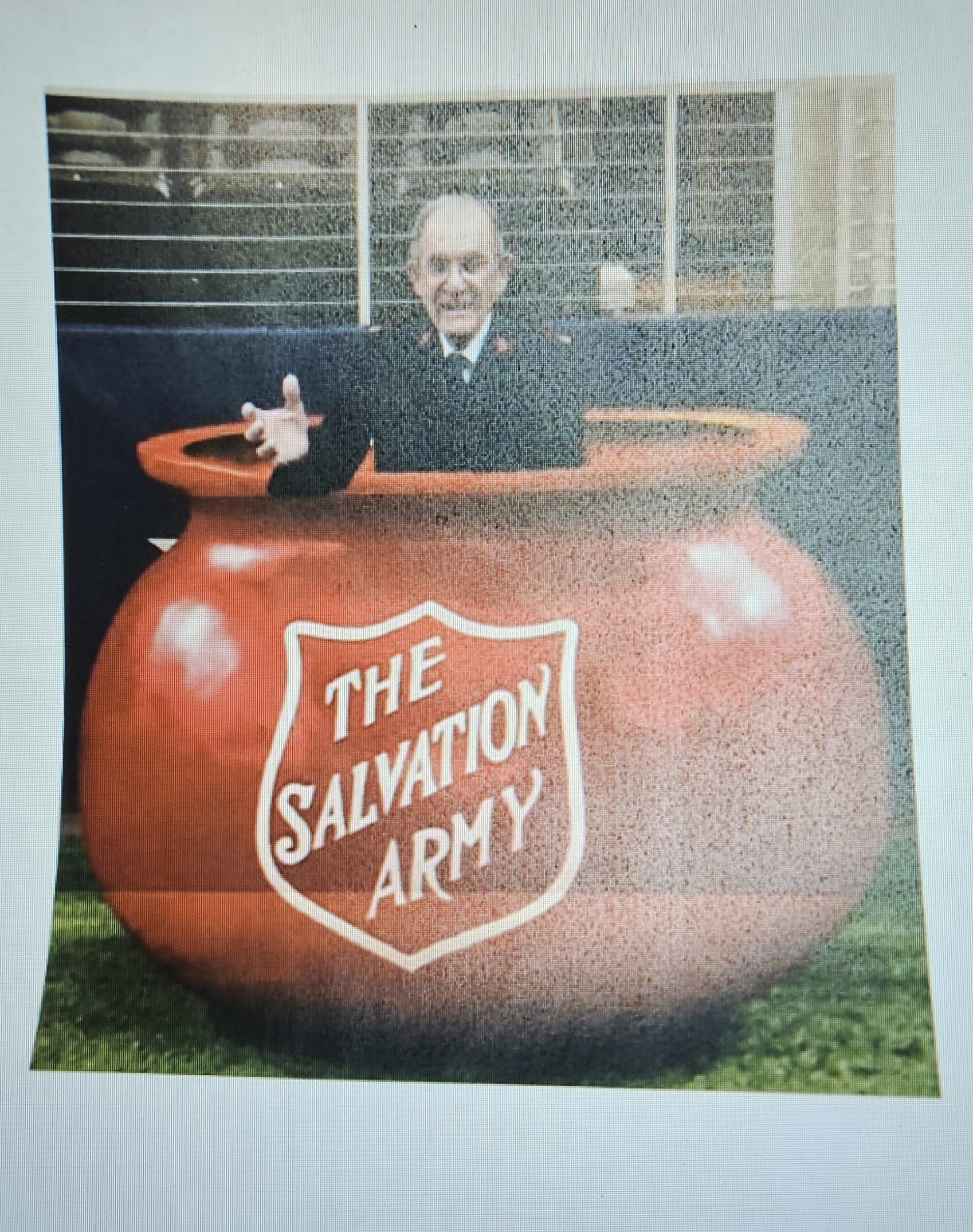
In summary, the Salvation Army in the U.S. has become one of the nation’s largest providers of social services, offering food assistance, shelter, disaster relief, addiction treatment, and support for veterans, families, and children. Its annual Red Kettle
campaign raises nearly $100million each year, funding programs
that serves millions of Americans.
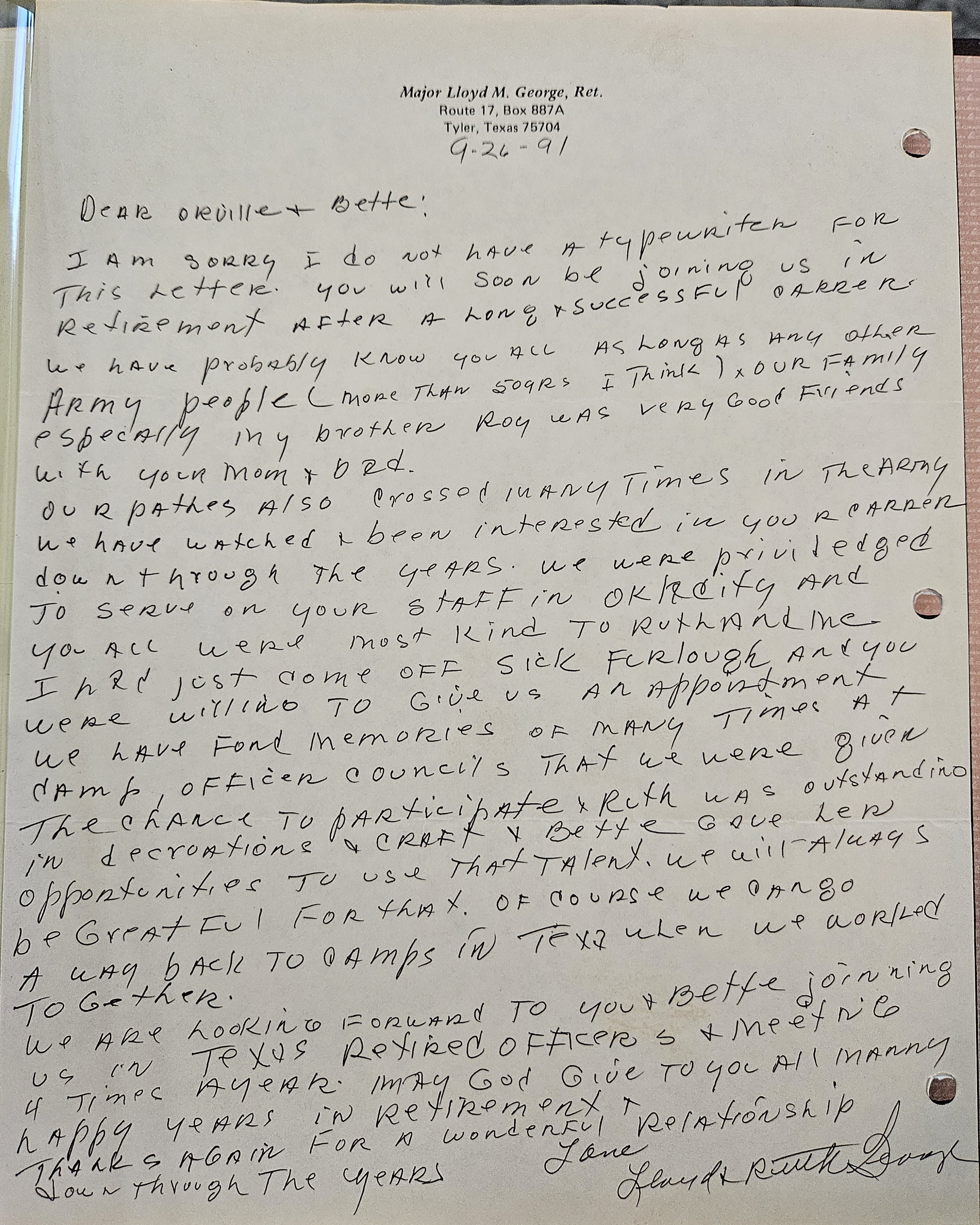
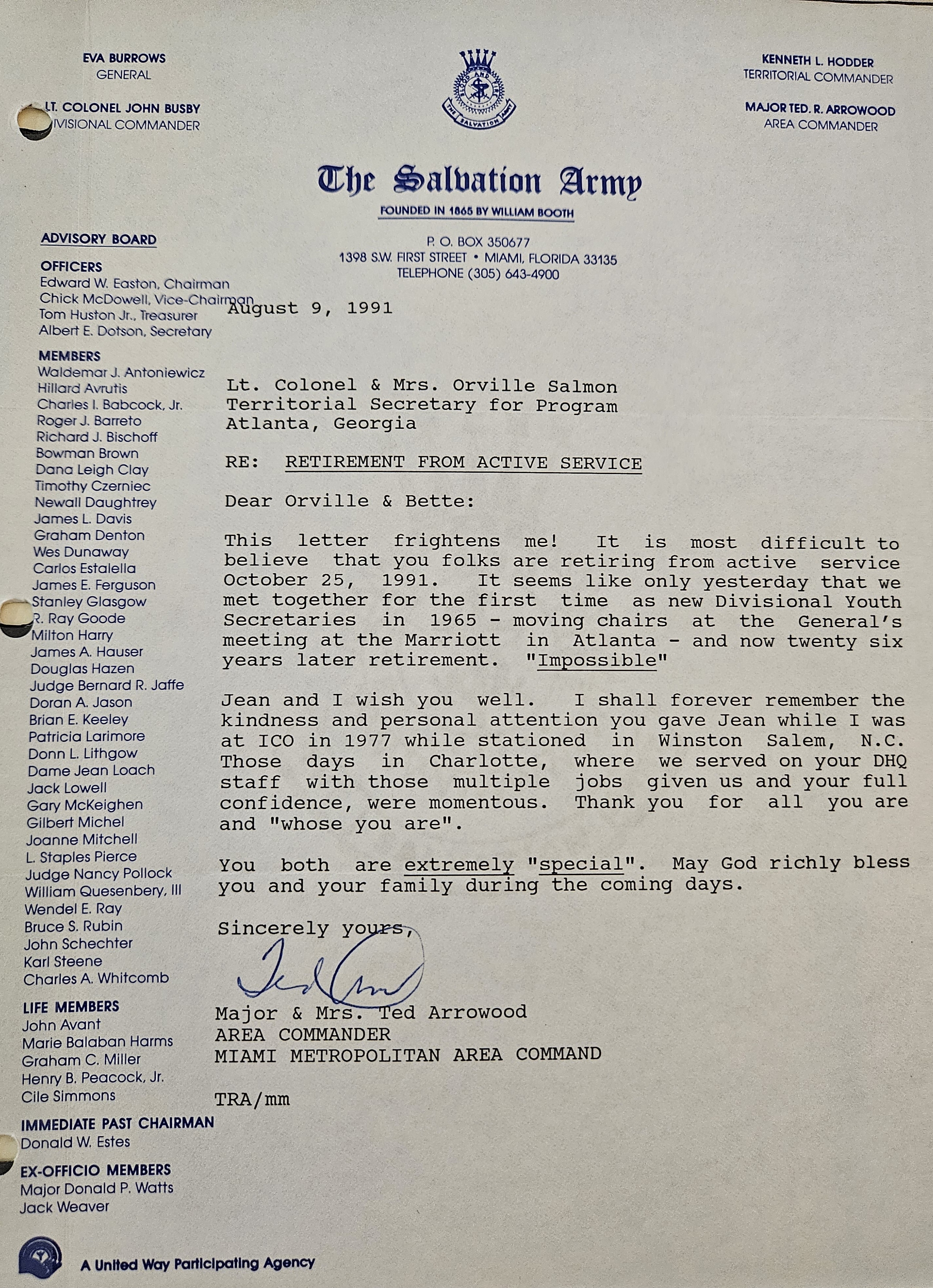
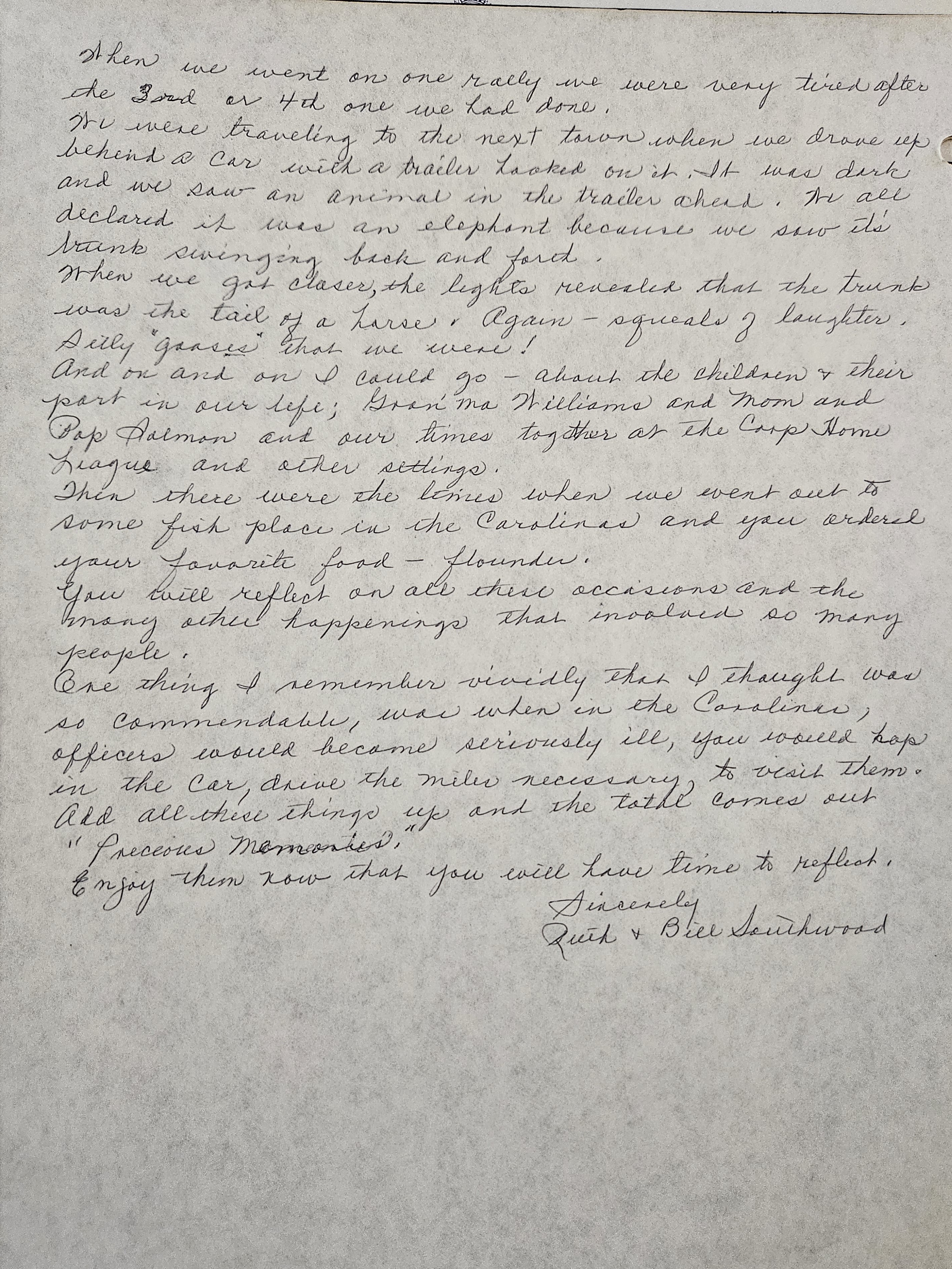
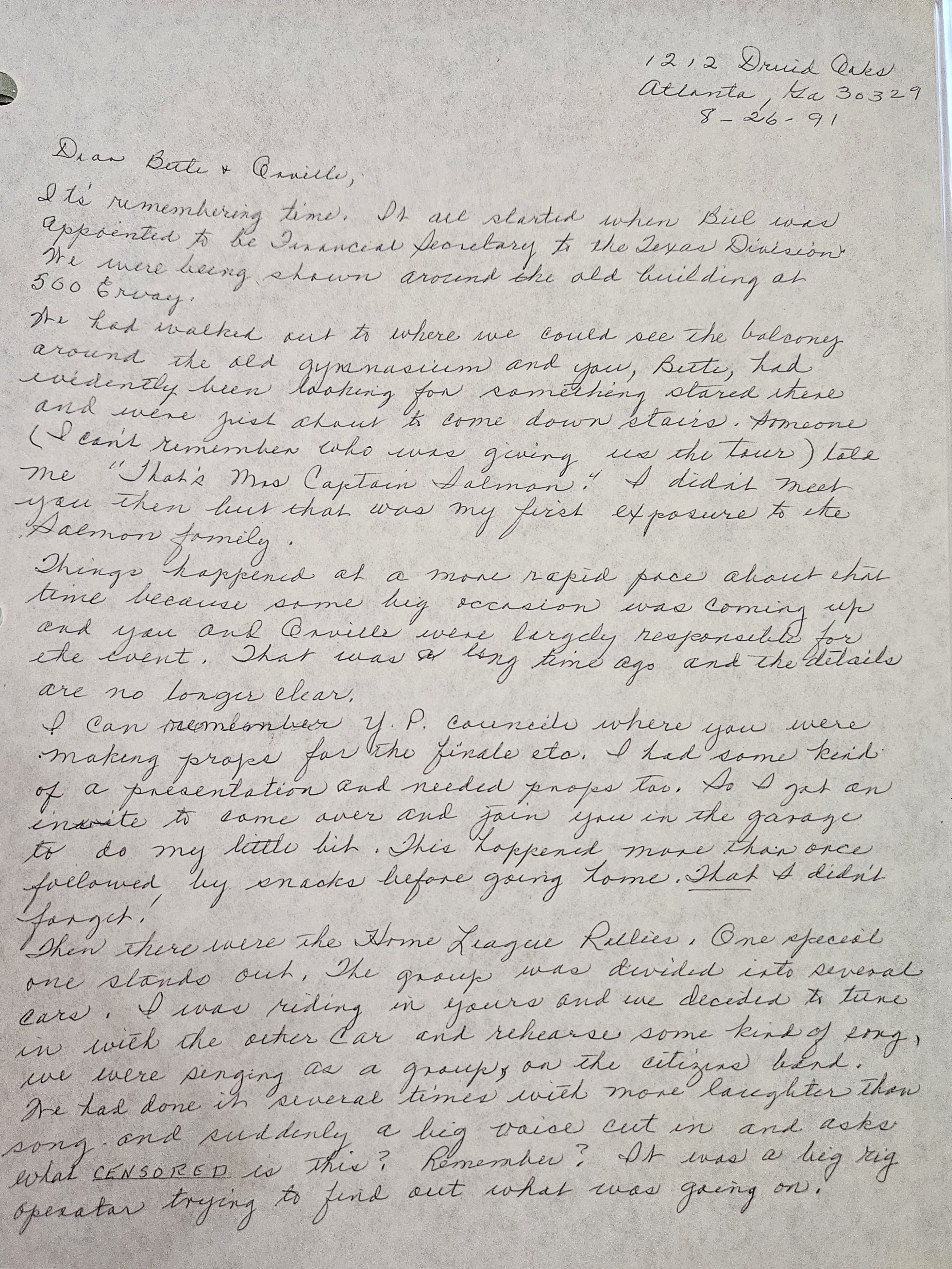
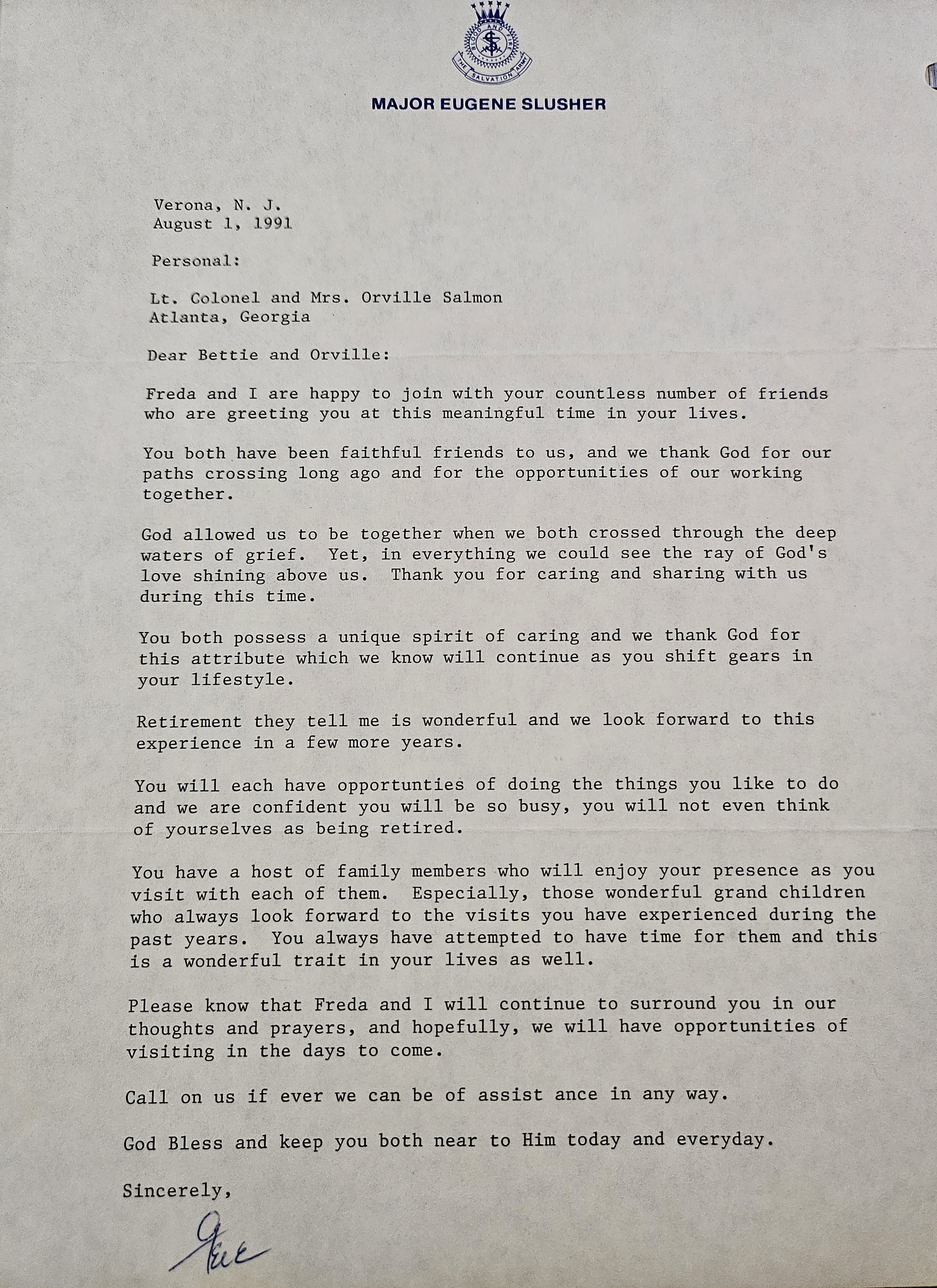
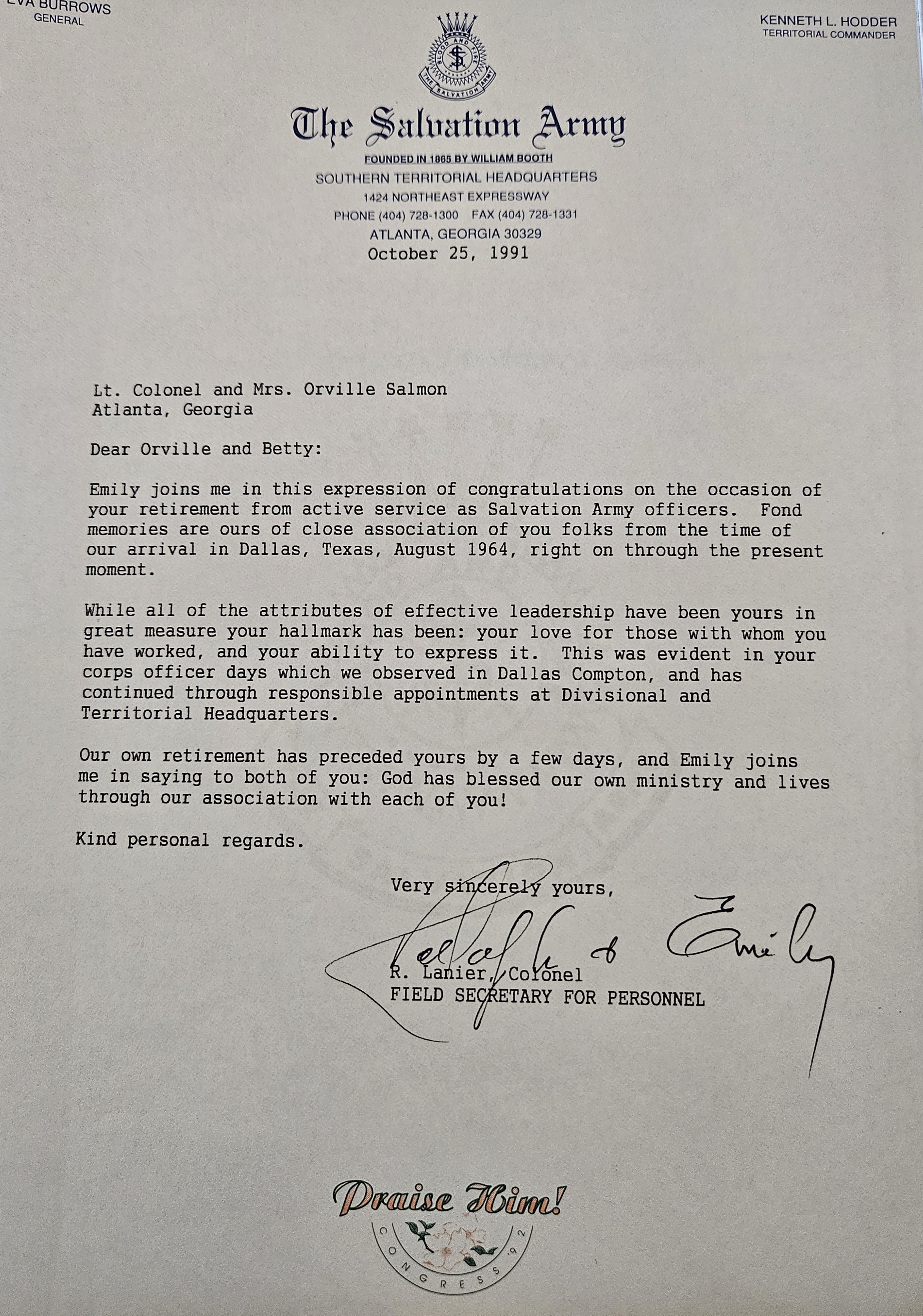
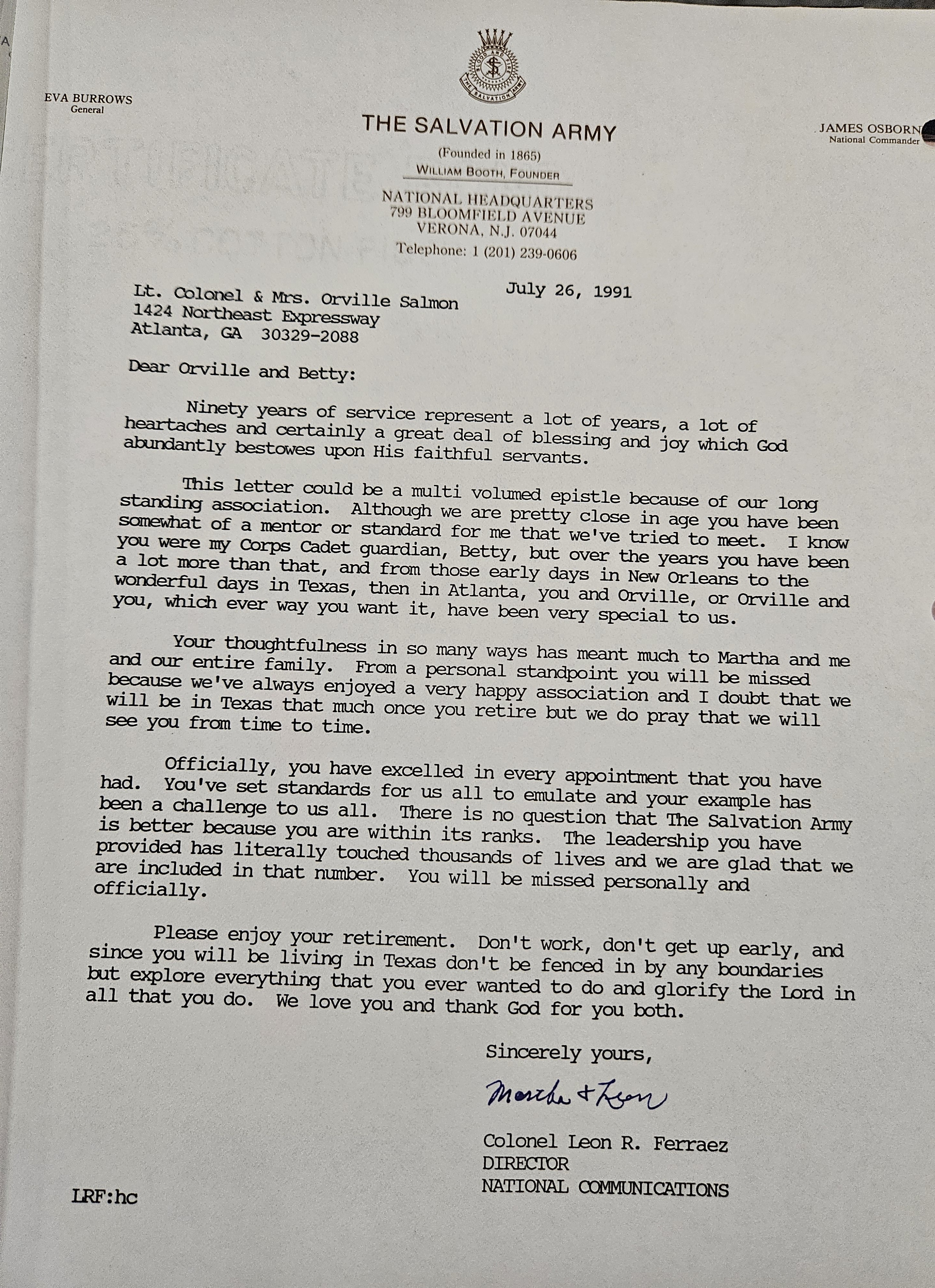
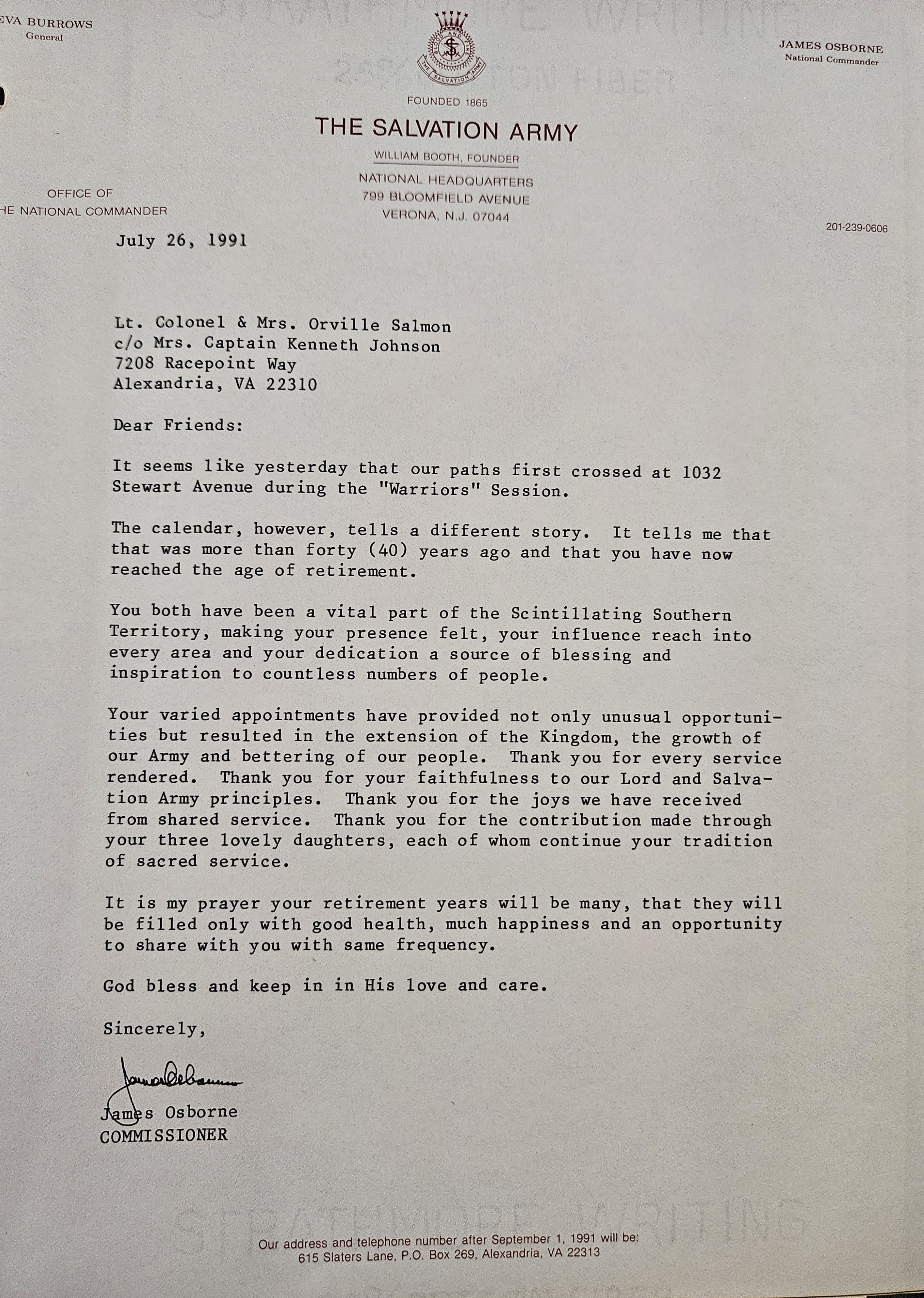
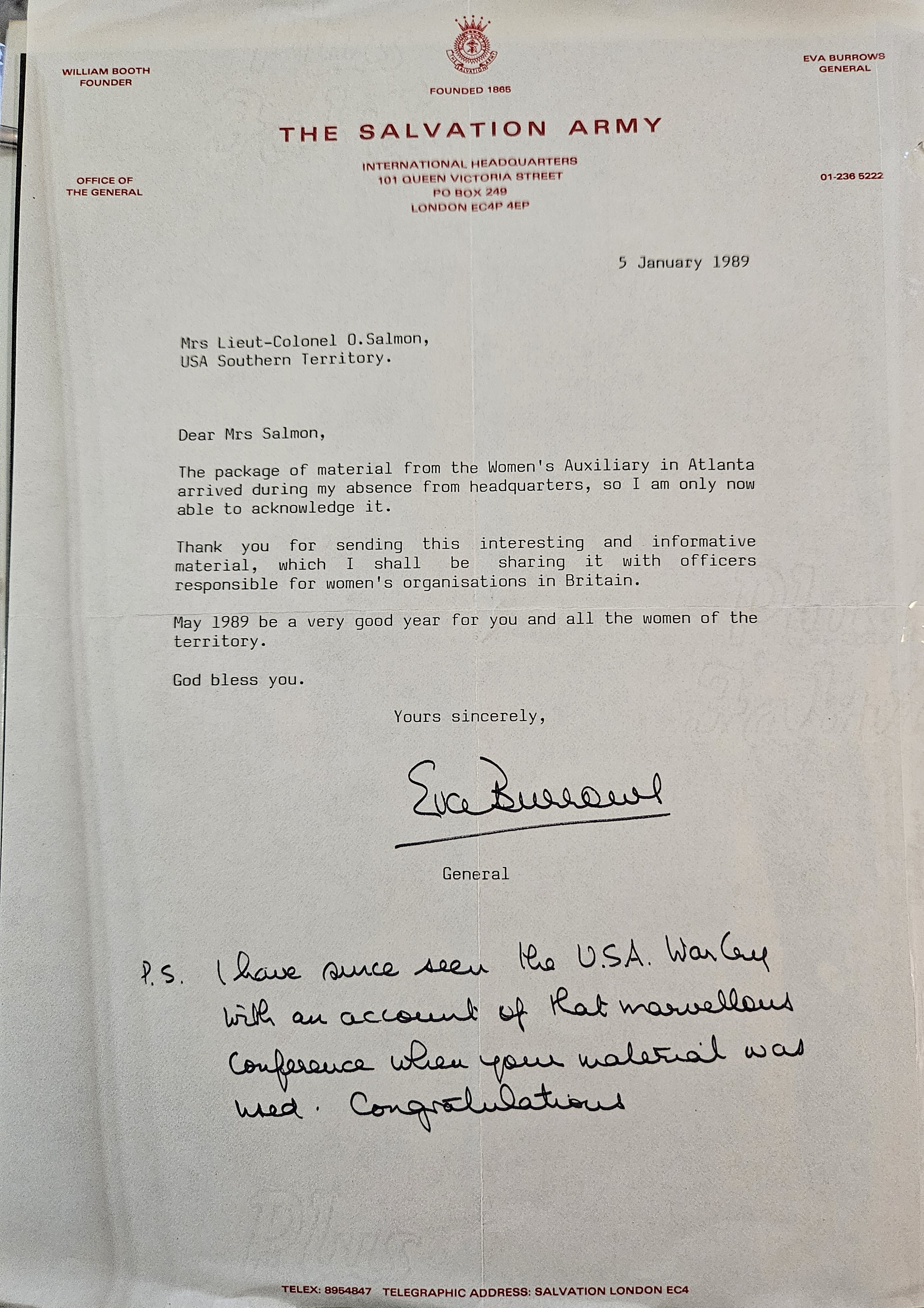
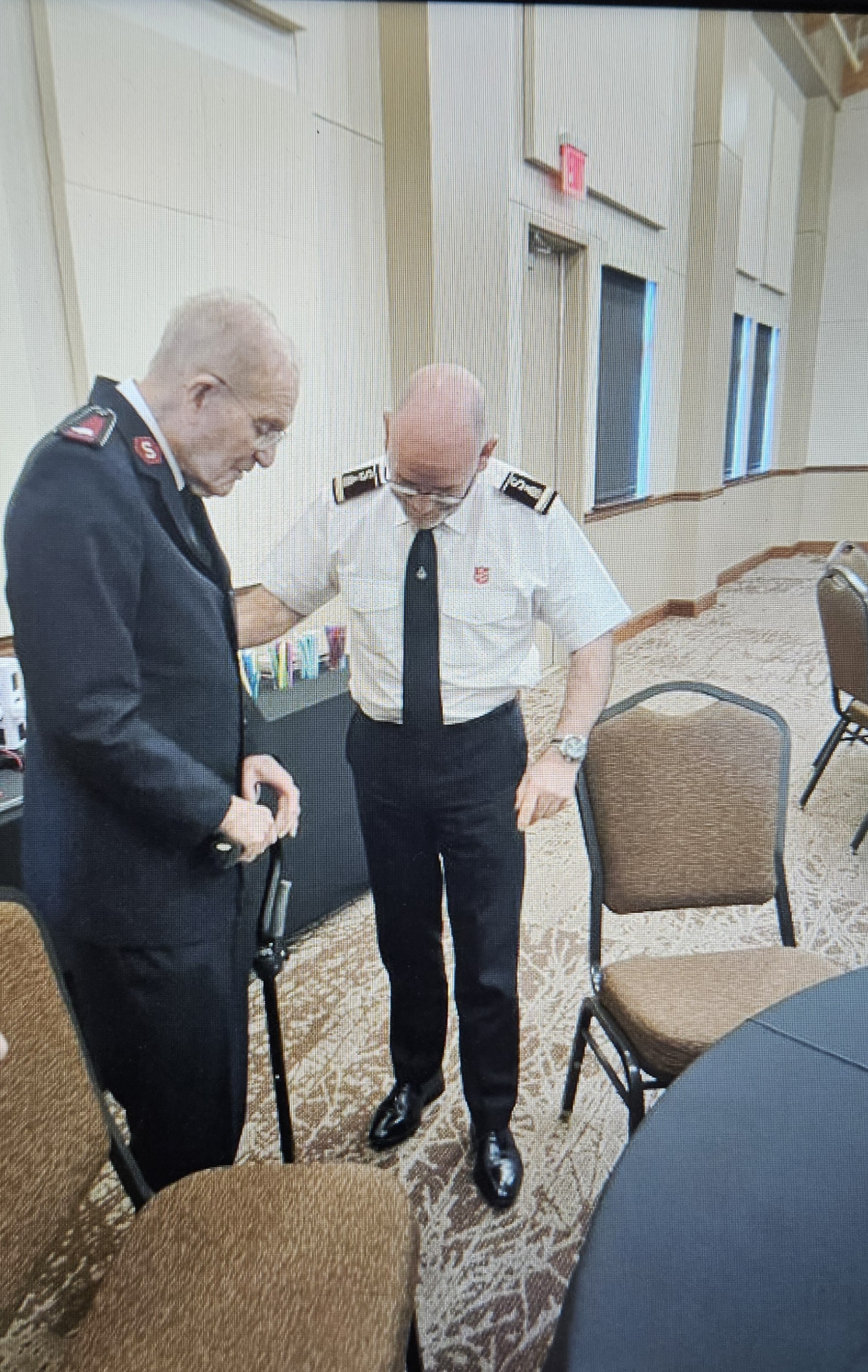
Lt. Colonels Orville and Bette Salmon were prominent leaders in The Salvation Army with a service history spanning nearly 50 years, particularly within the Texas Division and the Southern Territory.
Service History & Leadership
For the first nineteen years of their joint ministry, Orville and Bette Salmon served faithfully within the Texas Division, beginning with their inaugural appointment in Littlefield, Texas. Those early decades shaped their pastoral identity — hands‑on service, community engagement, and a shared commitment to meeting human needs in Christ’s name.
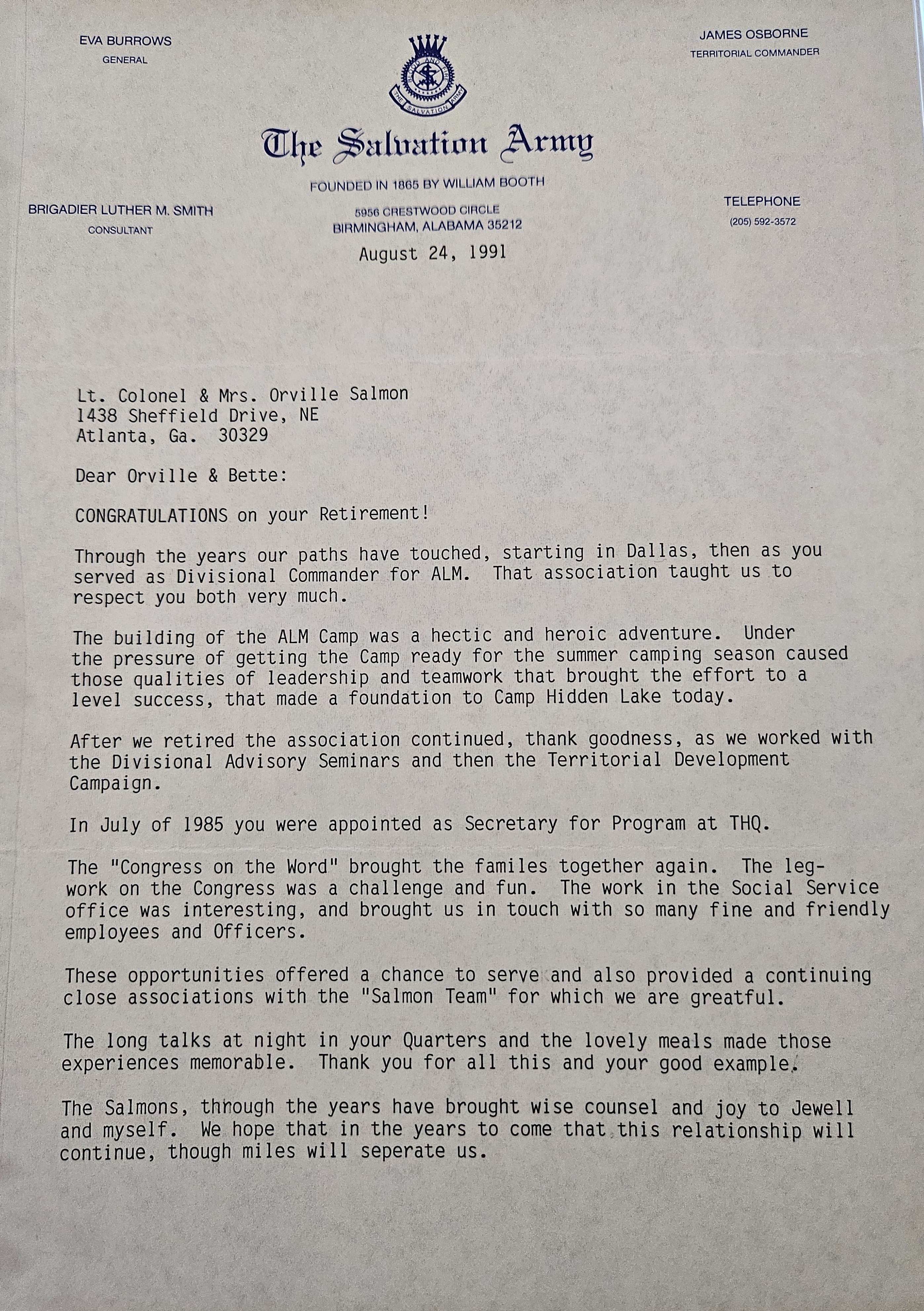
As their leadership gifts became evident, their responsibilities expanded across the Southern United States. They were appointed as divisional leaders for the Oklahoma–Arkansas Division beginning in 1973, and later for the North–South Carolina (NSC) and Alabama–Louisiana–Mississippi (ALM) divisions. In each assignment, they strengthened corps, supported officers, and guided the Army’s mission across diverse communities and cultures.
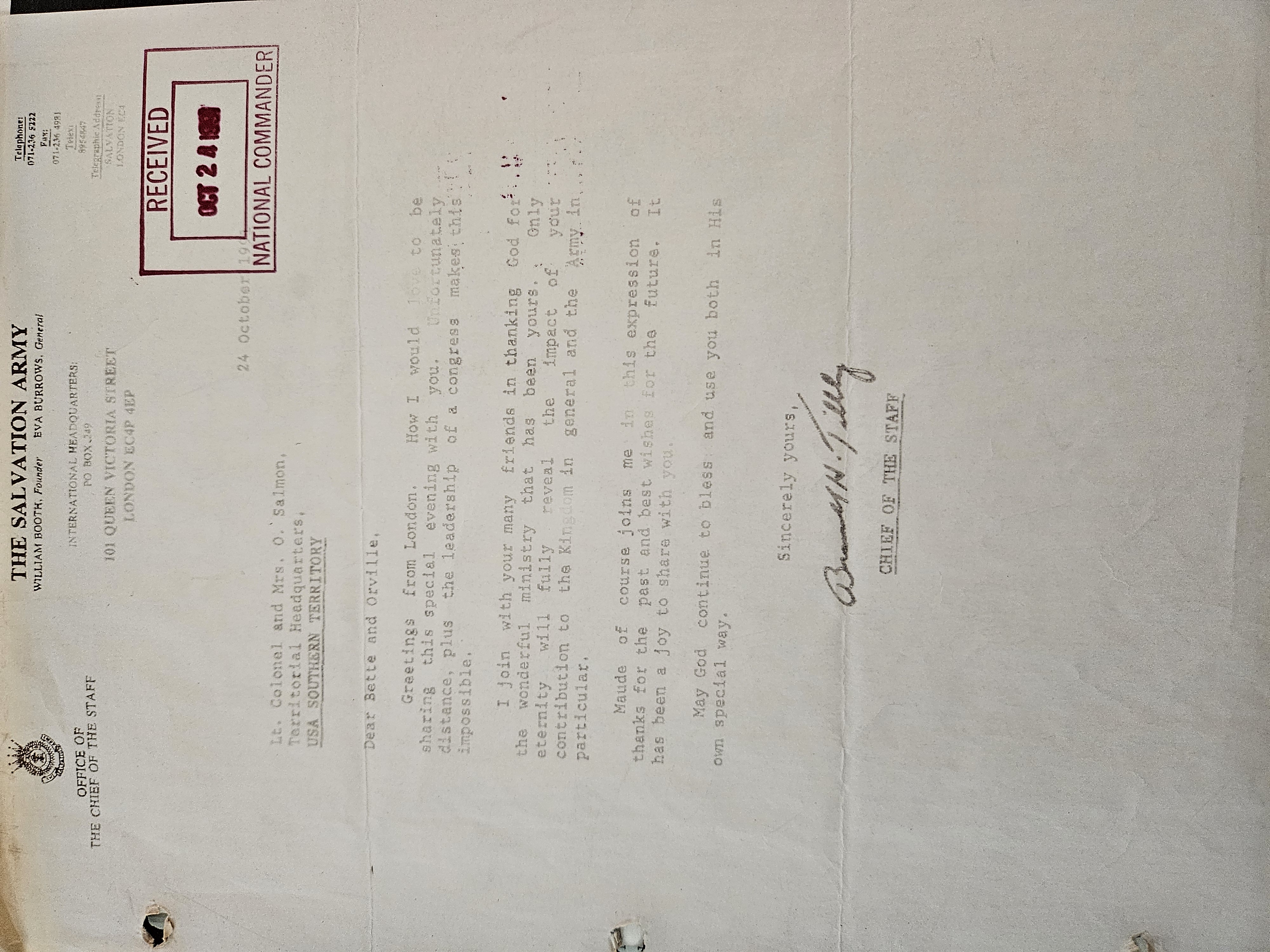
In 1985, their ministry reached its widest scope when they were appointed to the Southern Territorial Headquarters. There, Bette served as the Women’s Auxiliary Secretary and Territorial League of Mercy Secretary, continuing her lifelong work of compassion and visitation. Orville served as the Territorial Program Secretary, overseeing the broad sweep of programs designed to meet physical, emotional, and spiritual needs throughout the Southern Territory.
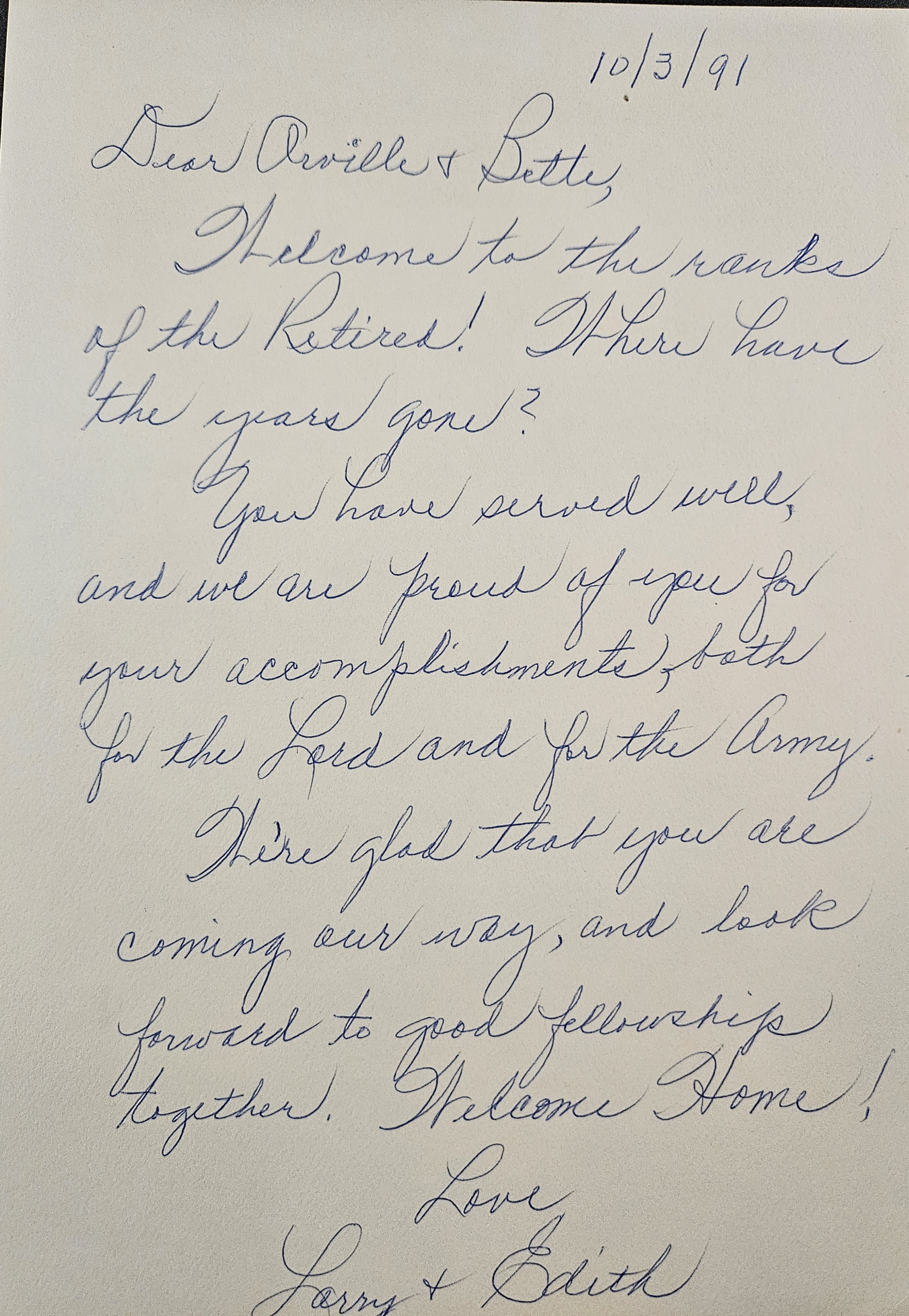
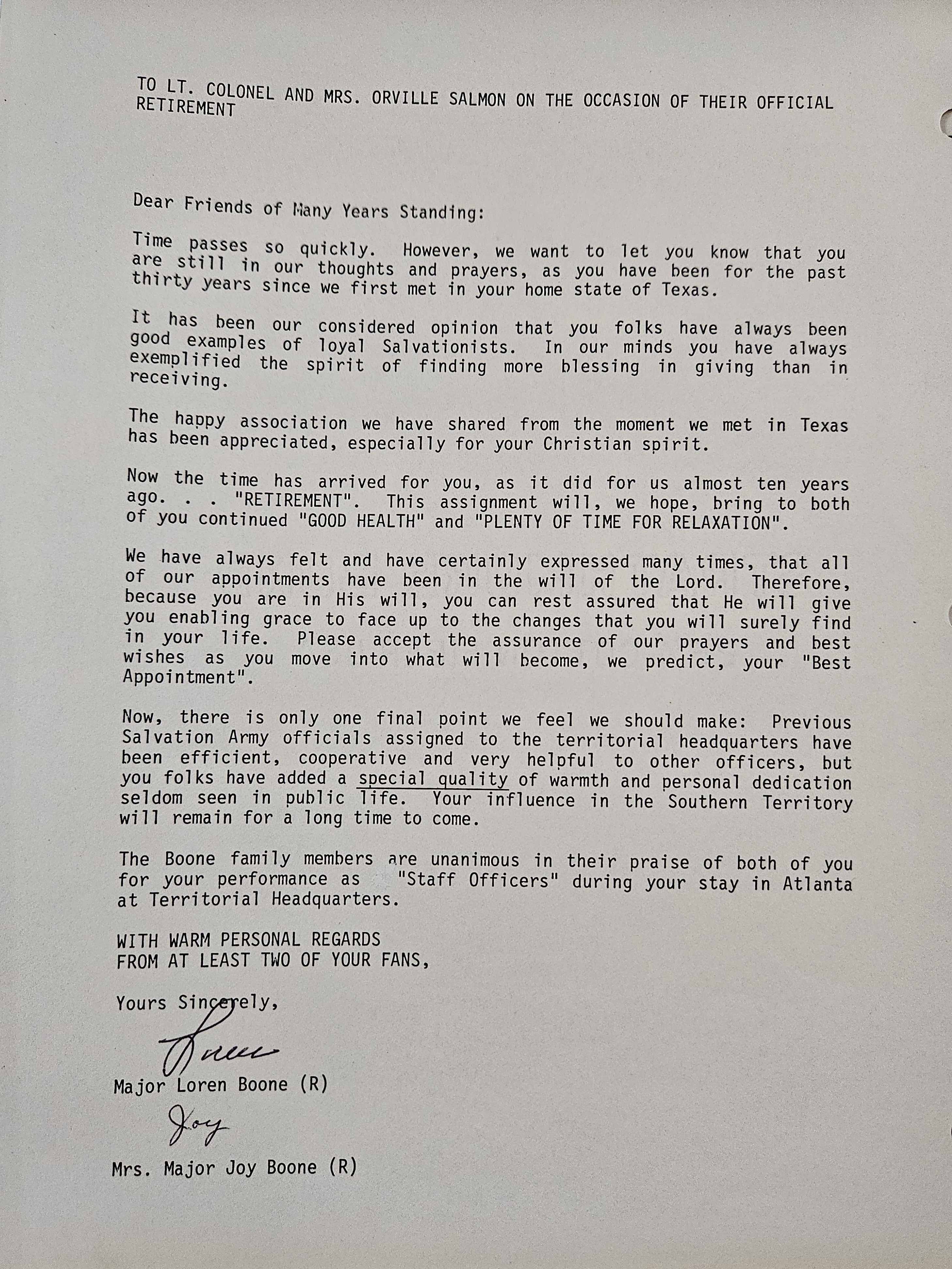
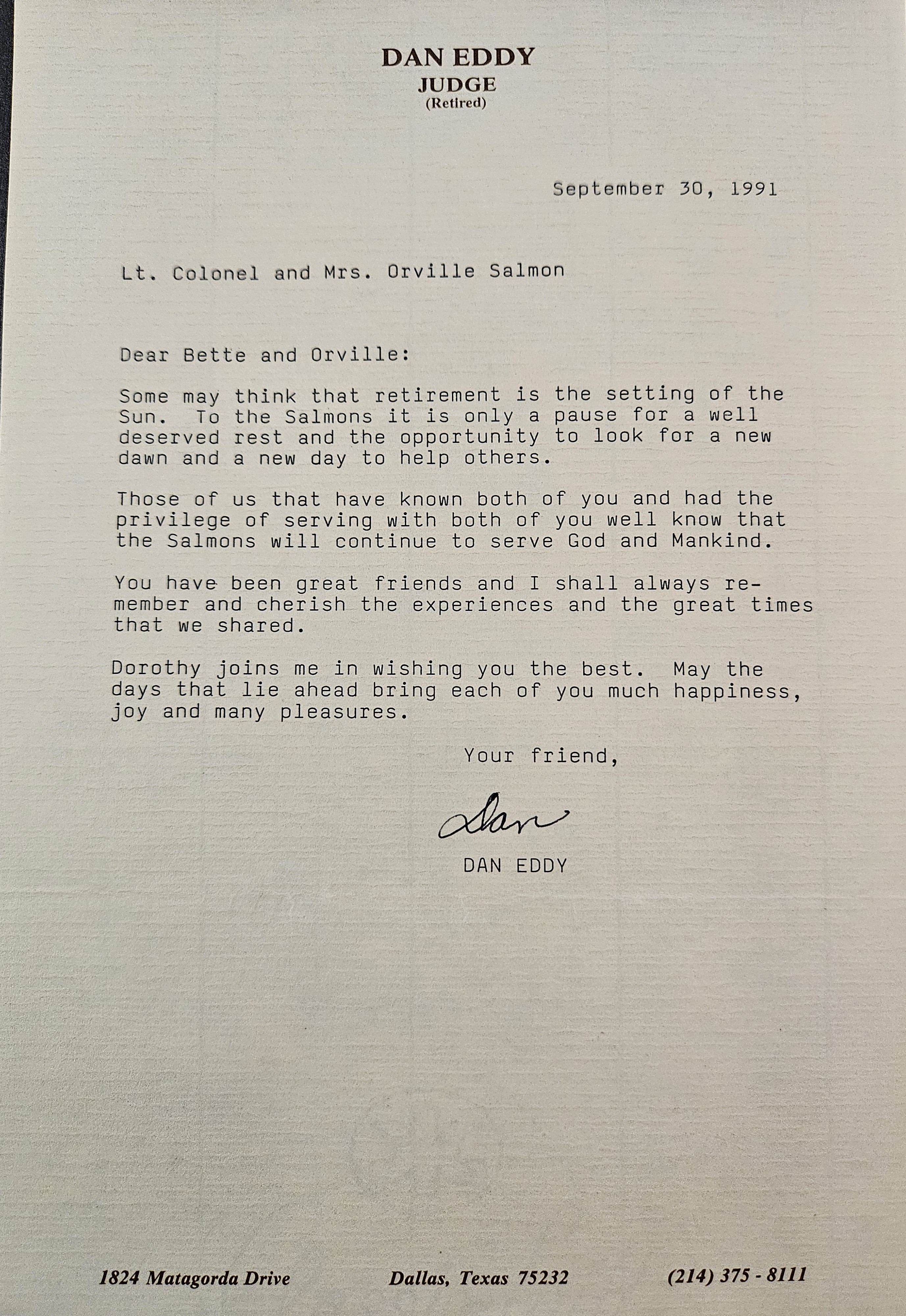
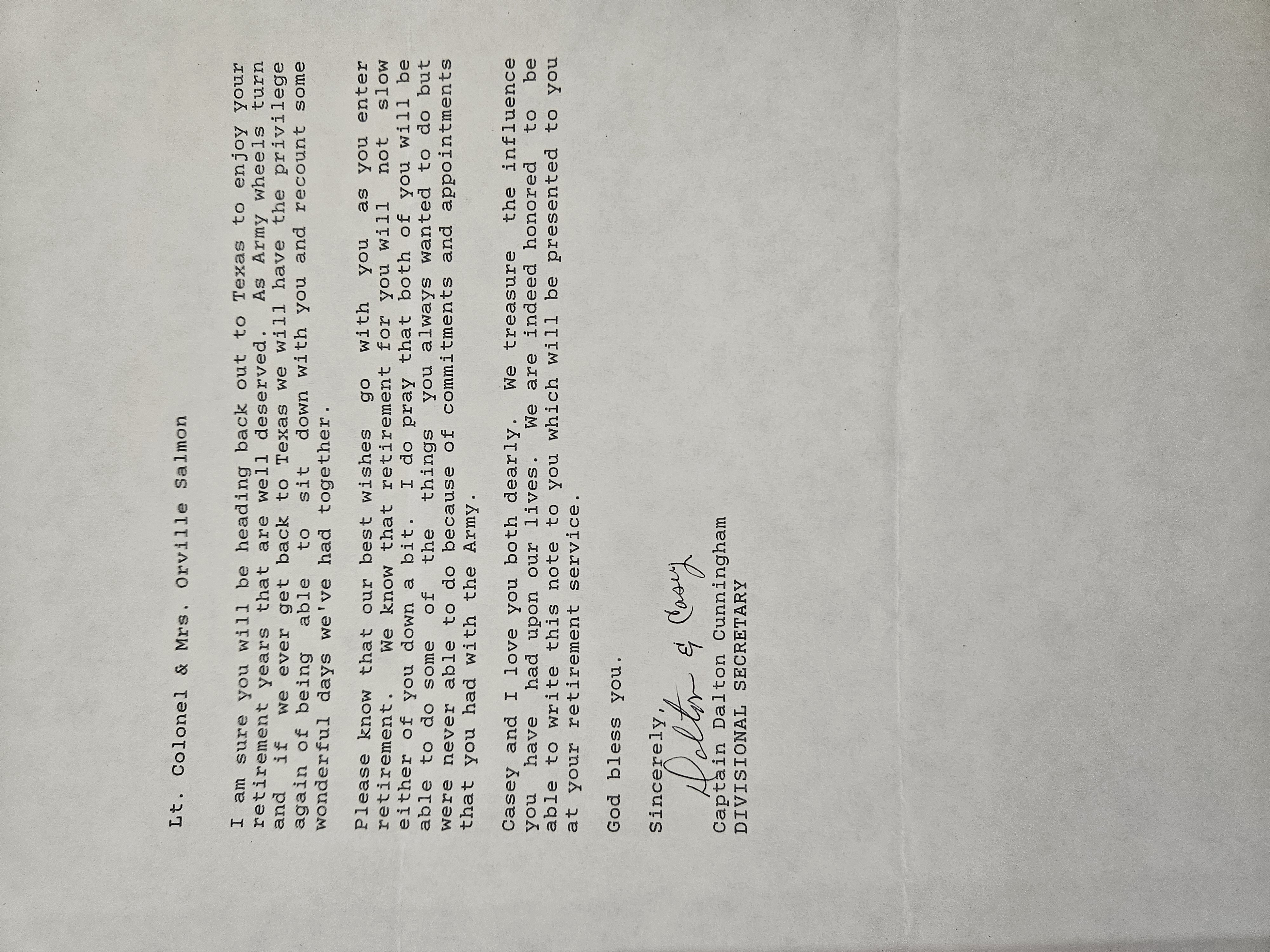
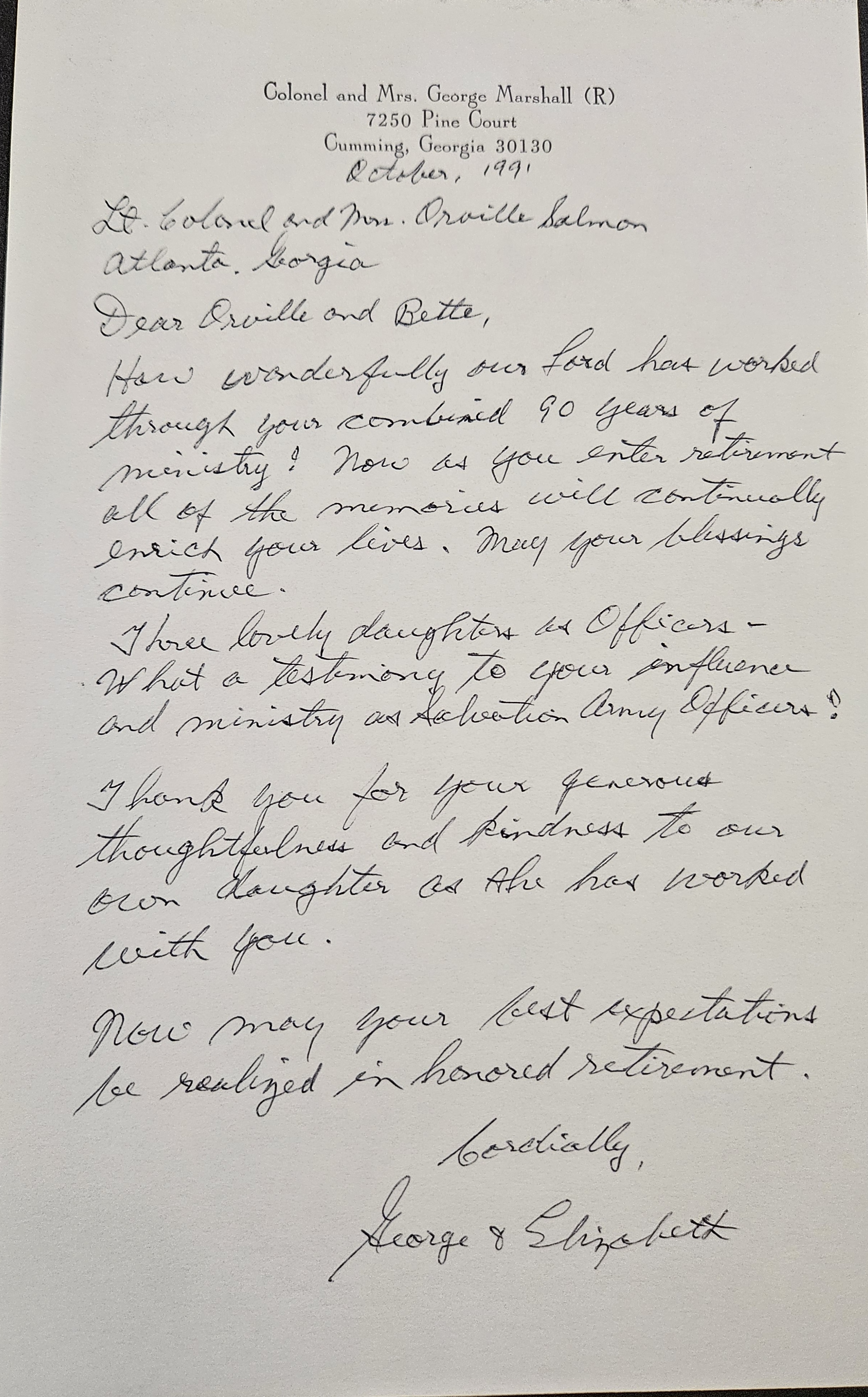
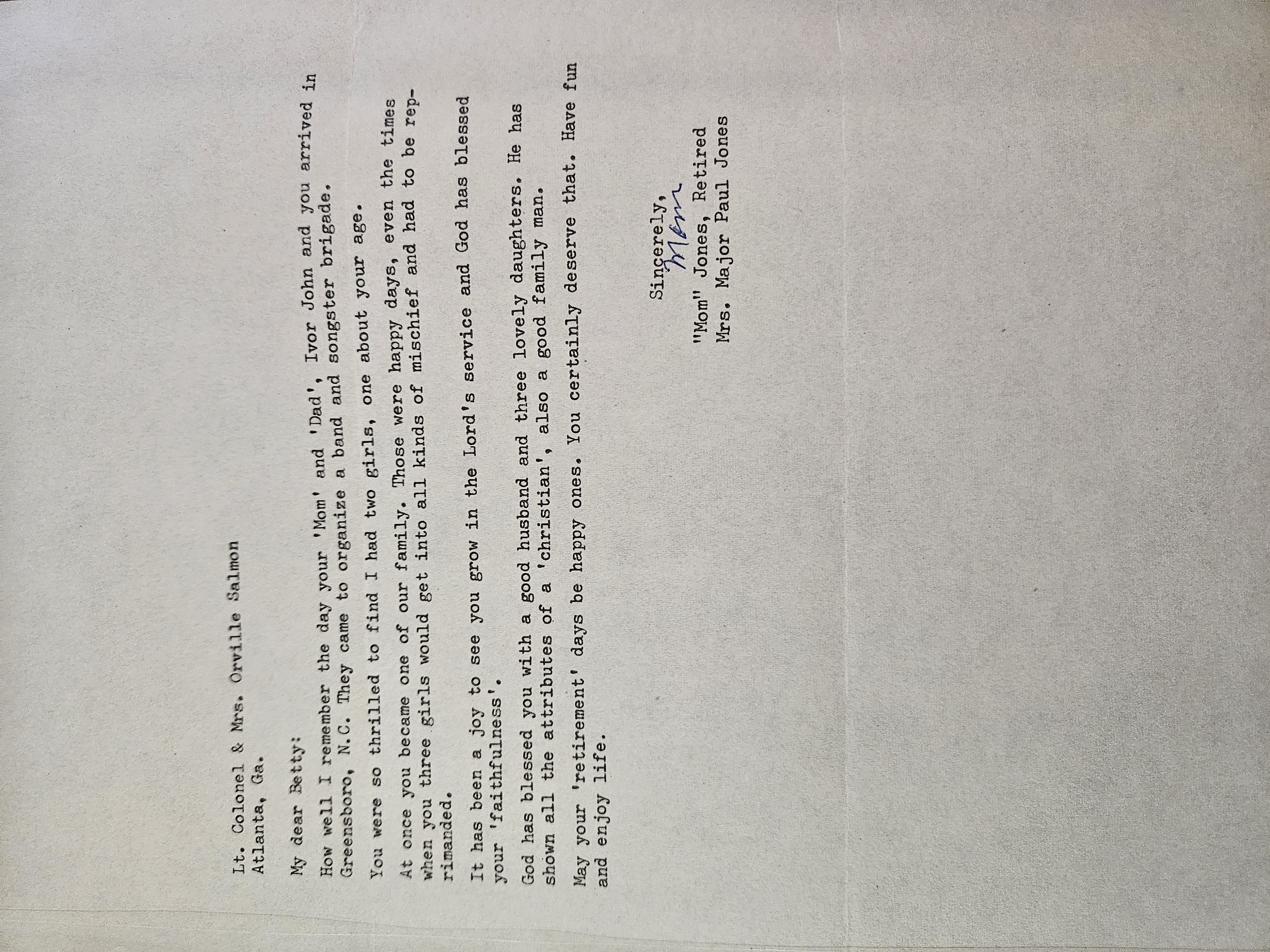
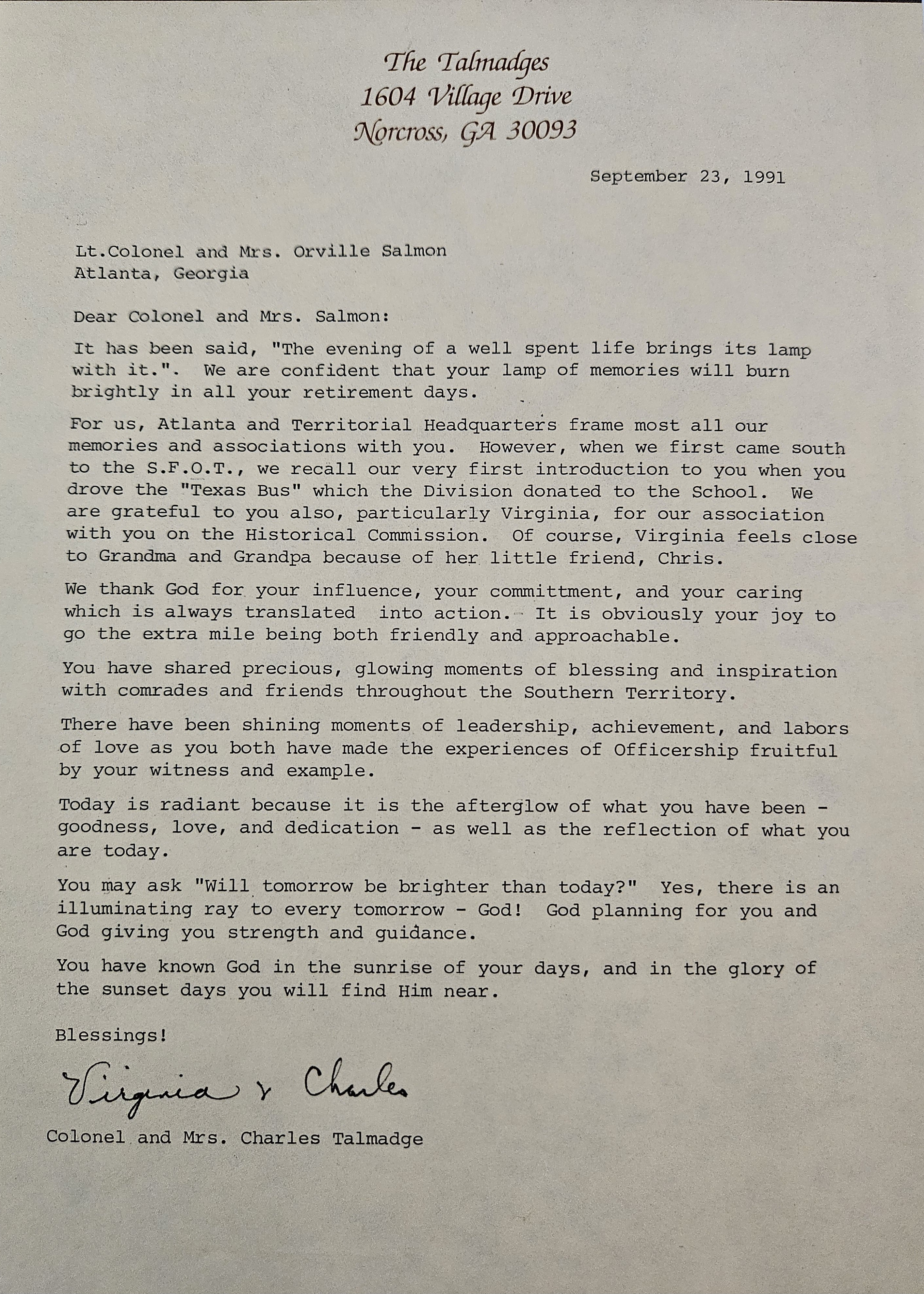
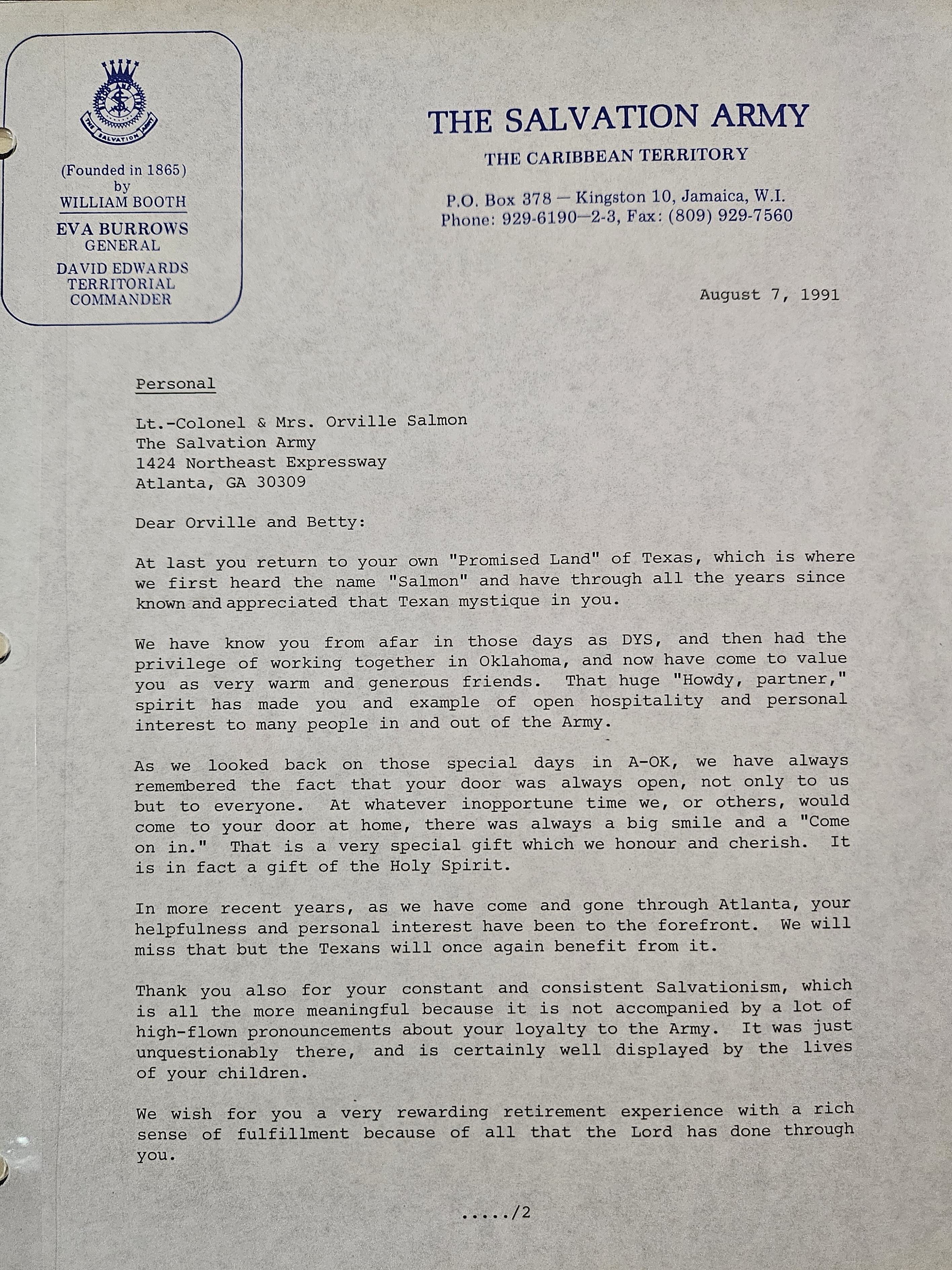
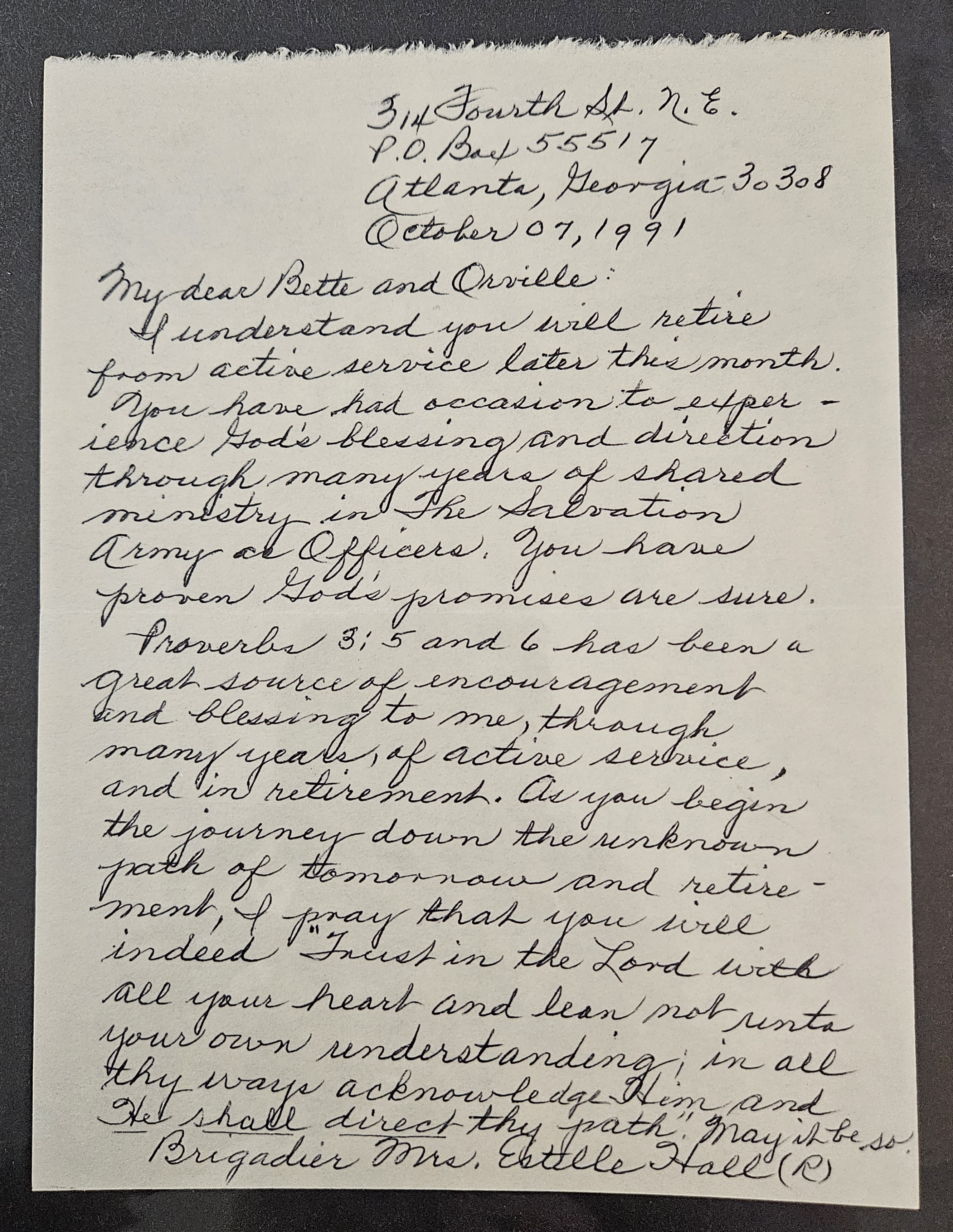
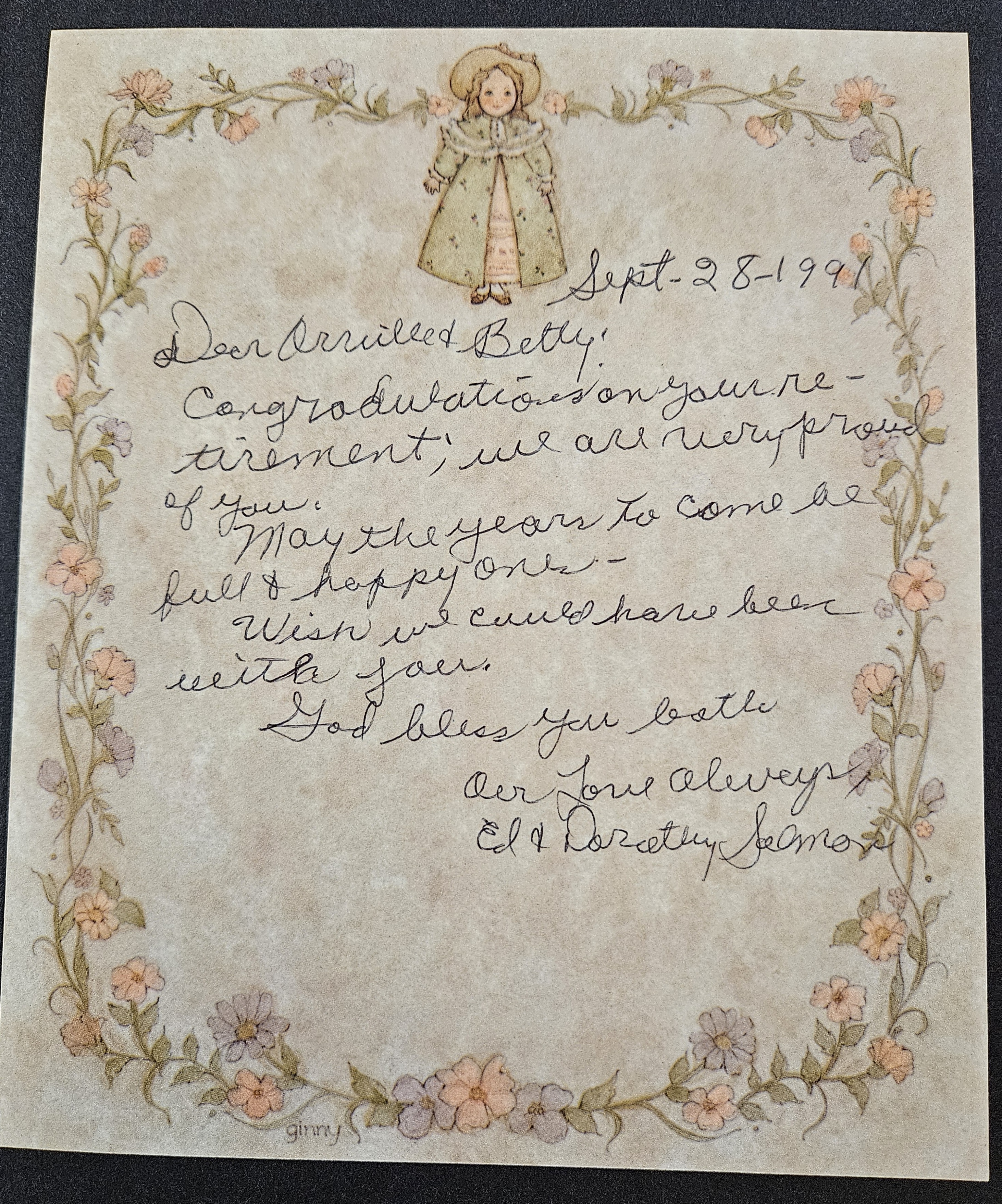
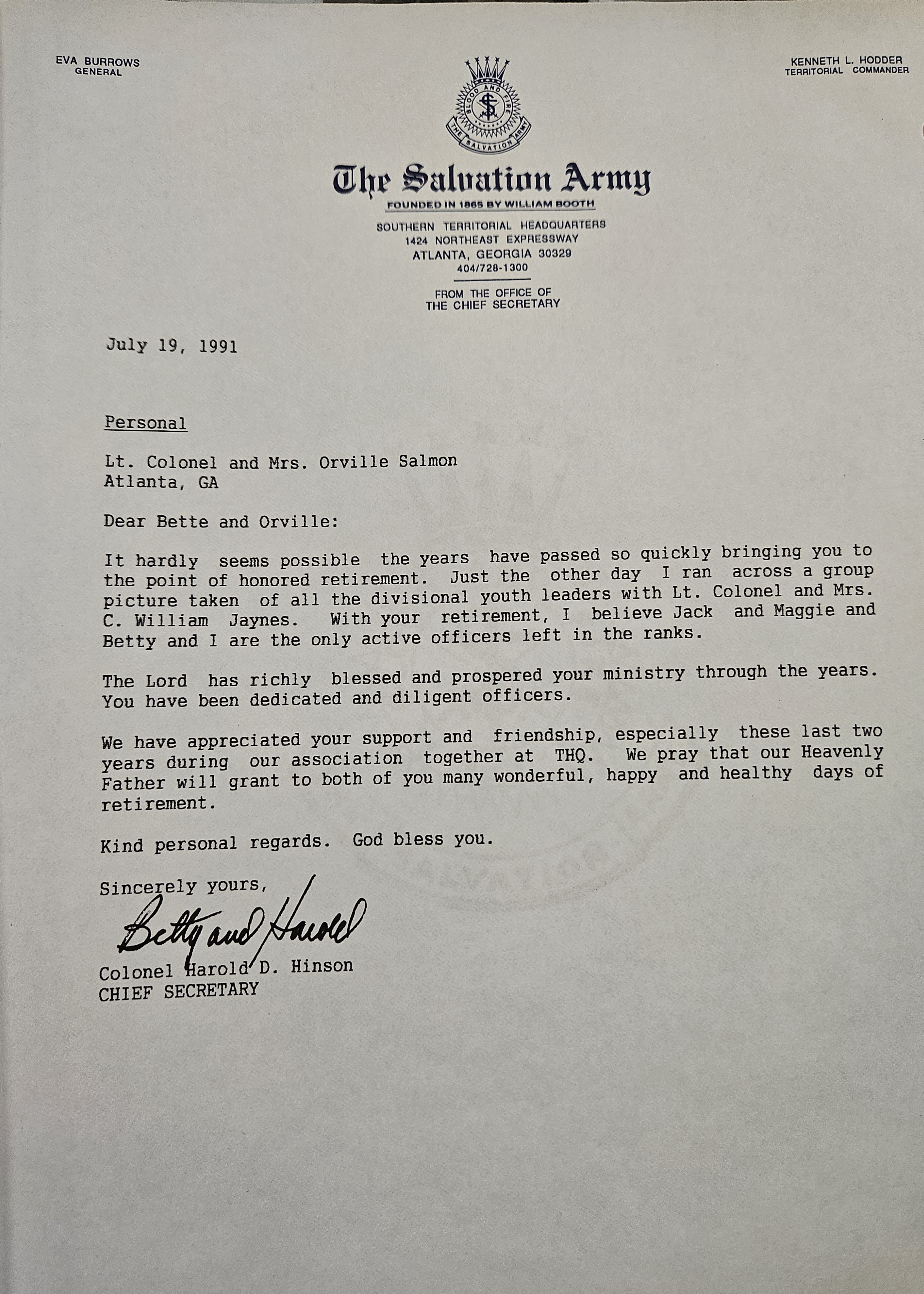
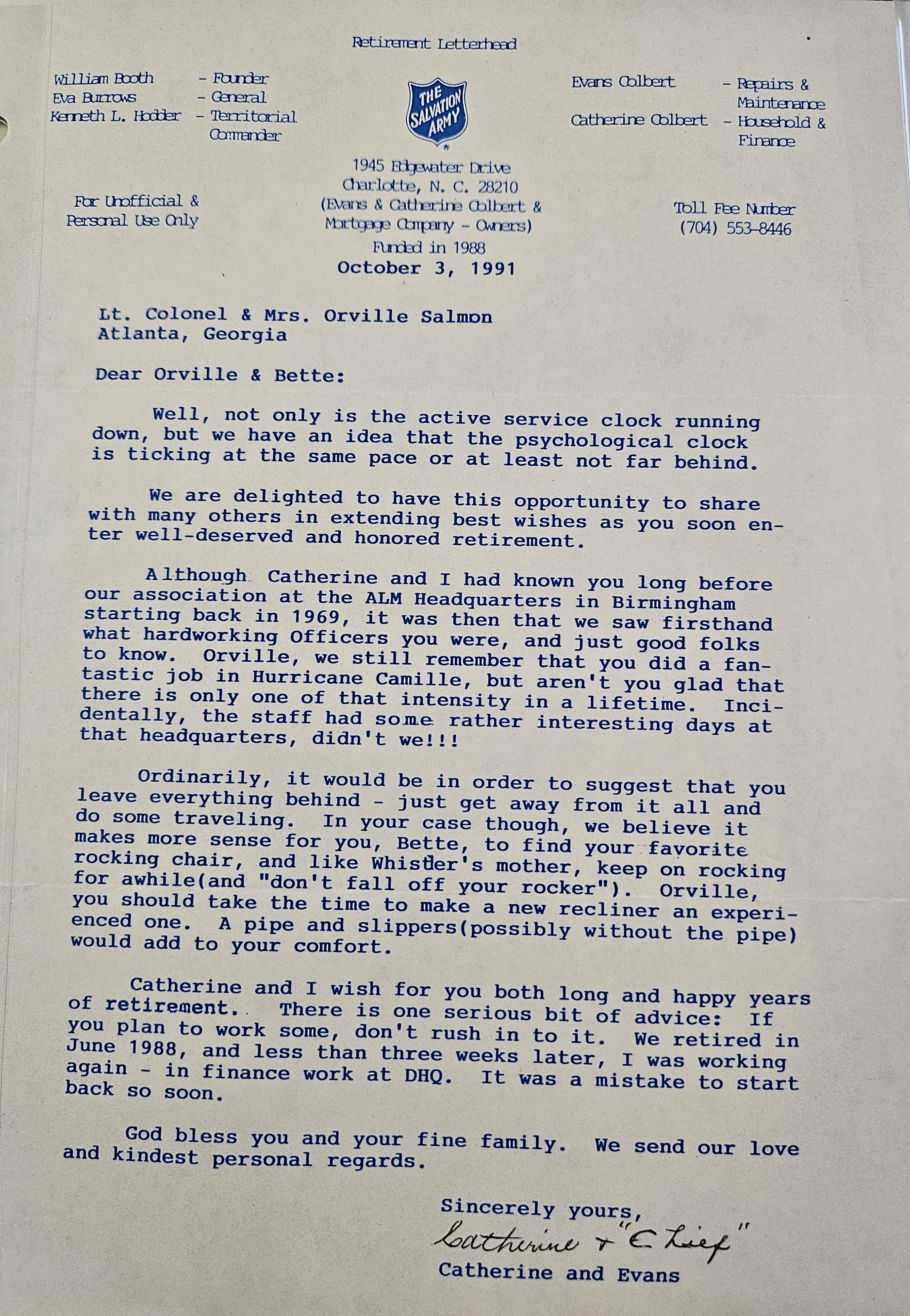
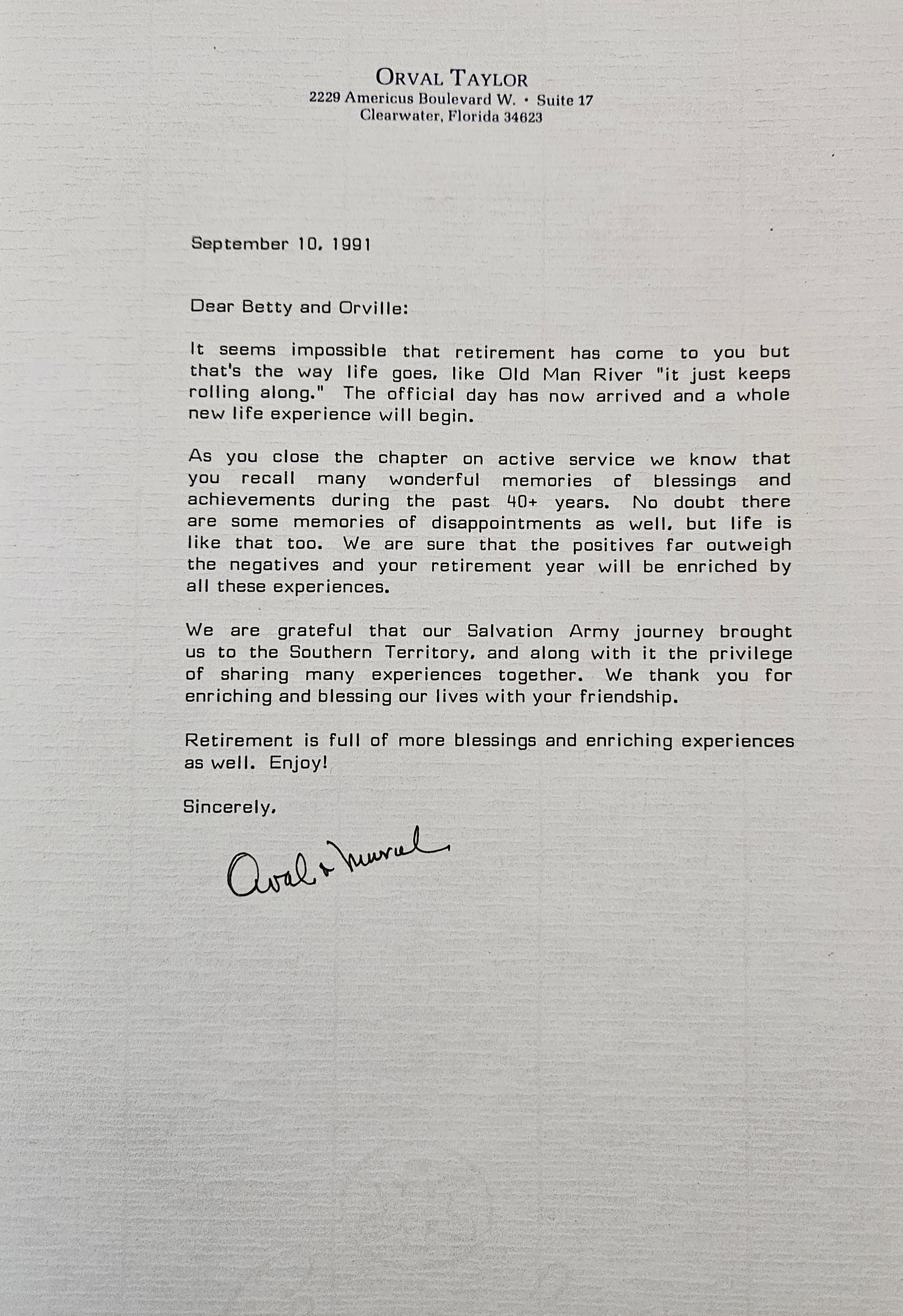
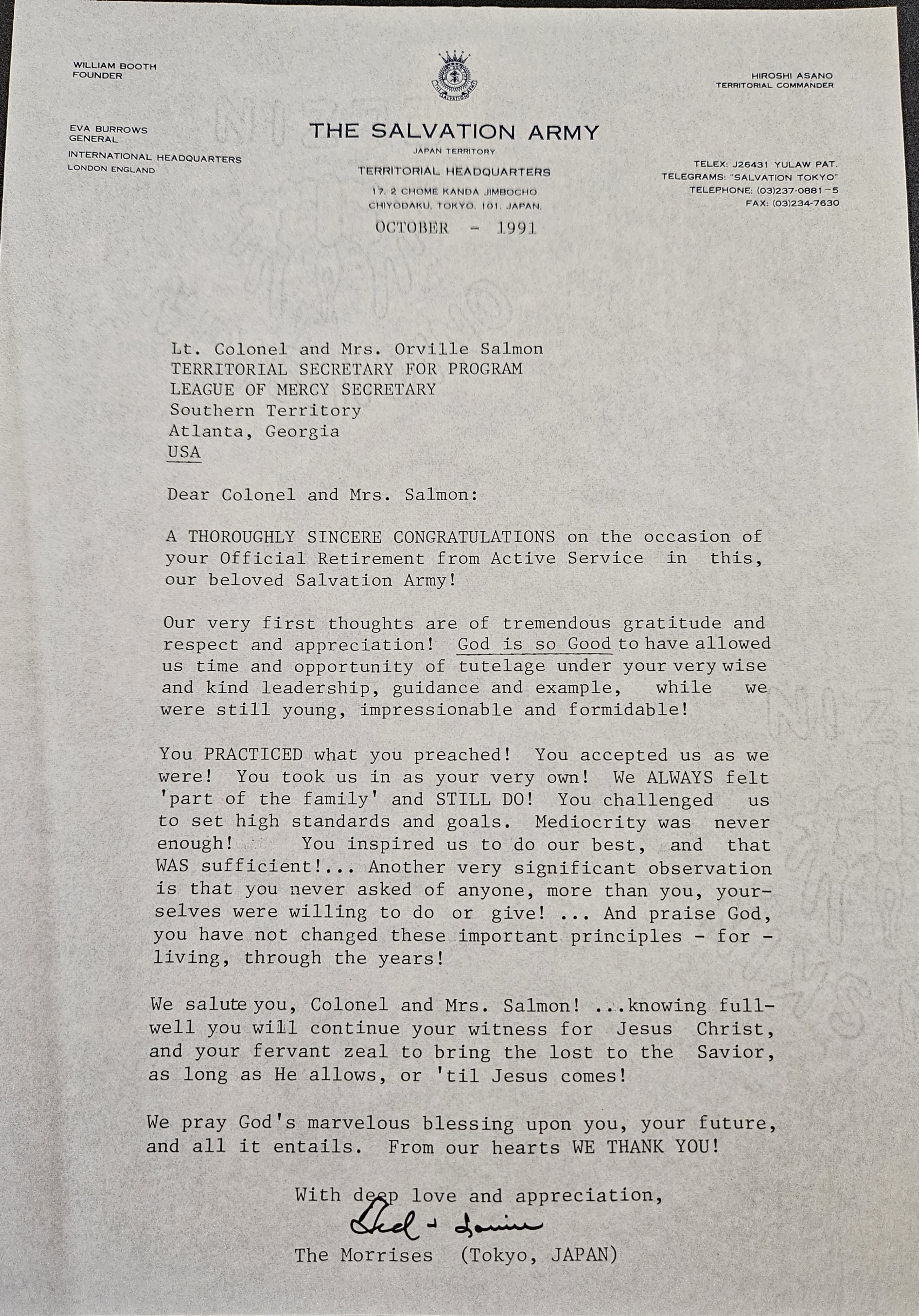
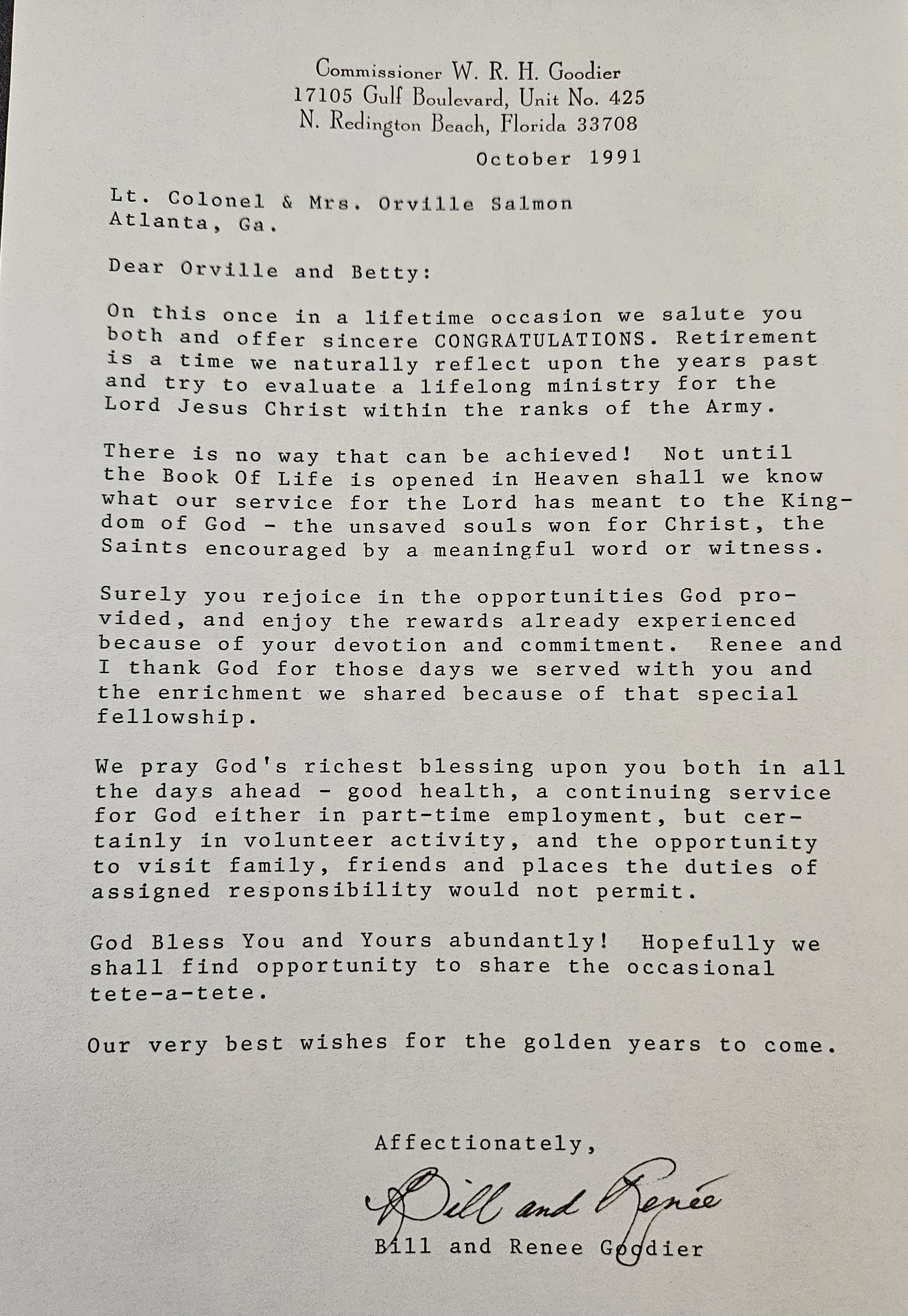
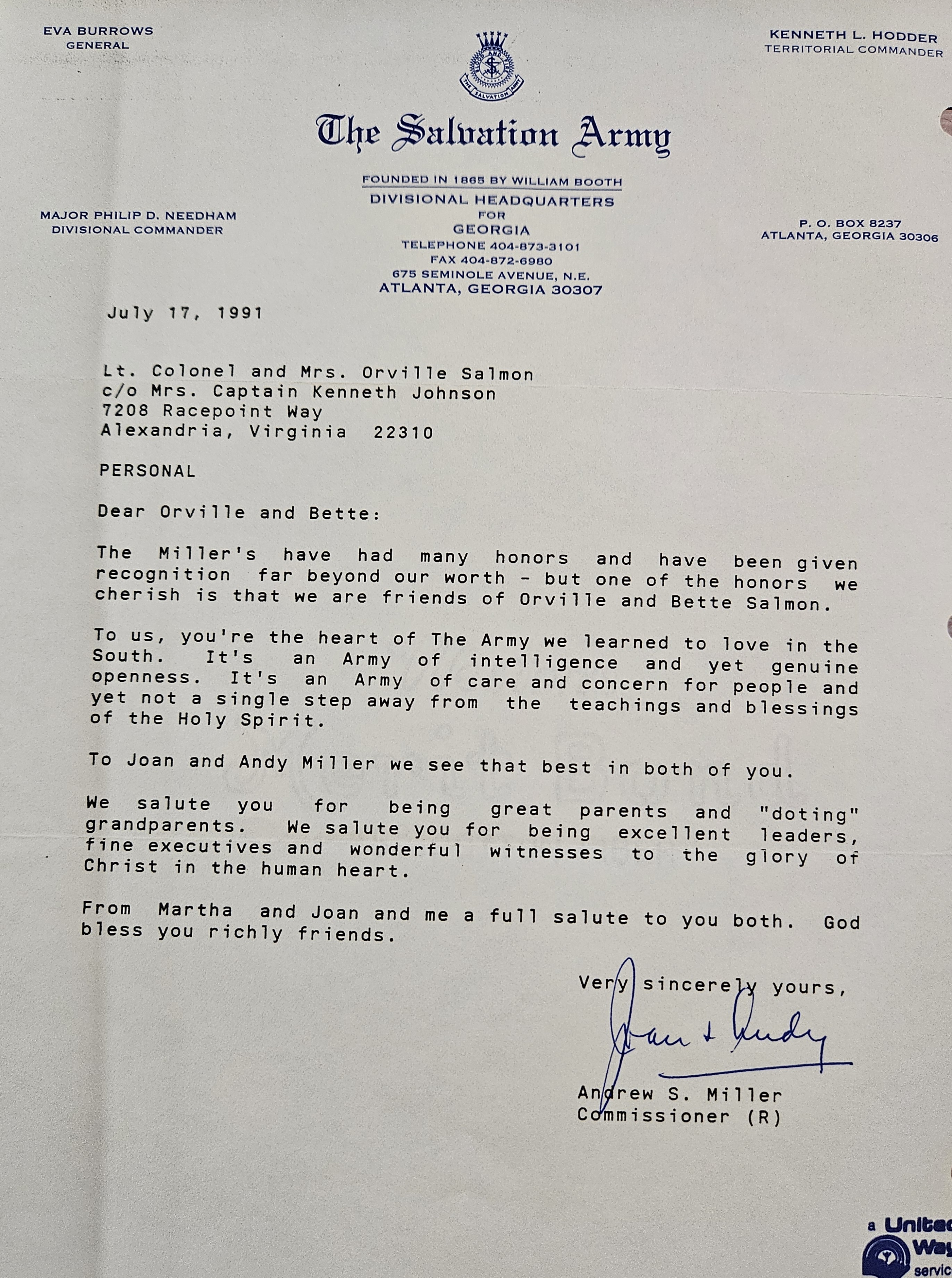
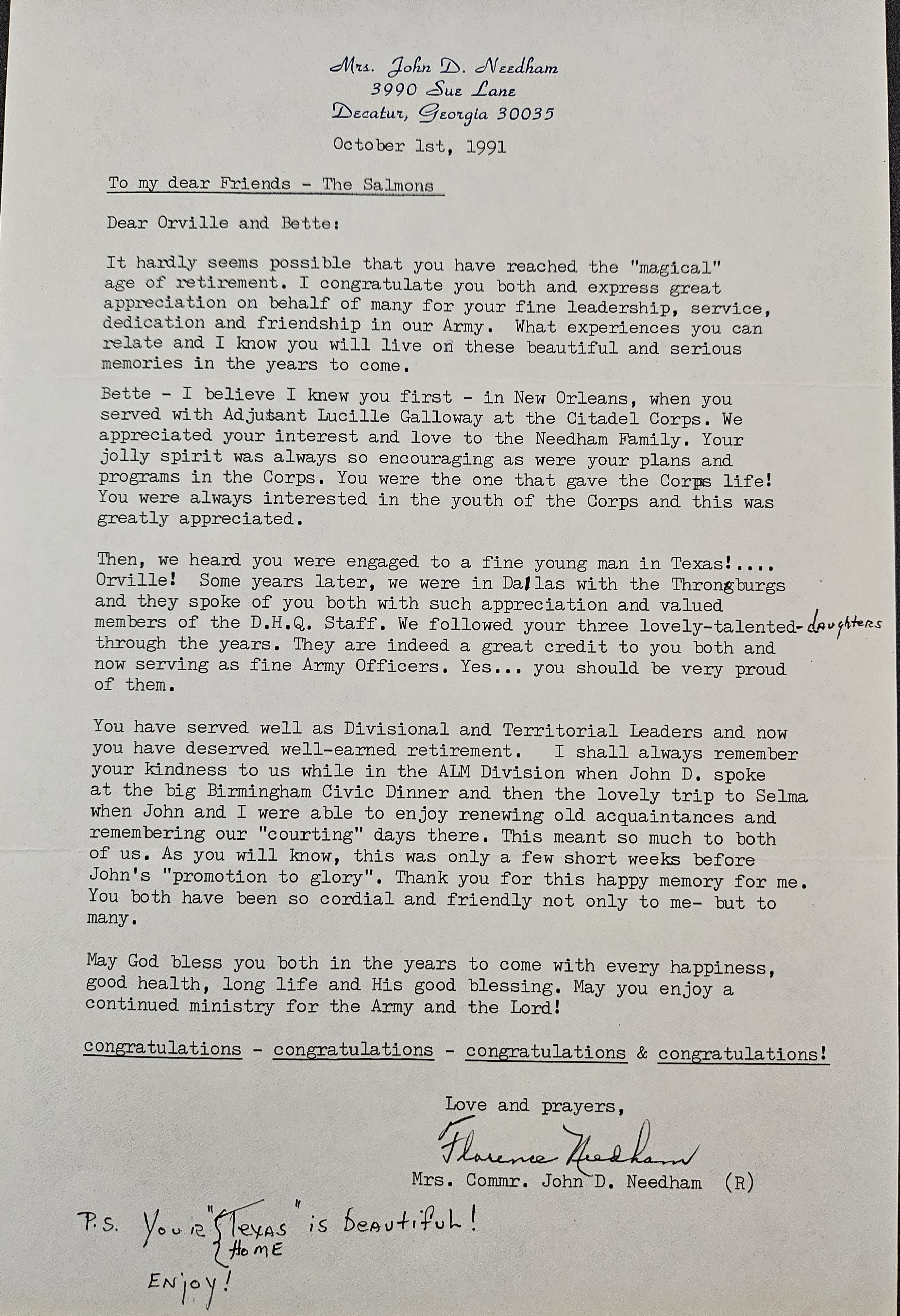
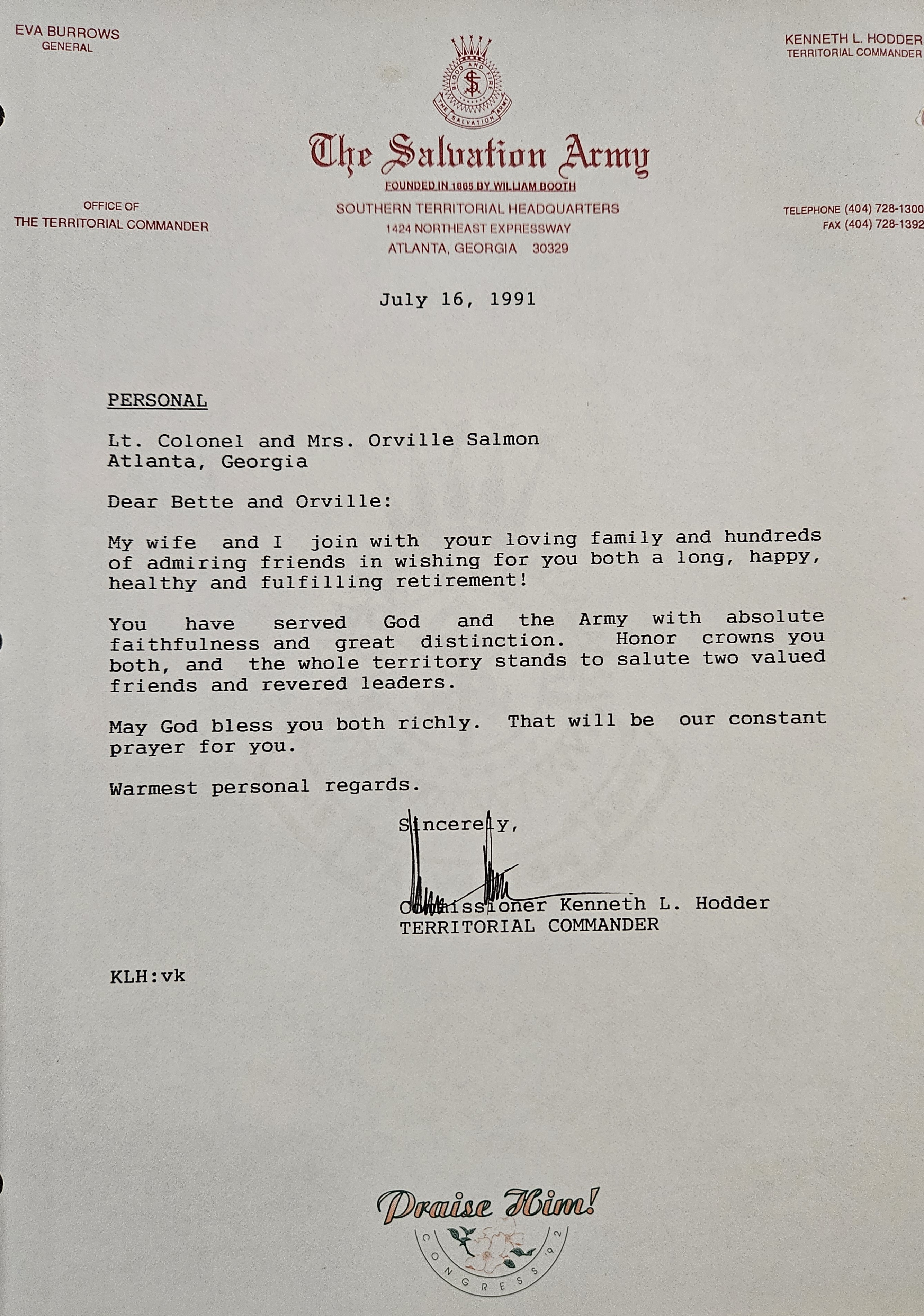
After decades of service — including leading several educational tours of the Holy Land that enriched the faith of hundreds — the Salmons retired on October 31, 1991. Their retirement marked the close of a remarkable chapter of leadership, partnership, and unwavering devotion to the mission of The Salvation Army.
Who He Helped
Across his long career as a Salvation Army officer — and later as Territorial Program Secretary at the Southern Territorial Headquarters — Lt. Colonel Orville Salmon devoted his life to meeting human needs with both compassion and clarity of purpose. His influence touched individuals, communities, and entire regions.
Local Communities In his early years of ministry, Orville served directly in towns such as Littlefield, Rockwall, and other Texas communities. There he offered hands‑on pastoral care, practical assistance, and steady support to families, seniors, and those facing hardship. His ministry was personal, relational, and rooted in presence.
Divisional Oversight As he stepped into broader leadership roles, Orville helped guide the Salvation Army’s mission across the Southeast. His work ensured that the poor, the hungry, and the destitute received both physical and spiritual care — food, shelter, counseling, and the hope of Christ. His leadership strengthened corps, empowered officers, and expanded the Army’s reach.
The League of Mercy While Bette faithfully led the League of Mercy — visiting hospitals, nursing homes, and those who felt forgotten — Orville’s role as Program Secretary placed him at the helm of large‑scale initiatives designed to “meet human needs” across the entire Southern Territory. Together, their ministries formed a seamless partnership of compassion: one personal, one organizational, both essential.
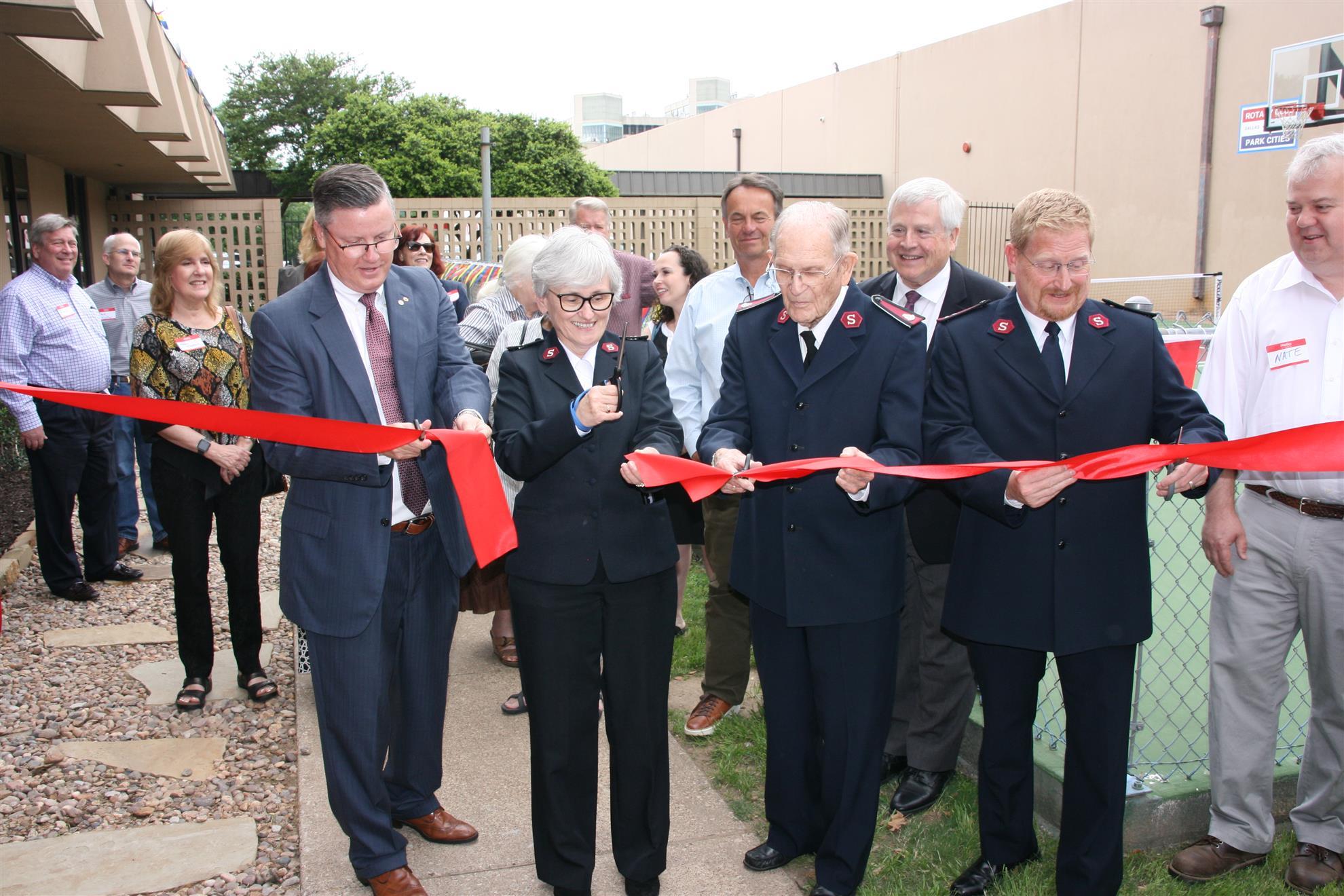
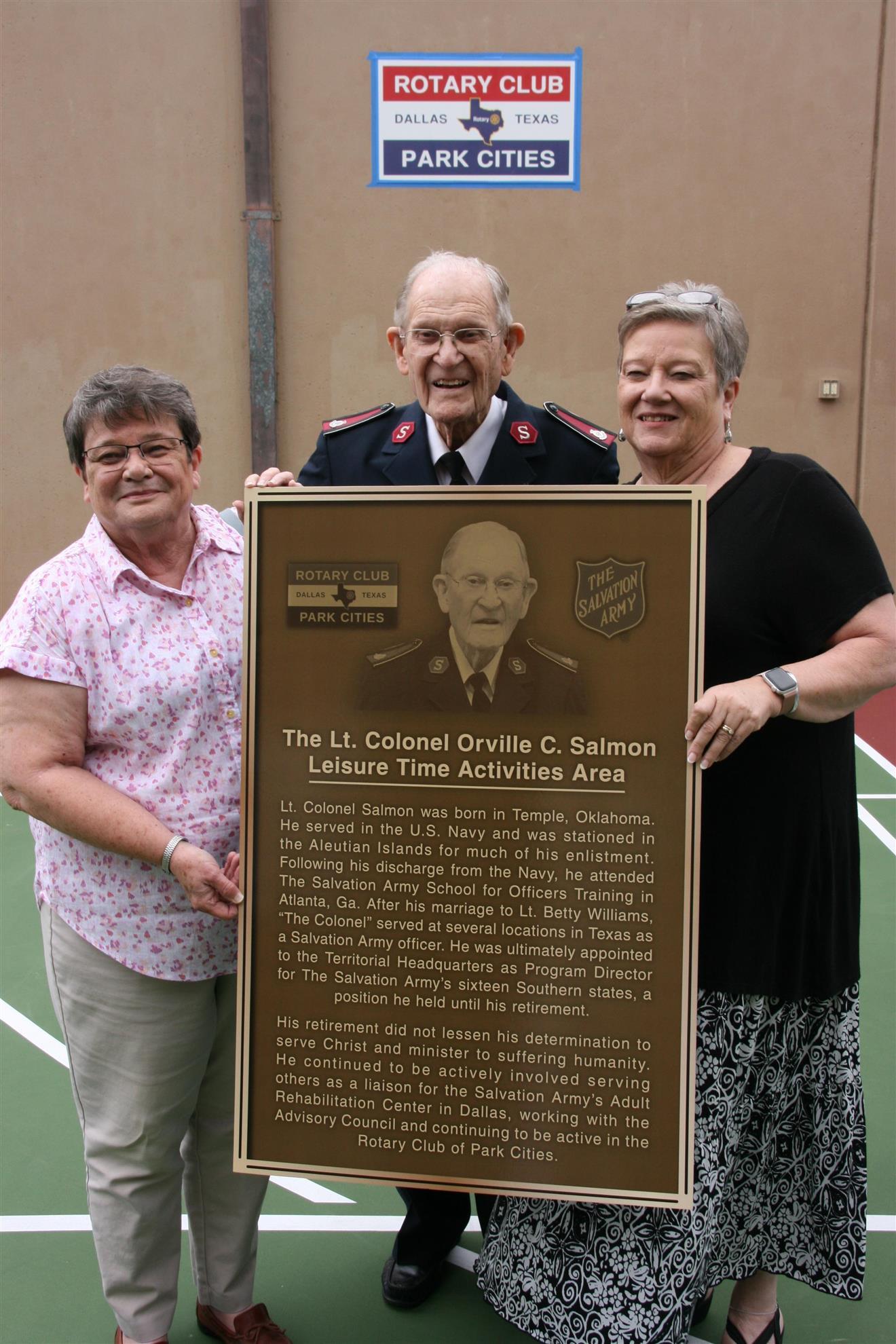
Legacy of Leisure In recognition of his lifelong service, the Lt. Col. Orville Salmon Leisure Activities Area was established — a space dedicated to recreation, fellowship, and community. It stands as a living tribute to a man who believed deeply in the value of rest, joy, and shared life.
Through every role, from small‑town pastor to territorial leader, Orville’s work was guided by the same conviction: that every person deserves dignity, care, and the love of God expressed through action.
Specific Groups He Helped
- Vulnerable Populations: As Territorial Program Secretary, he managed the large-scale social services that provide food, shelter, and disaster relief to millions without discrimination.
- The Elderly & Hospitalized: Through his leadership and support of the League of Mercy (which Bette directed), he facilitated thousands of visits to the lonely, sick, and aging in nursing homes and hospitals.
- Future Officers: He played a vital role in training and mentoring the next generation of leaders.
Camp Hoblitzelle
One of Orville’s most enduring contributions to The Salvation Army was his unwavering commitment to Camp Hoblitzelle. Just a few miles southwest of Midlothian, the camp has long served as a place of learning, adventure, inspiration, and fellowship — a setting where spiritual retreats, youth camps, leadership training, and team‑building events take root in a uniquely peaceful landscape.
Owned and operated by The Salvation Army, the camp’s heritage stretches back to the 1890s, when early Salvation Army camping programs were held across the United States. By the 1930s, Camp Lone Star in Irving had become the statewide camp for the Texas Division. But as Dallas expanded westward in the 1950s, the Army recognized the need for a new home.
That new beginning came on April 21, 1956, when Camp Hoblitzelle in Midlothian was dedicated as the Army’s new Texas camp — made possible through a generous gift from the Hoblitzelle Foundation and the sale of the Camp Lone Star property. More than 1,400 campers enjoyed the very first season on the new grounds.
The land itself carries a deeper history. Once the Singleton family ranch, the site includes the historic Singleton White House. In the 1800s, the property served as a watering and camping stop for wagon trains leaving Dallas. Its original owner, John Hawkins Singleton, served under three flags of Texas during the conflicts of his lifetime: the Texas Republic vs. Mexico, the United States vs. Mexico, and the American Civil War.
Since its dedication in 1956, Camp Hoblitzelle has grown from 370 acres to more than 1,200 acres as of 2026. Today it serves not only Salvation Army youth during summer camp but also civic groups, schools, churches, and business organizations throughout the year.
Colonel Orville Salmon has remained deeply involved with the camp, using its setting as a place to connect with business leaders, Salvation Army officers, and conference groups — continuing the legacy of service, leadership, and community that has defined his life’s work.
Two Lives on Separate Paths, Moving Toward One Calling
Long before their paths crossed, Orville and Bette were already being shaped for a life of service.
Orville, born in Temple, Oklahoma, entered adulthood early. At just seventeen he enlisted in the U.S. Navy, serving in the remote Aleutian Islands during the war — a rugged frontier that forged discipline, resilience, and a quiet sense of duty that would follow him all his days.
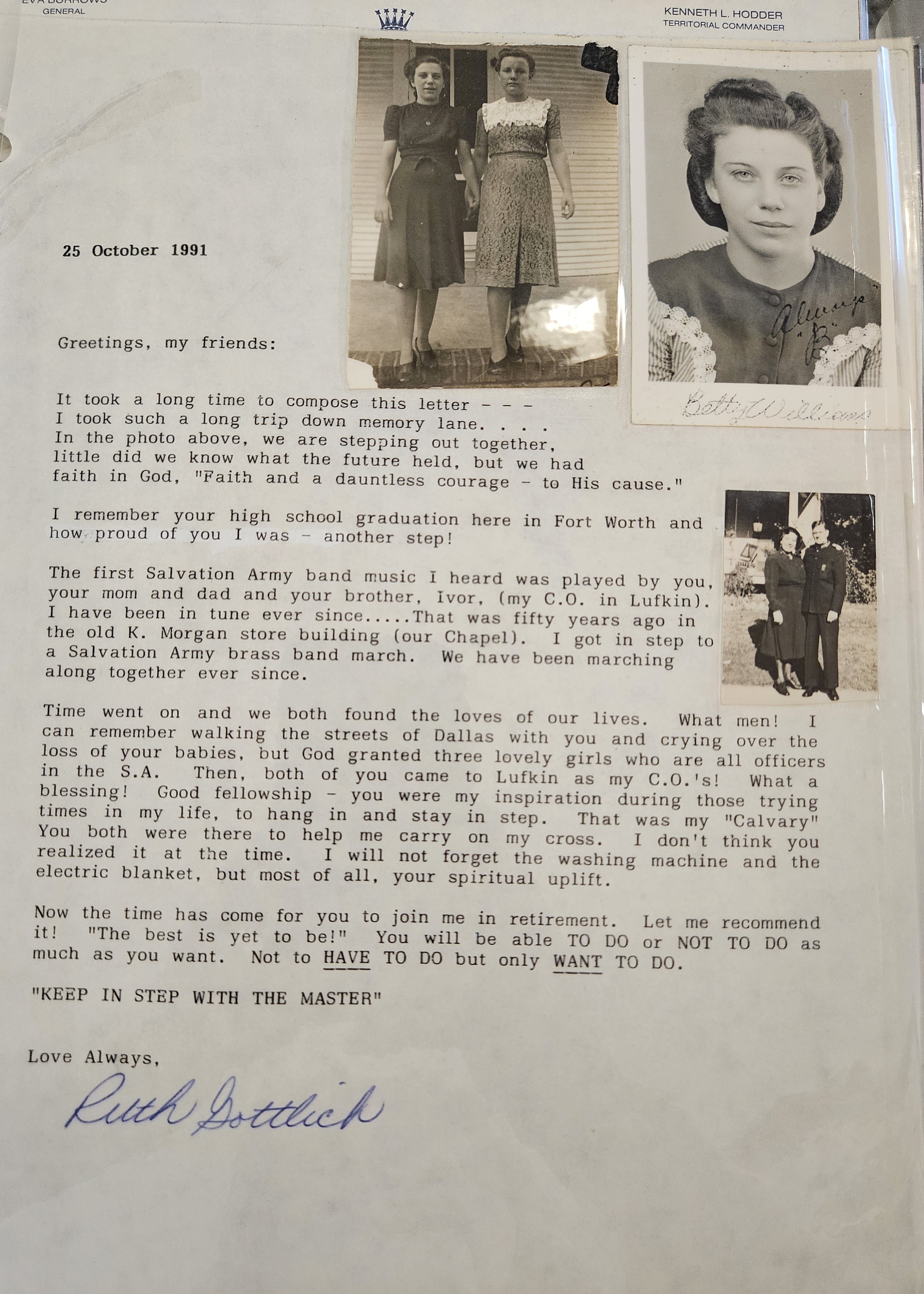
Across the ocean, Bette was beginning her own journey. Born in Glamorgan, South Wales, she immigrated to the United States as a young girl and grew up in Fort Worth. After graduating from Paschal High School, she answered a call she had felt since childhood, entering The Salvation Army seminary in Atlanta in 1942.
Two young lives, shaped by different continents, different hardships, and different beginnings — yet both guided by the same unmistakable pull toward ministry. Long before they knew each other’s names, their hearts were already being prepared for the work they would one day share.
A Christmas Dinner That Changed Everything
Their story together began in the most fitting way for two people devoted to faith and service: a church Christmas dinner.
Bette’s obituary records that she met Orville at a Christmas dinner shortly after he returned from military service.
There was no dramatic moment, no whirlwind romance—just two kind, steady souls recognizing something familiar and trustworthy in one another.
A Marriage Rooted in Purpose
Two years after that first meeting, Orville and Bette were married on November 24, 1947, in Rockwall, Texas. From the beginning, their union was more than a marriage — it was a covenant of shared calling. Together they entered The Salvation Army as officers, embracing a life of service as pastors, leaders, and steadfast servants to those in need.
Their ministry carried them across the southern United States, from small towns to growing cities, each appointment becoming another chapter in their lifelong commitment to others. Their first post in Littlefield, Texas, set the tone: humble work, long hours, and a deep belief that every soul mattered.
Side by side, they supported youth, families, seniors, and women’s ministries. They graded Bible lessons, taught, preached, counseled, and walked with people through seasons of hardship and hope. Their influence reached far beyond local corps walls — together they led six educational tours of the Holy Land, guiding more than 600 students through the landscapes of Scripture and deepening countless lives of faith.
A Family Built on Love and Faith
Orville and Bette raised three daughters and built a family culture grounded in kindness, service, and faith. Their home was known for warmth, hospitality, and the kind of gentle wisdom that comes from two people who lived their values every day.
A Love That Endured a Lifetime
Bette passed away in 2020, closing nearly seventy‑four years of marriage — a span so long and steady that it became its own quiet miracle. Their life together was not marked by dramatic turns or sweeping romance, but by something far rarer: a love built on steadiness, mutual respect, shared purpose, and deep affection.
Through decades of ministry, countless moves, and a lifetime of service, their bond remained constant. They walked side by side in every appointment, every challenge, every calling God placed before them. Their marriage was the anchor beneath their work, the quiet strength that allowed them to pour themselves out for others again and again.
It was the kind of love story that needs no embellishment. Its truth — lived faithfully, day after day, year after year — is already extraordinary.
Legacy
Orville’s life stands as a testament to quiet strength, steadfast duty, and a heart shaped by service. He belonged to a generation that believed character was proven through action, not words and in every chapter of his life, he lived that truth with humility and grace.
From 1944 to 1946, during the final and most demanding years of World War II, Orville served in the United States Navy as an Aviation Metalsmith Second Class (AM2). His skill and precision were tested in one of the harshest and least forgiving theaters of the war: the Aleutian Islands Campaign. Stationed in a region known for freezing temperatures, hurricane‑force winds, thick fog, and months of darkness, Orville worked under conditions that pushed even the strongest men to their limits.
Aircraft returned battered by weather as often as by combat, and it was Orville’s hands, steady, capable, and uncomplaining that kept them flying. He repaired structural damage, fabricated metal components by hand, and maintained the control systems that pilots trusted with their lives. In the unforgiving Aleutians, where supply lines were thin and improvisation was often the only option, Orville’s craftsmanship and calm under pressure became indispensable.
Though he rarely spoke of those years, the quiet resilience he carried throughout his life bore witness to what he endured and overcame.
After returning home, Orville found not only peace but purpose. He met Bette, the woman who would become the love of his life and his partner in every sense of the word. What made their bond extraordinary was that Bette, too, had dedicated her life to service. She had entered The Salvation Army College for Officers Training in 1942, answering a call to ministry long before she ever knew Orville’s name. When they married, they united not just their hearts, but their missions.
Together, Orville and Bette served as Salvation Army Officers for more than four decades. Their ministry took them across the southern United States, where they offered pastoral leadership, community outreach, emergency relief, and spiritual care to countless families. They were a team equal in devotion, equal in compassion, and equal in their belief that every person deserved dignity and hope. Whether organizing food distributions, comforting the grieving, or guiding young people toward better paths, they served with humility and unwavering faith.
Their shared calling strengthened their marriage, and their marriage strengthened their calling. They were partners in prayer, partners in service, and partners in every challenge and triumph that came their way.
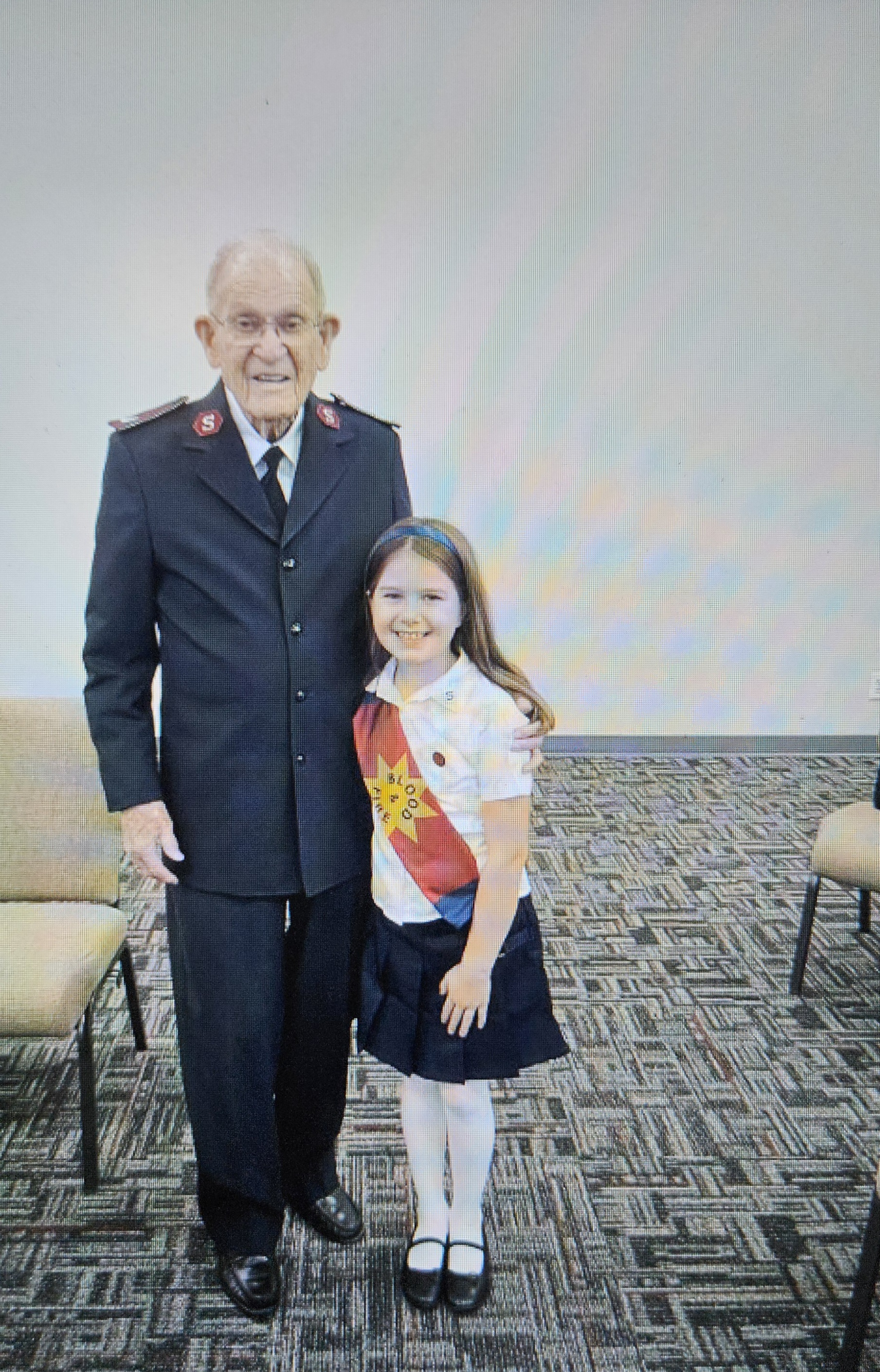
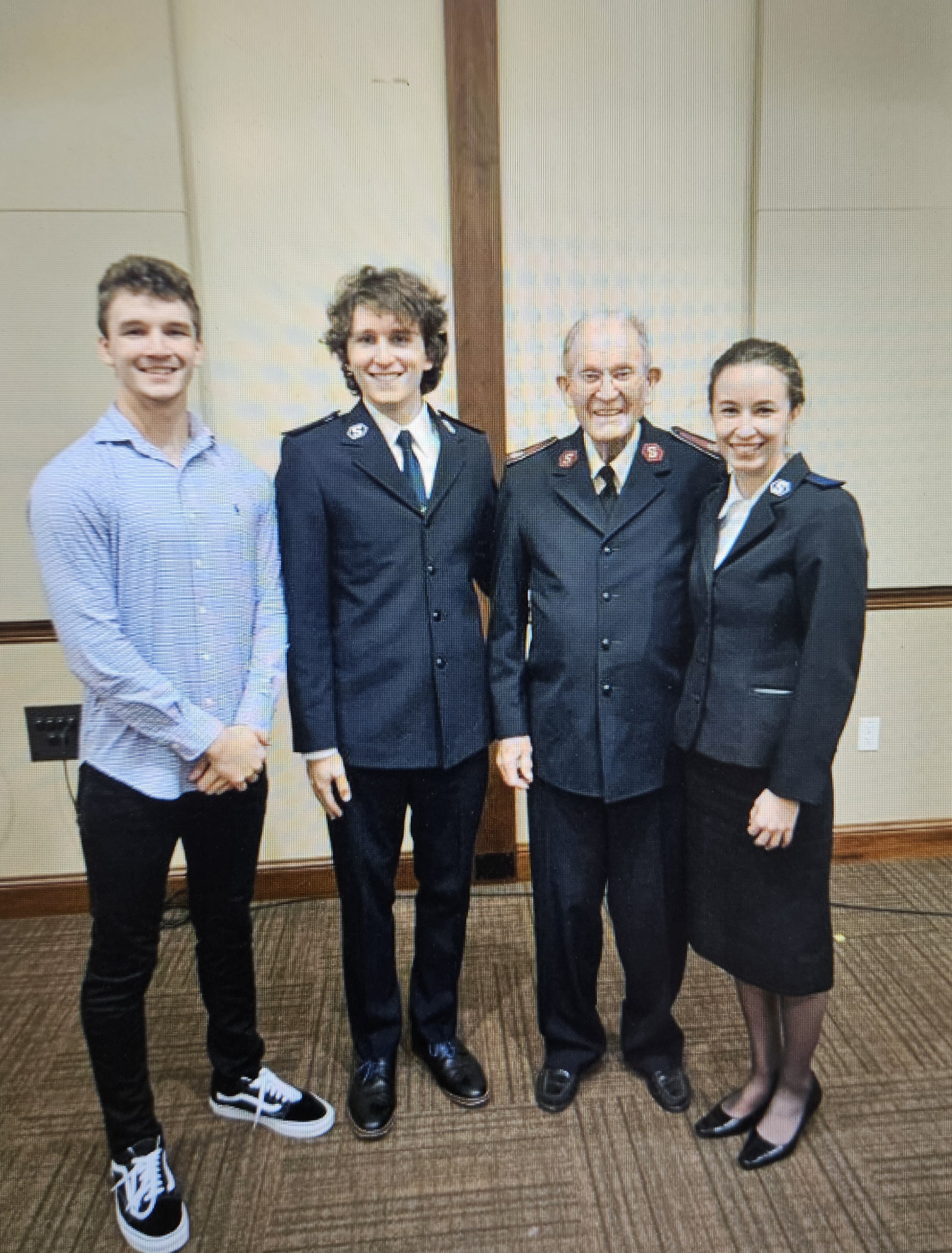
Orville and Bette didn’t just serve The Salvation Army — they raised a family that carried the mission forward. Their three daughters grew up immersed in the rhythms of ministry, music, service, and compassion, and each one stepped into Salvation Army life in her own right. Through their leadership, musicianship, volunteerism, and lifelong dedication to the Army’s mission, they extended their parents’ legacy into new communities and new generations.
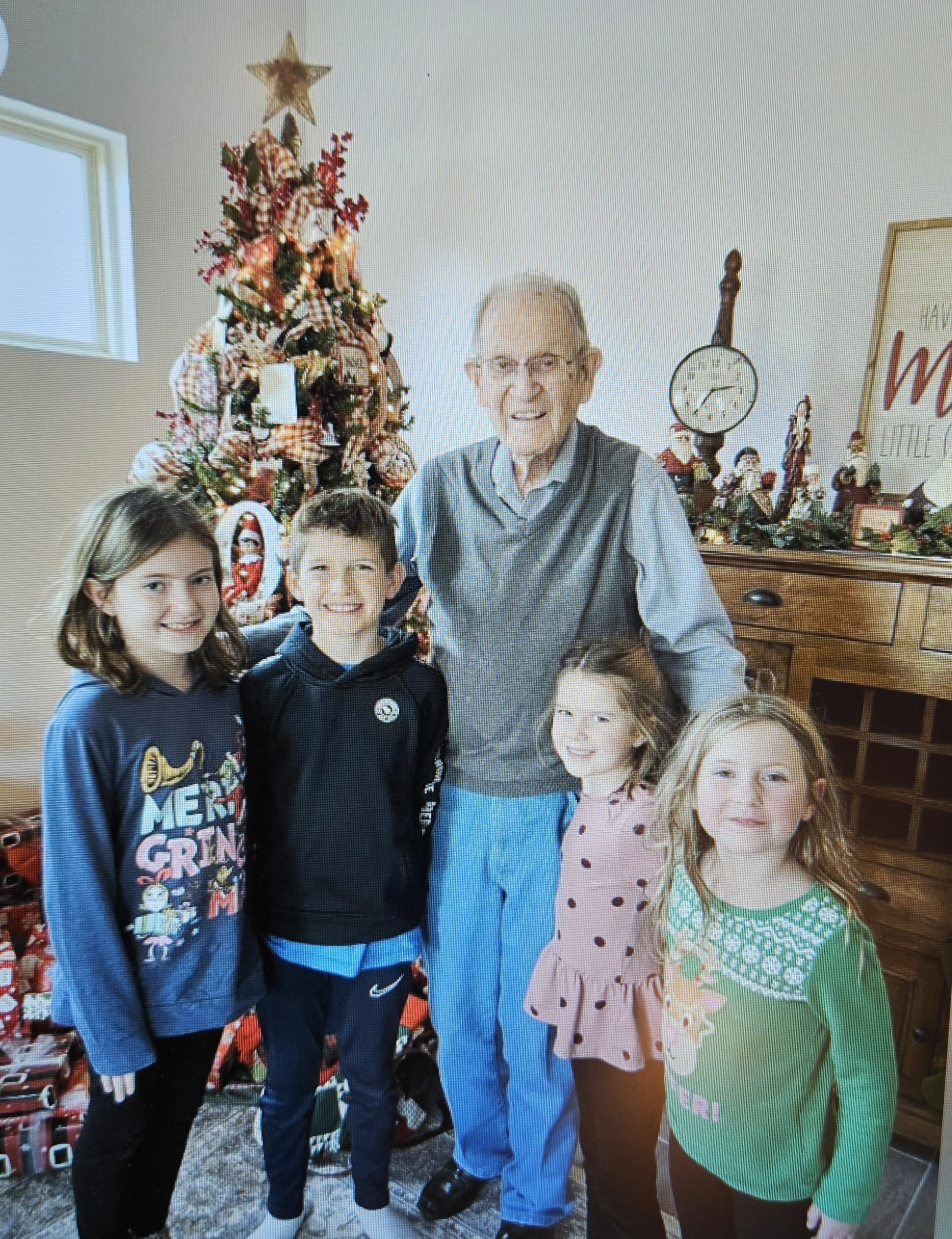
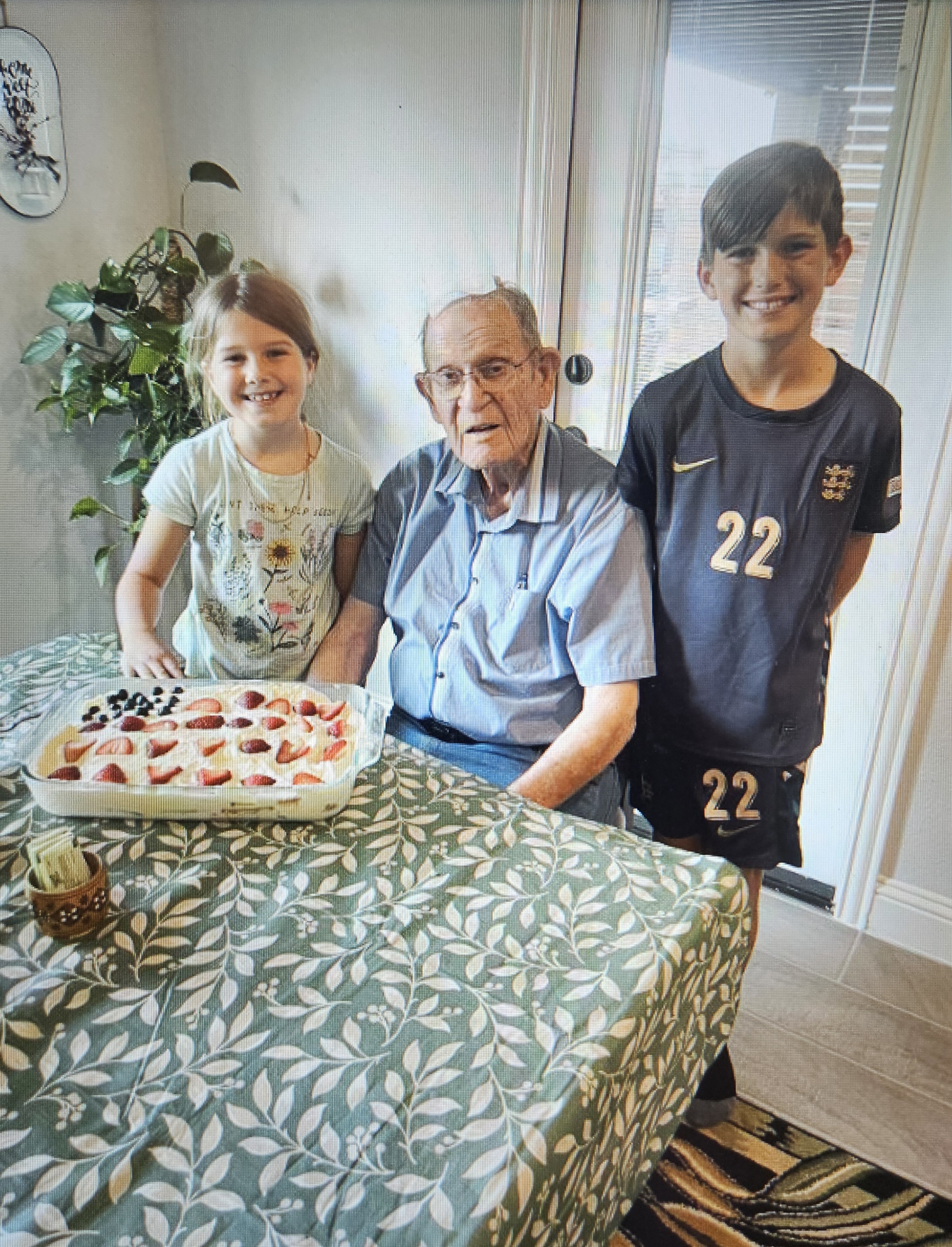
As the years passed, their family grew into a legacy all its own. Orville became a beloved grandfather—a gentle teacher, a storyteller, and a steady presence who made every child feel seen and valued. Later, he became a great‑grandfather, watching new generations carry forward the strength, kindness, and faith that he and Bette had planted.
Each grandchild and great‑grandchild became a living reflection of the love he poured into his family, a testament to the quiet but powerful influence of his life.
And woven through all of this was one of Orville’s greatest joys—fishing. Whether standing on a quiet bank at sunrise or casting a line into a still lake, river or ocean. Fishing and being around the water brought smiles and a sense of peace. It was his way of reconnecting with the world, with nature, and with himself. He shared that love generously, teaching his daughters, grandchildren, and eventually great‑grandchildren how to bait a hook, how to be patient, and how to appreciate the simple beauty of time spent together.
For Orville, fishing was also spiritual. In the Sea of Galilee, he even caught catfish, a simple yet unforgettable joy that stayed with him for the rest of his life. That moment became one of the quiet many treasures of his journey—a memory he carried with deep gratitude and reverence.
To his family, Orville was a foundation—steady, wise, and endlessly giving. He taught lessons without speeches: lessons about patience, responsibility, and the quiet power of doing what is right even when no one is watching. His presence was steadying. His wisdom was earned.
His kindness was intentional.
In his community, Orville became known as a man who could be counted on. He gave his time freely, shared his knowledge generously, and lived his values so consistently that others found themselves wanting to rise to his example. Through his military service, his shared Salvation Army ministry with Bette, his devotion to family, and the simple joy he found in fishing, he built a legacy of compassion, leadership, and unwavering faith in the goodness of people.
Orville’s legacy is not confined to a single chapter of his life—it is woven through every relationship he nurtured, every responsibility he honored, and every act of quiet service he offered. He leaves behind a heritage of character, courage, and compassion—a legacy that will continue to guide and inspire future generations.
His life was a gift, and his memory remains a blessing.