
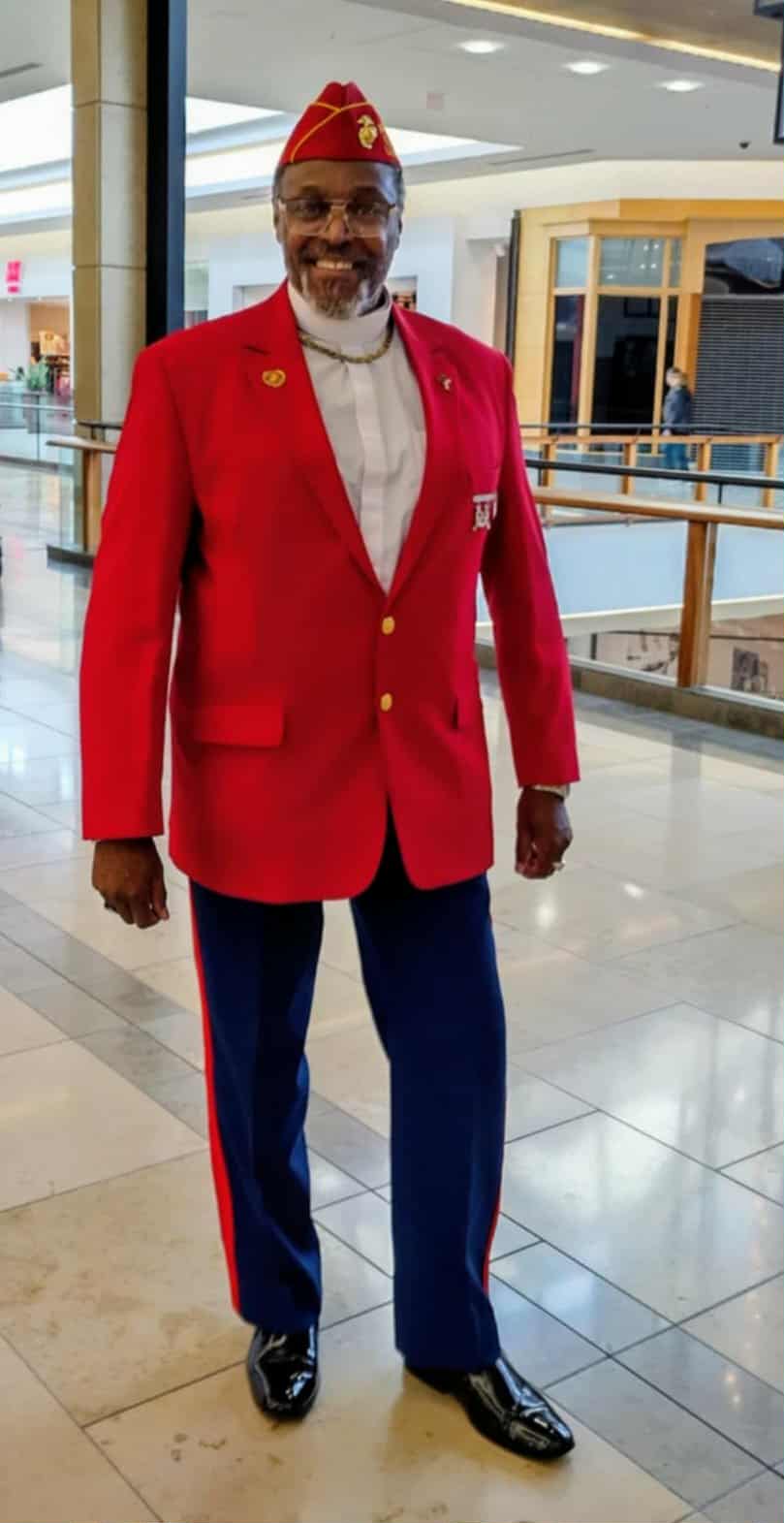
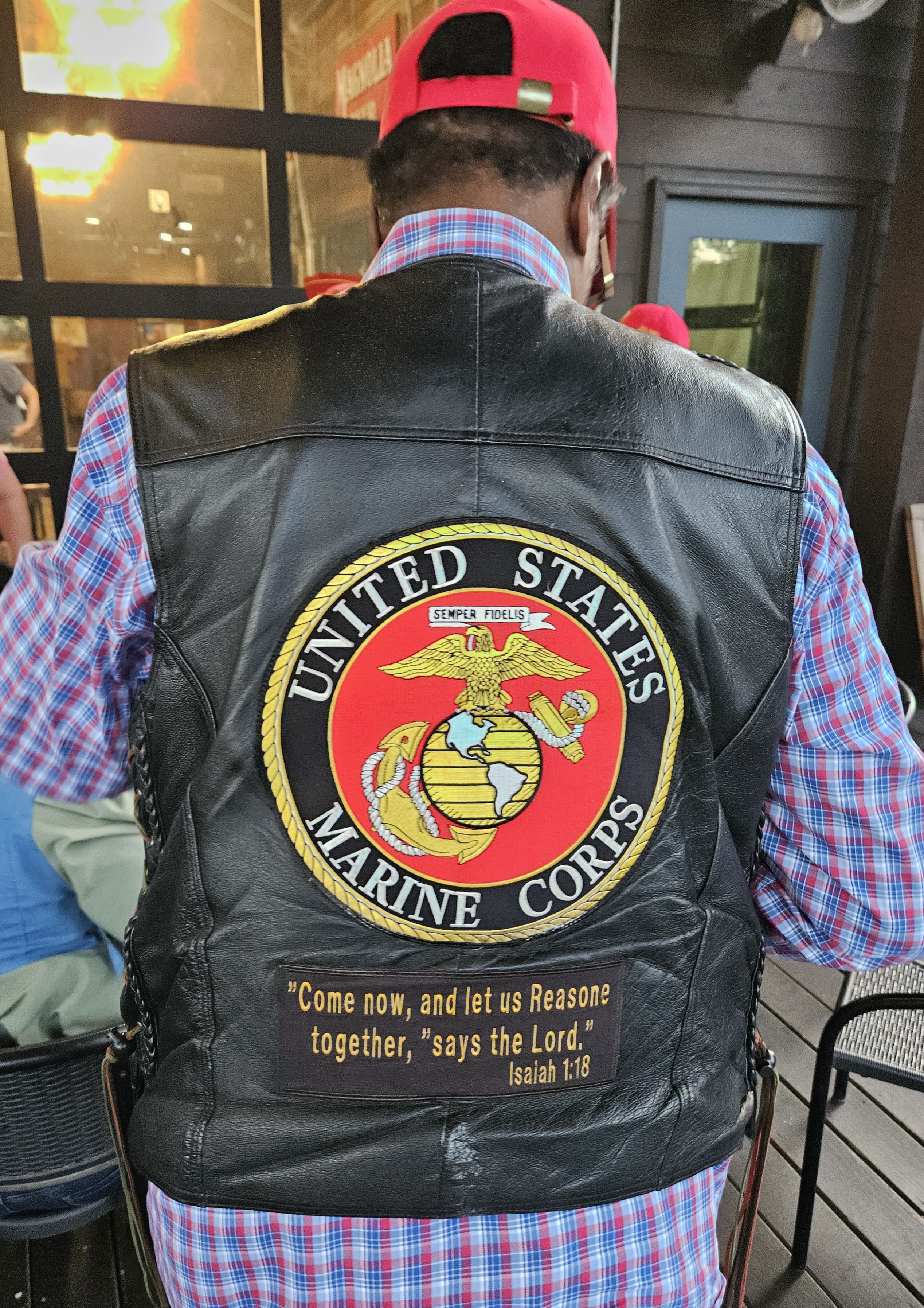
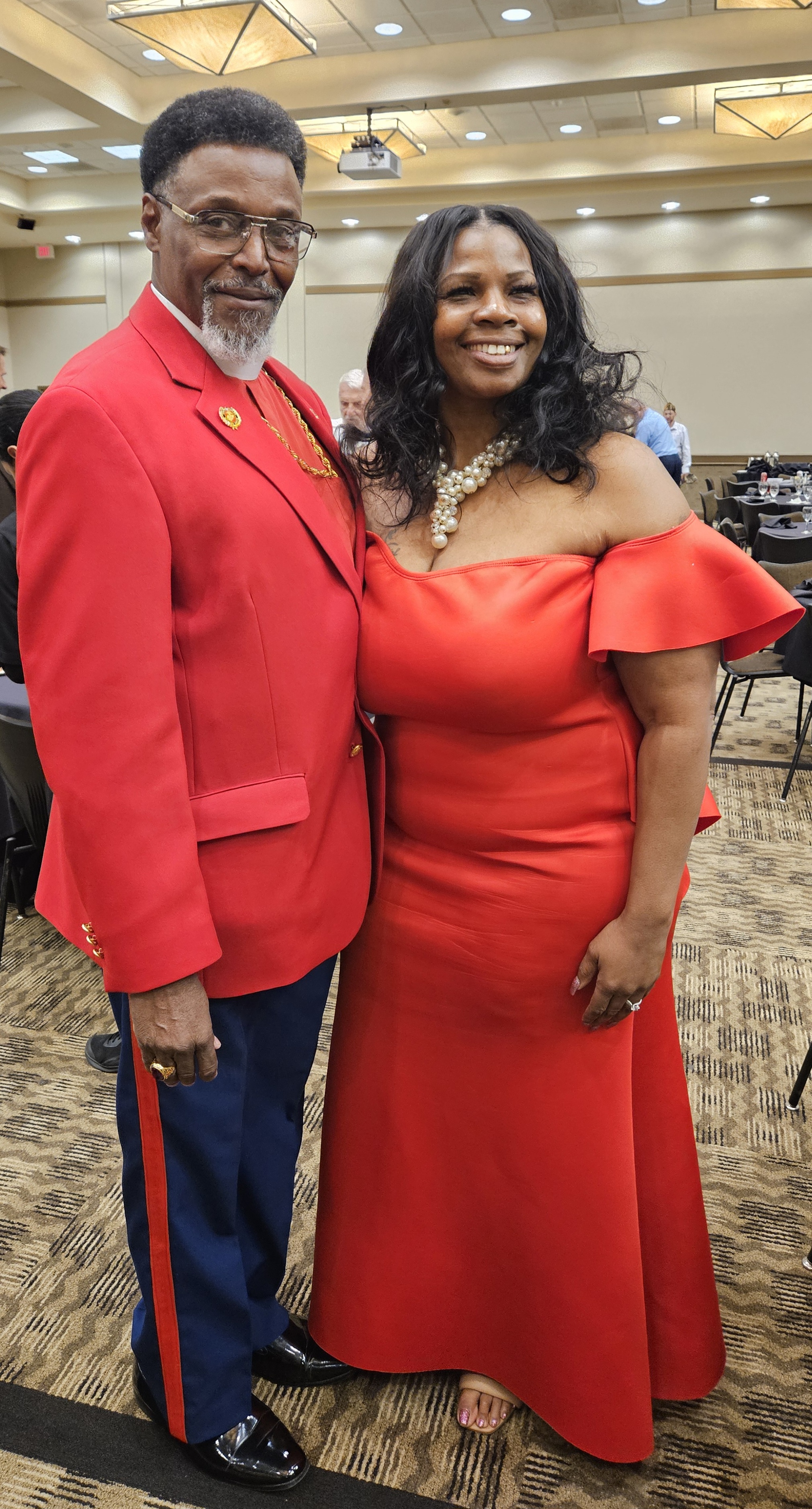
Bishop Marrvin Phillip Quick was born into two worlds that shaped his early life: the church, specifically COGIC, and the streets of the hood. He witnessed hardship in both environments and chose to run from them as soon as he was old enough. His youth included time in the Boy Scouts, which brought its own challenges. His grandfather, a Merchant Marine and two‑time Bronze Star recipient, became one of his earliest influences, teaching him work ethic, discipline, and the value of perseverance. His grandfather returned from war determined to build a life, marrying and raising fourteen children, establishing two businesses, and shaping a family that would come to know Jesus through Marrvin’s mother, the youngest and most spoiled of the siblings. For that spiritual foundation, Marrvin remained grateful.
Seeking to escape the city and travel, he chose the United States Marine Corps. With many cousins in the Army, he wanted a different path and believed the Marines would demand more of him. He also thought military service might distance him from the church, telling God, “Not now, I’m serving my country.” His first night in boot camp, lying in a top bunk among sixty‑seven men, he wondered what he had gotten himself into. The yelling and chaos felt familiar, but the intensity was unlike anything he had known. Only twenty‑seven recruits graduated.
He entered the Marines under Public Communication and Broadcasting, scoring highly, but learned the field would not open for four years. Infantry was available immediately, so he became an 0311 rifleman. At Camp Geiger and Camp Lejeune, he confronted racism in the South and moved past it quickly, learning that Marines relied on one another regardless of color. He dealt with bullies directly, regardless of rank, and earned respect.
He volunteered for overseas duty in Japan. After flying to Alaska and sailing to Mount Fuji, he witnessed tragedy on his third day. Assigned to fire watch at the outer gate, he encountered his company gunny walking alone, covered in blood and unresponsive. Marrvin followed the trail and discovered an overturned Jeep with a headless Marine beneath it. He alerted authorities, filed reports, and was overwhelmed by the trauma. He drank heavily, was hospitalized, and awoke still covered in blood. He was placed on International Legal Hold and told he owed thousands of yen for damages incurred while intoxicated. He paid the amount immediately, still shaken.
Anger grew within him. He watched his bunkmate’s belongings removed after the man’s death. He returned to the rifle range, winning twice and earning the Expert badge. His awakened anger made him formidable. He joined the Super Squad of 3rd Battalion, 9th Marines, 1st Marine Division, a twelve‑man team competing across the Corps. They were unstoppable, defeating every unit they faced. When offered money and rank to break up the team before competing at Quantico, Marrvin refused. Others accepted, leaving him alone. He stood firm in his principles.
He transferred to Military Police, but rumors labeled him a drug dealer. He was jailed for seven months under the UCMJ. After serving one and a half years in Japan, he rotated to California. He won the rifle range again, held the highest pro/con marks on base, and passed every inspection, though anger remained. During training on Catalina Island, he witnessed a woman being pushed off a boat and drowning. He attempted to report it, but was ordered not to get involved. He refused to accept the lie and became openly defiant. His resistance shortened the training from ninety days to two weeks.
Back at Camp Pendleton, he was moved from Kilo Company to Lima Company. The incident appeared in the news as an accidental drowning. Lima’s officers asked him what he wanted to do. He refused to follow a lie and chose to leave. He stopped complying with Marine customs, walking the base unbuttoned, unpressed, and unsaluting. No one challenged him. He was offered a Bad Conduct Discharge and refused, citing his high marks.
A new battalion commander approached him in the mess hall, recognizing him as the top Marine in the battalion’s “black book.” The commander wanted him to train Marines and promised his rank would return. Marrvin declined, wanting only to go home. The next day, Kilo Company pinned colonel bars on his collar in a gesture of respect. Eventually, he accepted a General Under Honorable Conditions discharge and left the Marine Corps.
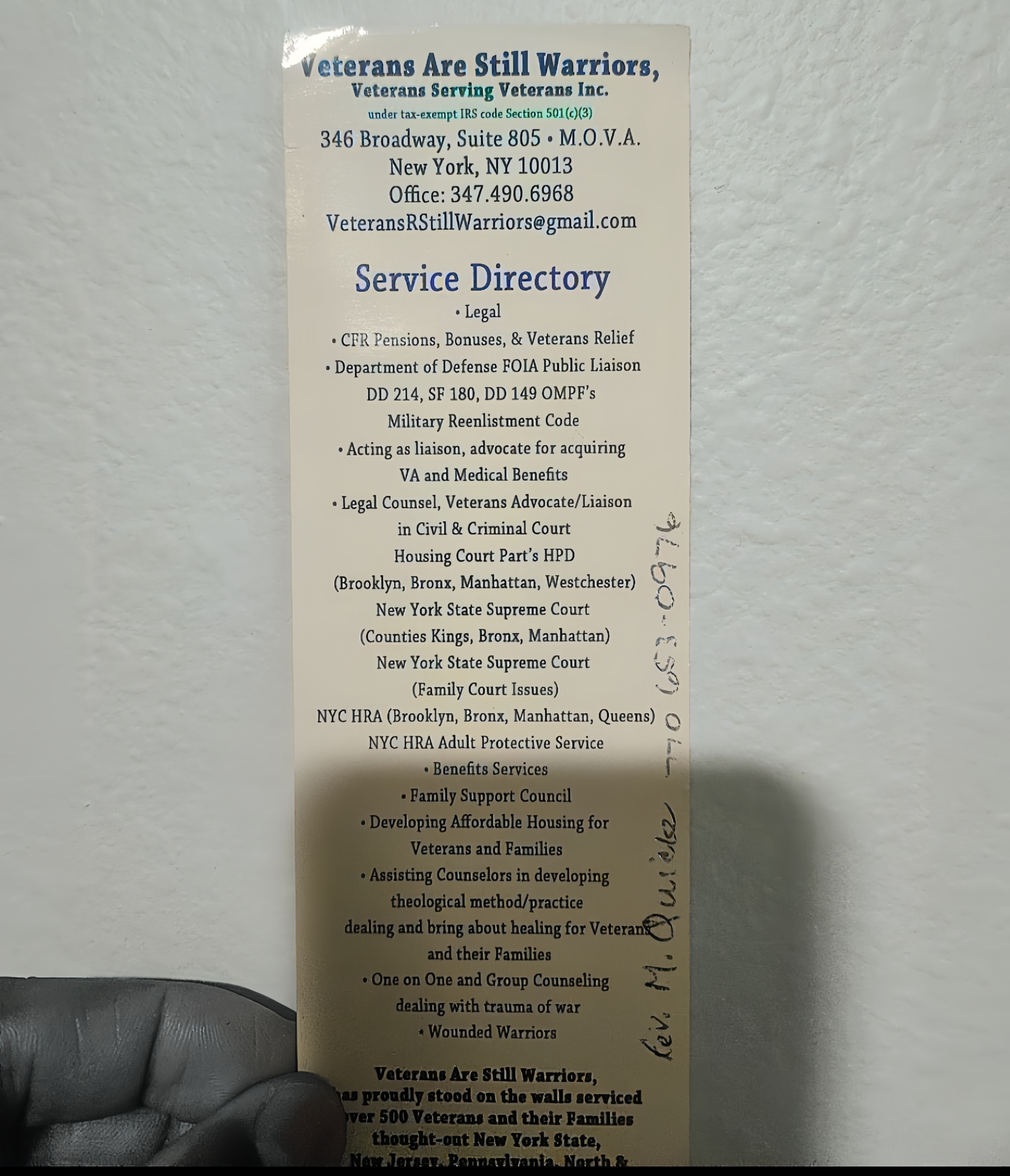
Returning to New York, he no longer ran from God. He ran to Him. He co‑founded Veterans Are Warriors with his cousin, continuing his service by fighting for veterans’ benefits. He confronted political obstacles, even reaching the Mayor’s office to advocate for veterans. Later, he moved to Georgia, but New York called him back. The Commissioner honored him with a Proclamation for helping more than three hundred veterans.
His mission continues. He remains committed to ensuring veterans receive the services they earned. Now in ministry, he works to help them heal from the pain of their past and reclaim their benefits in mind, body, and soul.
Faithfully In His Service,
Bishop Marrvin Phillip Quick
Supplemental Information
The World a Marine Carries
Infantry life surrounded a young Marine with a world shaped by duty, environment, and the quiet expectations of service. His days began with the steady responsibilities that kept the battalion functioning. He stood guard over entry points and supply areas, watched over vehicles that carried the battalion’s lifeblood of mobility, and manned posts where vigilance mattered more than movement. These duties taught him how to read the subtle cues of his surroundings — the hum of distant machinery, the soft scrape of gravel under approaching boots, the faint shift of wind through fencing or brush. Even in stillness, the world spoke, and he learned to listen.
Weapons maintenance carried its own rhythm. The scent of CLP oil lingered on his hands, carbon dust clung to his fingertips, and the smooth glide of a cleaned bolt carrier became a familiar reassurance. His rifle’s weight settled into his body until it felt like an extension of himself, shaping how he walked, how he stood, and how he interpreted the terrain around him. Gear checks, pack adjustments, and quiet preparation filled the spaces between duties, forming the unseen structure of readiness.
Within the fire team, movement became a coordinated language. He carried an M16A4 or M4 and operated as part of a four‑man unit whose cohesion shaped every action. Fire‑and‑maneuver drills taught him how to shift from cover to movement, how to communicate through subtle gestures, and how to trust the Marine covering his advance. Perimeter and convoy security introduced him to the contrast between stillness and motion — the quiet discipline of watching over a defensive line and the vibrating intensity of movement through uncertain terrain.
Night reshaped the world entirely. Darkness narrowed his vision until sound became the primary guide. The faint rustle of wind through brush, the distant hum of generators, and the soft crunch of boots on cooling soil formed a language he learned to interpret with instinctive precision. Moonlight cast pale reflections across his gear, and the cold metal of his rifle pressed against his palms with a weight that felt more pronounced after sunset. His breath moved in controlled rhythm, each exhale quiet and deliberate. In these hours, awareness lived in heartbeat, breath, and the subtle tension of muscles held just shy of movement.
Weather added another layer to this sensory reality. Heat pressed down with a force that settled into his shoulders, drawing sweat beneath his flak and coating his skin with dust lifted by every step. Cold brought a sharper clarity — breath rising in pale clouds, fingers stiffening despite gloves, and wind carrying the scent of wet soil or distant rain. Rain transformed everything. Water soaked through fabric, adding weight to every movement. Mud clung to his boots, pulling at them with each step, and the steady patter against his Kevlar created a rhythm that accompanied every thought. Weather extremes taught him endurance not through hardship alone but through the constant act of adapting to whatever the sky delivered.
Beneath these physical sensations lived an interior landscape shaped by emotion and expectation. Anticipation settled into his chest before a patrol, tightening his breath as he checked his gear one last time. Confidence felt grounded, steadying his heartbeat and sharpening his focus. Fatigue softened the edges of sound, stretching moments into long intervals where thought and sensation blurred. Pride carried warmth — rising when a squad leader offered a rare nod of approval or when the fire team moved with perfect cohesion. Camaraderie had its own sensory signature: the familiar sound of a friend’s voice, the shared rhythm of boots in formation, the quiet reassurance of another Marine’s presence beside him.
The barracks formed the quieter backdrop of his daily life, a place where the sensory intensity of the field softened into routine. The hallway smelled faintly of cleaning solution, boot leather, and the lingering scent of chow carried in from the mess hall. Doors opened and closed with familiar thuds, conversations drifted through thin walls, and the hum of fluorescent lights created a constant background tone. His rack held the weight of his exhaustion at the end of long days, the mattress firm beneath his back and the blanket carrying the faint scent of detergent. Gear was stacked neatly, each item in its place, forming a visual rhythm of order and discipline. The barracks had its own sounds: the clatter of weapons being cleaned, the muted laughter of Marines unwinding, the steady cadence of boots moving down the hallway during early‑morning formations.
Together, these elements formed a single, unified sensory world — duty’s steady rhythm, night’s quiet tension, weather’s relentless presence, emotion’s subtle interior pull, and the barracks’ grounding calm. Through them, a young Marine learned how to remain aware, how to endure discomfort, and how to interpret his environment with instinctive precision. This woven landscape shaped him into a reliable member of the battalion’s operational foundation, carrying forward the quiet readiness that defined infantry life.
Daily Infantry Responsibilities and Core Skills of a Young Marine
A Private First Class in the Marine Corps infantry carried responsibilities rooted in long‑standing doctrine that shaped generations of riflemen. His daily tasks were not glamorous, but they were essential to the functioning and readiness of the battalion. Guard duty, vehicle security, and standing post were standard assignments across all infantry units, historically documented in Marine Corps orders and training manuals. These duties ensured the protection of personnel, equipment, and critical infrastructure, and they demanded vigilance regardless of weather, fatigue, or time of day.
Weapon maintenance was a constant requirement. Marines were trained from boot camp onward that a rifle must be cleaned, inspected, and kept serviceable at all times. This expectation is historically accurate across every era of Marine infantry service. Gear preparation followed the same principle. Packs, protective equipment, communication devices, and load‑bearing gear had to be checked and rechecked so that a Marine could move instantly when the squad was called. These routines formed the quiet backbone of infantry life, documented in field manuals and reinforced by noncommissioned officers who ensured readiness at every level.
Within this daily rhythm, a Private First Class lived the core skills of the rifleman. Marine Corps doctrine has long centered the fire team as the foundational unit of infantry operations. Historically, a fire team consists of four Marines: a team leader, an automatic rifleman, an assistant automatic rifleman, and a rifleman. A PFC typically served as a rifleman or assistant automatic rifleman, roles that required disciplined coordination with the Marines beside him. He carried an M16A4 or M4, both standard issue weapons for infantry Marines across the modern era, and trained to employ them with accuracy and reliability.
Fire and maneuver tactics were central to his training. These tactics, historically codified in Marine Corps Warfighting Publications, taught Marines to advance, cover, and communicate as a unified element. Perimeter security, convoy security, and defensive operations were part of everyday infantry practice, especially in deployed environments. These tasks required situational awareness, adherence to rules of engagement, and the ability to respond instantly to threat. Whether on patrol, holding a defensive line, or escorting vehicles through contested terrain, a young Marine applied these skills daily.
Through these responsibilities and skills, a Private First Class learned the deeper truth of infantry service. Readiness was maintained through constant care of weapon and gear. Cohesion was built through shared movement and mutual trust. Discipline was shaped by repetition, vigilance, and the understanding that every small task supported the battalion’s mission. These elements combined to form the factual, historically grounded rhythm of a young Marine’s life, a rhythm demanding, disciplined, and essential to the success of the infantry.
The Eras of 3rd Battalion, 9th Marines
Across its history, 3rd Battalion, 9th Marines carried a legacy shaped by the eras in which its Marines served. Each generation stepped into the battalion’s story at a different moment in time, yet all were bound by the same discipline, the same brotherhood, and the same expectation of readiness.
The battalion’s earliest identity was forged in World War II, when its Marines fought through the Pacific campaigns with a determination that became part of the unit’s character. Bougainville, Guam, and Iwo Jima were not only battles; they were crucibles that shaped how future Marines understood the weight of the battalion’s name. Those who served in the decades that followed inherited this legacy, carrying it into the early Cold War years when vigilance and preparation defined Marine life.
A new generation stepped forward during the Vietnam War, where 3/9 became known for its intensity and endurance. Operations across I Corps, from Starlite to Dewey Canyon, demanded resilience from Marines who faced a conflict unlike any the battalion had seen before. Their service added another layer to the battalion’s identity, one built on jungle warfare, close combat, and the unbroken trust within a fire team.
In the years after Vietnam, 3/9 continued to serve as part of the Marine Corps’ forward‑deployed strength. Cold War readiness shaped the battalion’s rhythm, with Marines rotating through Pacific deployments, multinational exercises, and amphibious operations that kept the unit sharp and expeditionary. This era emphasized mobility, cooperation, and the ability to respond anywhere the nation required.
The Gulf War period brought another shift, as elements of 3/9 supported operations during Desert Shield and Desert Storm. Their role reflected the battalion’s long‑standing ability to adapt to new forms of conflict, carrying forward the same readiness that had defined earlier generations.
Through the 1990s, 3/9 continued to serve in humanitarian missions, peacekeeping support, and global contingency operations. These deployments showed the battalion’s versatility, proving that Marines could move from combat readiness to humanitarian assistance without losing the discipline that defined their service.
The Global War on Terror brought 3/9 into a new era of modern conflict. Deployments to Iraq and Afghanistan demanded counterinsurgency skills, cultural awareness, and the same courage that had carried the battalion through earlier wars. Marines of this generation added their own chapter to the battalion’s lineage, shaped by patrols, security missions, and the complexities of twenty‑first‑century warfare.
Across all these eras, one truth remained constant. Every Marine who served in 3/9 stepped into a legacy built by those who came before. World War II, Vietnam, Cold War deployments, the Gulf War, humanitarian missions, Iraq, and Afghanistan — each era shaped the battalion’s identity, and each generation carried that identity forward with pride.
3rd Battalion, 9th Marines is more than a unit. It is a lineage of service woven across decades, held together by Marines who understood that the battalion’s history lived in them, and that their own service would become part of the story carried by those who followed.
WWII Legacy of 3rd Battalion, 9th Marines
Bougainville • Guam • Iwo Jima • The Pacific War’s Strategic Arc
The story of 3rd Battalion, 9th Marines in World War II is not simply a list of battles. It is a progression — a sharpening of discipline, cohesion, and combat identity — forged across the most brutal terrain and conditions the Marine Corps had ever faced. Each island taught the battalion something different, and together they formed the foundation of everything 3/9 would become in later wars.
Bougainville — The First Crucible (1943–1944)
Bougainville introduced 3/9 to the Pacific’s unforgiving reality. The island was a suffocating world of dense jungle, tangled undergrowth, and mud that swallowed movement. Ravines, swamps, and thick canopy erased visibility and broke formations. Japanese forces were deeply entrenched in bunkers carved into hillsides, spider holes hidden beneath foliage, and defensive pockets designed to exploit the terrain.
Combat here was intimate, chaotic, and often fought at distances measured in feet rather than yards. Squads and fire teams became the decisive element of battle, navigating terrain where radios faltered and sightlines vanished. Japanese infiltration tactics turned night into a realm of constant threat, forcing Marines to develop a discipline that did not depend on daylight or clear terrain.
Bougainville taught 3/9 how to fight without reliable support, without predictable terrain, and without the comfort of visibility. It was the battalion’s first lesson in darkness, isolation, and cohesion, and it became the foundation for everything that followed.
Guam — The Return to American Soil (1944)
After Bougainville, 3/9 entered the liberation of Guam, a battle that demanded amphibious assault skill and relentless pressure against fortified Japanese defenses. Guam’s terrain was a brutal mix of steep ridges, thick vegetation, and cave networks carved into limestone. Every advance was contested.
The battalion pushed inland through heat and humidity that punished every movement. Japanese forces used cave‑to‑cave movement, concealed firing positions, coordinated night attacks, and sniper nests hidden in jungle canopy. The fighting shifted from organized defensive belts to scattered but deadly pockets of resistance, forcing Marines to clear ridge lines, caves, and ravines one by one.
Guam taught 3/9 how to fight through layered defenses, reclaim ground inch by inch, and maintain momentum under punishing conditions. It was a battle of endurance, discipline, and relentless forward pressure — a crucible that shaped the battalion’s unity and sharpened its combat instincts.
Iwo Jima — The Night Attack Near Hill 362 (1945)
The battalion’s defining moment came on March 8–9, 1945, during the Battle of Iwo Jima — the most iconic Marine battle of the war. In one of the most extraordinary feats of Marine combat leadership, 3/9 executed the only battalion‑sized, unsupported, non‑illuminated night attack in the entire Pacific Theater.
The conditions were almost unimaginable:
- volcanic ash that swallowed boots
- shattered rock that offered no cover
- Japanese tunnel networks beneath the surface
- no artillery preparation
- no flares
- no moonlight
Advancing near Hill 362, the battalion fought through entrenched Japanese pockets designed to exploit darkness. The Marines moved by touch, sound, and discipline alone. The attack was costly but successful, and it became one of the battalion’s defining historical moments — later cited in postwar analyses as a model of Marine small‑unit discipline under extreme conditions.
Iwo Jima proved that 3/9 could fight in conditions where every advantage was stripped away except the character of the Marines themselves.
The Wider Pacific War — The Strategic Arc Surrounding 3/9’s Battles
Although Bougainville, Guam, and Iwo Jima were the battalion’s major engagements, 3/9’s service existed within a larger Pacific strategy that shaped the entire war.
The Island‑Hopping Strategy
The Marine Corps’ Pacific campaign required seizing islands that allowed:
- airfields for bomber escort
- naval bases for fleet movement
- staging areas for deeper operations
- footholds for the eventual approach to Japan
3/9’s battles were part of this larger operational design:
- Bougainville secured the Northern Solomons.
- Guam anchored the Marianas.
- Iwo Jima provided airfields critical for B‑29 bomber survival.
Each battle pushed the front line closer to Japan.
The Conditions of the Pacific Theater
The battalion fought in an environment defined by:
- extreme heat and humidity
- disease‑ridden jungle terrain
- volcanic ash and rock
- fortified cave systems
- entrenched Japanese resistance
- amphibious landings under fire
- night fighting with limited visibility
These conditions shaped the battalion’s discipline and cohesion, forging a combat identity that would carry into future wars.
The Japanese Defensive Doctrine
3/9 faced an enemy that fought with:
- no expectation of surrender
- deeply fortified positions
- tunnel networks designed for ambush
- night infiltration tactics
- coordinated counterattacks
- sniper harassment
- booby traps and mines
The battalion learned to fight an enemy who used terrain as a weapon — an experience that shaped its later excellence in Vietnam’s jungles and Afghanistan’s villages.
The WWII Legacy
Bougainville taught 3/9 how to fight in jungle darkness. Guam taught them how to advance through fortified terrain and reclaim ground inch by inch. Iwo Jima proved their ability to execute one of the most daring battalion‑level attacks in Marine Corps history. The wider Pacific campaign taught them endurance, adaptability, and the discipline required to fight across an entire ocean.
This legacy became the foundation for the battalion’s later identities — The Walking Dead, Shadow Warriors, Striking 3/9, and Death in the Dark — carried forward into Vietnam, Desert Storm, Somalia, Iraq, and Afghanistan.
Lineage of 3rd Battalion, 9th Marines
From the Pacific War into Vietnam, the Cold War, Desert Storm, Somalia, Iraq, and Afghanistan
The identity of 3rd Battalion, 9th Marines began in the Pacific, where Bougainville, Guam, and Iwo Jima forged a battalion defined by discipline, cohesion, and the ability to fight under conditions that stripped away every advantage except the character of the Marines themselves. That identity did not remain on those islands. It traveled forward, carried by new generations who inherited the battalion’s legacy and added their own chapters to its history.
From the Pacific to the Post‑War World
When World War II ended, the Marines of 3/9 returned home, but the battalion’s combat legacy remained embedded in Marine doctrine. The discipline learned in jungle darkness, volcanic ash, and fortified ridges became the backbone of the battalion’s post‑war identity.
In the early Cold War, 3/9 experienced cycles of deactivation and reactivation as the Marine Corps reshaped its forces for a world divided by ideology and nuclear tension. Training emphasized amphibious readiness, rapid deployment, and the ability to respond anywhere in a world where conflict could erupt without warning. The battalion’s WWII cohesion became the foundation for the Marines who would carry its colors into Vietnam.
Vietnam — The Hardening of The Walking Dead
Vietnam demanded a different kind of endurance. The battalion deployed into I Corps, the northernmost and most volatile region of South Vietnam, where monsoon rain, jungle terrain, and enemy pressure created conditions as unforgiving as Bougainville.
Operation Buffalo
Along Route 561 near Con Thien, 3/9 encountered well‑prepared NVA forces who used trenches, bunkers, and coordinated fire to devastating effect. Casualties were severe, but the battalion held its ground with the same cohesion that had carried it through Hill 362.
Con Thien and the DMZ
The DMZ became a crucible of constant artillery, ambushes, and trench warfare. Marines endured daily shelling, patrolled terrain riddled with mines, and fought close‑quarters engagements in thick vegetation. Night operations demanded the same discipline the battalion had learned in the Pacific.
Operation Dewey Canyon
In the rugged A Shau Valley, 3/9 maneuvered through steep mountains and dense jungle, conducting raids and assaults that demanded exceptional endurance. Dewey Canyon showcased the battalion’s ability to operate in terrain as unforgiving as Bougainville.
Vietnam hardened 3/9’s identity into one defined by resilience, initiative, and the ability to operate effectively in unforgiving terrain — an identity that echoed the discipline of the Marines who had fought at Guam and Iwo Jima.
Cold War Deployments — Global Vigilance
After Vietnam, 3/9 remained active as a forward‑deployed infantry battalion throughout the Pacific and Mediterranean. The Cold War era demanded mobility, cooperation with allied forces, and readiness for crises that could erupt anywhere.
The battalion participated in multinational exercises, amphibious operations, and rapid‑response missions that kept its expeditionary character sharp. These deployments carried the battalion’s legacy into a new generation, preparing Marines for the conflicts that would define the late twentieth century.
Operation Desert Storm — Mechanized Precision
In 1991, 3/9 shifted from jungle and mountain warfare to mechanized desert operations during Operation Desert Storm. The battalion participated in breaching Iraqi defensive belts, clearing fortified positions, and securing key objectives for the 1st Marine Division during the rapid 100‑hour ground campaign.
Their speed and precision proved that 3/9’s combat effectiveness extended across every environment — jungle, ridge, desert, and urban terrain. The adaptability first forged in the Pacific proved essential in the mechanized battles of the Gulf War.
Somalia — Humanitarian Security in Mogadishu
Soon after Desert Storm, 3/9 deployed to Somalia for Operation Restore Hope. The battalion secured food distribution points, protected humanitarian convoys, and conducted urban security operations in Mogadishu and surrounding areas.
Marines operated in a city fractured by civil war, famine, and militia violence. Their presence helped stabilize the early phase of the mission, reinforcing the battalion’s reputation for discipline and effectiveness in complex humanitarian environments.
Reactivation for the Global War on Terror
After fourteen years on the inactive rolls, the Marine Corps reactivated 3/9 in May 2008 to meet the operational demands of Iraq and Afghanistan. The battalion was rebuilt from the ground up — headquarters reestablished, companies staffed, leadership assigned, and modern equipment issued.
Training pipelines were rebuilt to prepare Marines for counterinsurgency operations, partnered missions with host‑nation forces, counter‑IED warfare, and rapid deployment into complex environments. The return of 3/9 restored a unit known for toughness, discipline, and combat effectiveness.
Operation Iraqi Freedom — Counterinsurgency in Transition
Operating in Anbar Province, 3/9 conducted partnered operations with Iraqi Police and Army units, counter‑IED sweeps, route security missions, tribal engagement efforts, and stability operations supporting local governance.
Marines navigated the transition from kinetic combat to stability operations, balancing force protection with community engagement and local security development. Their work helped shape the final phase of the Marine Corps’ mission in Iraq.
Operation Enduring Freedom — Helmand Province
Following Iraq, 3/9 deployed to Helmand Province, Afghanistan, one of the most dangerous regions of the war. The battalion executed village stability operations, counter‑IED patrols, clearing missions in Taliban‑held terrain, and security operations in key river valleys.
Helmand’s terrain — farmland, canals, villages, and desert — demanded exceptional discipline, endurance, and small‑unit leadership. The battalion’s deployments were marked by intense small‑unit combat and high operational tempo, reflecting the same aggressive spirit that defined its earlier generations.
The Lineage That Endured
Across oceans and generations, 3rd Battalion, 9th Marines carried forward a character first shaped in the Pacific’s unforgiving crucible. Bougainville taught them to fight in darkness and isolation. Guam taught them to advance through fortified terrain with relentless resolve. Iwo Jima proved their ability to act with discipline when every advantage was stripped away except the courage of the Marines themselves.
That same character resurfaced in Vietnam’s monsoon‑soaked jungles, where the battalion endured artillery, ambushes, and night fighting along the DMZ. It carried into the Cold War, where readiness became a quiet but essential form of service. It sharpened again in Desert Storm’s mechanized advance, where speed and precision defined victory. It steadied humanitarian corridors in Somalia, where discipline protected the vulnerable. It adapted to the shifting streets of Iraq, where counterinsurgency demanded patience and partnership. And it endured in Afghanistan’s river valleys, where small‑unit leadership and cohesion determined survival.
Through every era, the battalion remained constant in the ways that mattered: the unity of Marines who trusted one another, the discipline to act under pressure, the willingness to carry the mission forward regardless of terrain, weather, or enemy.
Generations changed, uniforms changed, technology changed — but the battalion’s identity did not. It remained a lineage defined by endurance, initiative, and the quiet understanding that each Marine was part of a story larger than themselves.
When 3/9 was deactivated in 2013, it was not an ending. It was a pause in a lineage that remains intact, ready to rise again if the nation calls. The battalion’s history lives in the Marines who served, in the families who carried them, and in the legacy preserved by those who honor their story today.
This is the closure of the lineage: a battalion that endured every battlefield, every generation, every era — and left behind a legacy worthy of remembrance.
The Man Behind the Words
Veterans Are Warriors” began with Marvin, and its meaning reaches directly into the Marine Corps — the world that shaped his discipline, his loyalty, and his understanding of what it meant to be a warrior. He learned early that the Corps was more than an institution. It was a brotherhood built on endurance, responsibility, and the quiet strength shared among Marines who carried one another through every challenge.
The phrase rose from the life he lived in uniform. It came from the long marches, the relentless drills, the weight of a rifle carried day after day, and the unspoken trust within a fire team. It came from the barracks where camaraderie grew in the spaces between duty, from the nights when Marines stood watch under a sky that demanded vigilance, and from the moments when discipline held firm even in exhaustion. Marvin saw that a Marine’s identity was not limited to the years of active service. It lived in character, in resilience, and in the way Marines continued to stand for one another long after their uniforms were folded away.
When Marvin later stepped into veteran advocacy in New York, he carried the Marine Corps with him. The loyalty, the brotherhood, the sense of responsibility — all of it lived inside the phrase he created. “Veterans Are Warriors” became his way of honoring the men he had served beside and the veterans he met across the city. He spoke the words with the same conviction he had carried in uniform, offering them as recognition, affirmation, and respect.
“Veterans Are Warriors” is more than a phrase. It is the legacy of a man who understood the continuity of service across decades. It is the identity he carried from his own era into the next. And it is the truth he continues to share with every veteran who still walks with the heart of a warrior.
Legacy
Marrvin Phillip Quick’s legacy rests on two pillars that shaped the course of his life: the pride of a United States Marine and the purpose of a man devoted to uplifting every veteran he encountered. His service with 3rd Battalion, 9th Marines placed him within one of the Marine Corps’ most storied lineages, a battalion defined by courage, sacrifice, and an unbroken tradition of answering the nation’s call. Though his time in uniform was brief, his commitment was unwavering. He earned the title Marine, and he carried it with the same seriousness and honor as those who served long before him.
Yet his legacy did not end when he stepped out of the Corps. In truth, it began to unfold more fully there. Marrvin understood the quiet battles veterans face, the silence that follows service, the pride that protects them, and the invisible weight carried long after the uniform is set aside. From that understanding, he helped give life to Veterans Are Warriors. It was never intended to be an organization. It was a message, a movement, and a mission. Through it, he reminded every veteran that their service mattered, their struggles were seen, and their strength endured.
As co‑founder, Marrvin shaped Veterans Are Warriors into a banner of identity and belonging. He used the phrase to lift others up, to connect veterans across generations, and to give voice to those who felt overlooked. What began as his personal expression grew into something larger, embraced by fellow Marines, community members, families, and veteran groups who recognized the truth in his words. Through him, the phrase became a statement of pride, resilience, and unity.
His legacy is the fusion of these two worlds, the Marine he was and the advocate he became. He leaves behind a name spoken with respect, a message carried forward by others, and a reminder that one person’s conviction can ignite a movement. His life stands as proof that service does not end with a uniform. Sometimes it evolves into a mission that continues long after.
This is the legacy of Marrvin Phillip Quick. A Marine. A brother. A warrior for veterans. A man whose love for the Lord shaped his purpose, and whose heart gave life to a message that will outlive him.
His story continues in every veteran who finds strength through his words, in every family who feels seen because of his compassion, and in every community that carries forward the mission he helped ignite. Marrvin’s legacy lives in the quiet moments when a veteran stands a little taller, in the shared understanding between brothers in arms, and in the enduring truth that warriors do not walk alone. His life reminds us that service is not measured in years but in impact. He proved that a single voice, guided by faith and conviction, can become a beacon for many, and the message he carried now belongs to all who continue the work he began.
This is his enduring light. This is the legacy he leaves in the hearts of those he served and uplifted.