
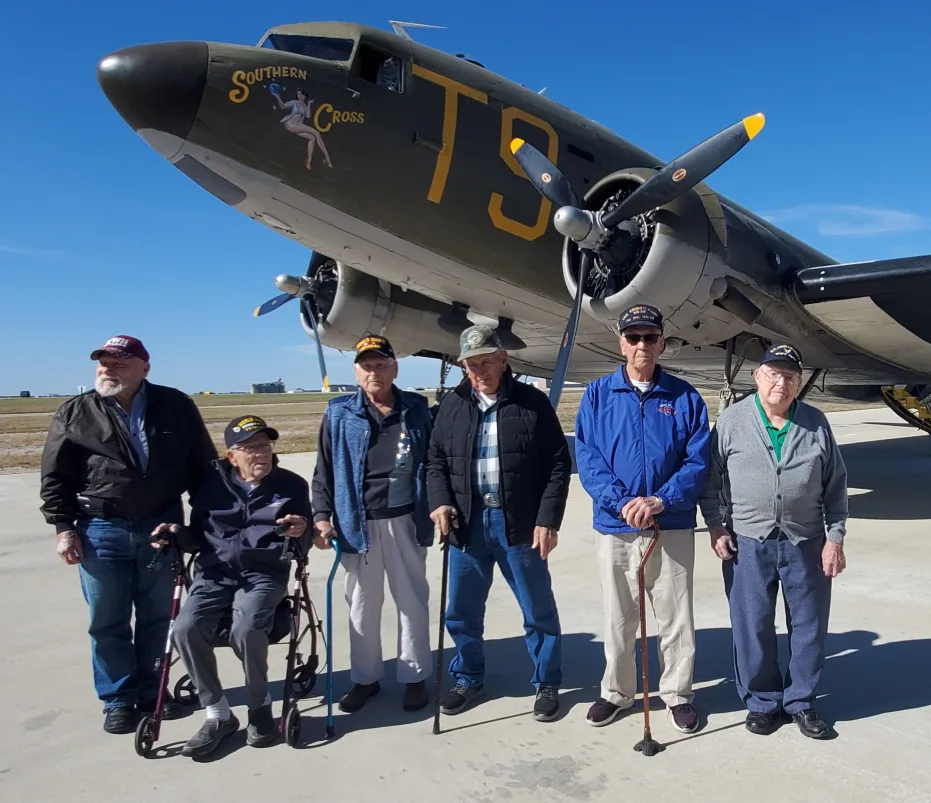
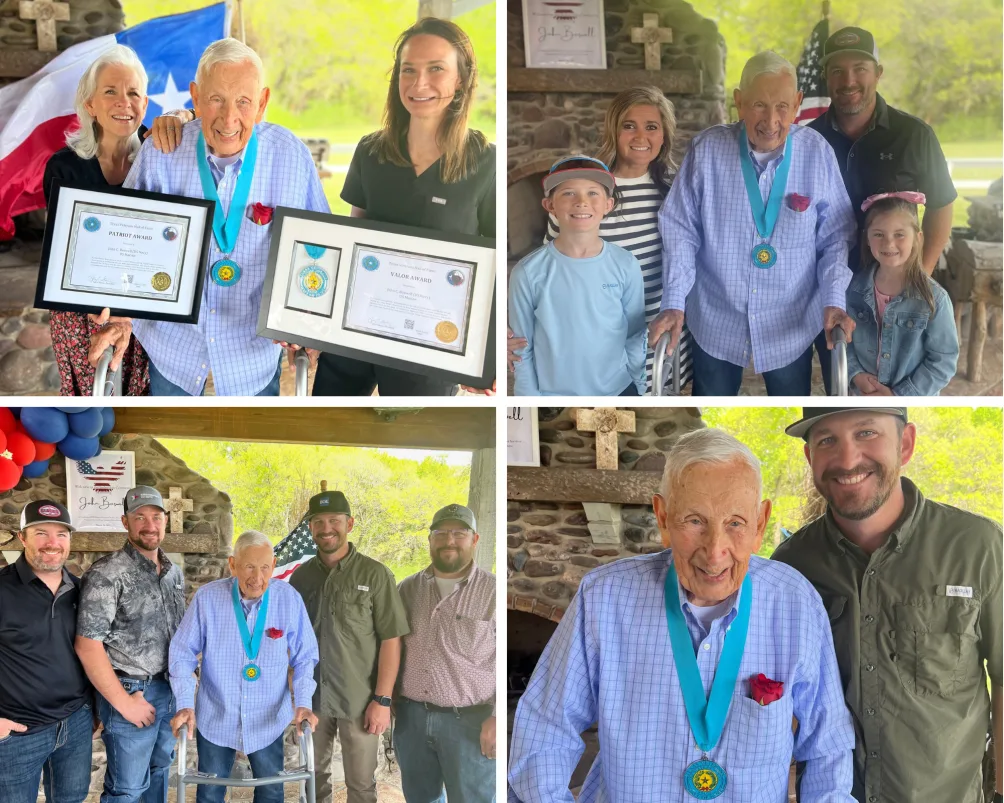
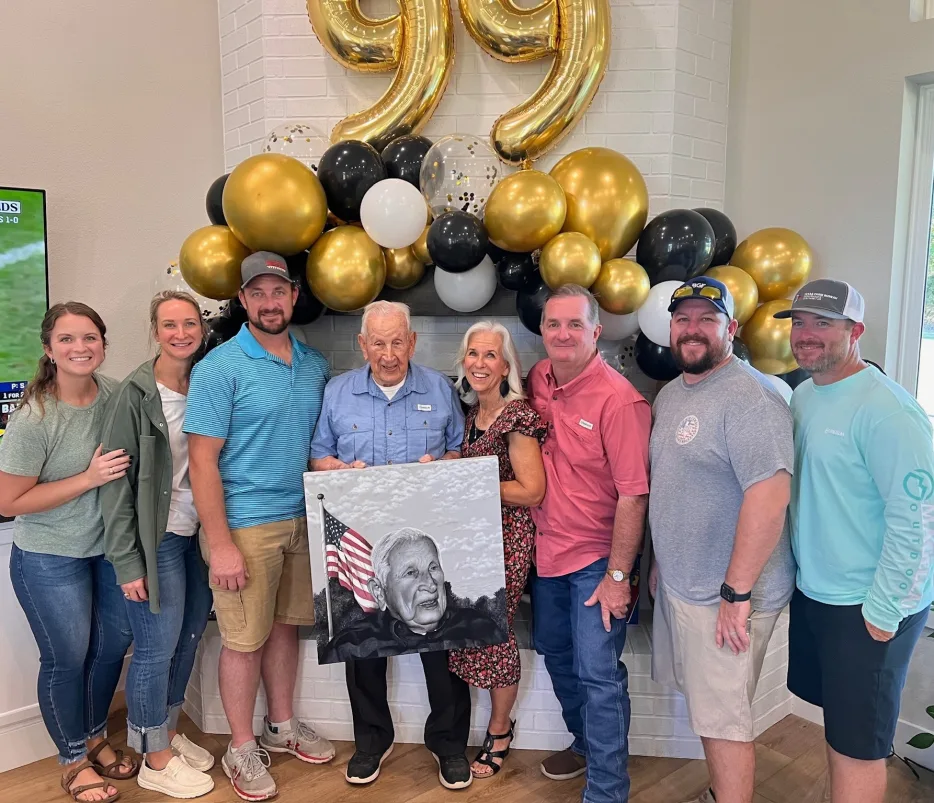
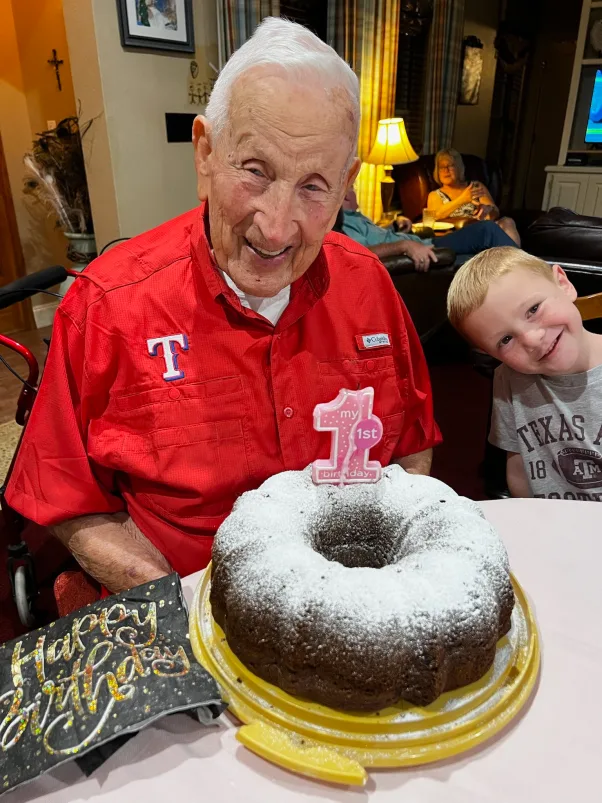
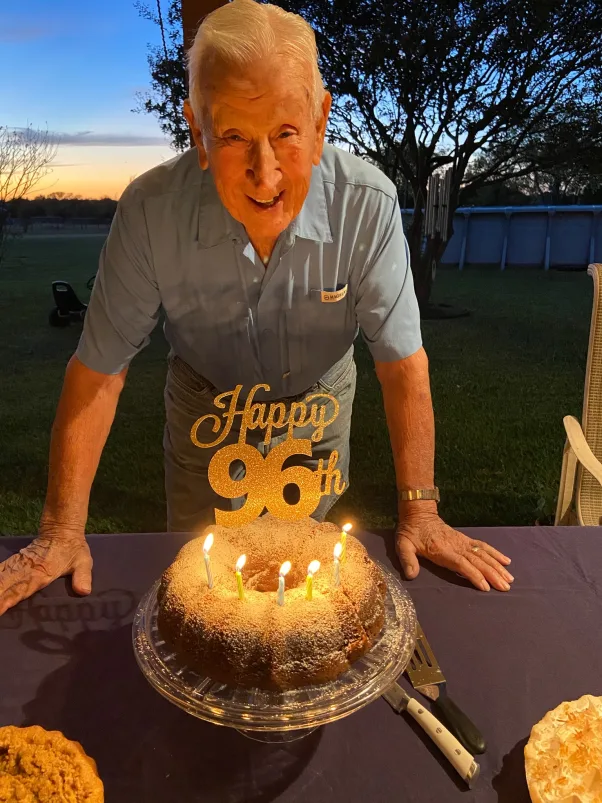
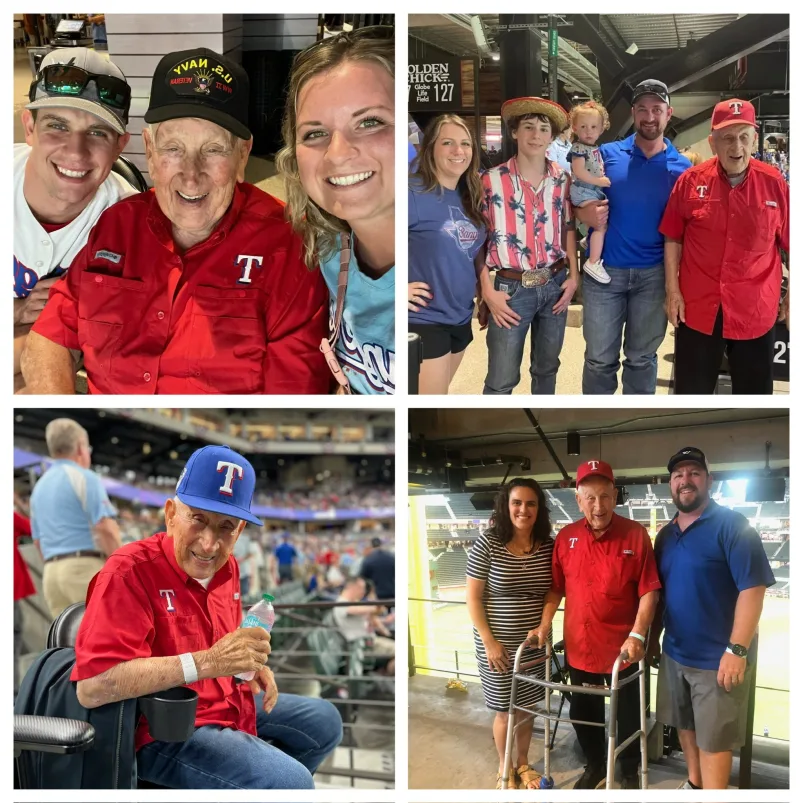
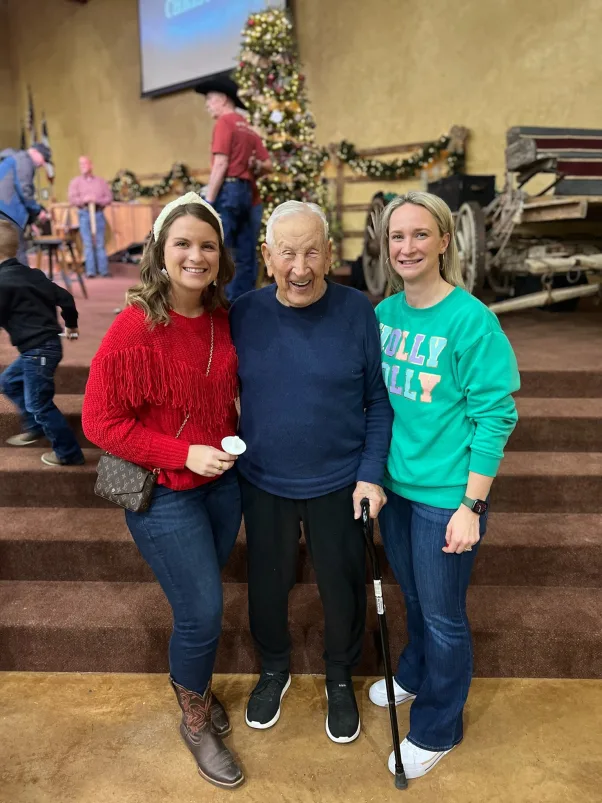
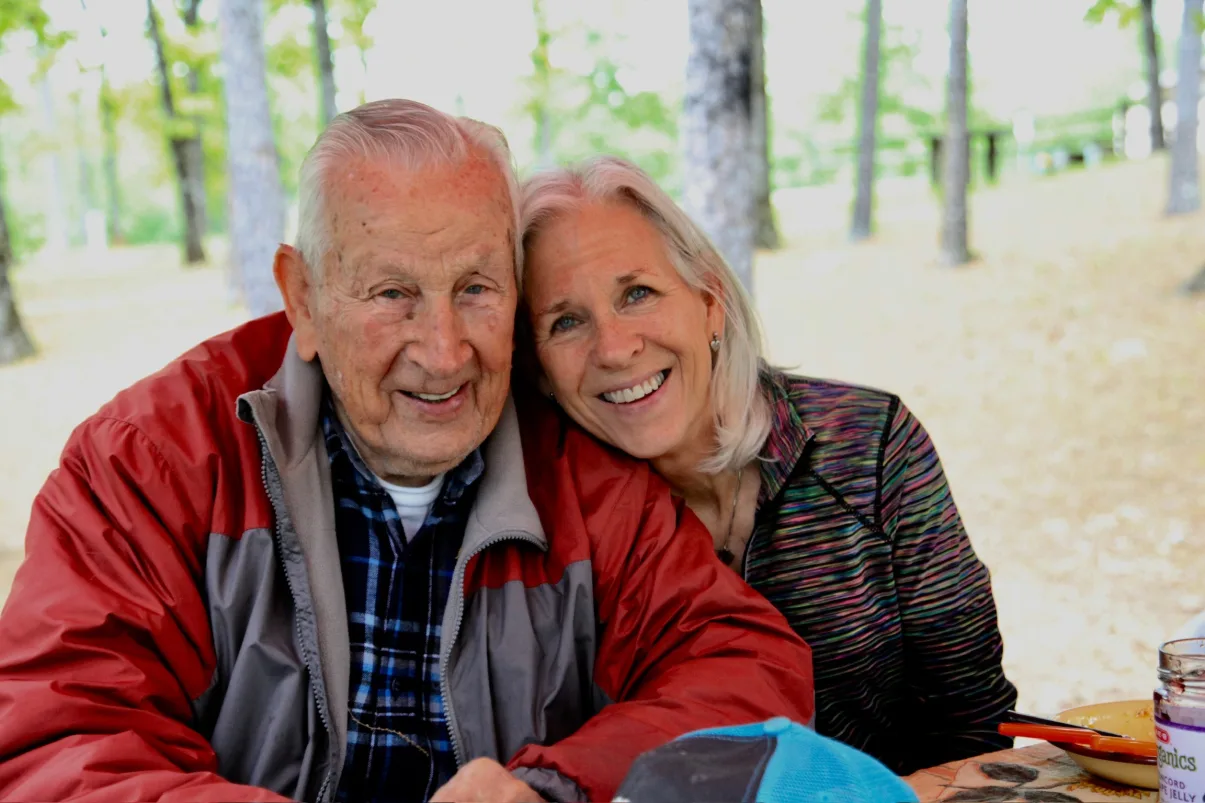
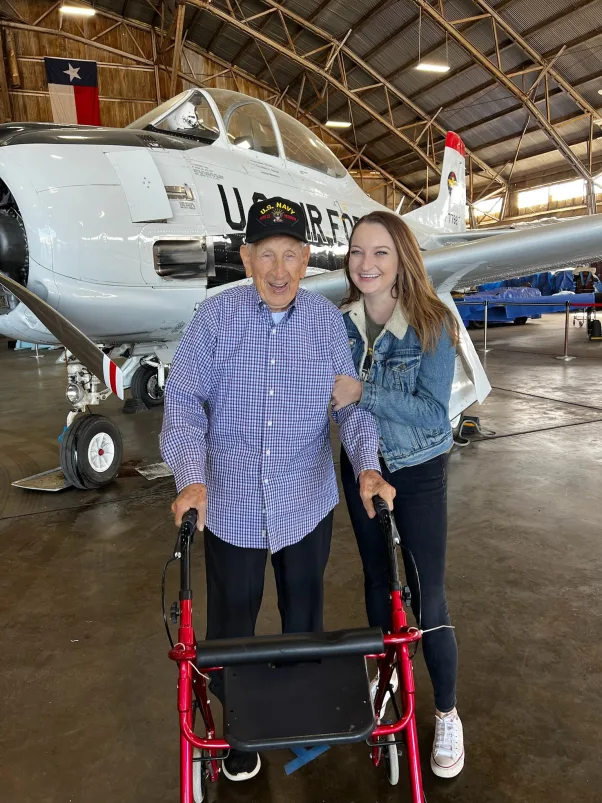
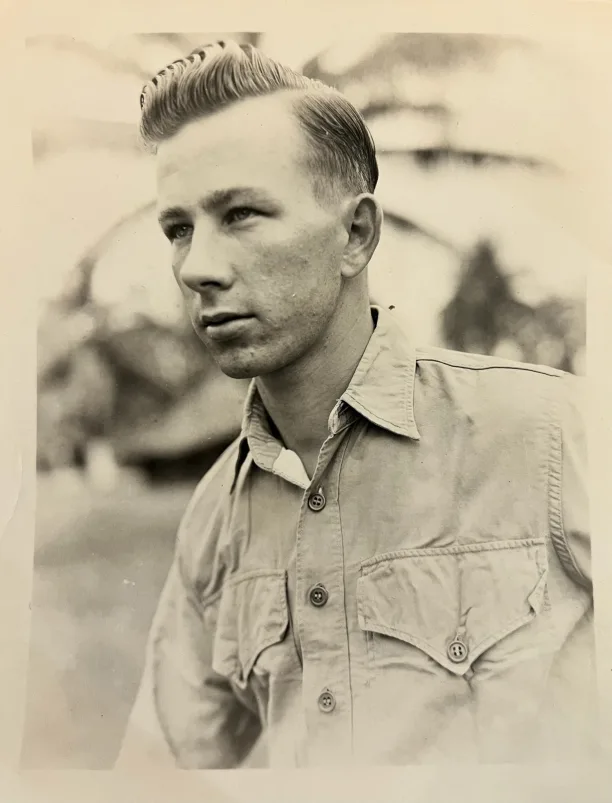
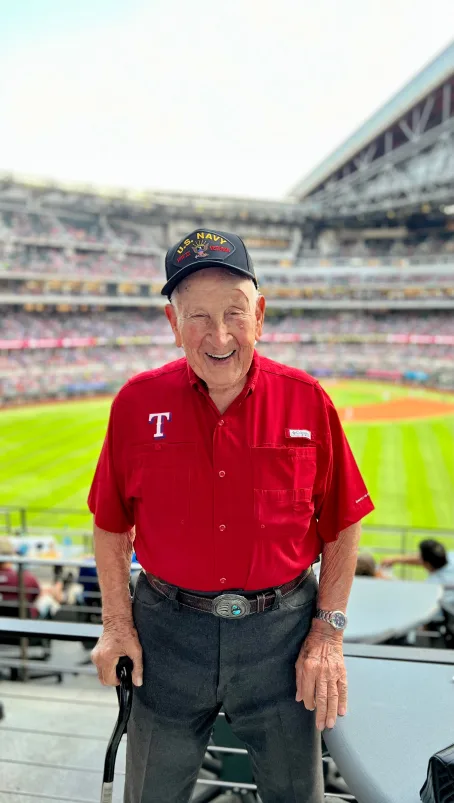
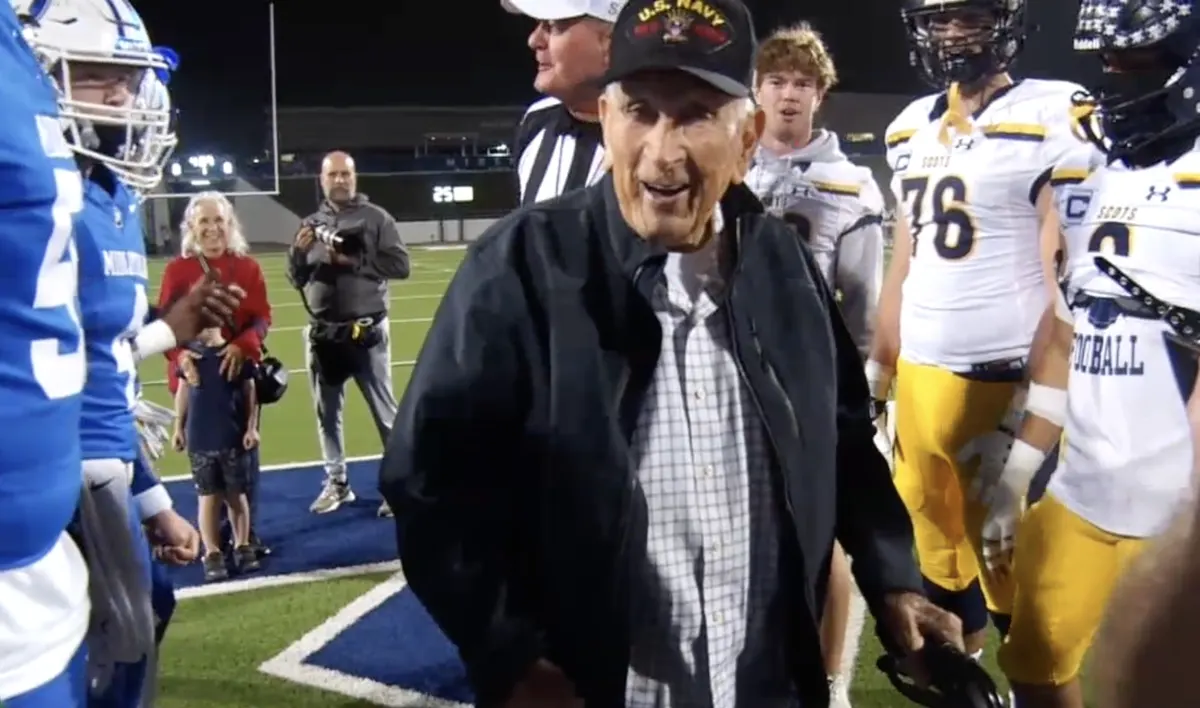
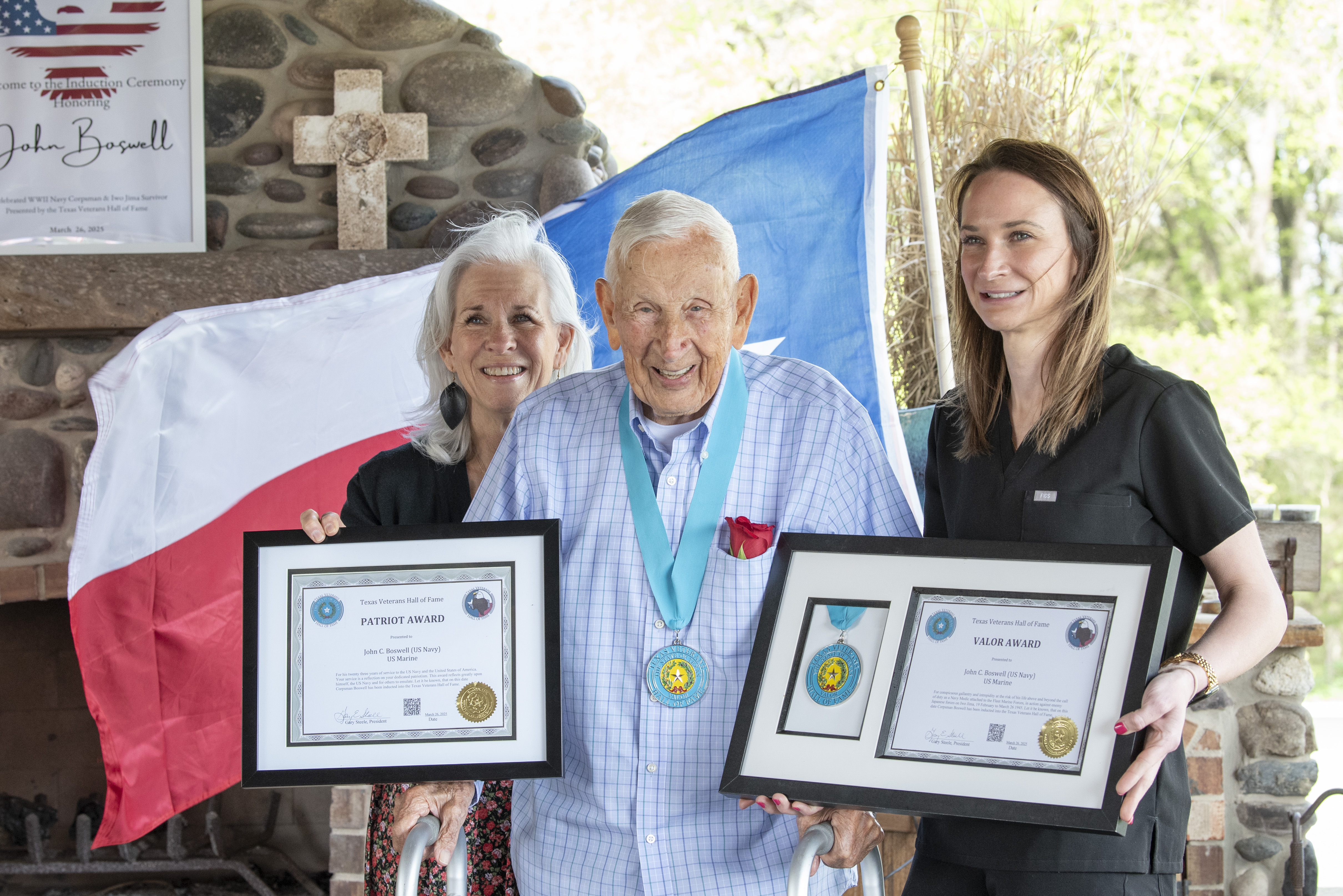
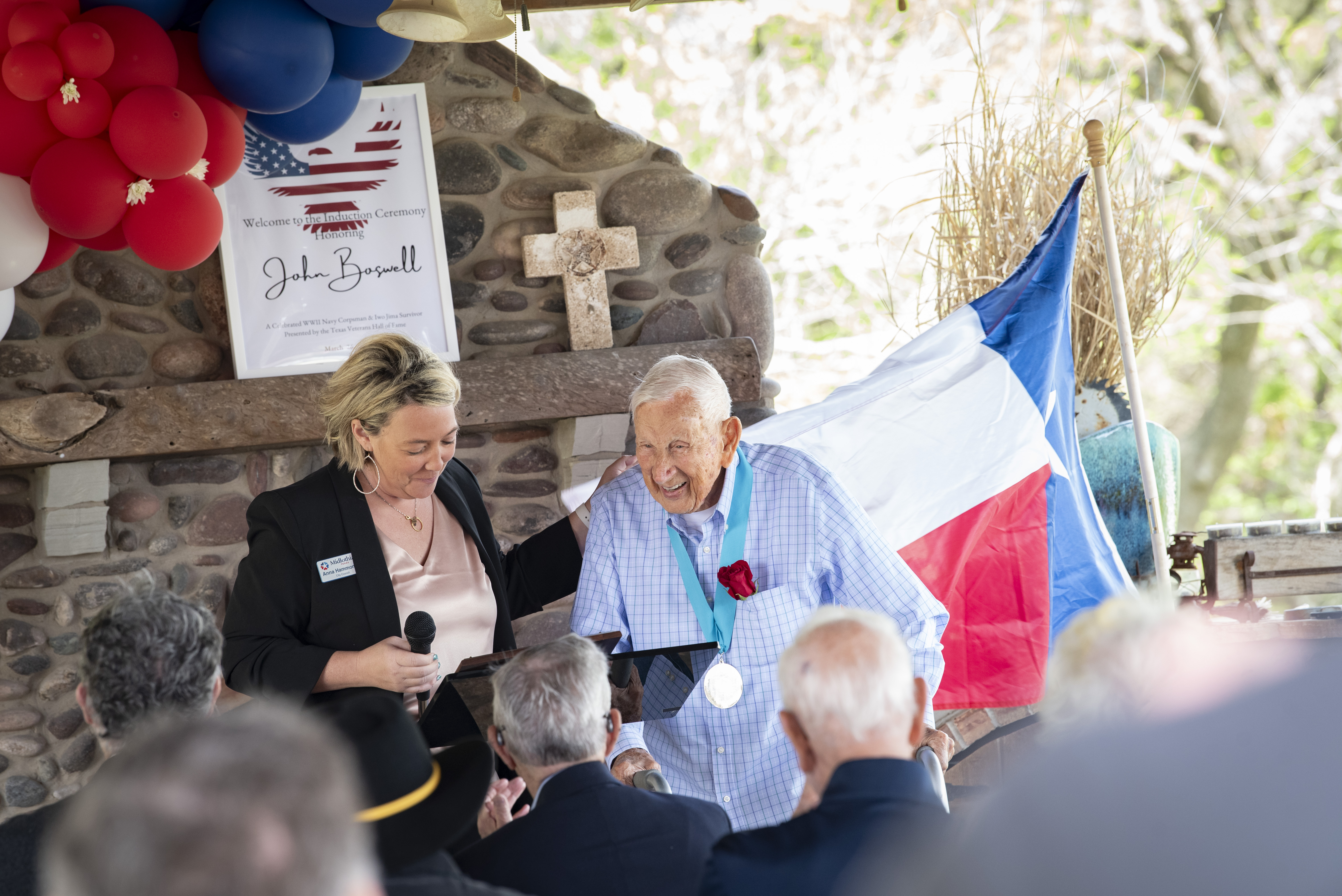
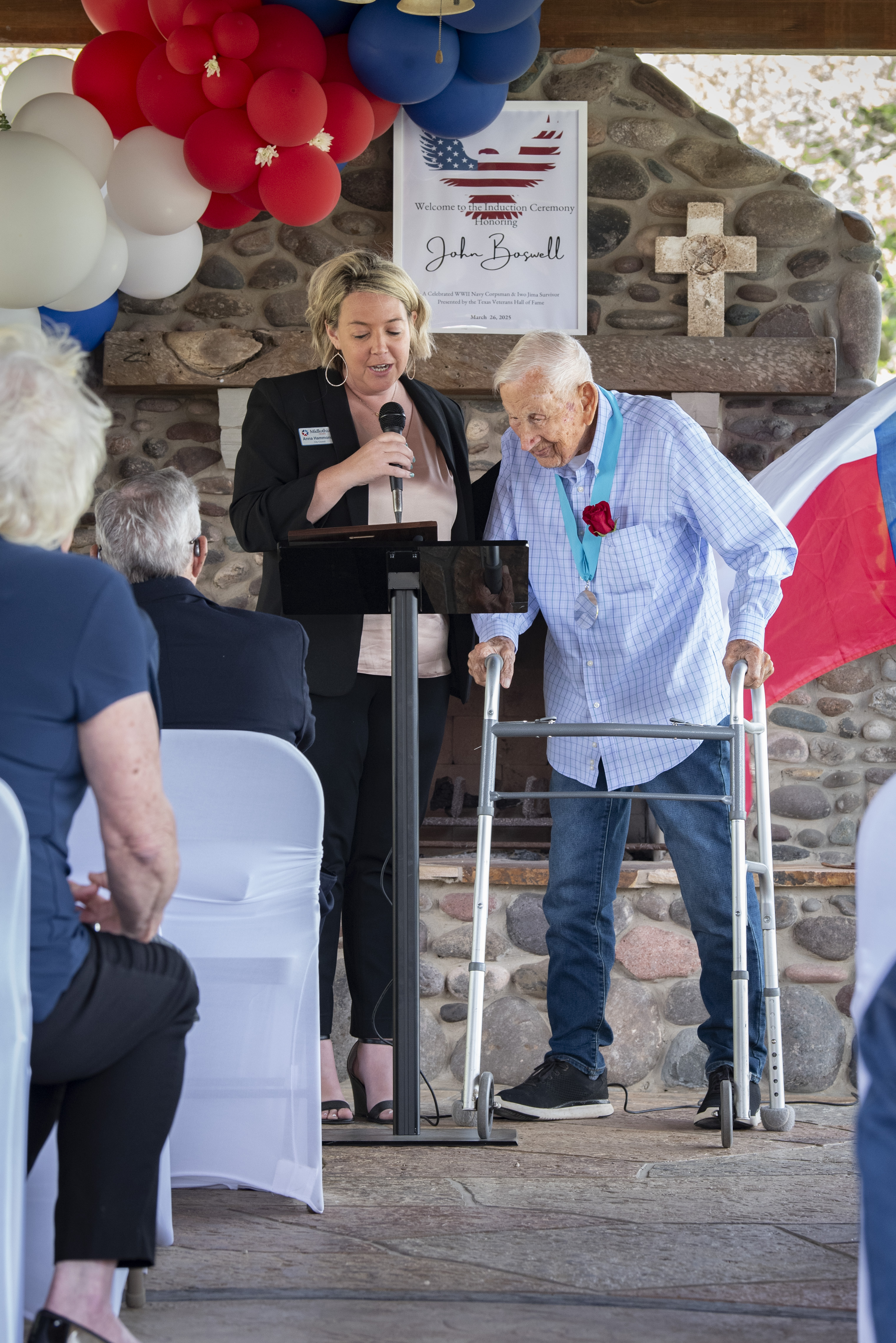
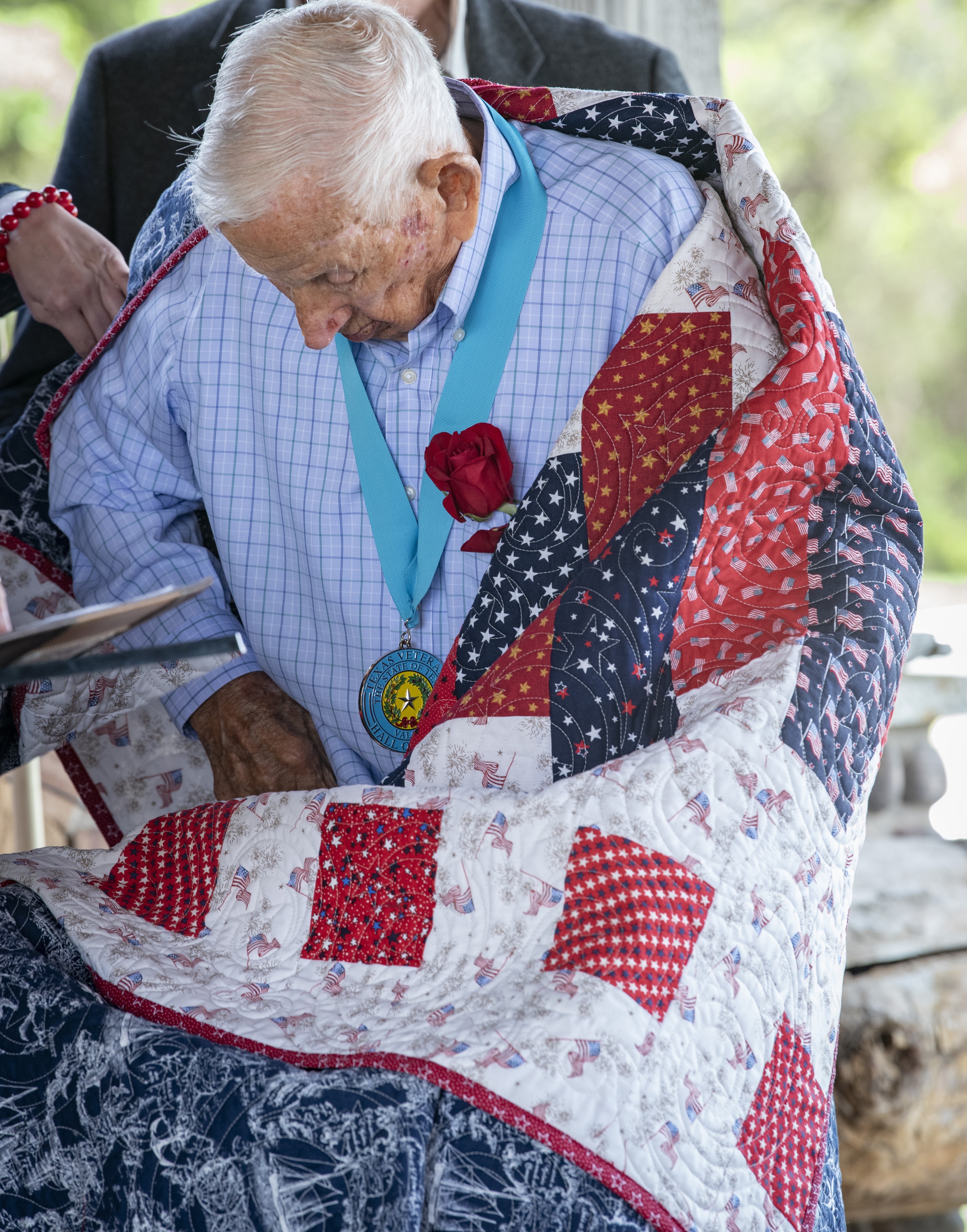
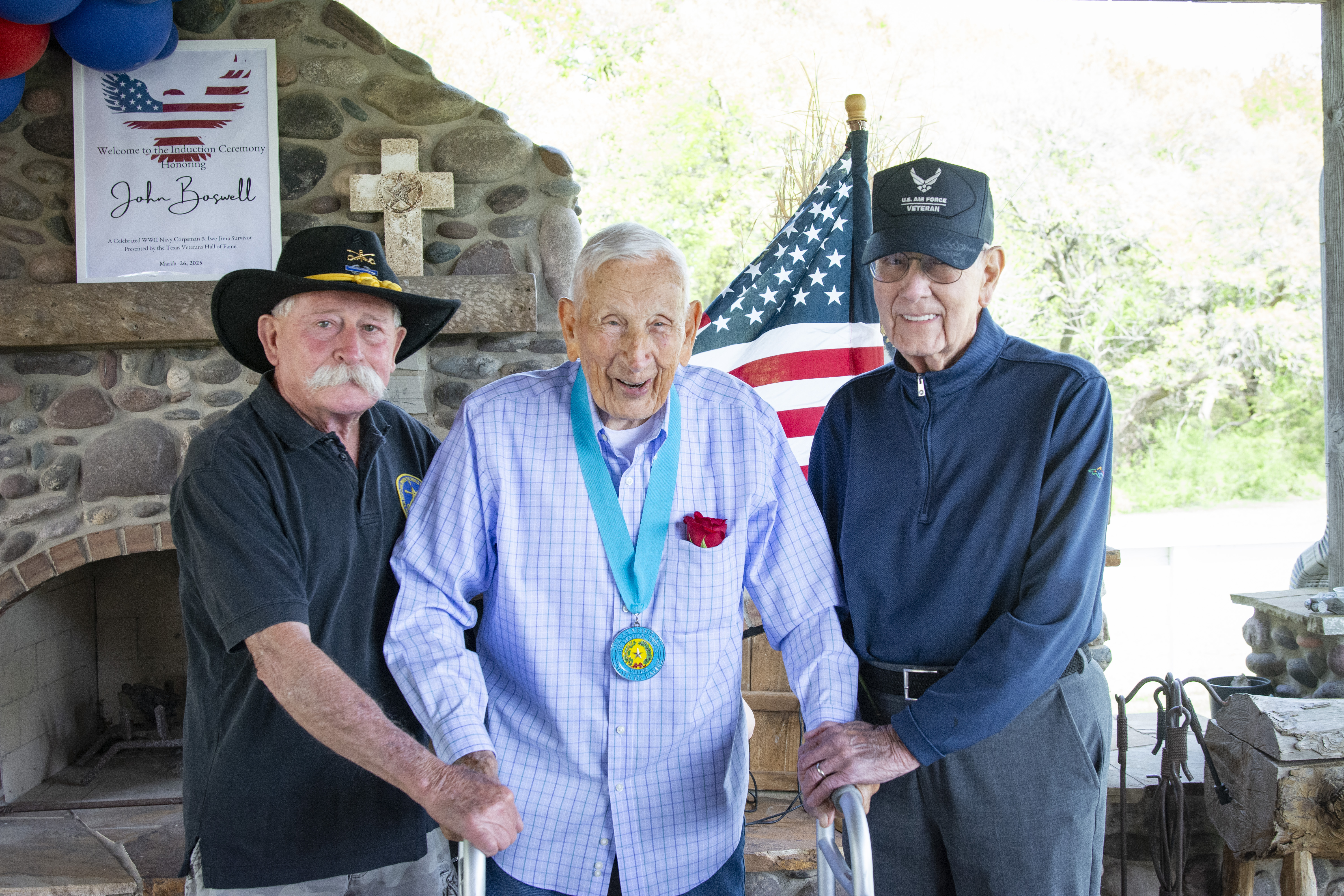
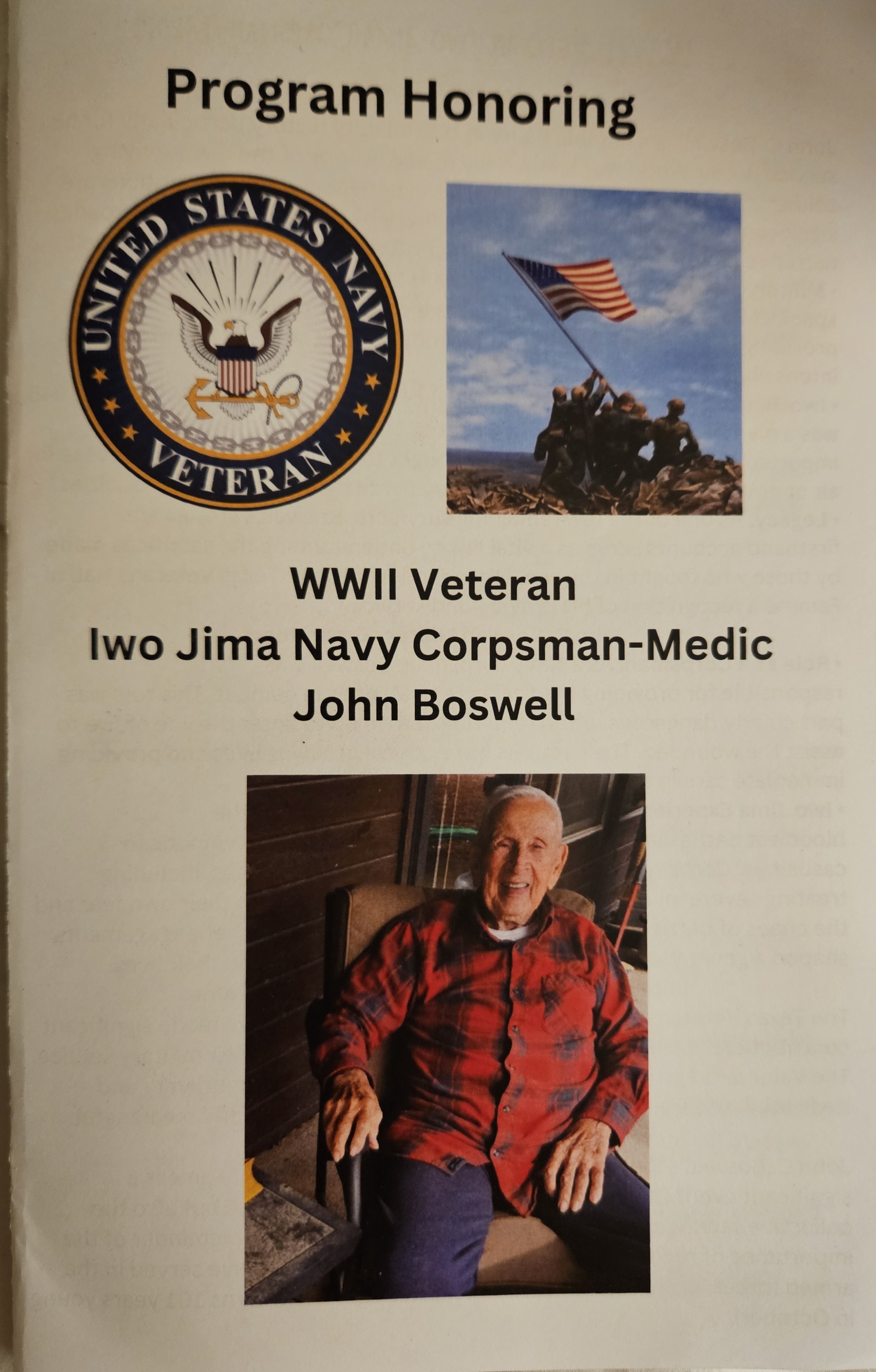
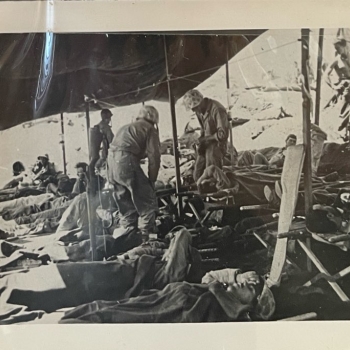
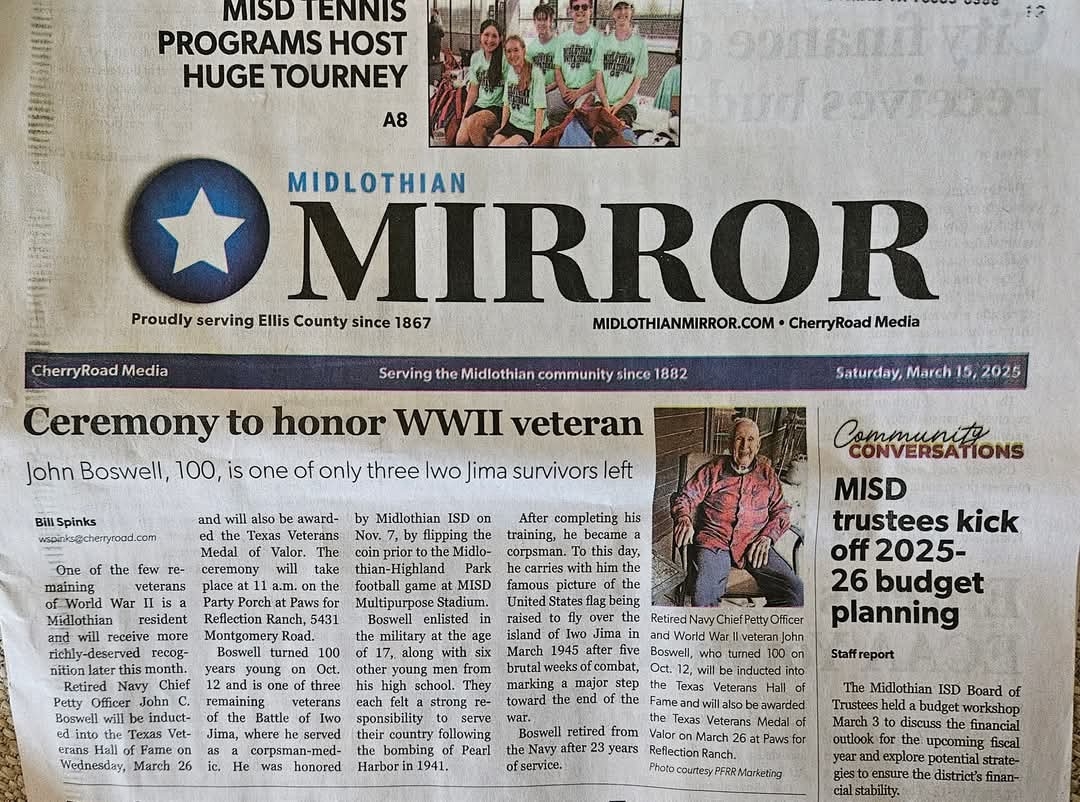
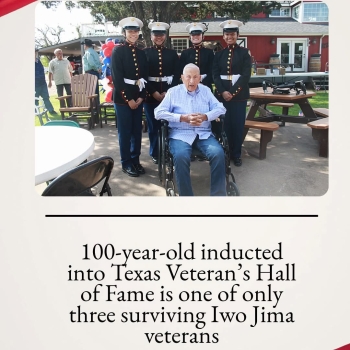
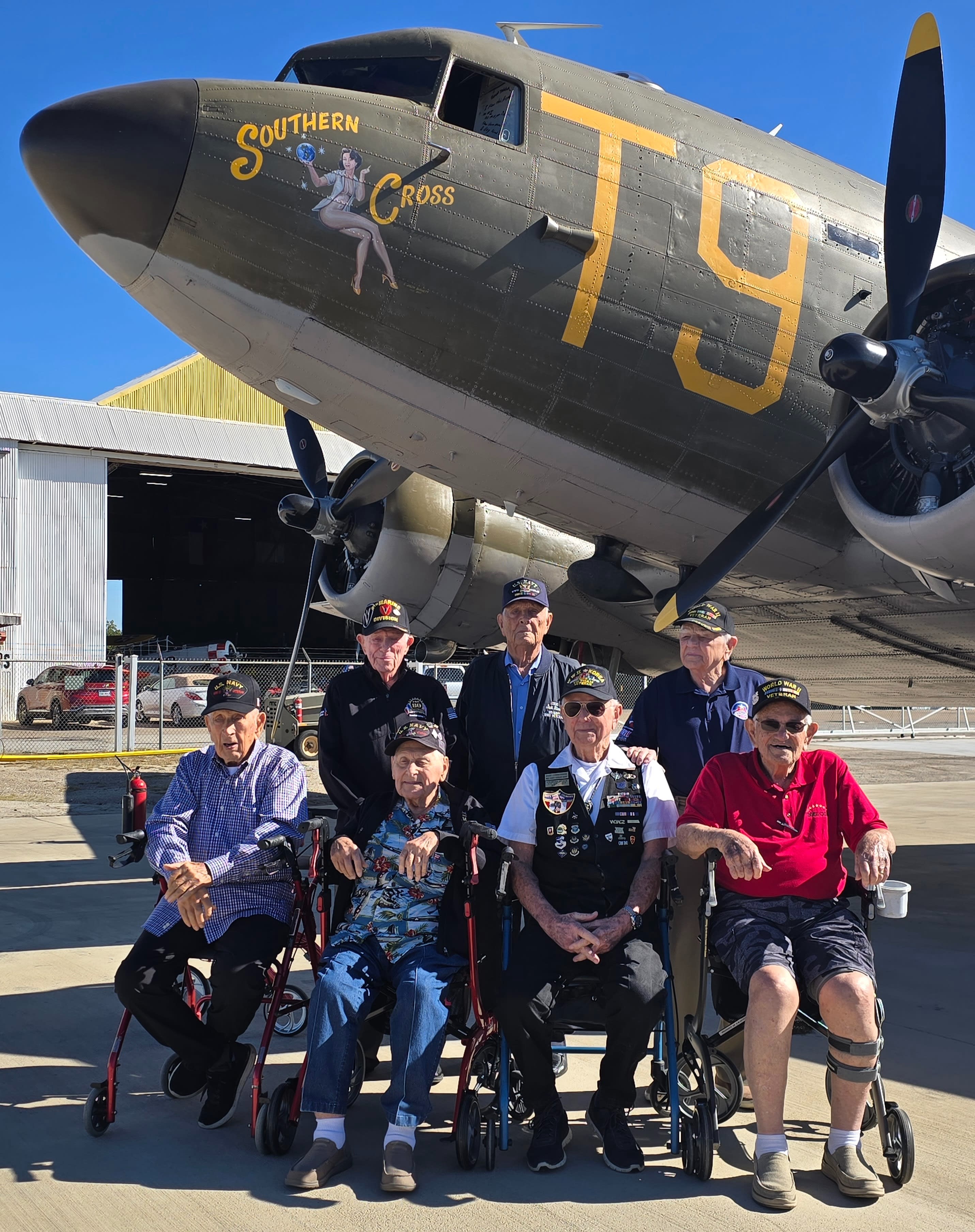
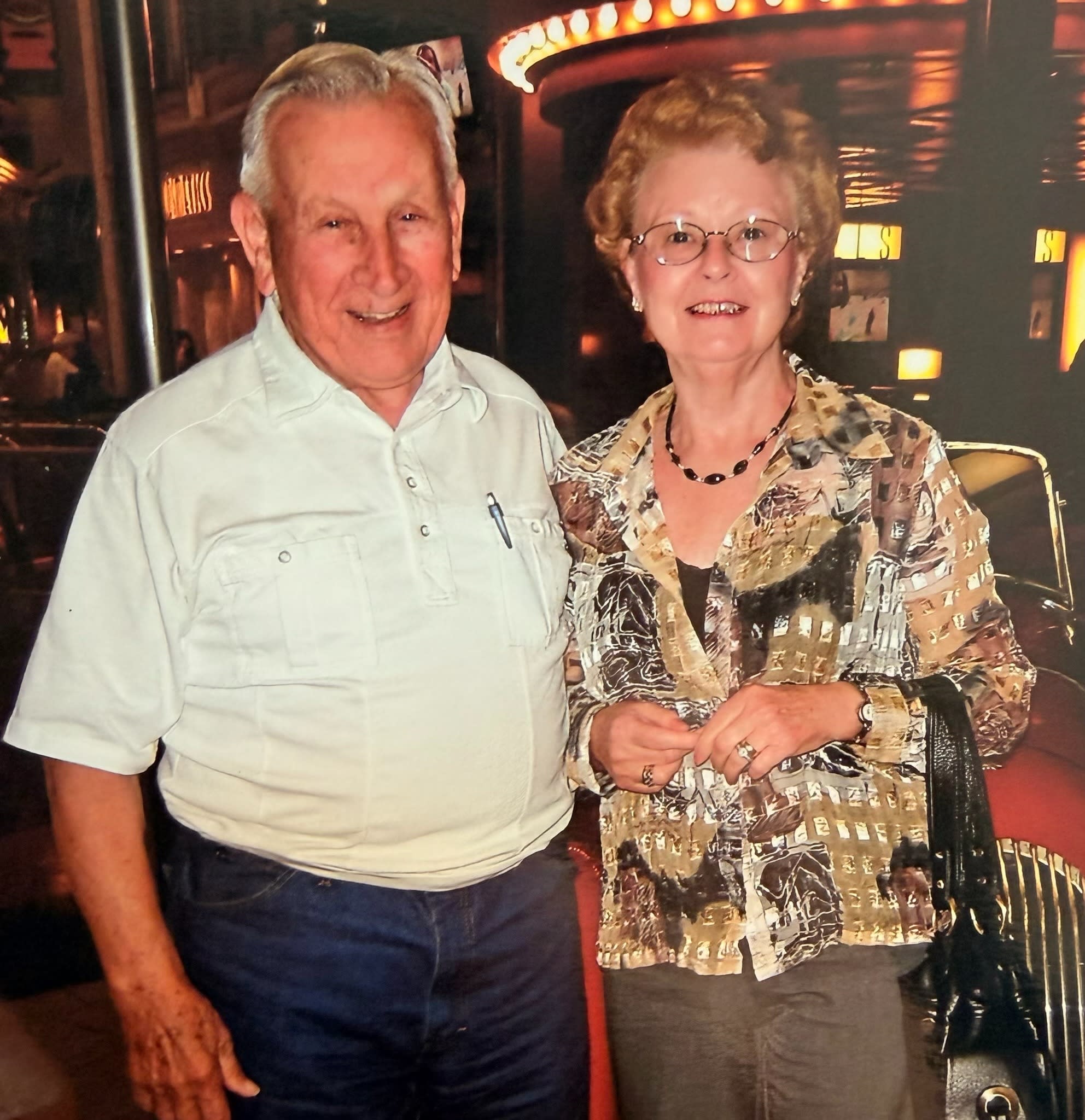
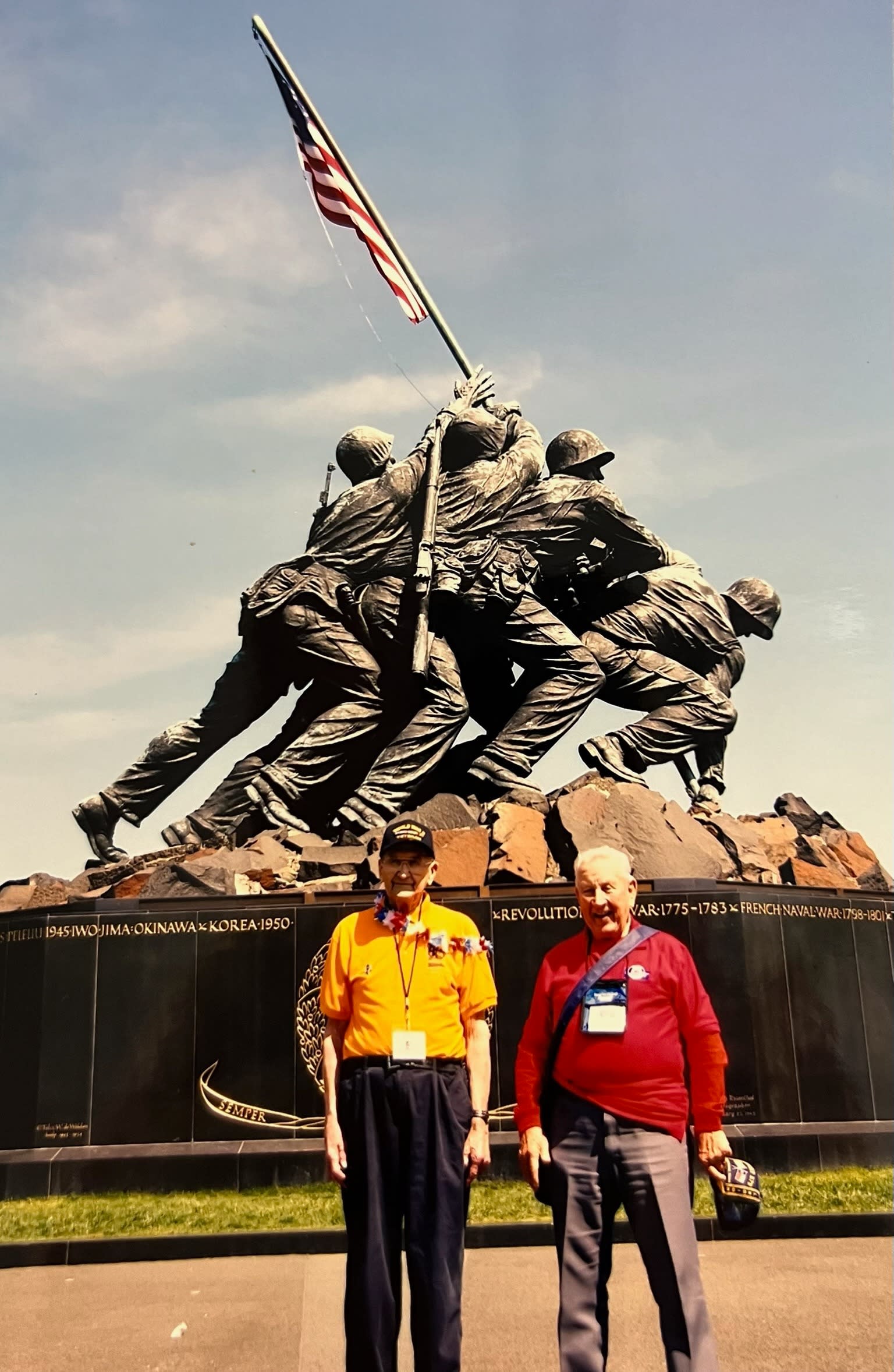
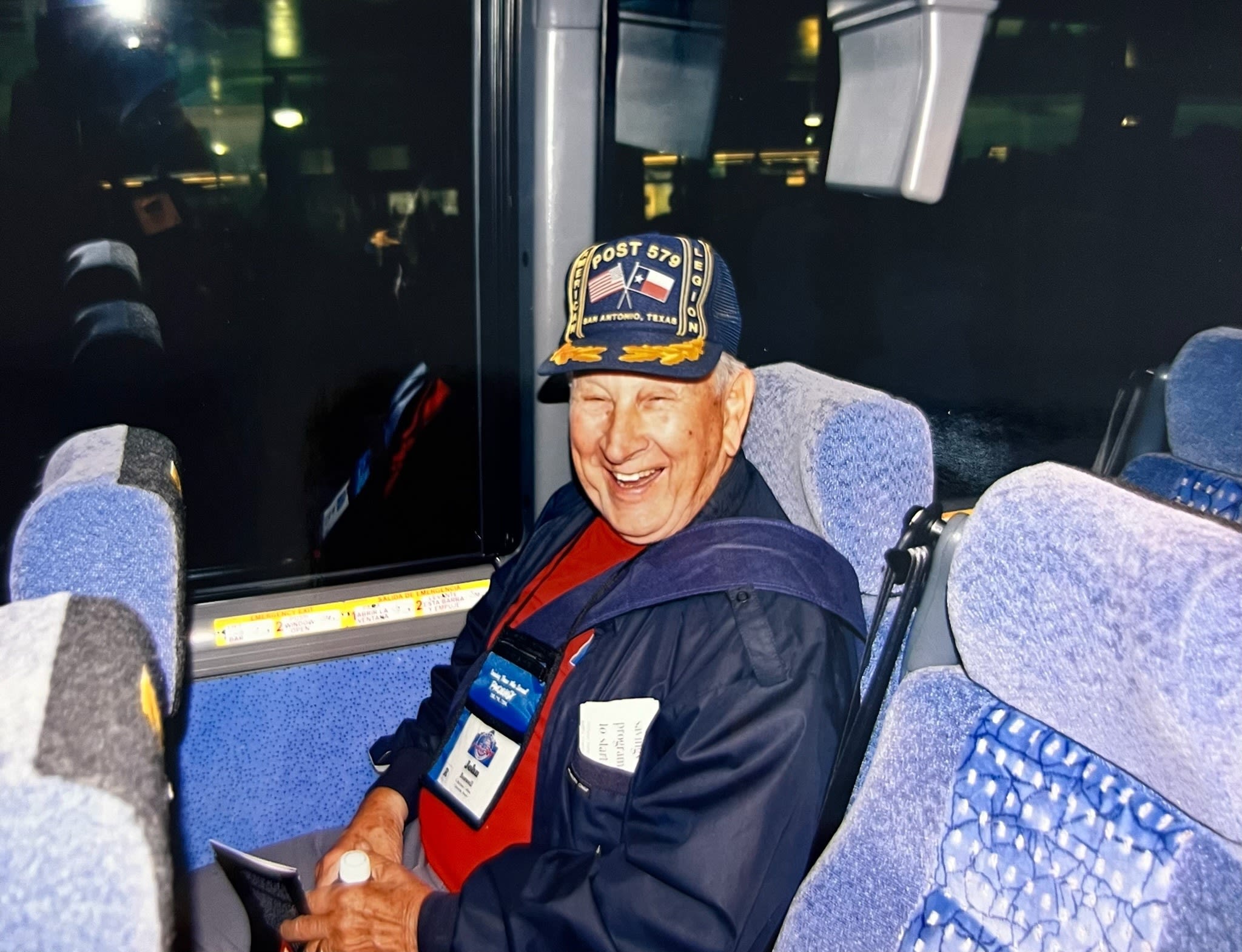
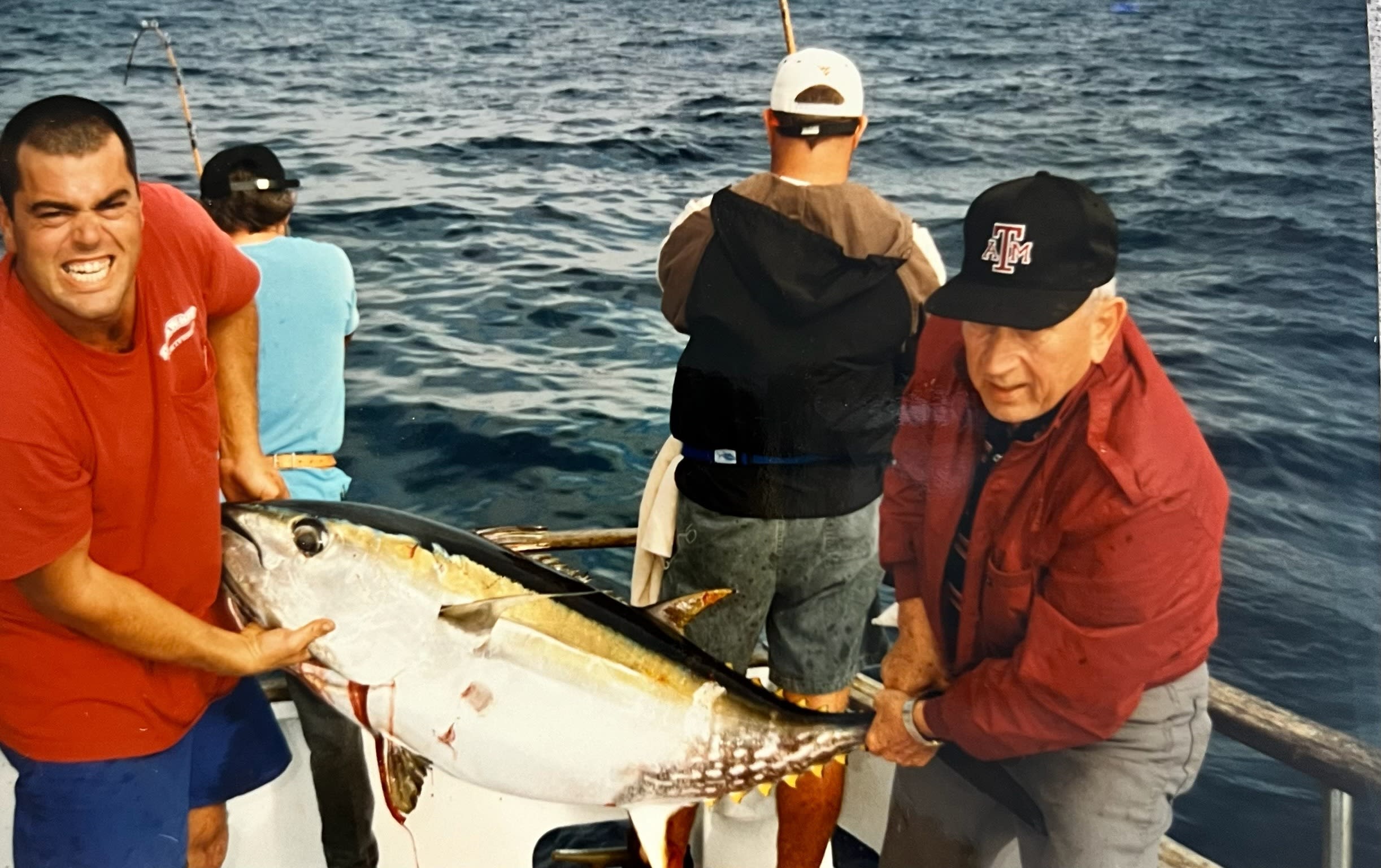
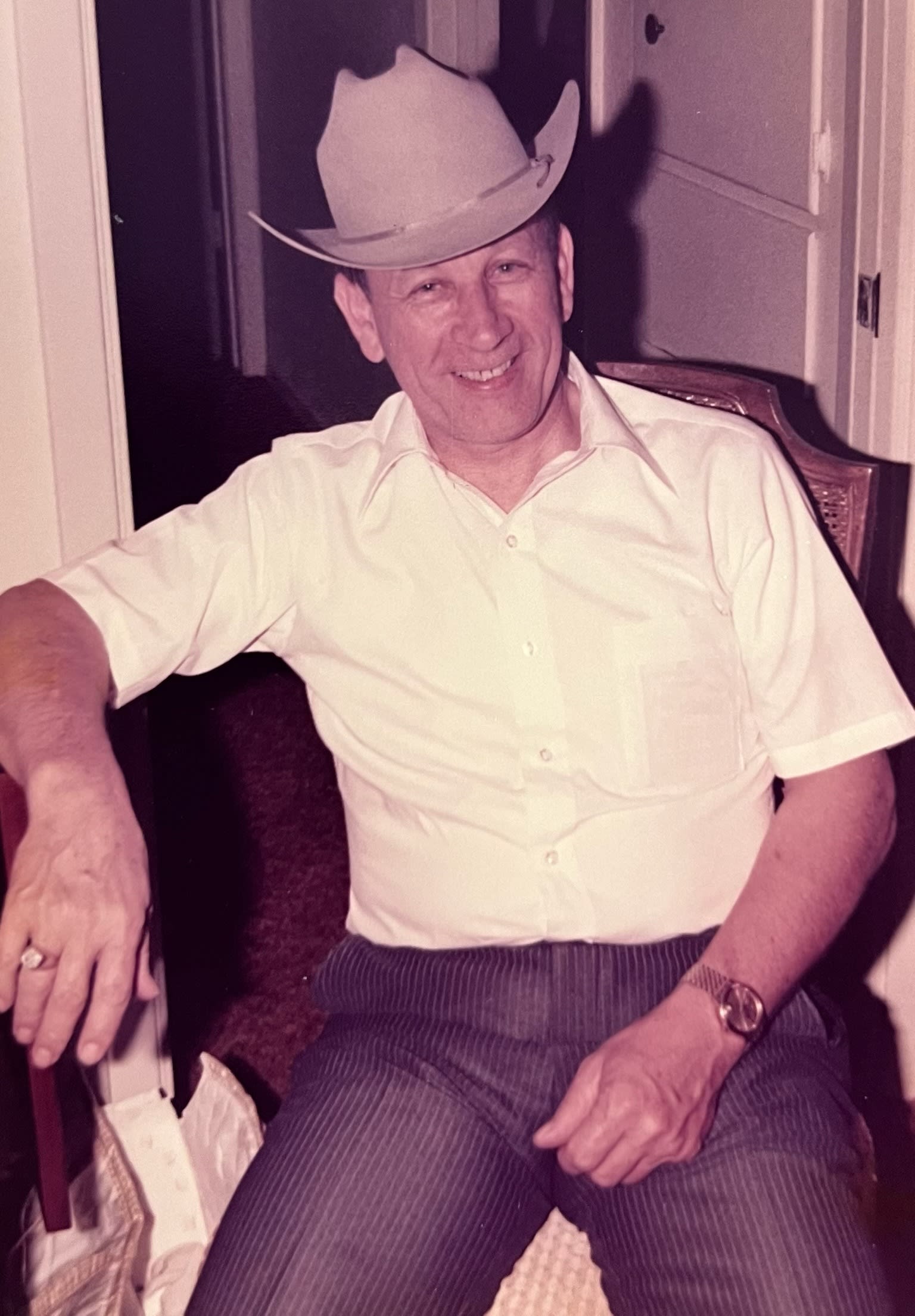
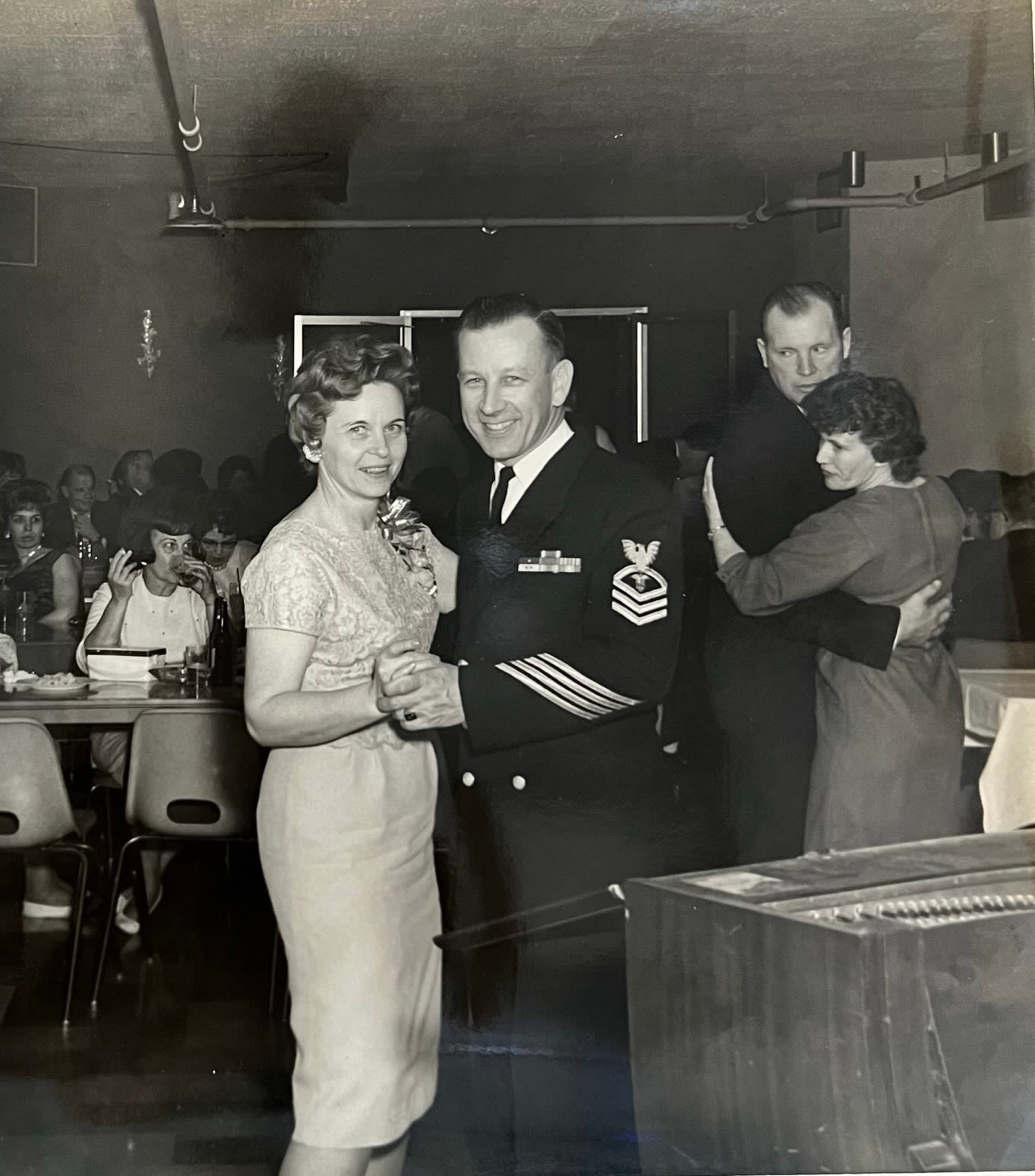
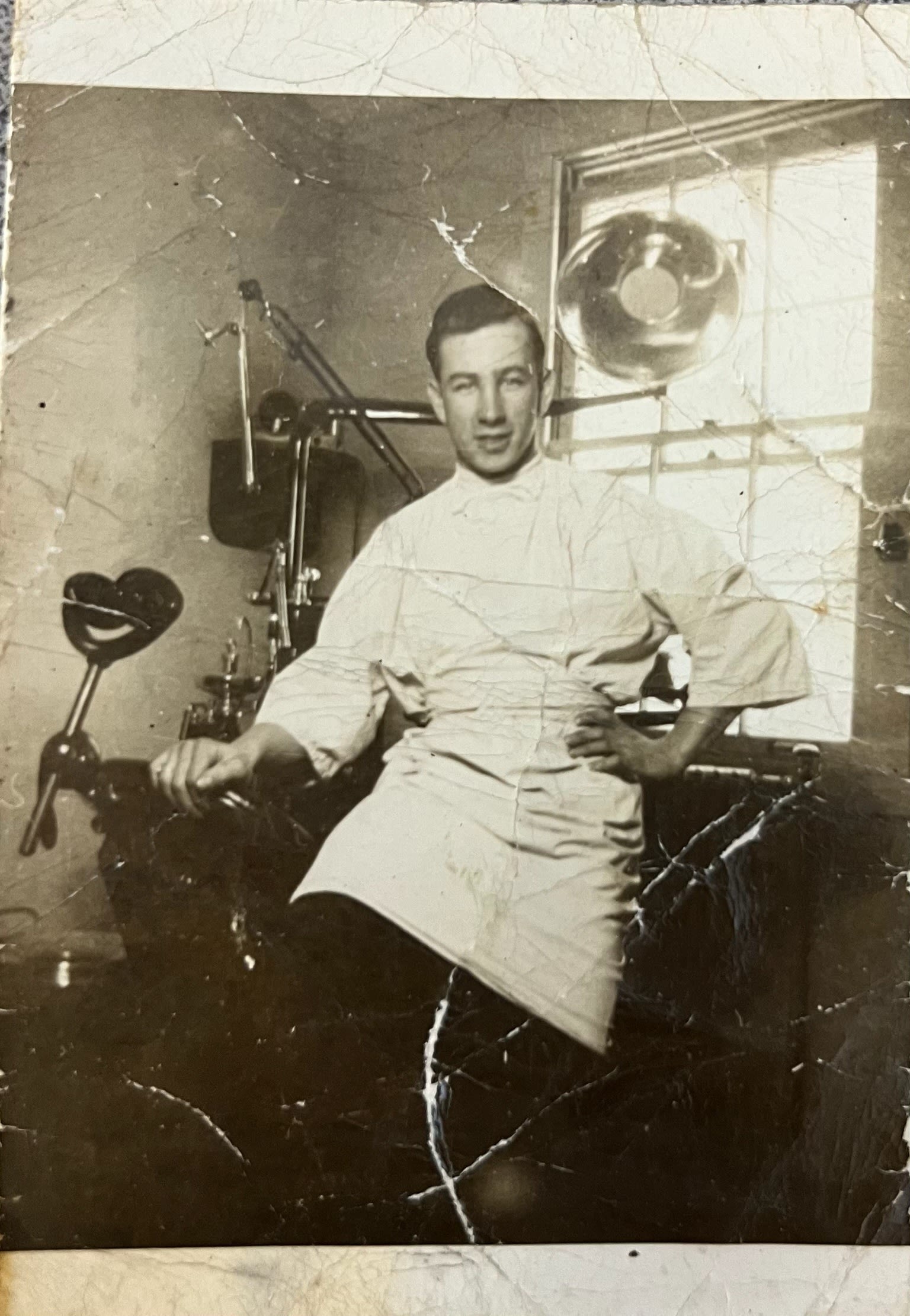
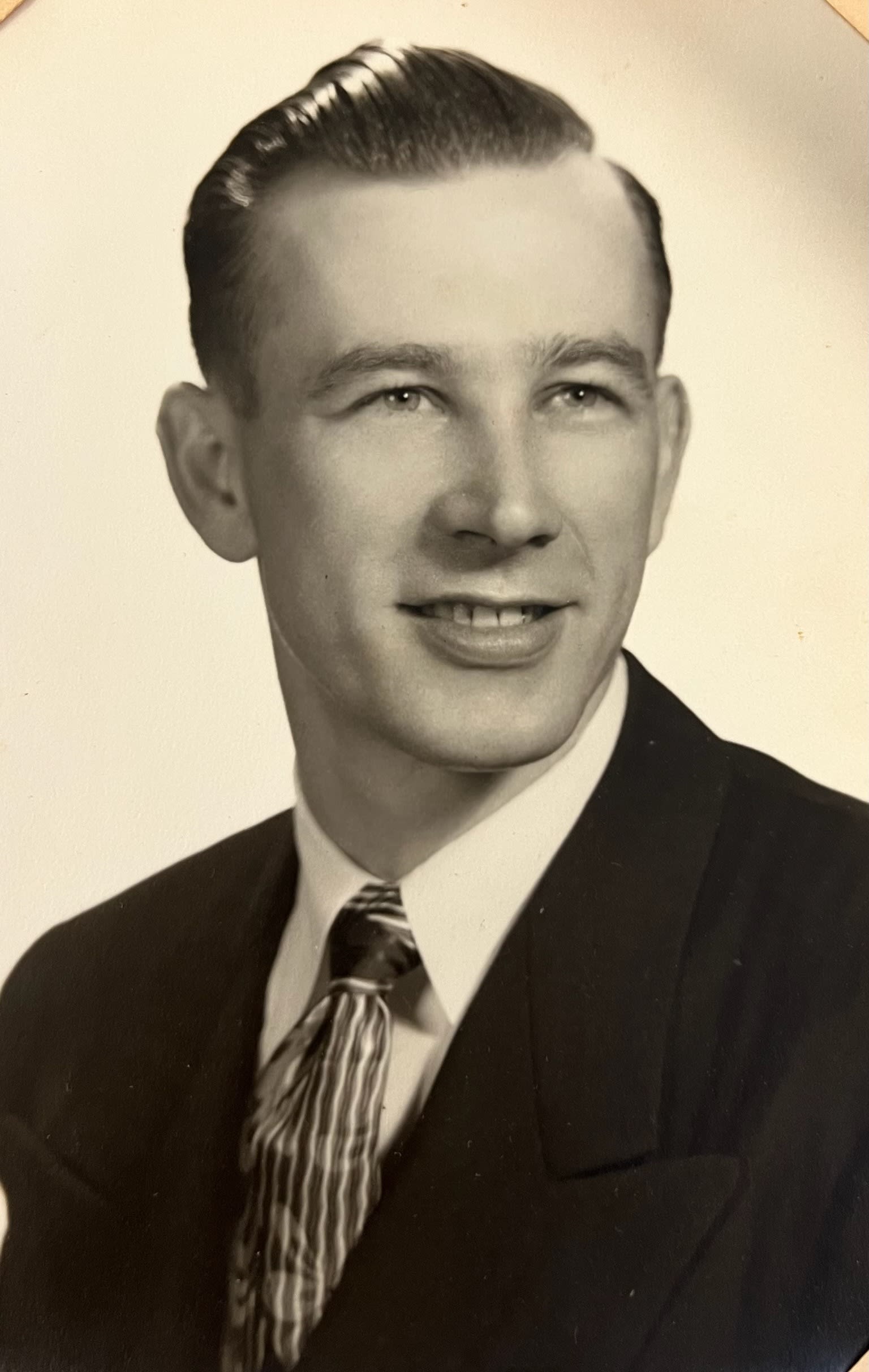
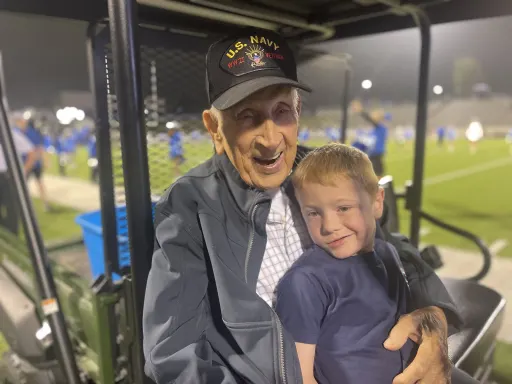
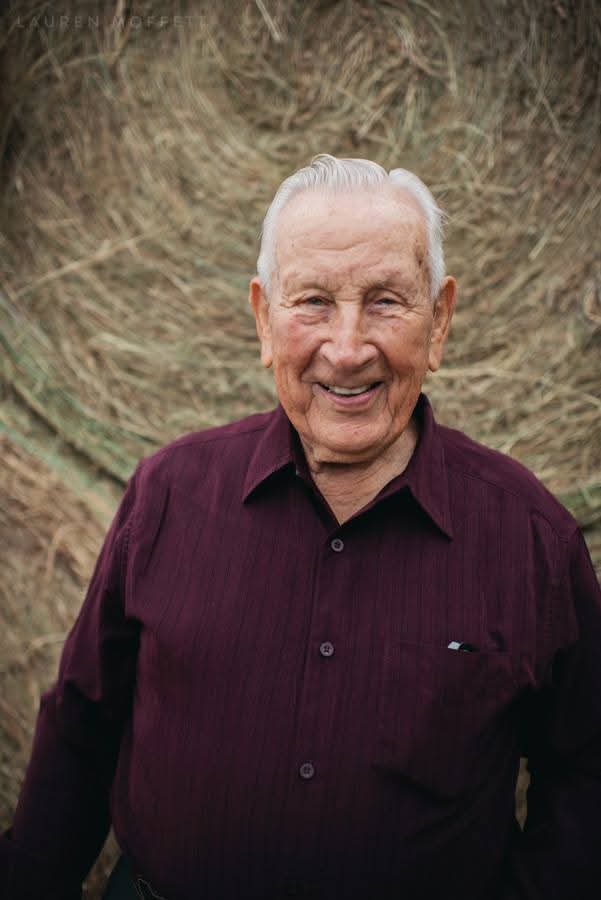
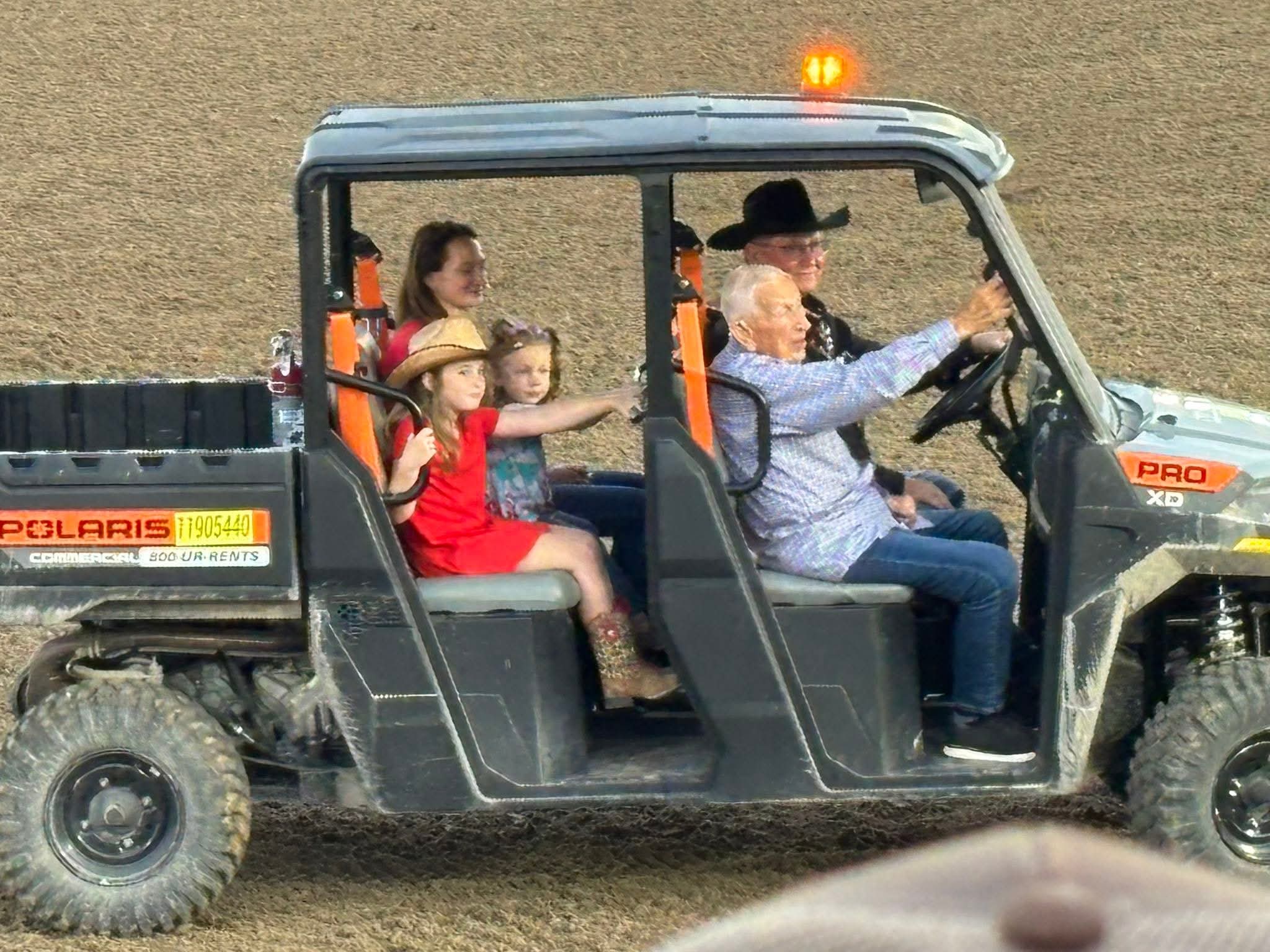
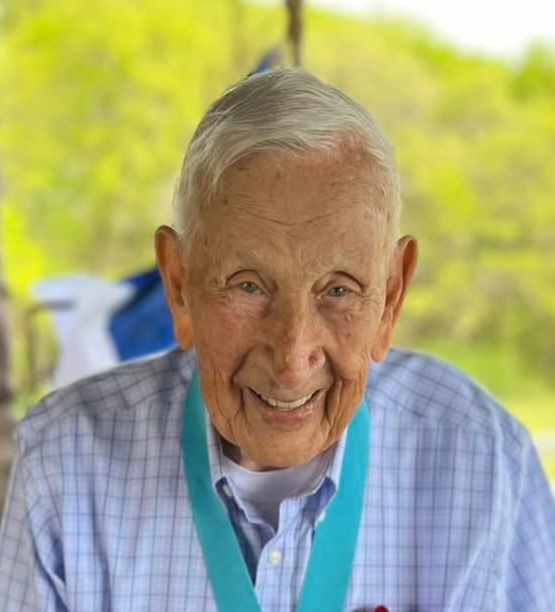
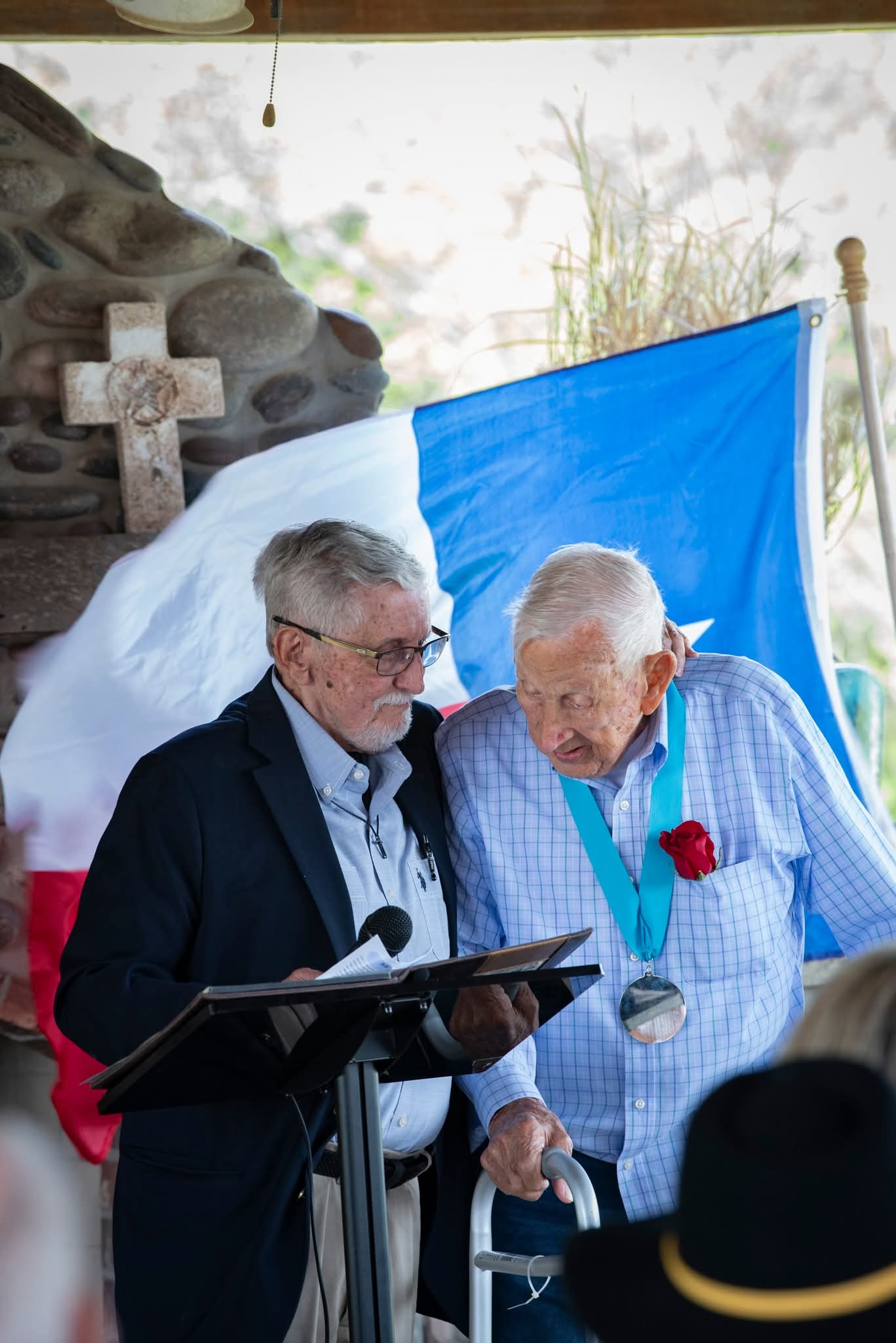
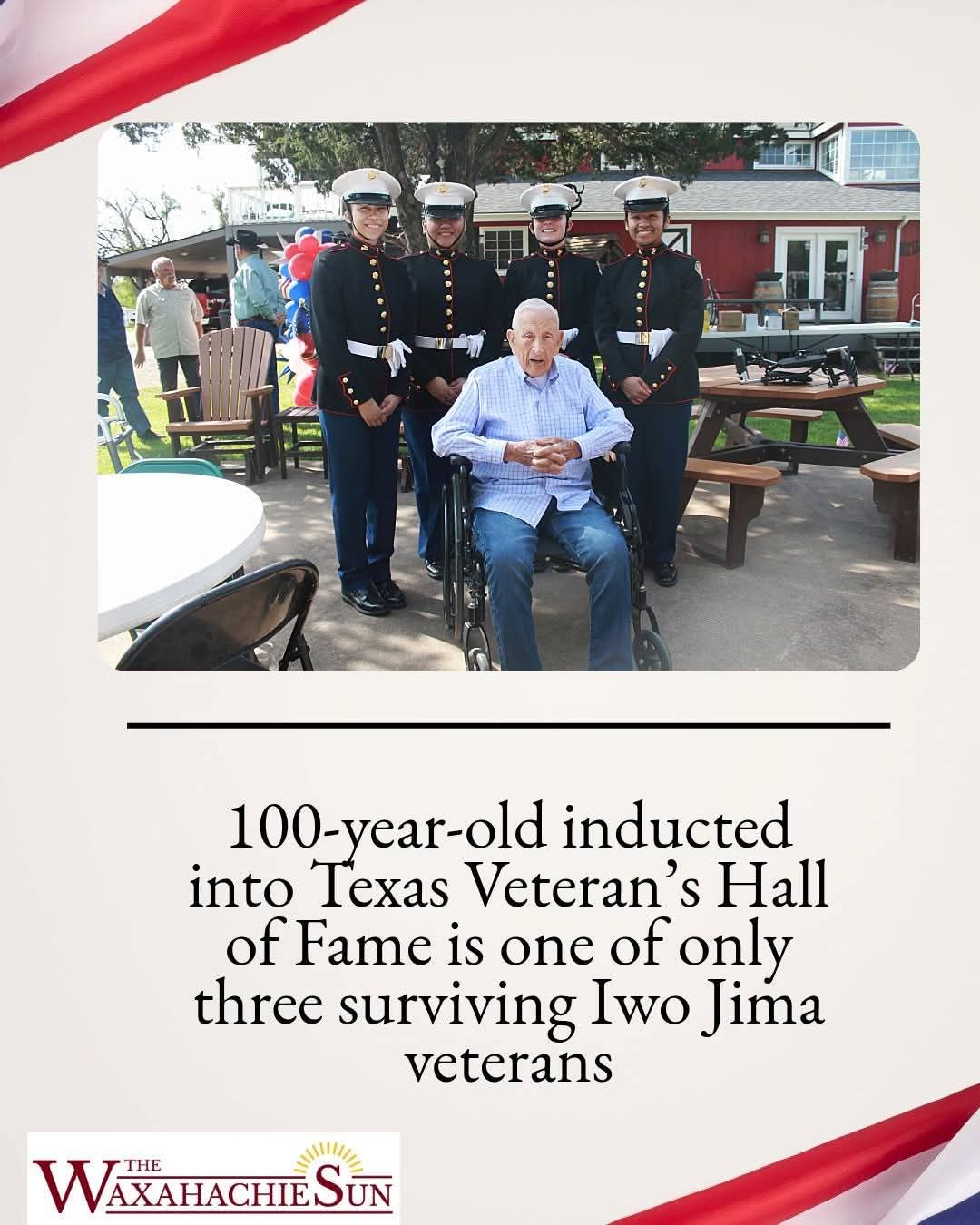
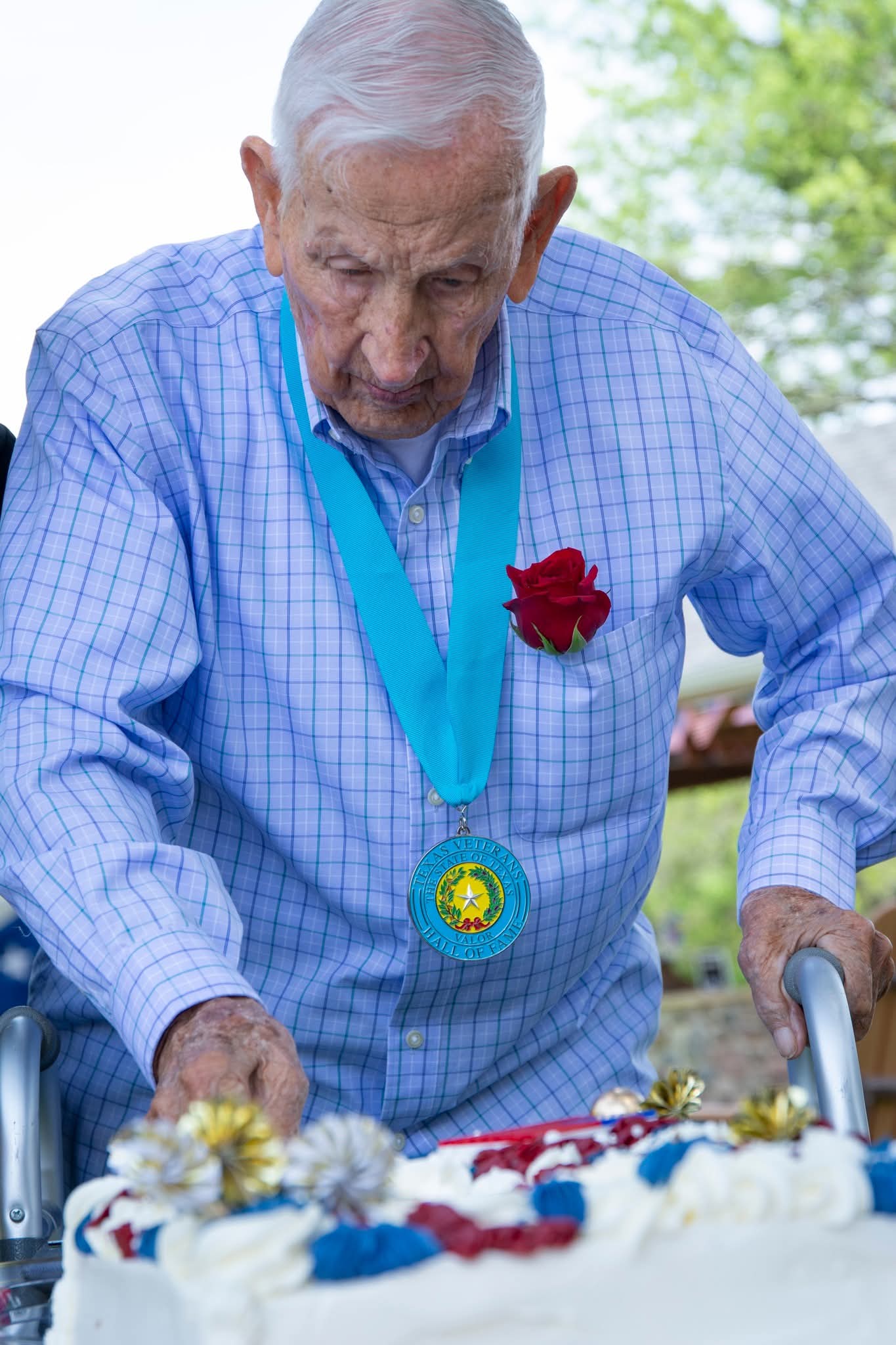

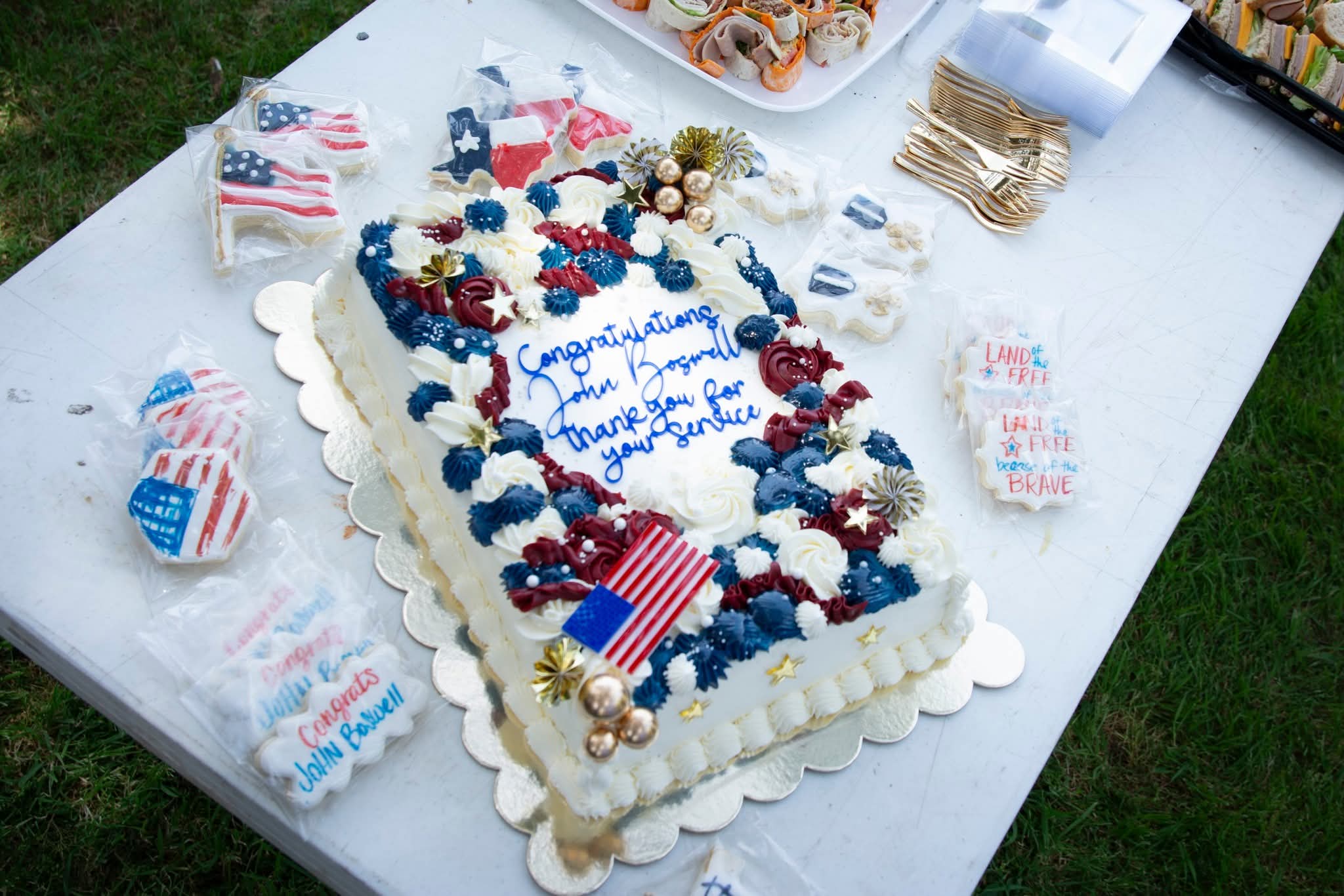
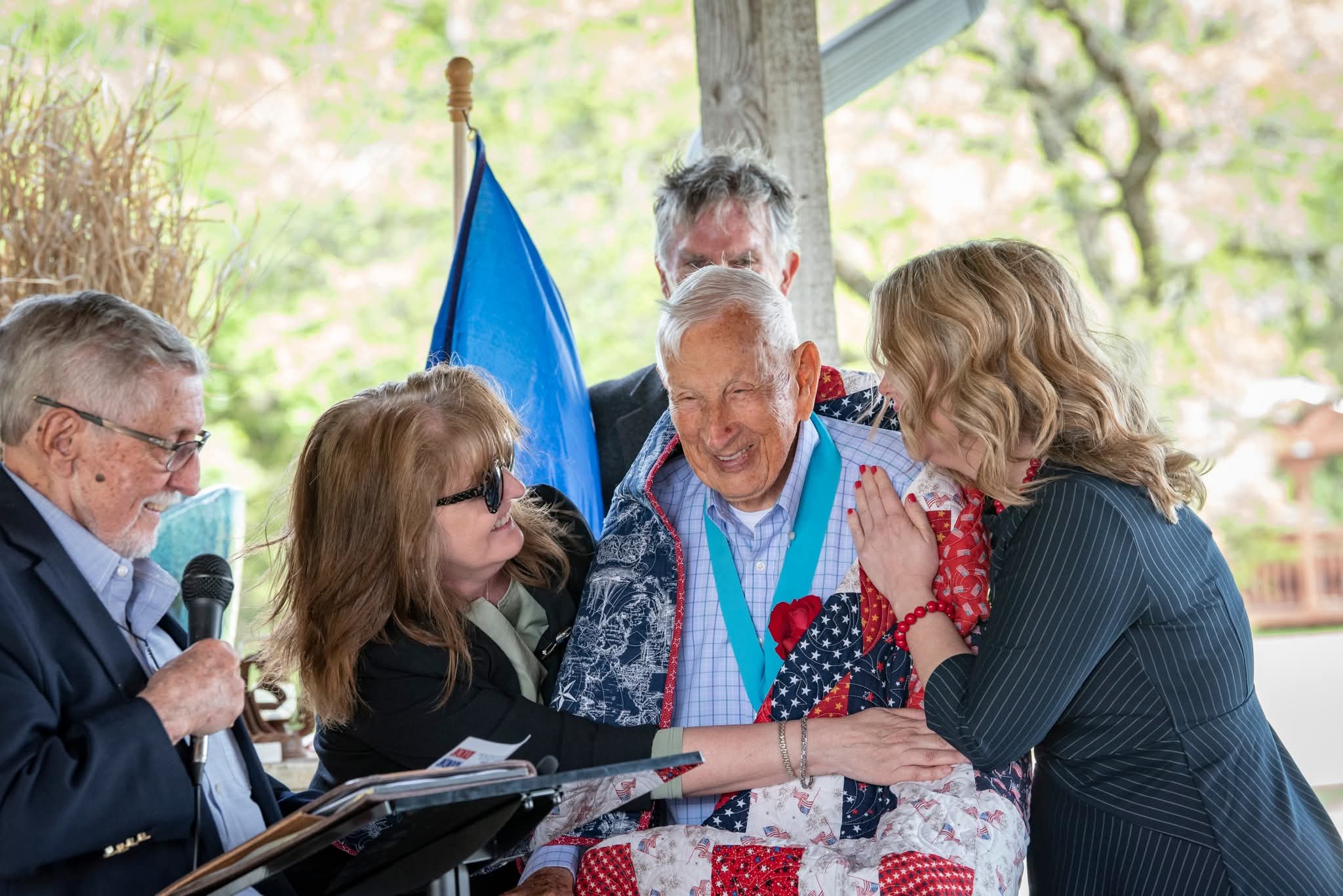
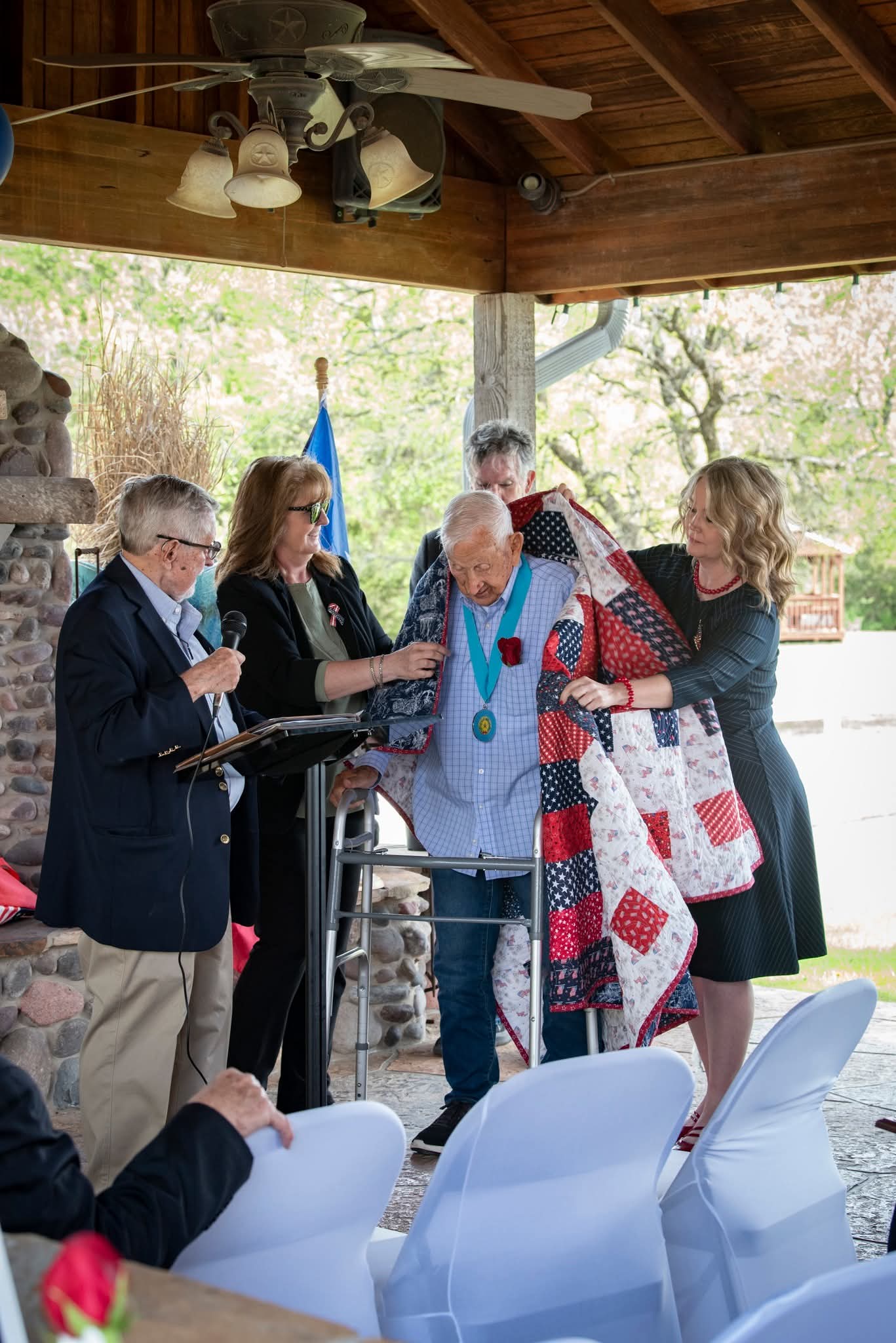
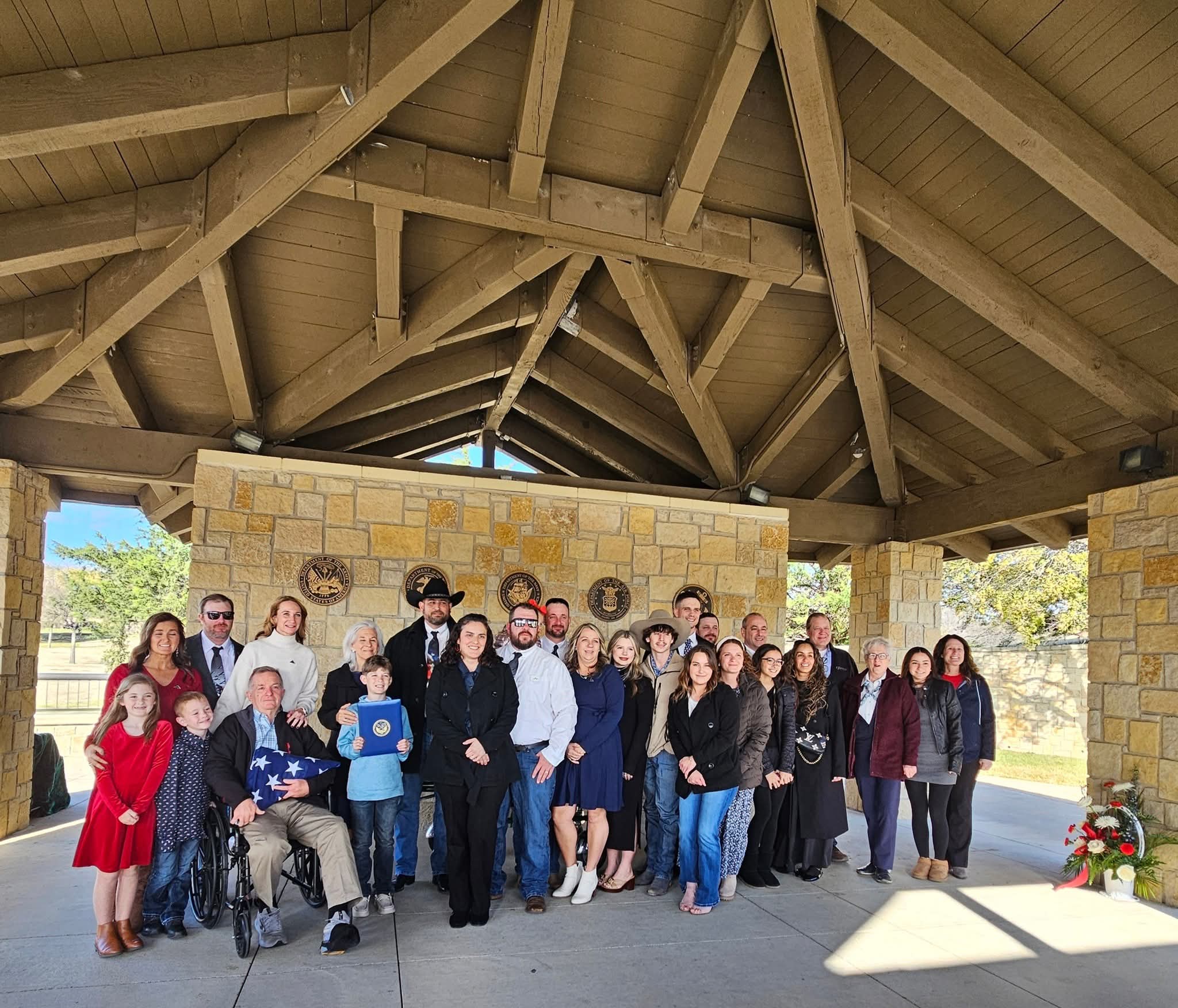
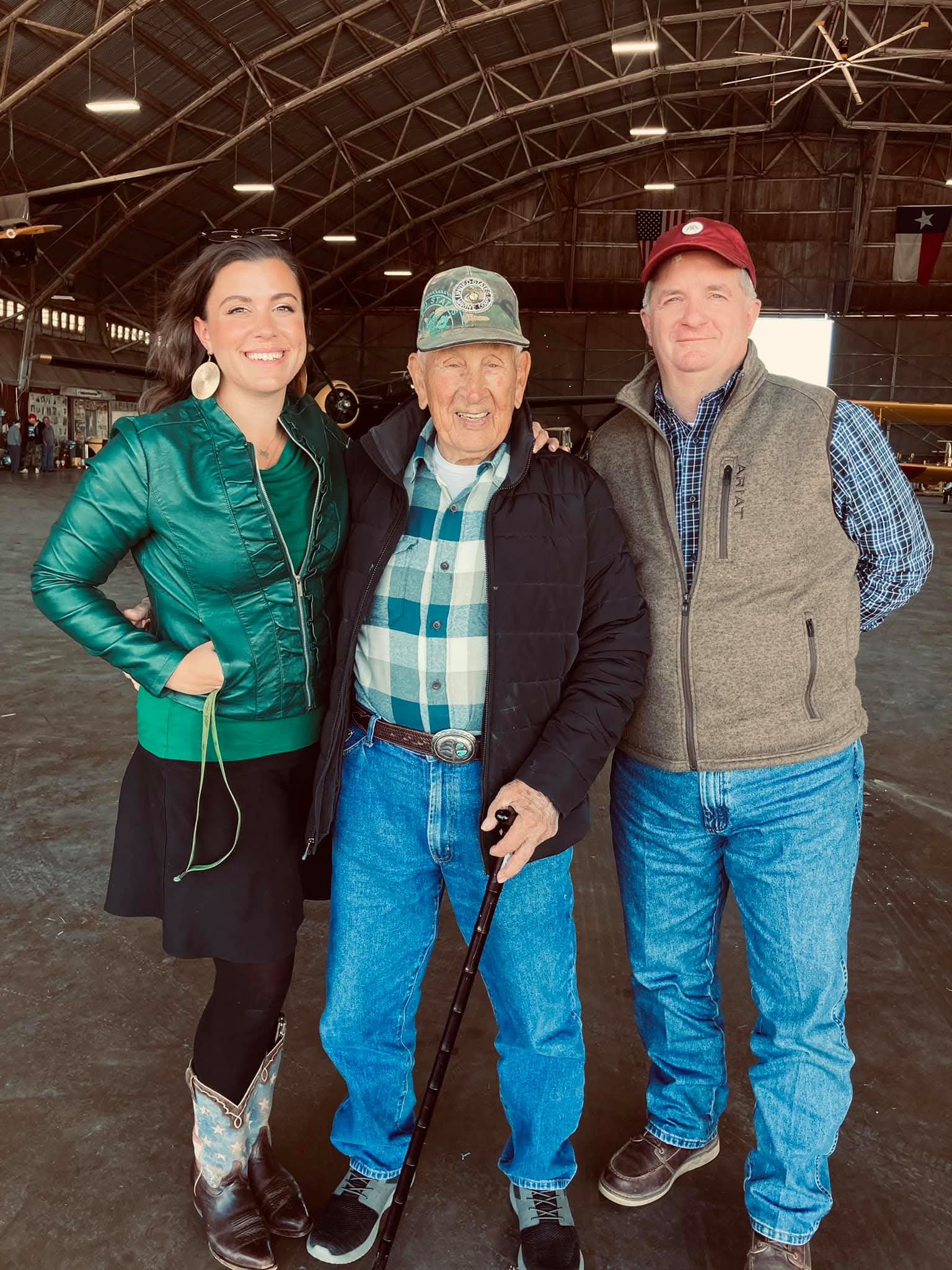
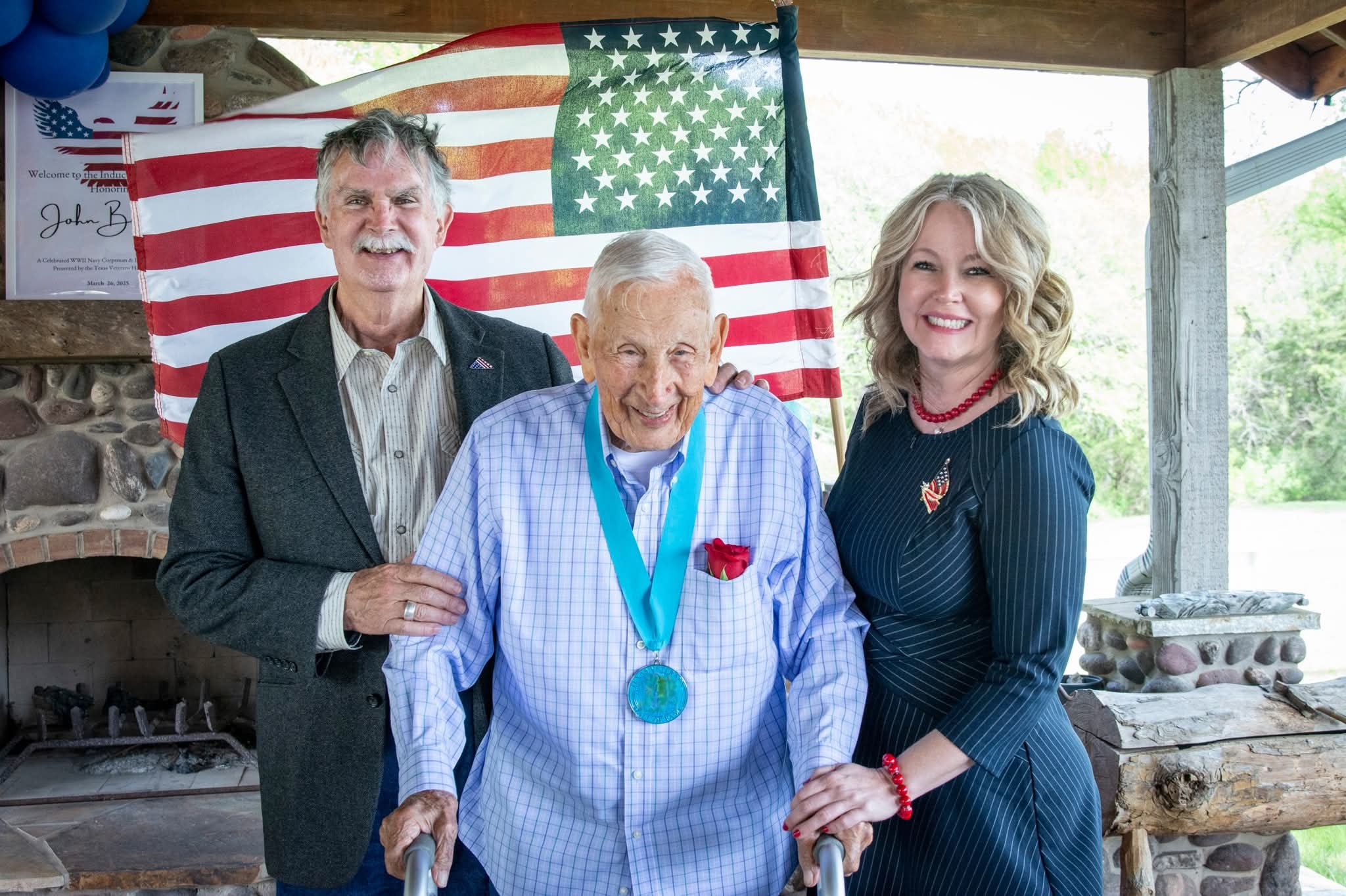
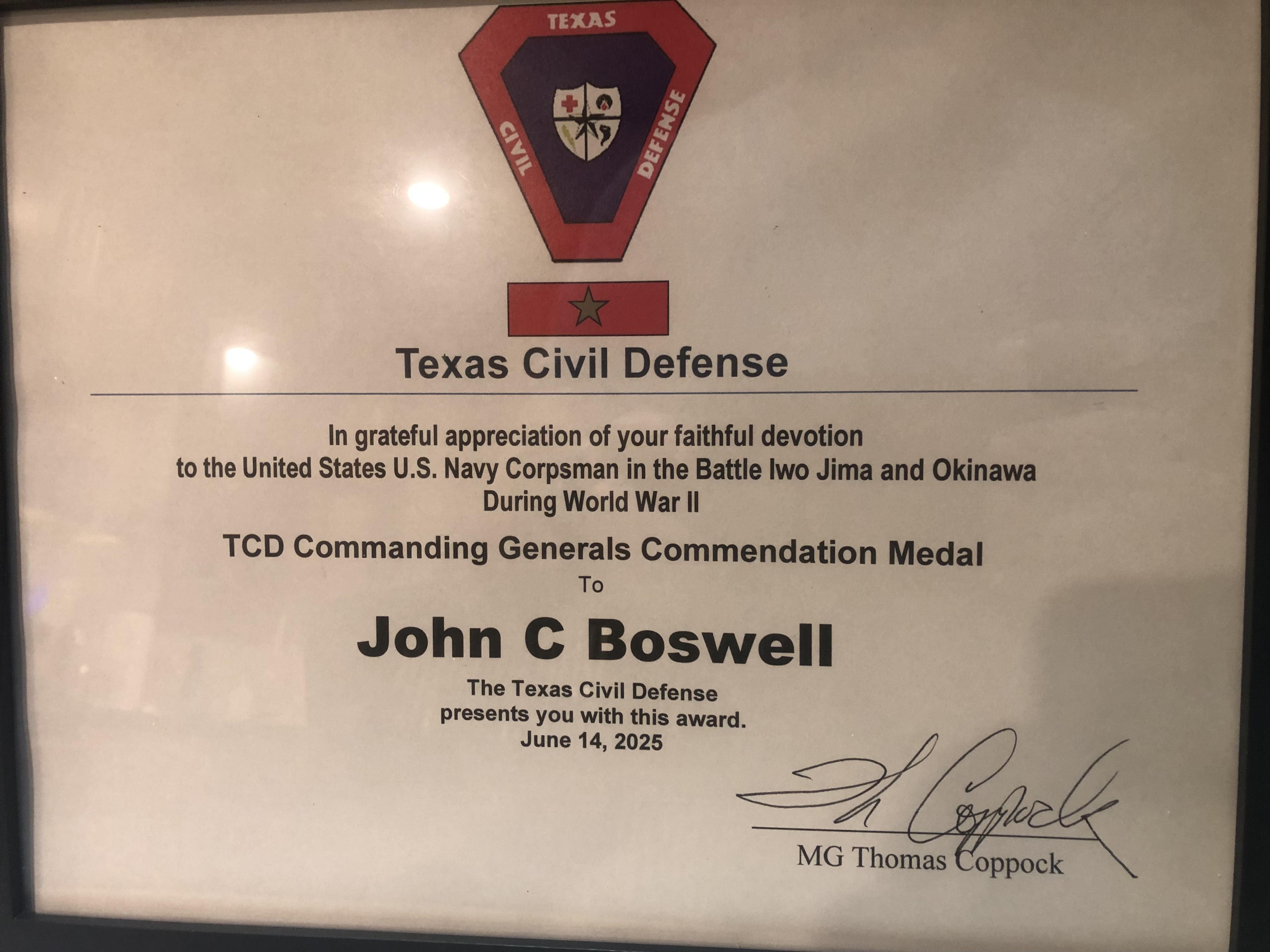
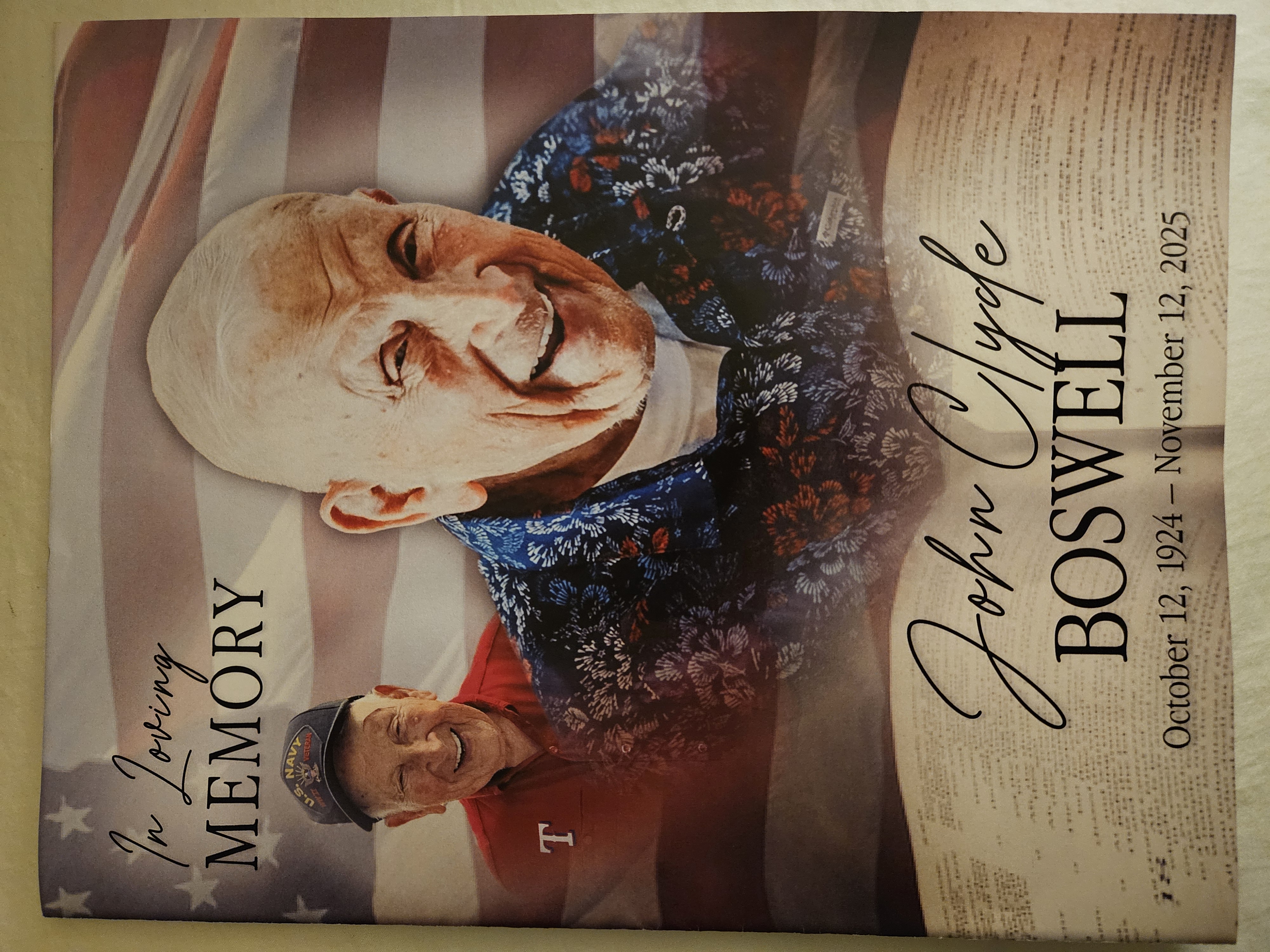
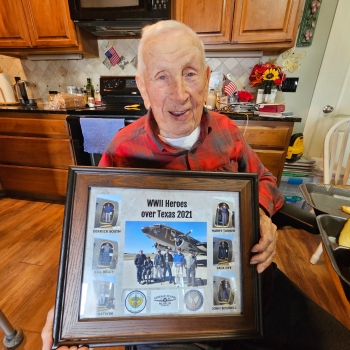
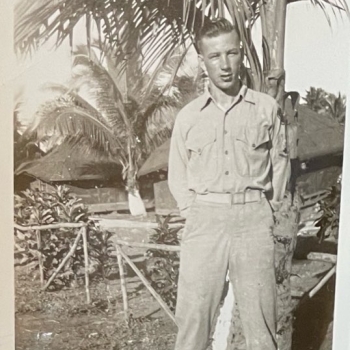
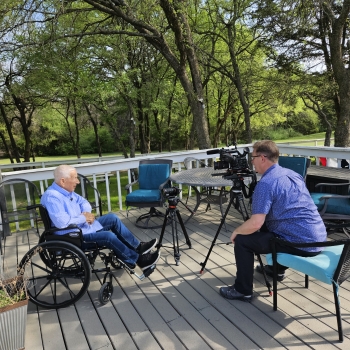
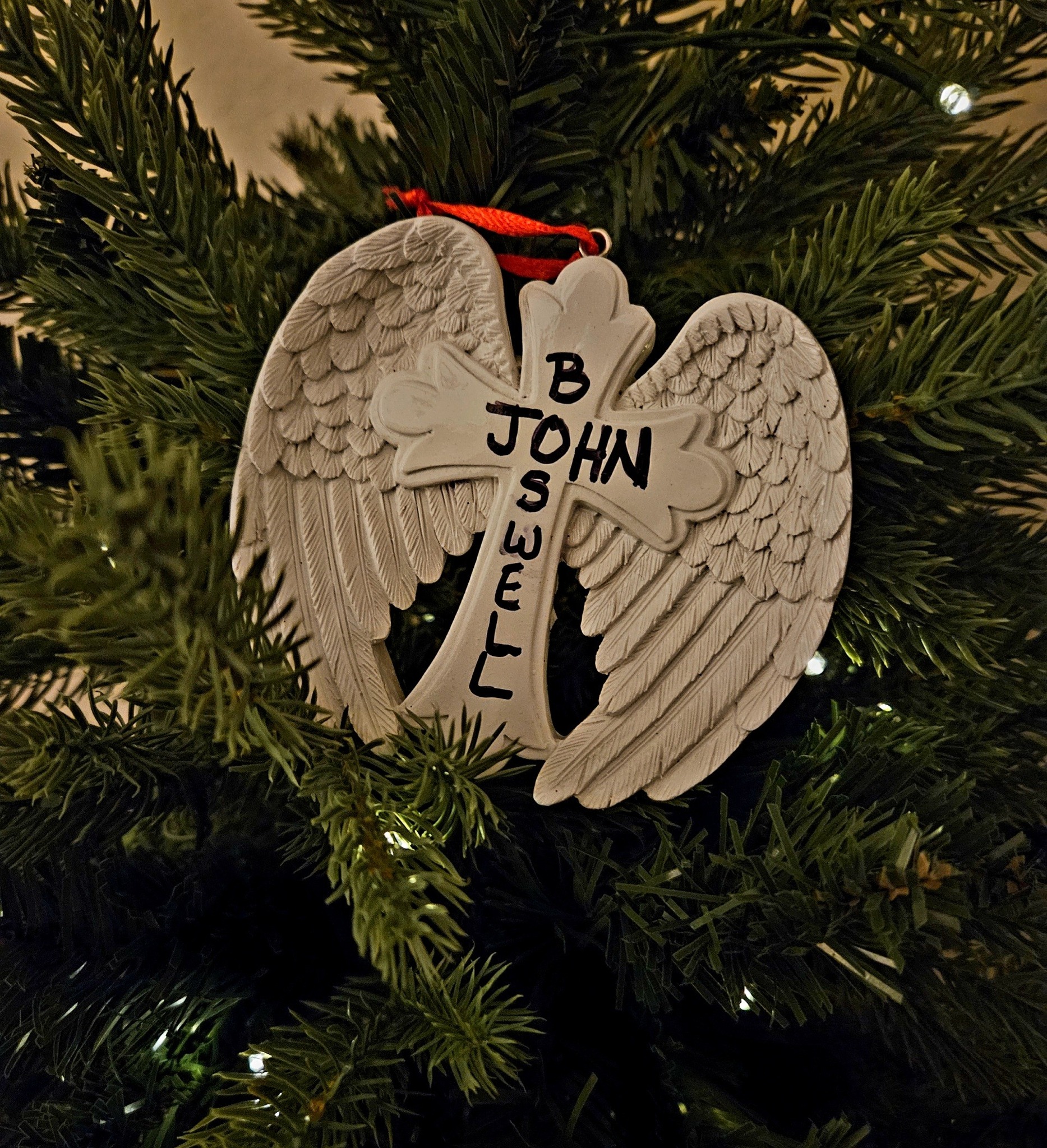
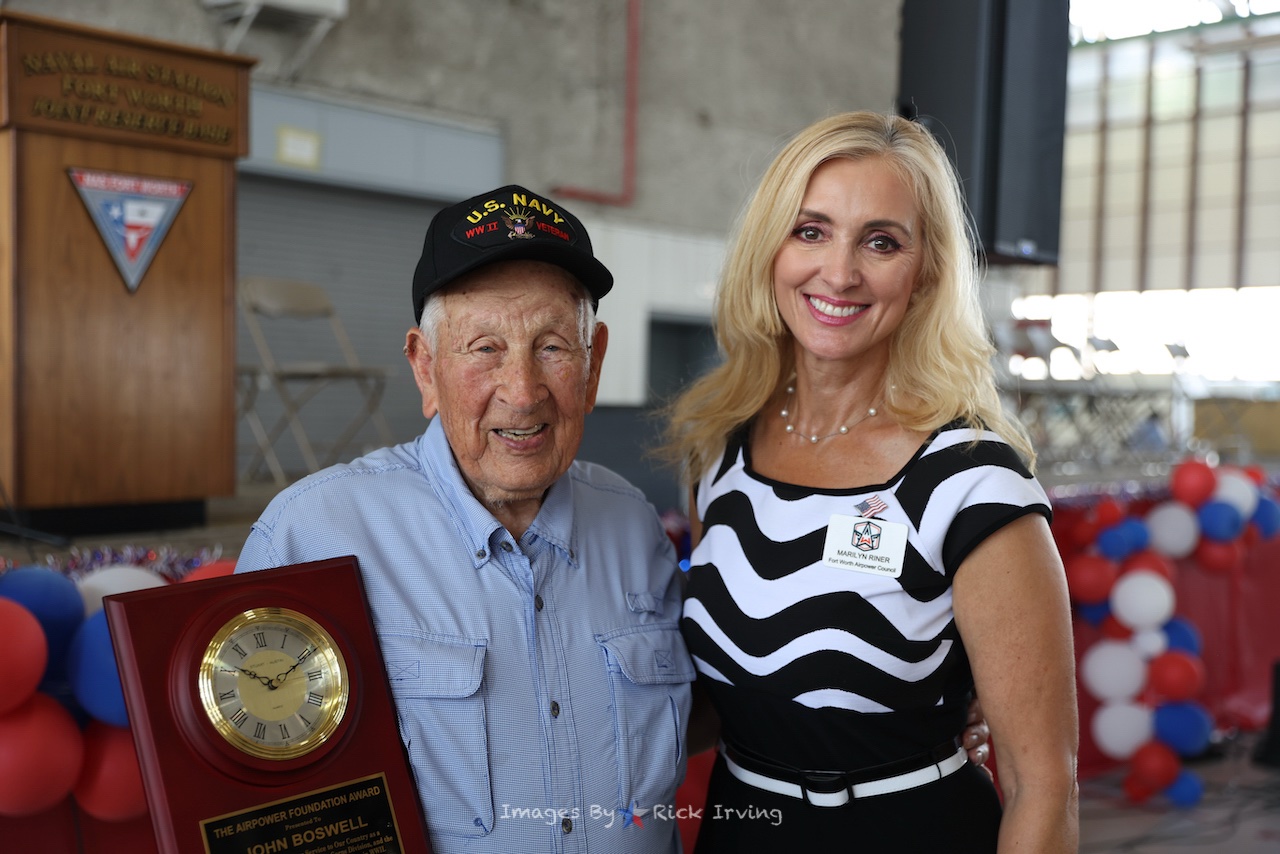
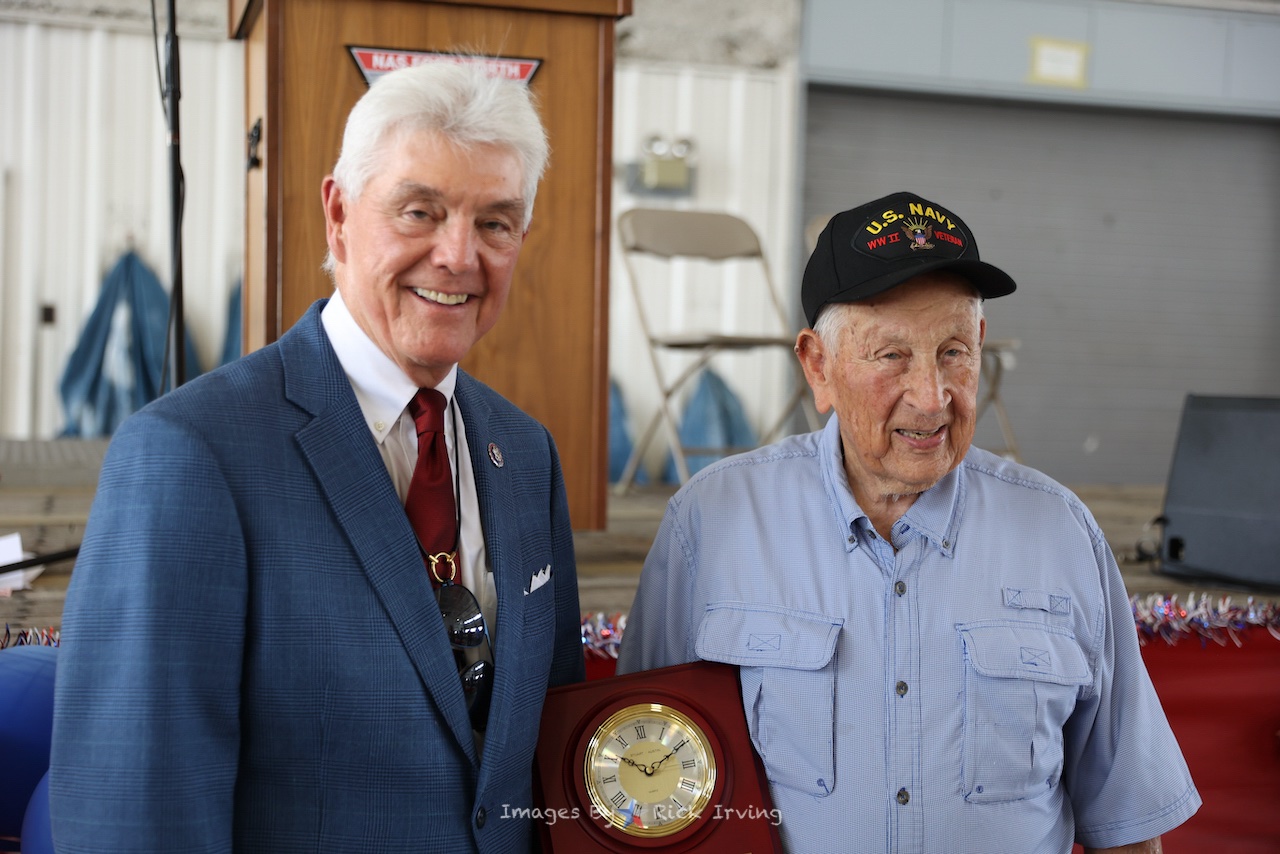
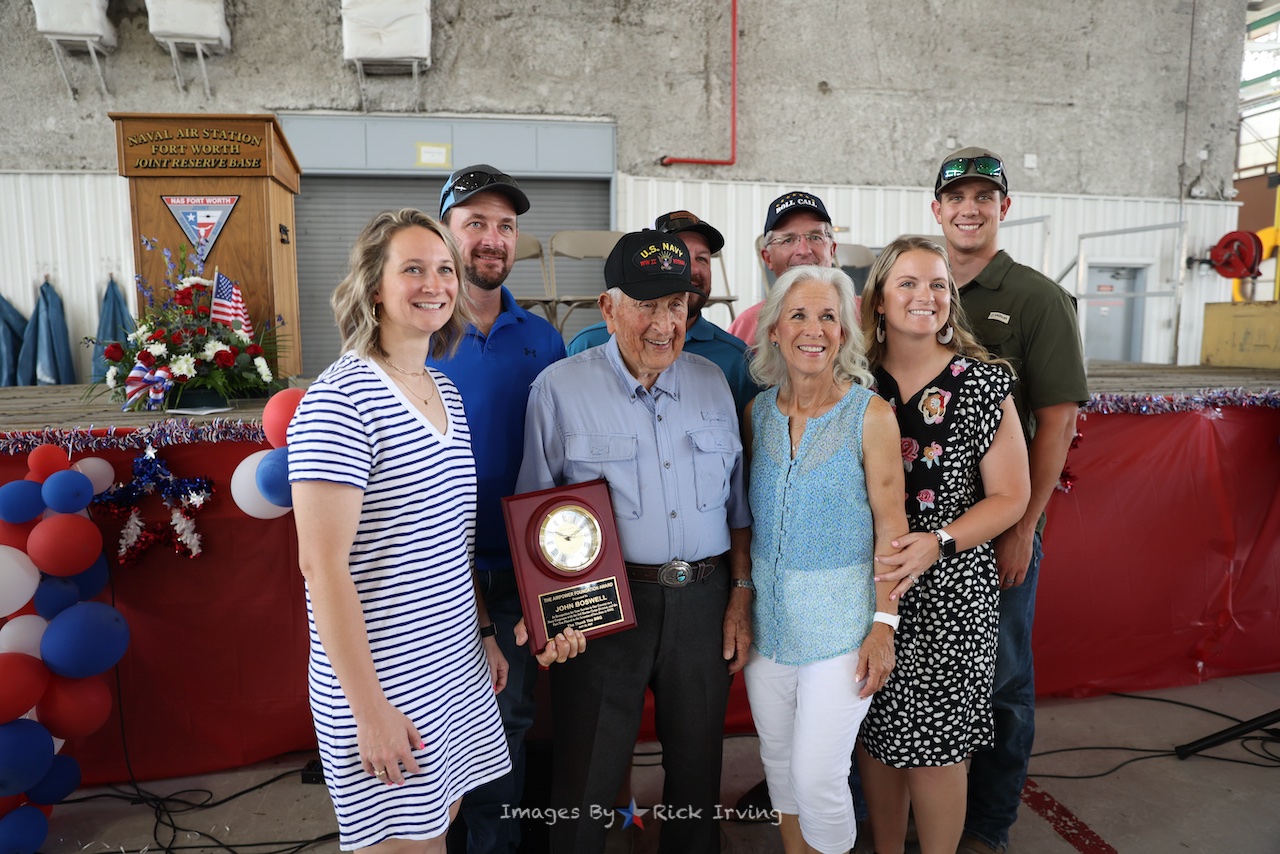
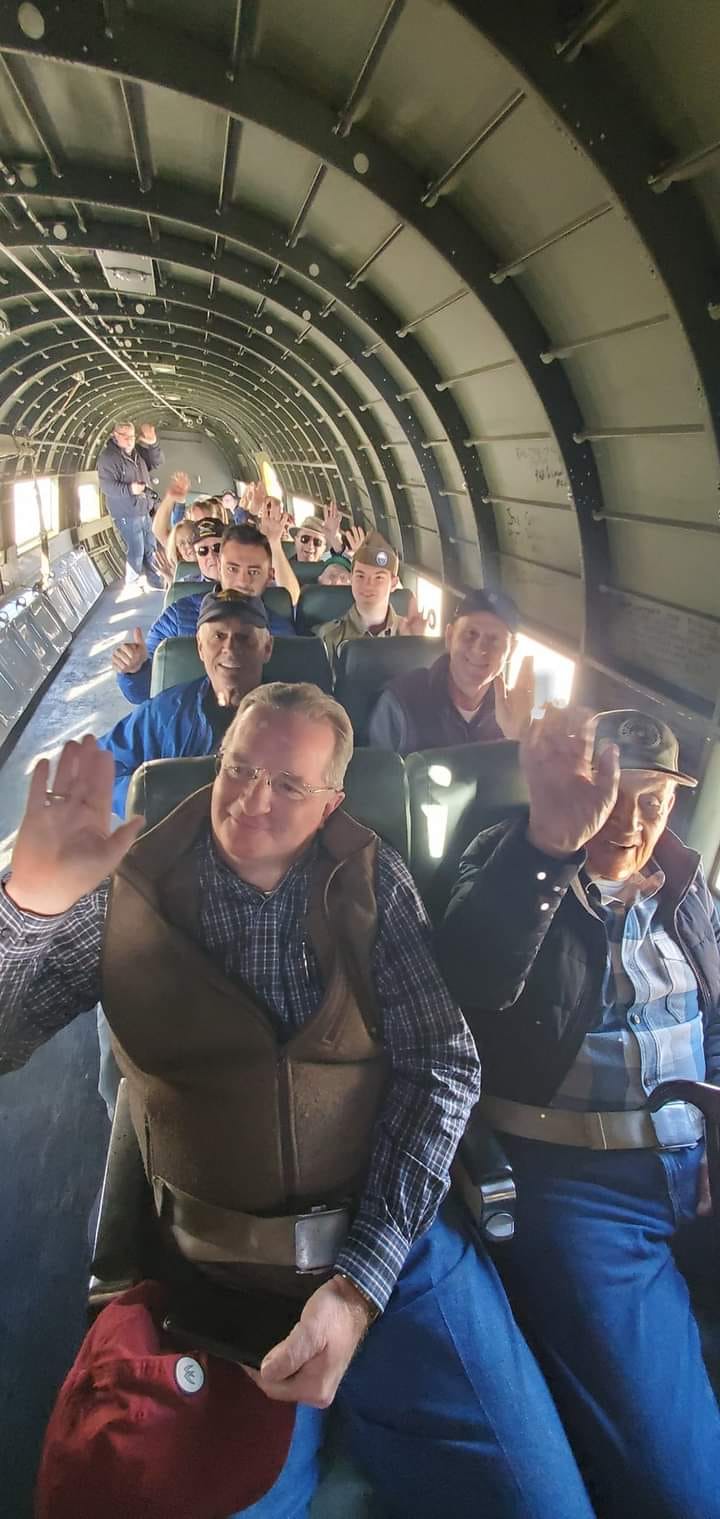
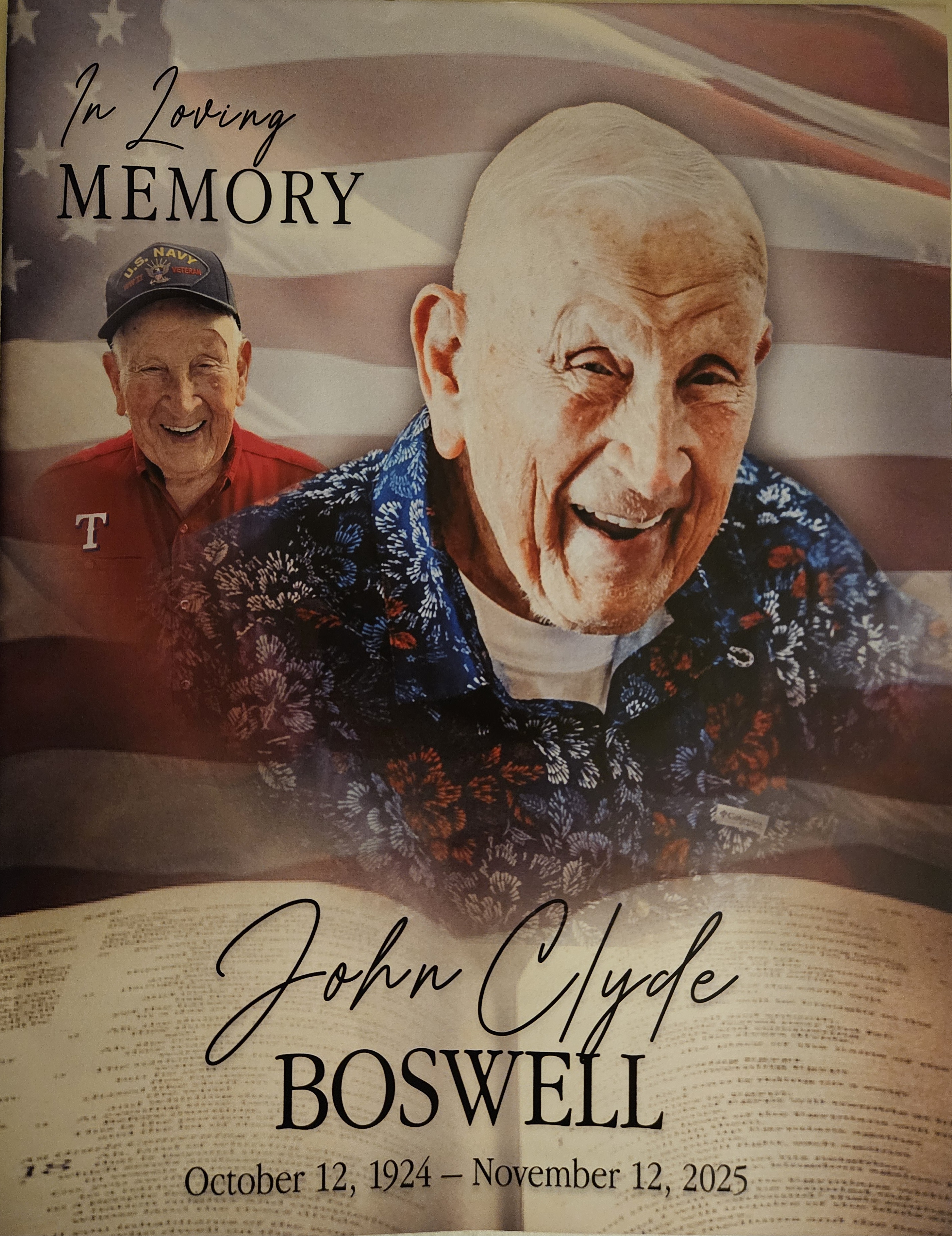
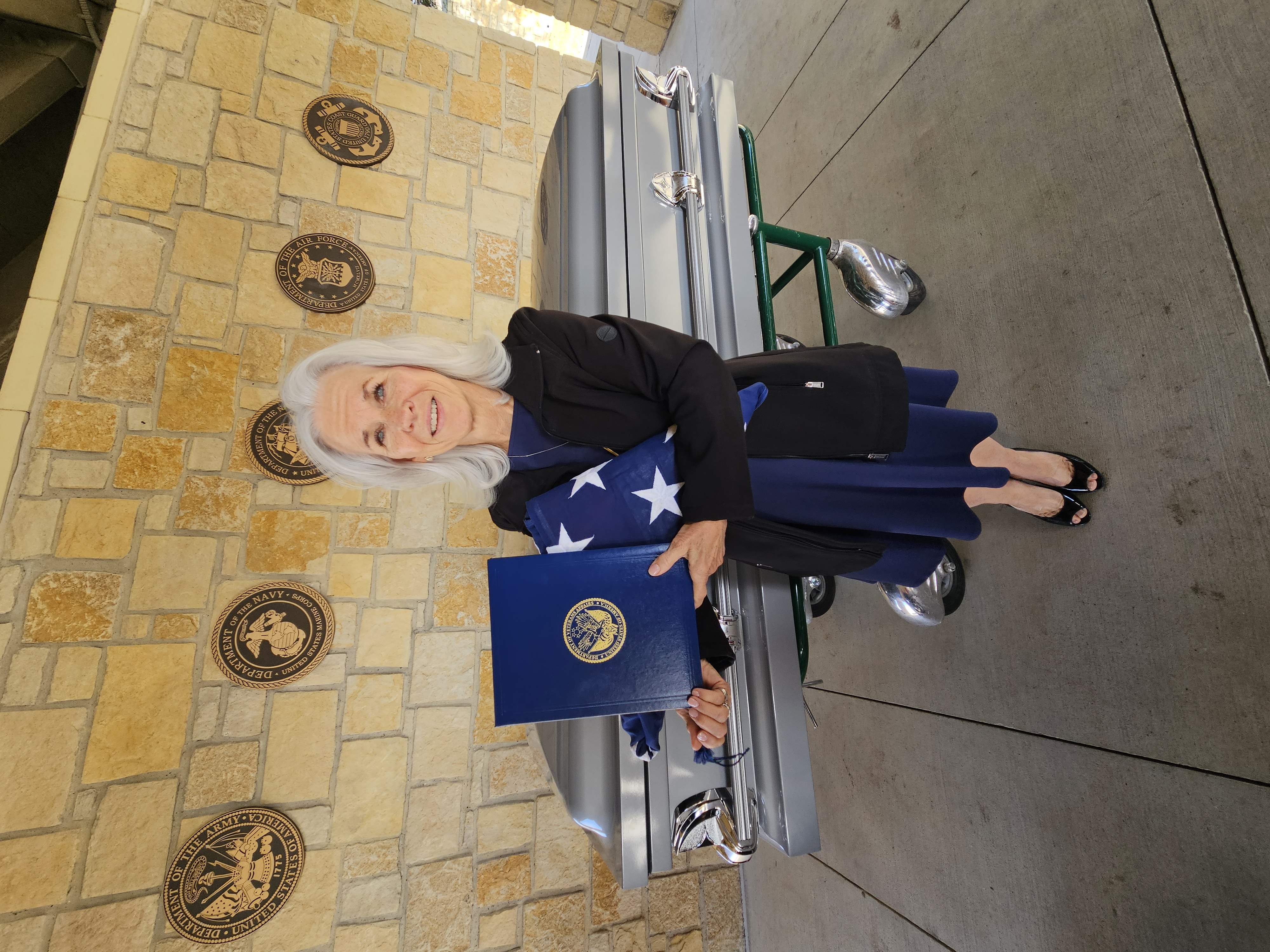
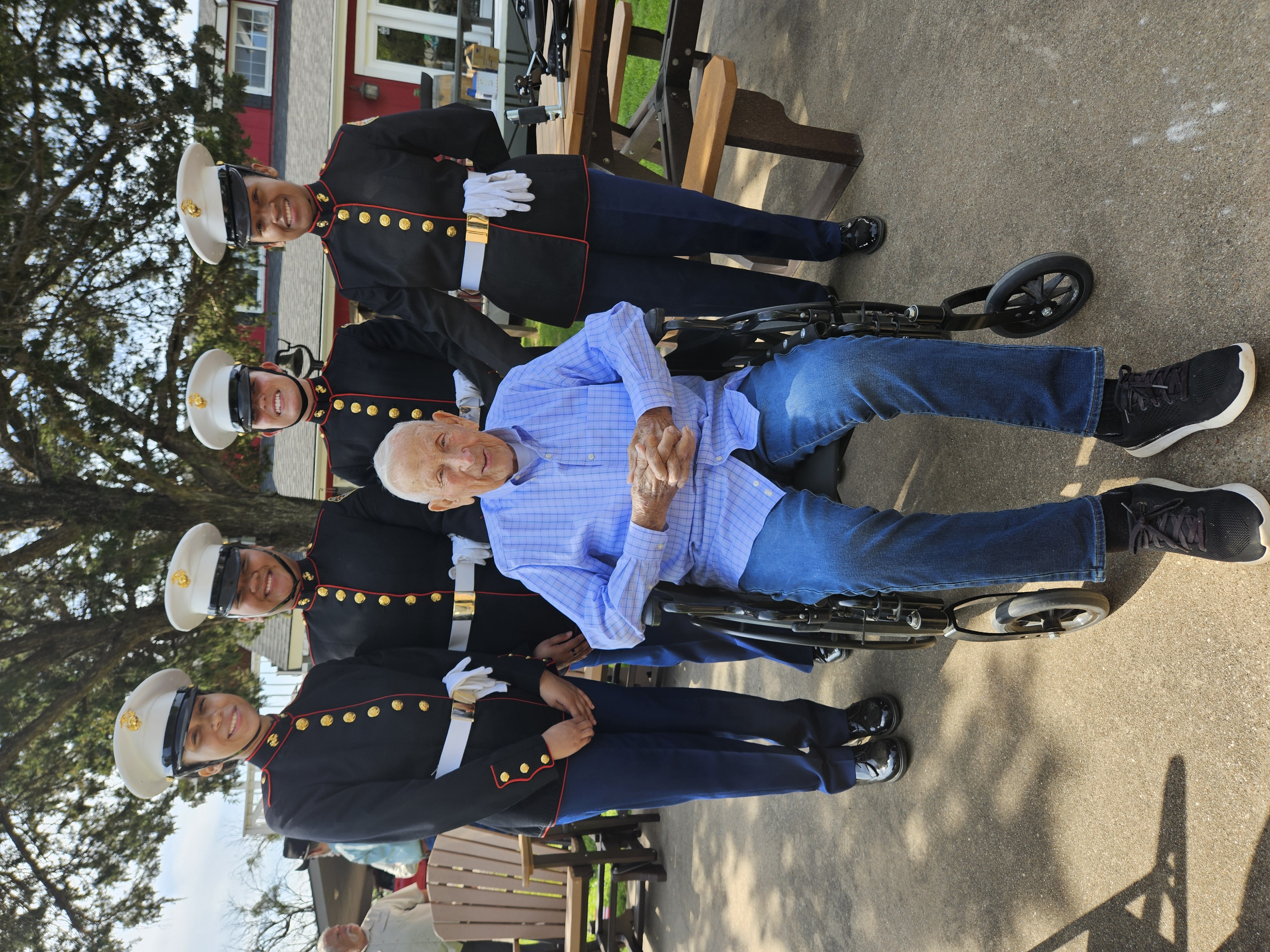
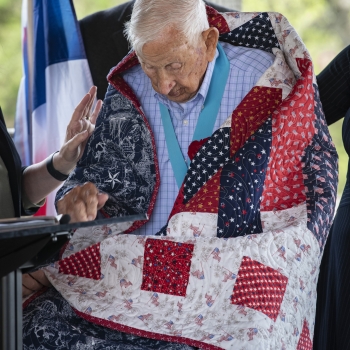
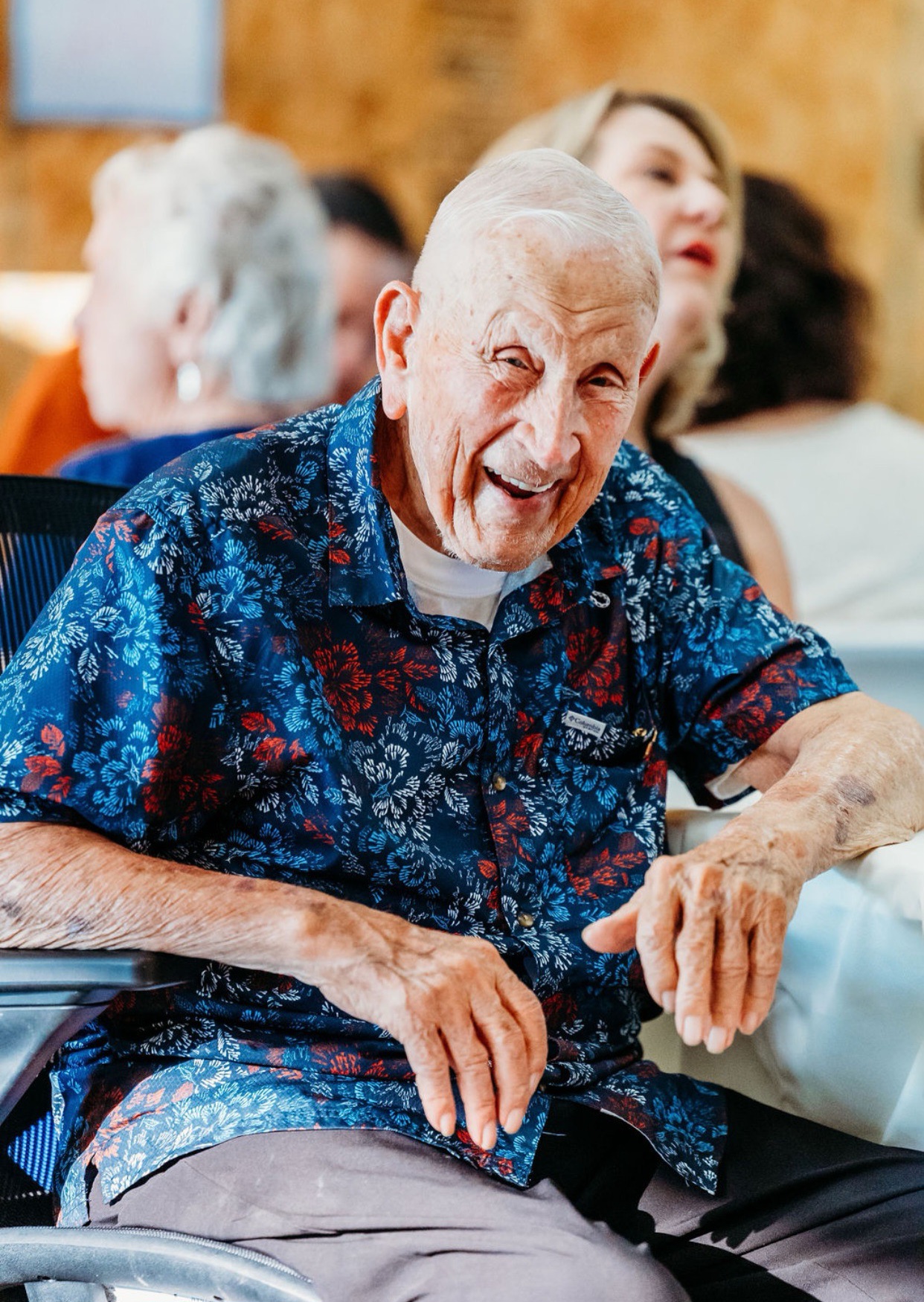
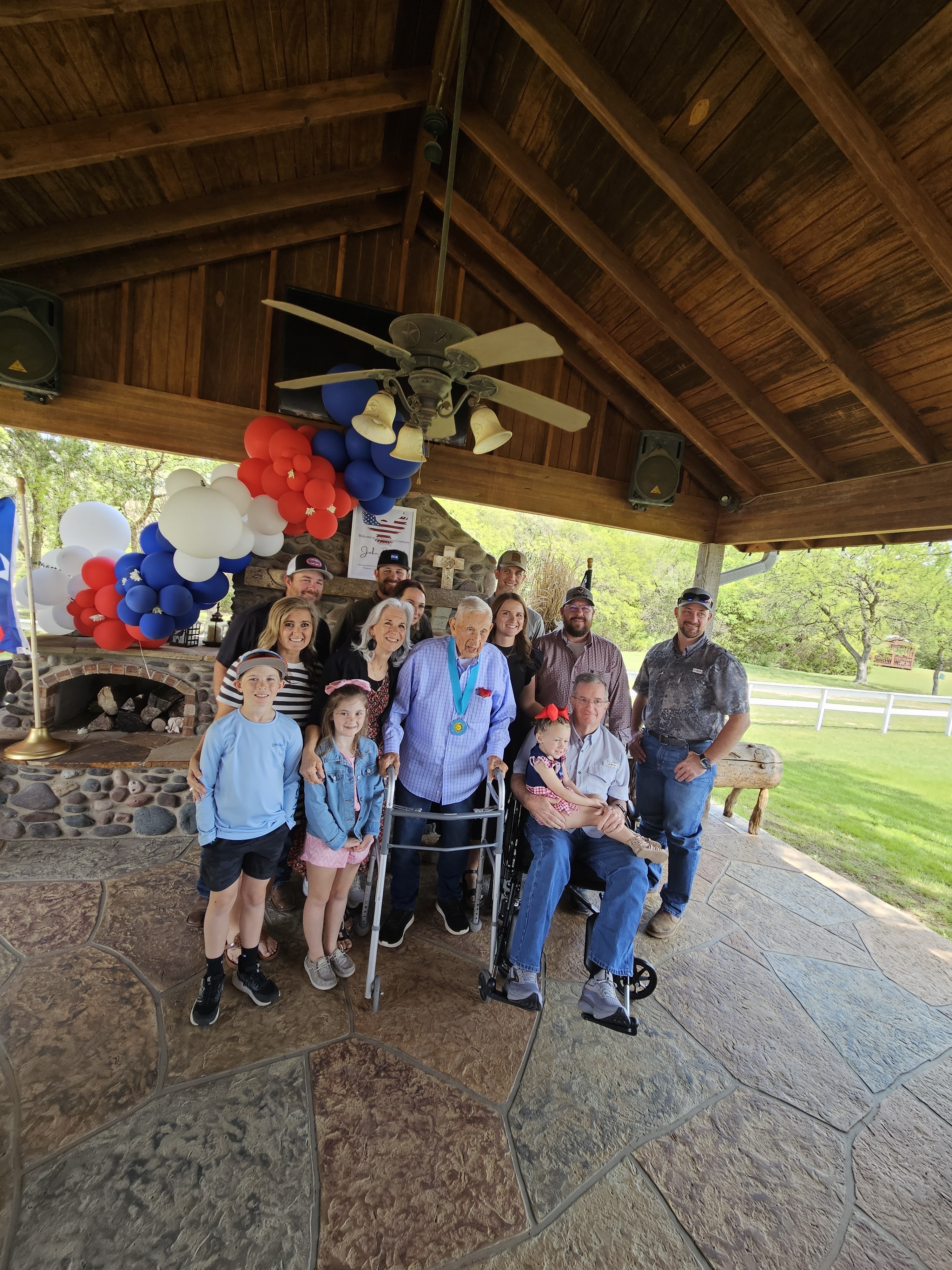
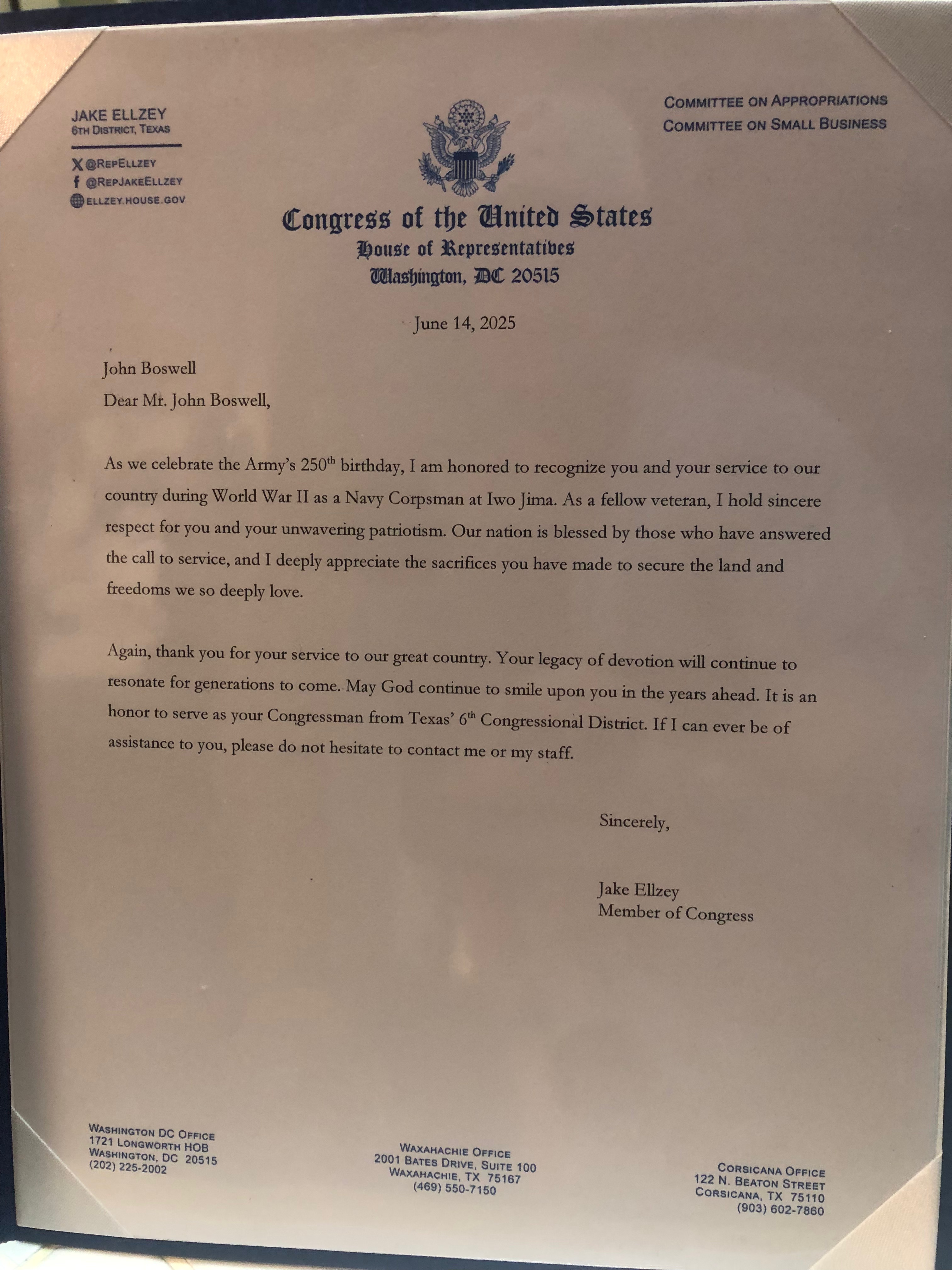
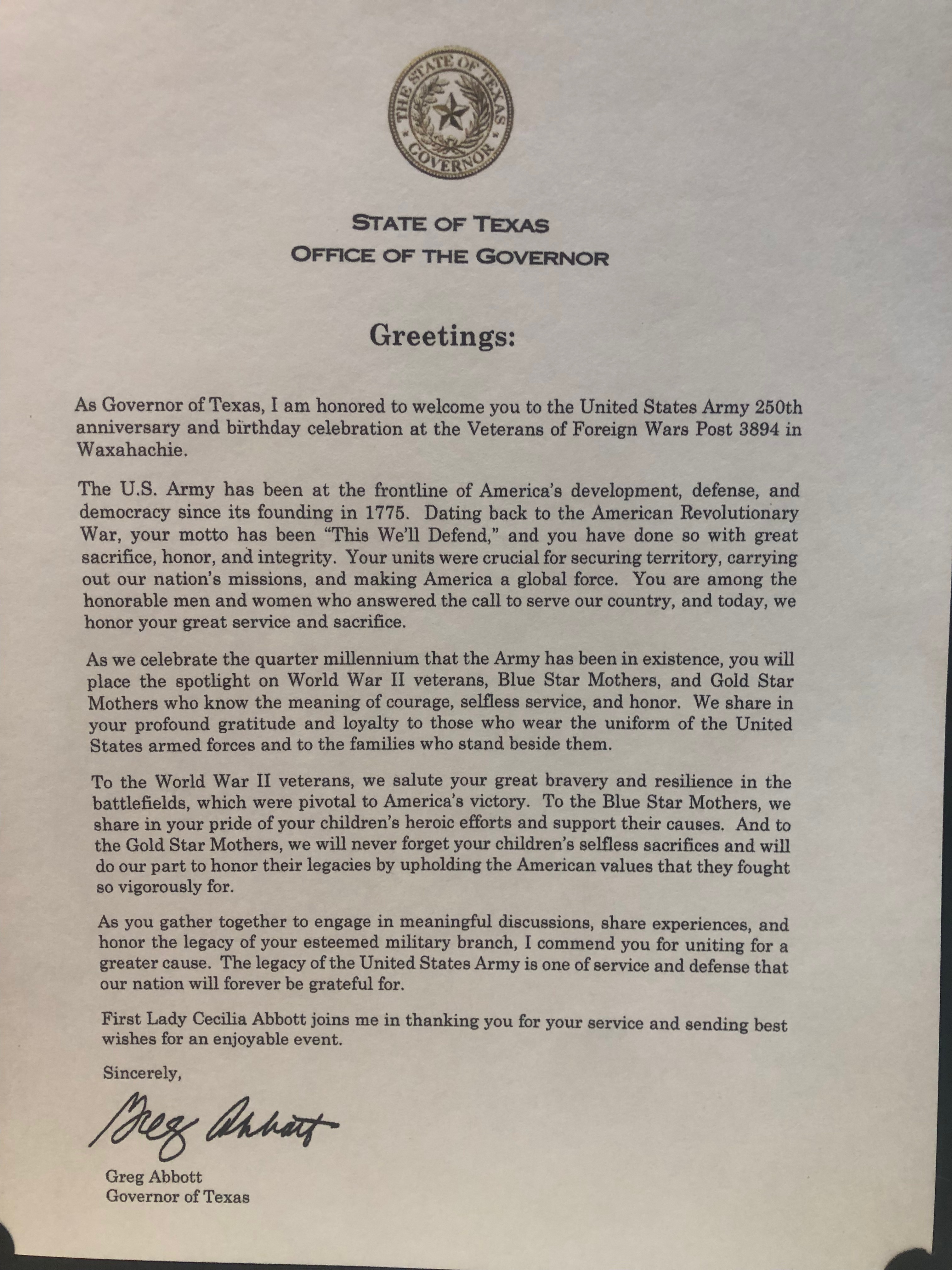
“It was a hell hole… I don’t want to remember it.” —John Boswell
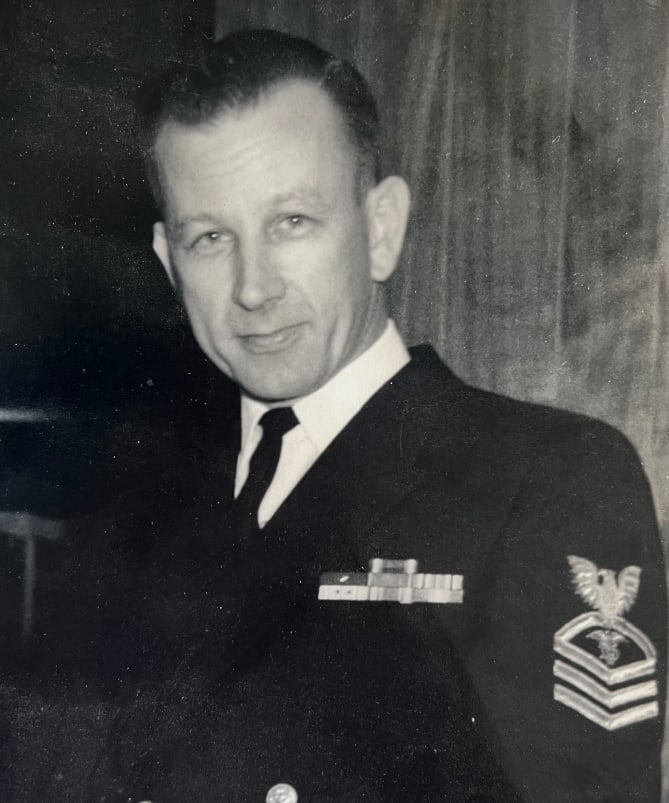
Despite the trauma, he spent over a month saving as many wounded Marines as he could. To start my military training, soon after December 7th, 1941, (the bombing of Pearl Harbor), I was a senior in high school at a small school with 7 boys in the class. Five or 6 of us went to Joplin, Missouri to the recruiting station and enlisted in the service. You didn’t get the branch of service you wanted but they gave you a choice. Mine was the Navy and I got it. Soon we were called for our physical and if passed we would be signed in and possibly continue on for active duty, my sign date was February 22, 1942, and I continued on to Kansas City. There, we formed a large group, put on a train and headed to San Diego, California for boot camp.
The third day out, we woke up on a siding in Cheyenne, Wyoming. When I found out where we were (cold and snowing) this didn’t compute to be on the way to San Diego. We were a couple car loads which had been dropped off the train and were very shortly attached to another and on our way north & west, we ended up in Farragut, Idaho. A brand new training station, sent to a barrack and there we found a large room with unassembled double deck bunk beds. Let me back up, on the way, we were issued our sea bag and clothing. (that “p” coat was welcome).
We continued to set up our bunks and pile our clothes on the bunk. Then, we met an older fellow in uniform which was our chief in charge. He was our mother, father, brother, minister and whatever else we wanted. We soon learned he wasn’t any of those but our trainer and that he was. He had retired and volunteered to come back and be a boot pusher. He was in his early 60’s and hard as nails.
I got through boot camp and somehow got picked to be a medic. I went to San Diego to corps school, to Great Lakes for duty (working in the hospital). One day, we were all assembled in a large hall for the normal group training and at the close of class they asked for volunteers for field medical school, so I took it. Wasn’t long before I got orders to Camp Lejeune, North Carolina for school. Marine boot camp till noon and medical school in the afternoon. Afternoon was 12 to 8 pm. 8 to 5 next morning was yours. That was a tough school but good.
Remember this was wartime and no time was wasted. Finished and a troop train to the west coast. I was an E-4 at that time and first job of responsibility, the “doc” of three cars – the one in front and the one behind and assistant to the sergeant in charge of the same area. On the train we had our mess hall — 2 meals a day — and about a week from the east coast to west. The marines were taught to look out for the medic, he may save your life and did a number of times later on.
Anyway we got to the west coast and no time was wasted getting us aboard ship and on our way as replacement personnel in the Pacific. Again you’re a medic and there are many troops on board with one more problem “sea sickness.” That trip took us to Guadalcanal. When we arrived that island was secured months ago so 22 of us medics caught a ship to Guam to the third “mar” division. We all felt better now that we were assigned to an outfit.
We were aboard a merchant marine ship as passengers. Nothing to do except eat, sleep and study. Study we did because we were getting close to combat. We crossed drilled one another in cases that we would have in actual combat and of course if you got the chance to take a test for advancement – you wanted to get the highest score possible.
We got to Guam and offloaded us on a L.S.T. and told us we were needed in Sipan – an overnight trip. When we arrived they knew who we were and handed us our assignment. That island was pretty well secured, but we did clean up and went back to Guam. What a break for me for the initial involvement in combat.
Guam was the same experience but much more action. Night raids and snipers were in action. Another week and that was pretty well finished. We had a few snipers as long as I was on Guam. There I made “E-5” which put me in the SGT’s class, have their own mess and are leaders of the unit.
Now we go into training for our next operation which we thought was the mainland, Japan. That consists of getting all equipment in top notch shape, all supplies stocked to combat ready level. At this point we go aboard ship via landing craft and cargo nets with full gear which we had trained for but this was real. Had been hit – burned and still smoldering. I said to “Herbie” aboard ship we learned where we were going and what to expect, beach conditions etc.
On February 22, 1942, my entry date there it is February 19, 1945 and we were going in on Iwo Jima. We had steak and eggs breakfast, over the side, in landing craft and in circles waiting for our turn to go in. Next the front of the landing craft troops and out we go.
As medics we worked as a pair with our normal medical supplies and a “B” unit as back up supplies between us. I was a senior corpsman so I called the shots. After on solid ground ahead of us about 30 yards was a truck that (Herbert Brandcamp) let’s make it to behind the truck and hit the ground. We did — at that point I said let’s make it to a crater just ahead of us. He said let’s stay here a minute. Knowing that if you are still and they get ahead of you – you’re gone. I take off with the “B” bag between us. I’m almost dragging him. We no longer hit the crater a shell hit where we were and made another crater. After all the debris had fallen I looked back at Herbie — are you all right”– he was as white as a sheet and said “When you say go, I’m right behind you.
As scared as we were I had to smile – we moved on and work (treatment) went well from there on. We soon got a little elbow room and had a dozer level and lower us a spot and set up an aid station that soon became a point of evacuation. Ducks came from somewhere. Hospital ship appeared off the coast as close in as dared and we moved the wounded as fast as possible. Four or five days had gone by and the enemy dead were accumulating and again we called upon our dozer to cut a strip about 6 ft. deep for a mass grave and that was carried out. Our dead were handled but we were not involved, so I can’t comment on that.
As days went by it got a little better and I guess we got better organized so the pressure was less and less. At the end of the third week, things started looking much better. Soon a ship appeared in the bay that had our name on it and was headed for Guam. That dozer that I spoke of got hit and lost. We came with a dozer and we left with one.
As soon as we got to Guam it was painted and the old number appeared. Our captain in charge, was a reserve, owned a bar and construction company in Chicago before the war and was a great leader. His work was good and it flowed down the ranks which made our leadership very strong. He had a saying “you don’t steal anything but we can transfer from one activity to another for the benefit of the activity.” A great man, great marine and a great leader.
Training resumed and soon we were back up to compliance, our supplies up to par and ready to go to Japan. We were going to finish that job and be home for Christmas. Our president, Harry Truman, stepped in and did us all a great favor. By the way I saw the flag raised on Iwo Jima and the first crippled B-29 land on the runway that was not finished otherwise he would have been in the pond.
Enough of that, got home by Christmas, hung up my green uniforms, went to Great Lake. Got with the reserve training command, made chief “E-7” in 16 years and went to leadership school. Greatest training I ever got. I’ve used it every day of my life since. Our class was how to cope, how to use your personnel — if you got someone that you just can’t find a place for him or her — use them as a bad example.
Some months later I set an example of leadership. While at the club one night I made a statement “the leadership of this club stinks– I could do a better job myself.” A couple of days later I was to be at the captain’s office (base commander) at 11:00 the next day.
What have I done?
Well at 11:00 the next day I was at the captain’s office. At exactly 11:00 I went in. Sharp salute and he gave me a sloppy half-ass salute and said relax, at ease. He didn’t leave me hanging-said i heard you made a statement at the club the other night that you could do a better job (managing) – well we are going to give you that opportunity, manager of the club. What’s management – leadership, where did I learn it – my navy career.
Well if the captain said do it you are going to do it. I did and did a great job. So I say any training you can get while in the service pertaining to leadership or management – don’t pass it up. I’ve got two of the finest adult children that anyone could have, and why are they that way- “leadership.” Thank You.
THE REST OF THE STORY- WHERE IT BEGAN
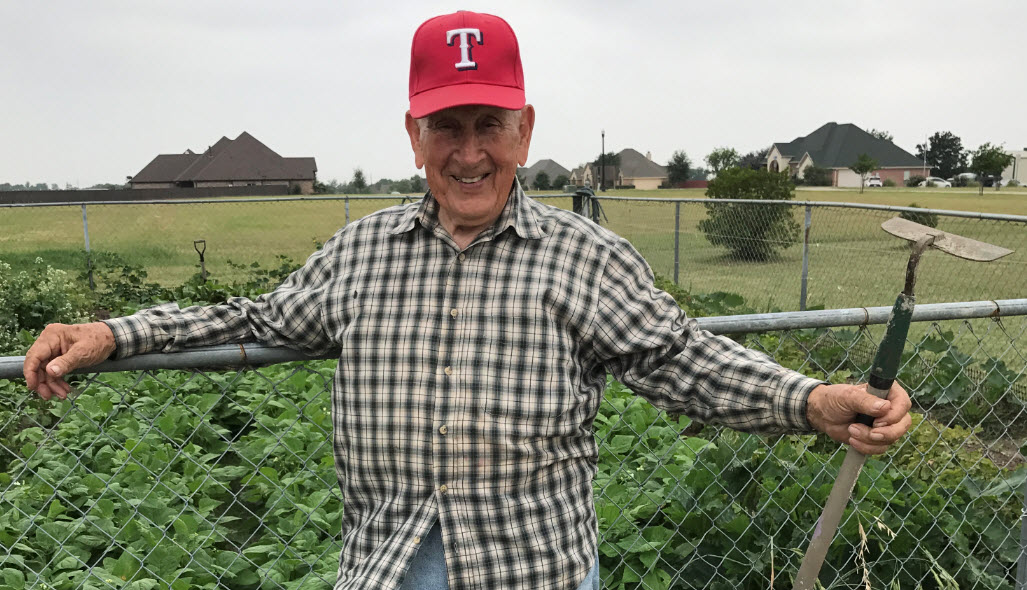
I was born in 1924, and grew up on a farm in southwest Missouri during the Great Depression. I am 1 of 8 children, 5 sisters and 2 brothers. Gardening was not a hobby, it was how my family survived.
In addition to feeding them, my dad was able to make a few dollars selling milk. I literally do not remember a time in my young life that the garden was not a part of my daily routine. Up until a few years ago, I have kept a garden my entire life.
When the bombing of Pearl Harbor happened, I was 17 years old and I signed up to join the Navy. I served in the Pacific as a Corpsman during World War II.
It was 1942 when I enlisted in the US Navy and was trained as a corpsman at Great Lakes Medical Center, Bay City, Michigan. After my medical training, I was assigned to Camp Lejeune in North Carolina for the final stages of my instruction as a Field Medical Technician.
Immediately following my training at Lejeune, I was transported by train to San Diego to join in the formation of my unit, the 3rd Marine Division and continued my training at Camp Pendleton. After arriving and setting up, I soon realized “Marines never Rest,” they are always moving.
For me personally, as I ‘chuckle’, I only wanted to read my medical books and study to continue my education as a Corpsman, whether it be pulling teeth, surgically stitching wounds and/or incisions from surgery or any other medical treatment that would require my presence.
At the end of the day the Navy and Marines had a job to do. Everyone had their roles they needed to do and we did them. I had my role. He had his role. The next one had their role and so forth.
Our Division was soon ordered to join the war in the Pacific. We were loaded on transport ships and participated in the mopping-up operations on Guam and Saipan. I was assigned to the Pioneer Battalion of the 3rd Marine Division.
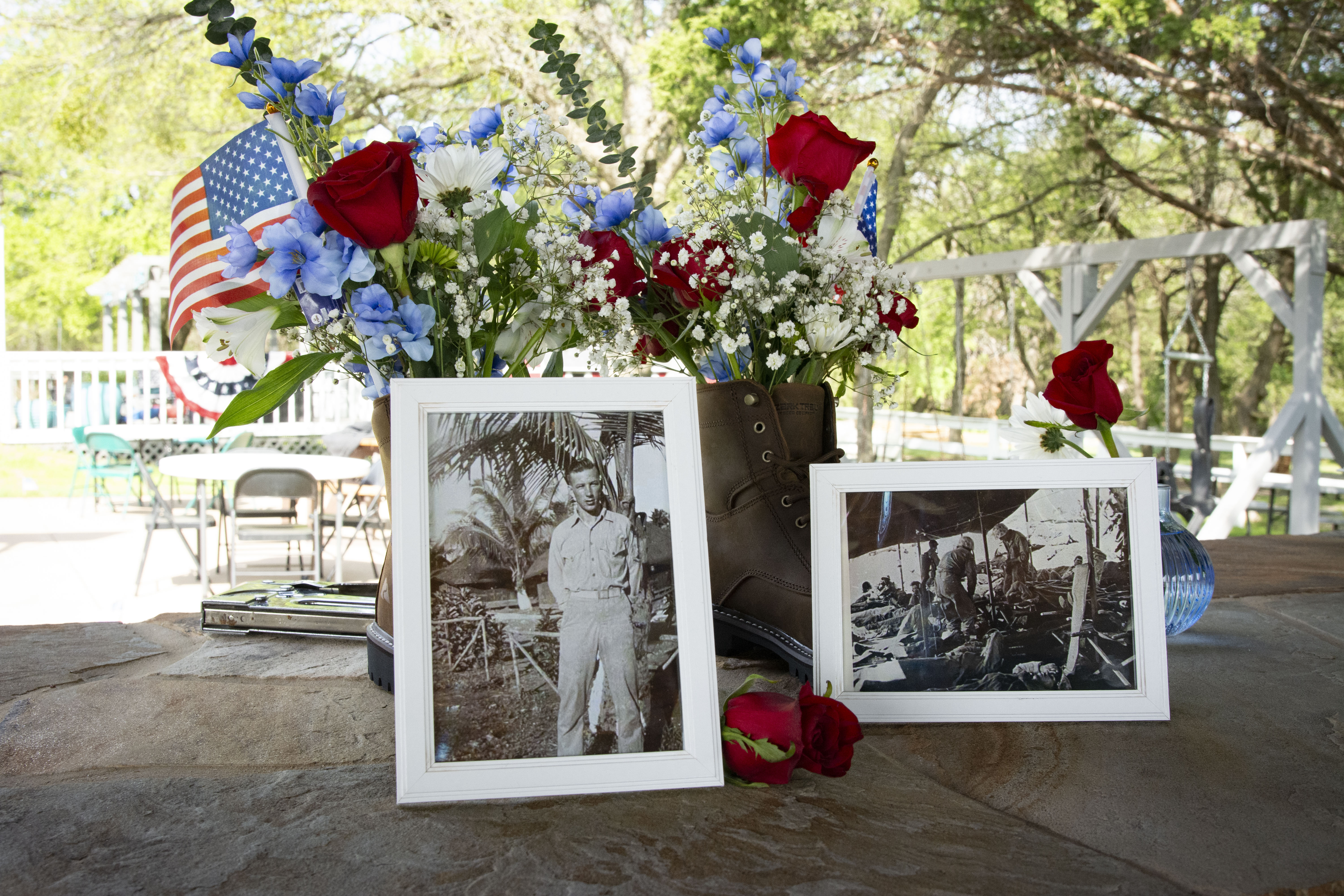
As a Navy corpsman, I arrived in the second wave of troops on the island of Iwo Jima which was dominated on the western end of Mt. Suribachi . My job was to help treat and save as many of the wounded as I could.
It was February 20, 1945, when I landed on Iwo Jima at the age of 20. It was D+2 and I survived 33 days on the island. I served on the lines with the Marines, and in an aide station slightly behind the lines, aiding the wounded and preparing casualties for evacuation to hospital ships.
To get to the island, we headed out on Higgins boats. When we hit land we ran for cover. I led looking for places we could hide, like behind a jeep that had been hit or sunk into craters that had been formed from the bombing. Due to the heavy artillery and mortars being shot at us, we could only make it ahead a few feet at a time. Getting to the point where we set up aid stations was difficult.
When finally making it to our destination, a line had already been forming with the wounded and casualties waiting and more were on the way. Many were killed instantly. Sleep was rare, if at all. I slept spontaneously standing up with my back to the hillside whenever they were bringing in more of the injured.
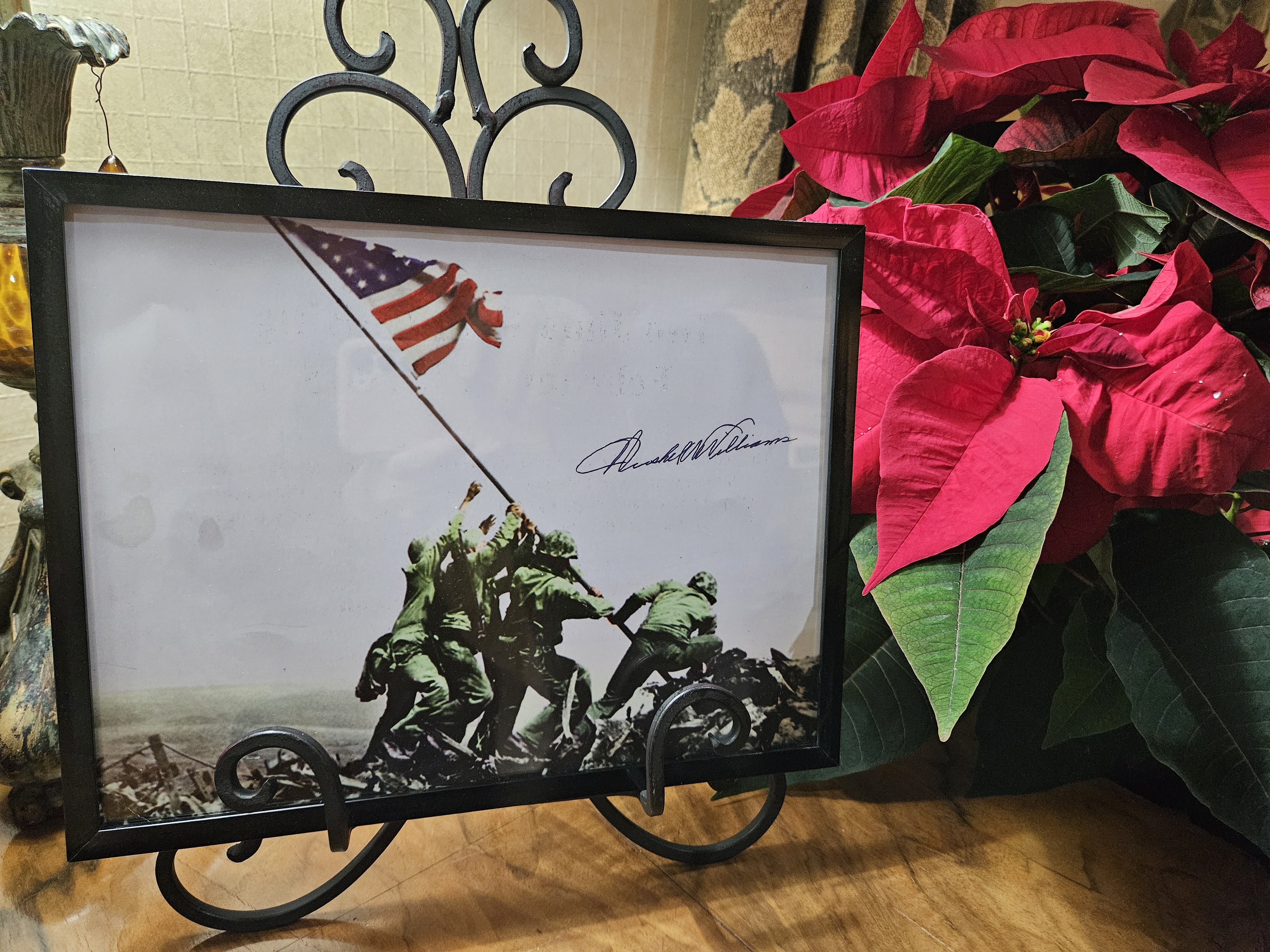
This was one of the bloodiest battles of the Pacific Theater in World War II. The 35 day battle cost 7,000 American lives and more than 18,000 Japanese. It was a hell hole. I don’t want to remember it, just a little highlight here and there and that’s enough. It will always be difficult. In the midst of everything we were experiencing, there was a moment I witnessed our American flag being raised on the top of Mount Suribachi, what today has become the iconic photo that represents the Battle of Iwo Jima.
As for the memories that have faded, some with time and some by choice, I am still a soldier at heart. I lived it once, the Lord got me through it and I don’t want to go back. But if I were called on for duty, I would go to defend this great nation while also offering my advice for the future generations I helped save.
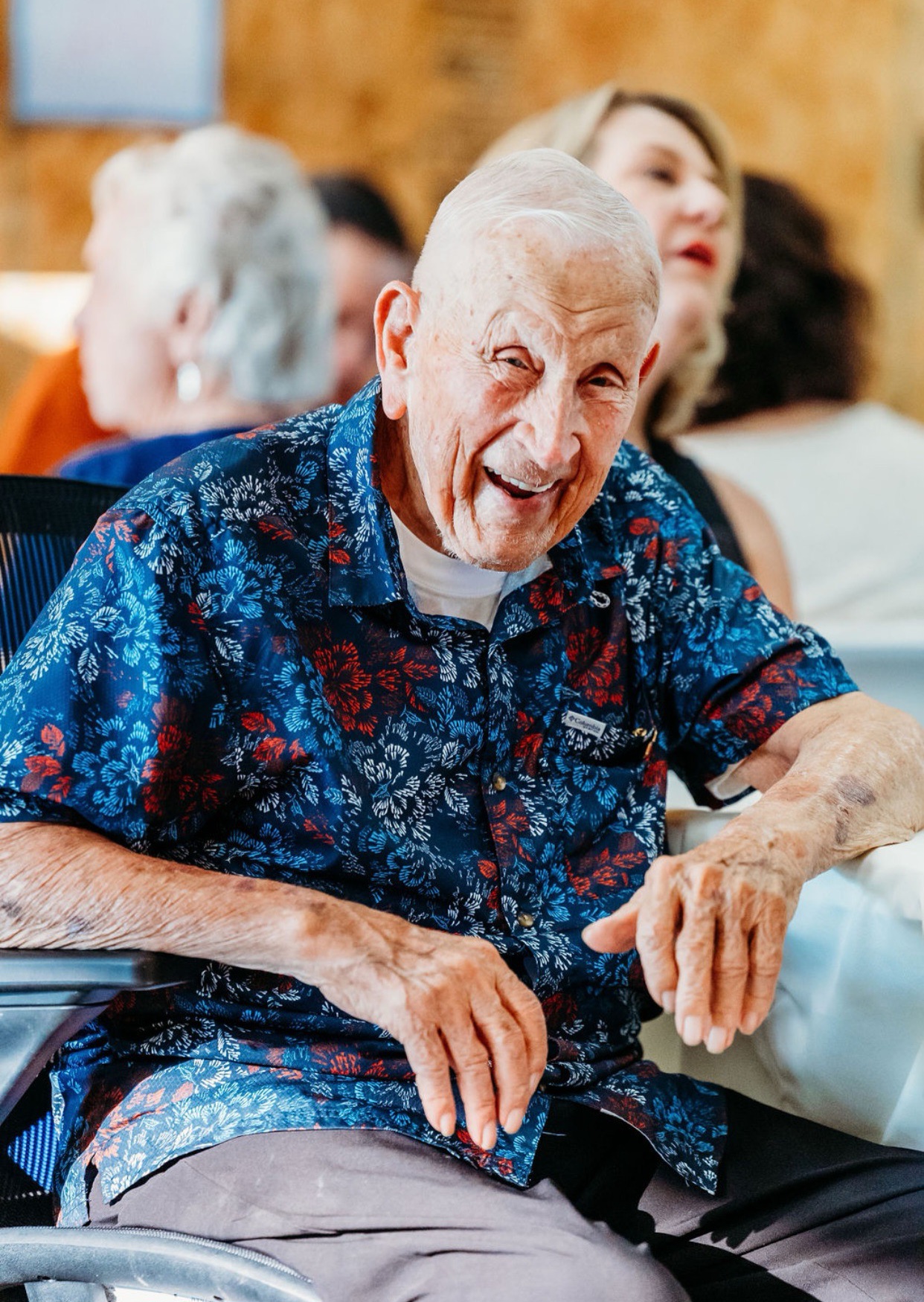
As of 2025, the 80th anniversary of Iwo Jima, I am one of only three surviving World War II veterans to have been in the Battle of Iwo Jima on Mount Suribachi.
I made a career in the Navy, retiring after 23 years of service. My wife, Martha, and I ended up in San Antonio where I managed a Holiday Inn during HemisFair , the World’s Fair ‘68. I survived the war without being hit or injured. It was only after the war that I was shot when an attempted robbery occurred at the hotel. In the middle of the night I was awakened from my sleep with a knock on my door. At gunpoint a robber demanded money out of the safe. He never succeeded in gaining access. I was trained to defend and protect my country from my military career, and I carried that into my civilian life.
The robber didn’t know who he was up against the night he tried to rob my hotel. I live today with the bullet still lodged in a muscle in my back. After just skimming my heart sack, it traveled through most of my organs and stopped there. It has led to many interesting conversations later in my life when I have had imaging done. Doctors asked me, “Mr. Boswell, how did this get there? Please explain!”
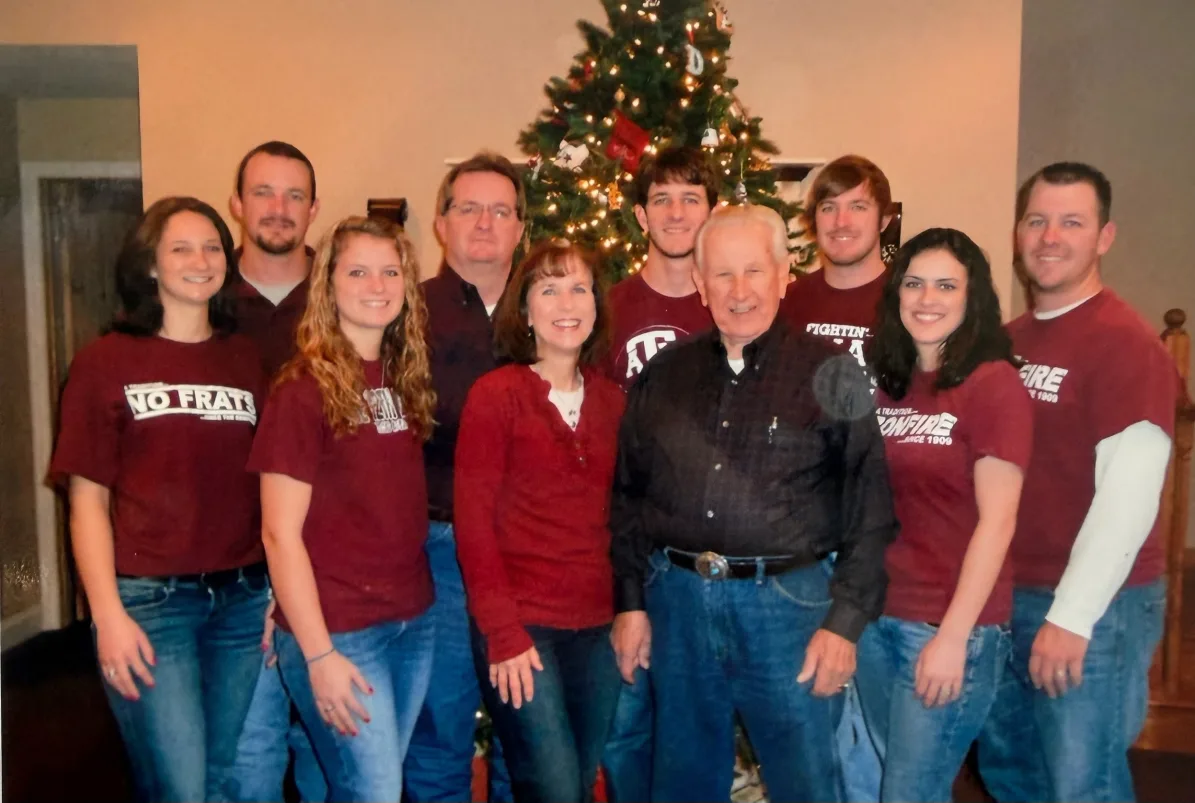
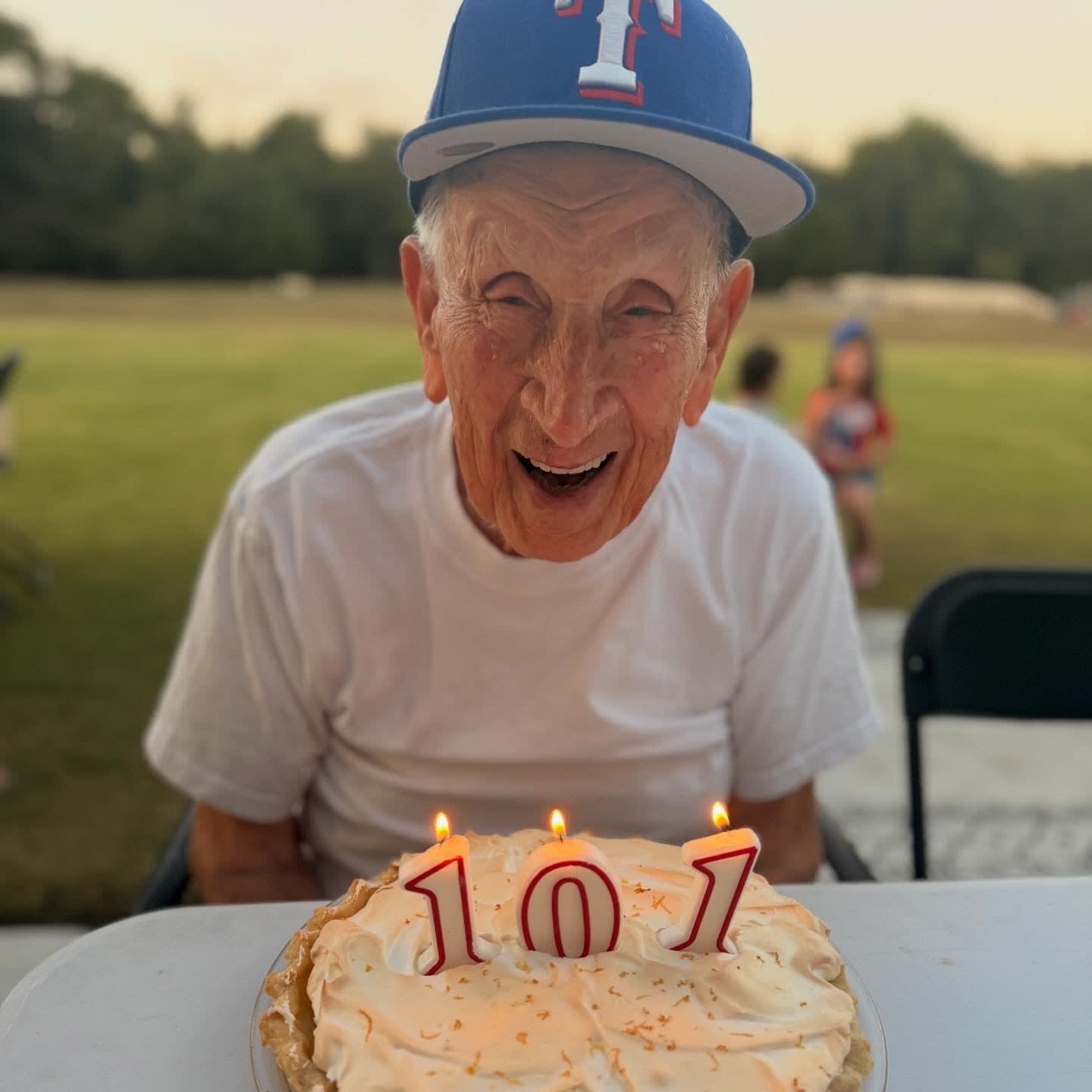
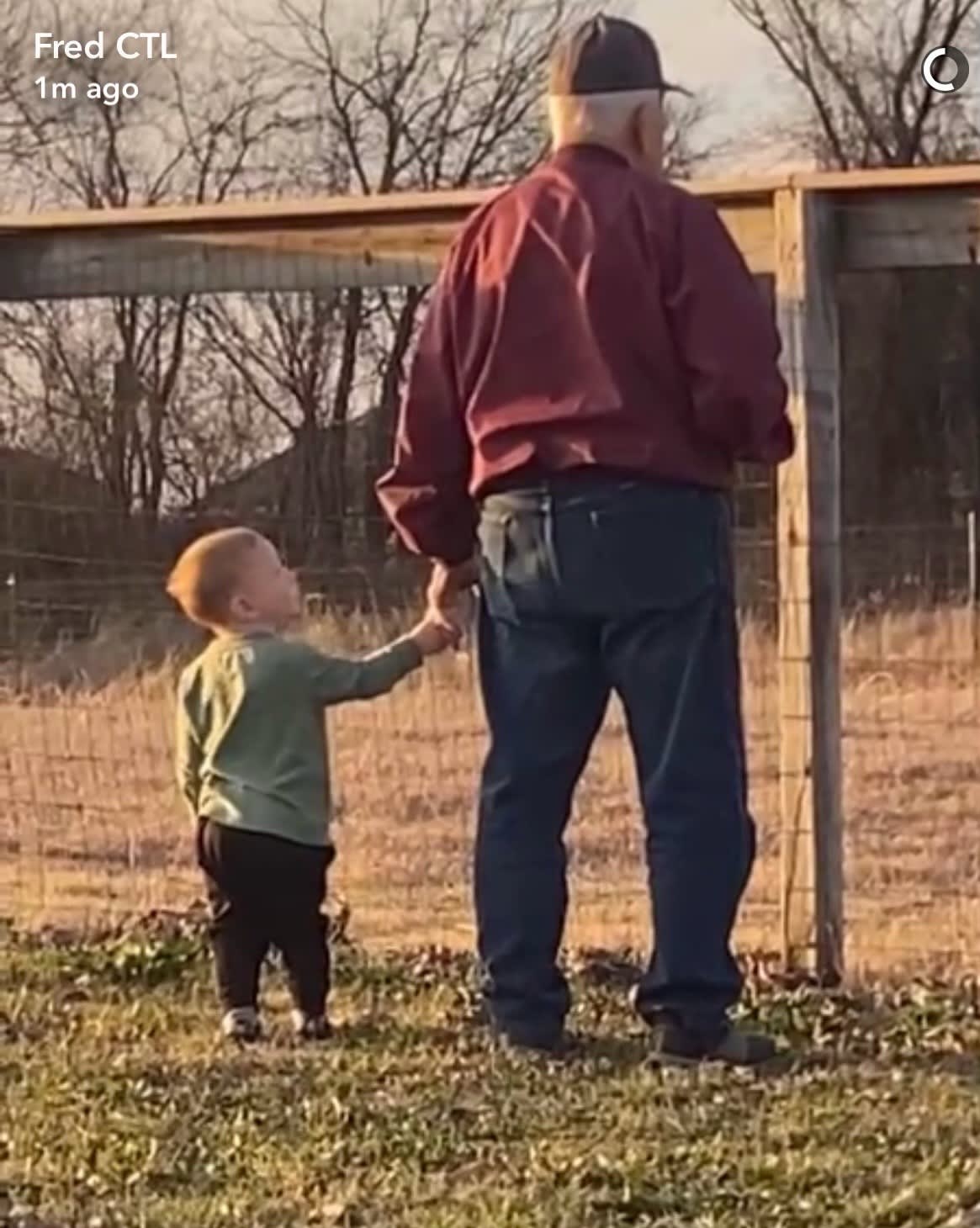
I was married 53 years to the love of my life. We had 2 children who married and have had children of their own. I have 8 grandchildren, and at current count, they have given me 18 great-grandchildren and 1 great-great-grandchild. When asked how many grandchildren and great grandchildren I have, I respond with, “Enough to make ‘Boswell City’.”
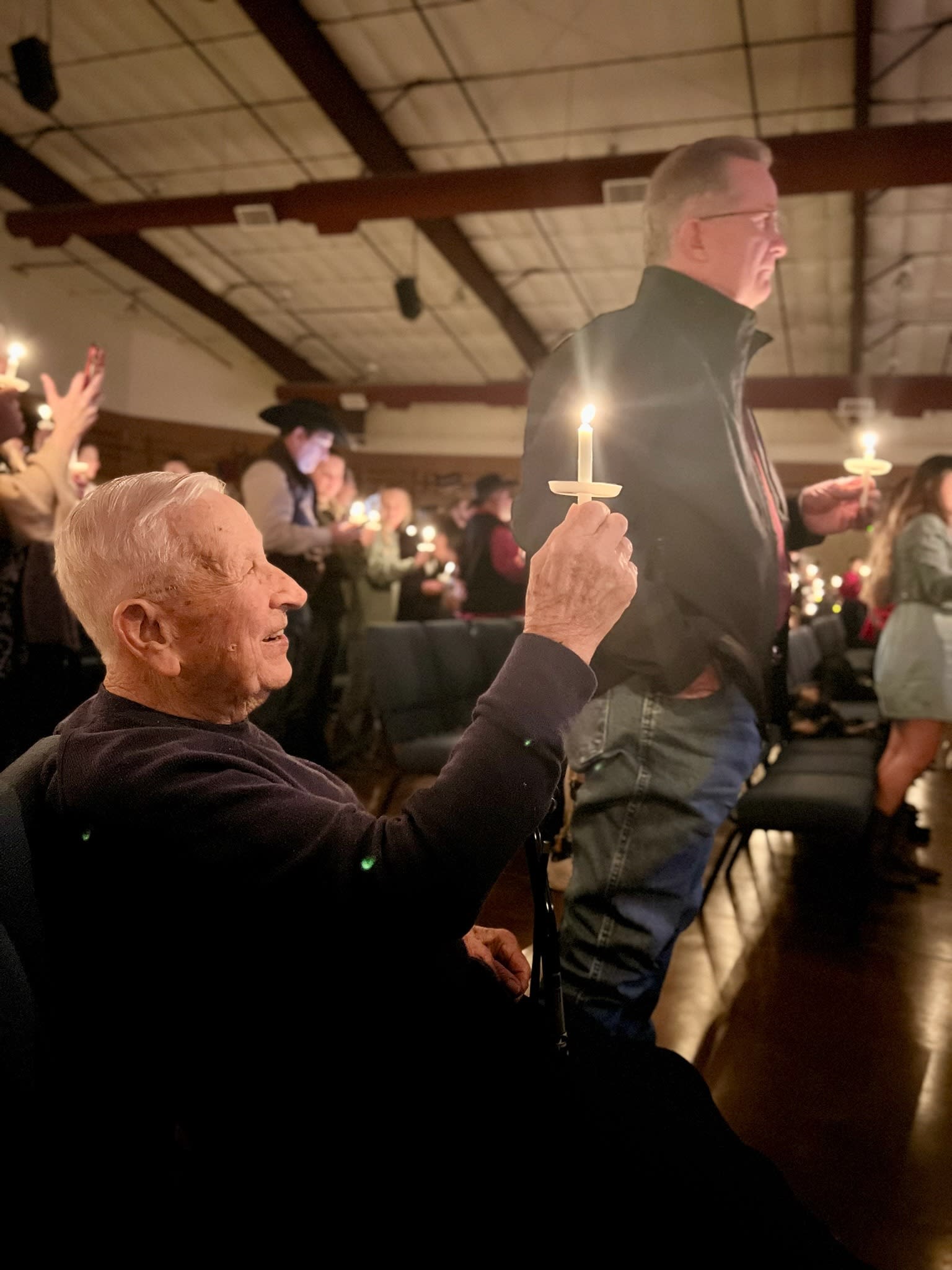
I have been blessed with a good life, I have made friends with many great Americans along the way. I am extremely grateful for my military career and all the training I received and would gladly live my life all over again. Looking back, I can see God clearly had His hand on my life all along and He’s been leading me all the way, and I wouldn’t want to change a thing.
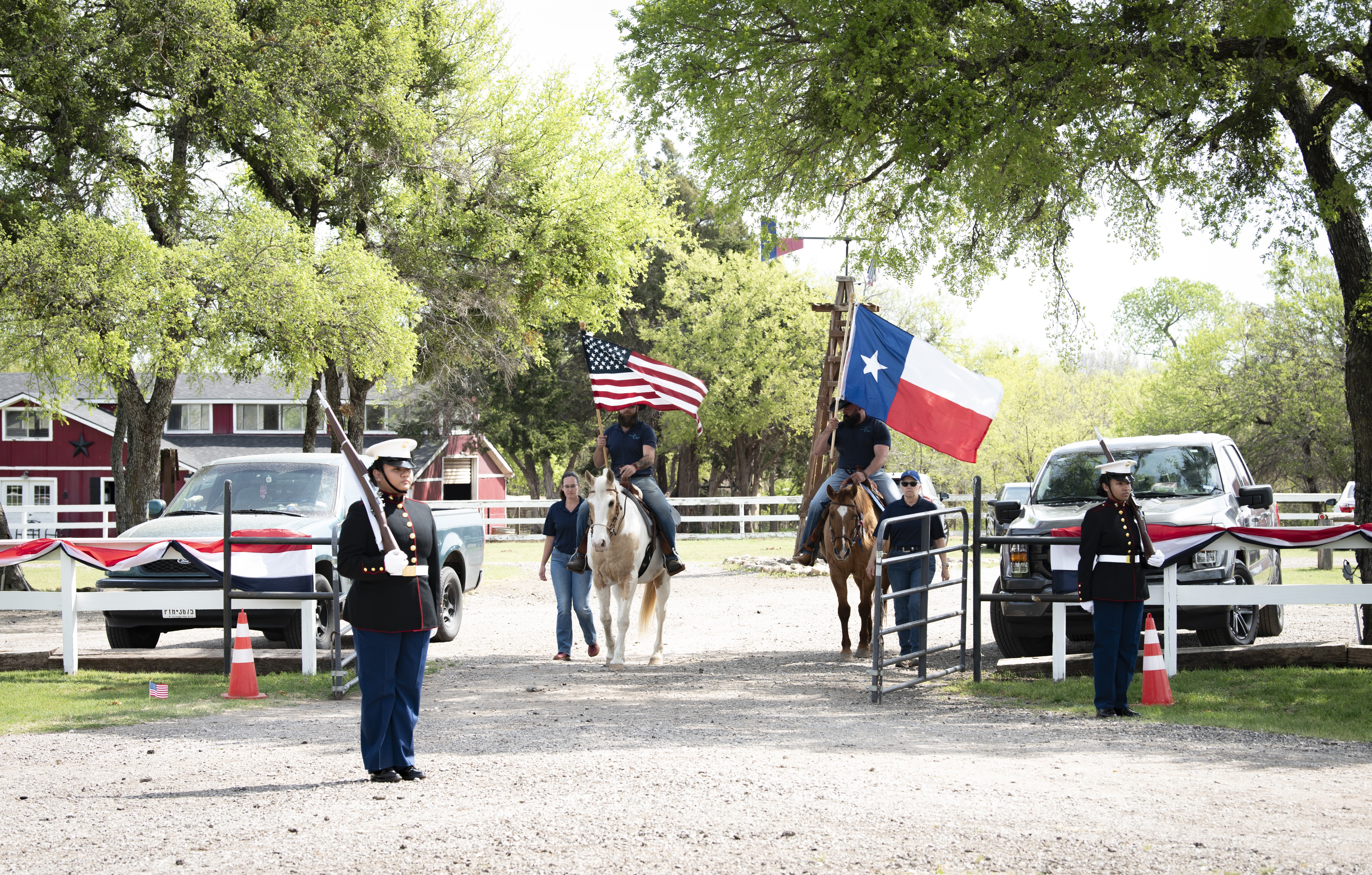
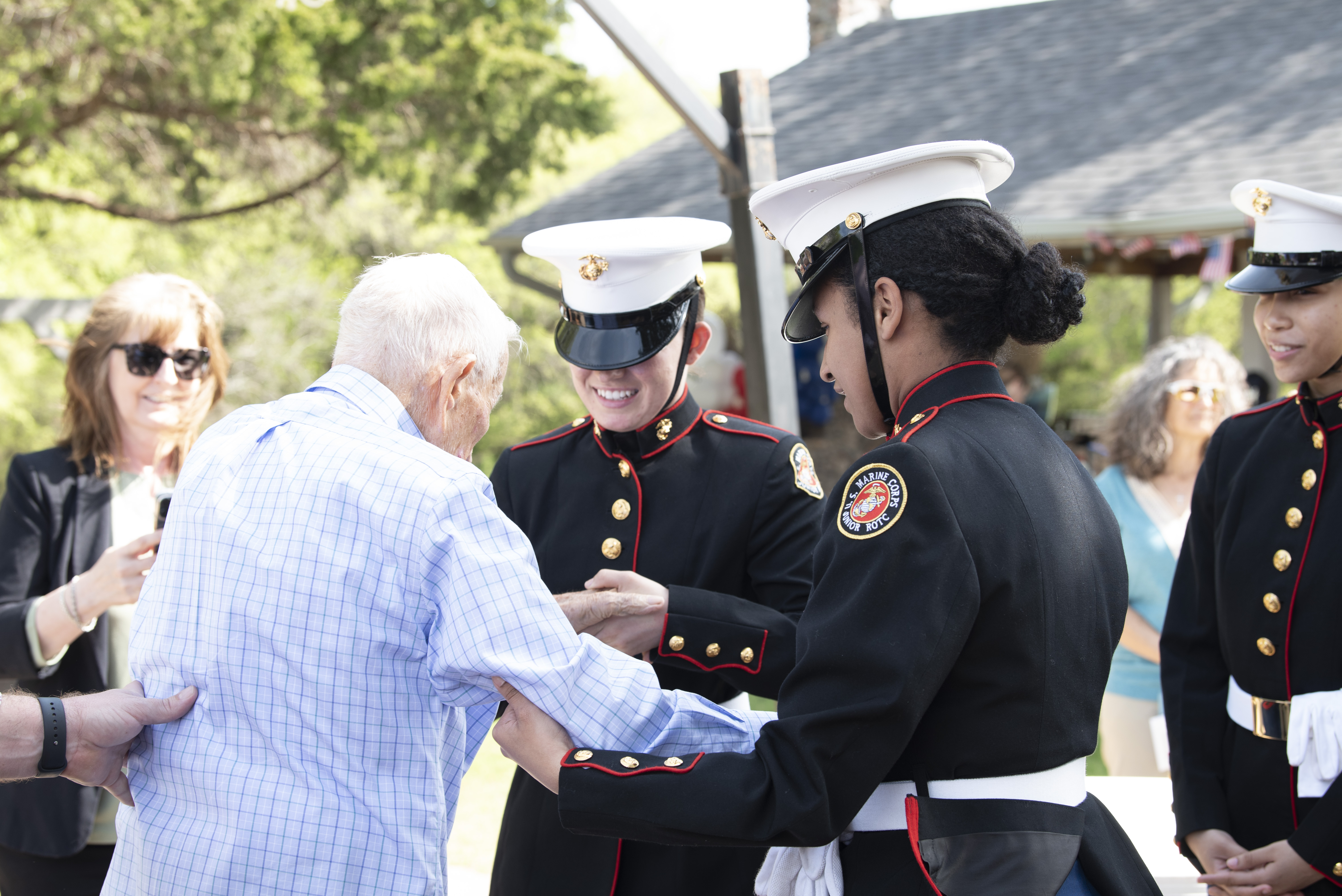
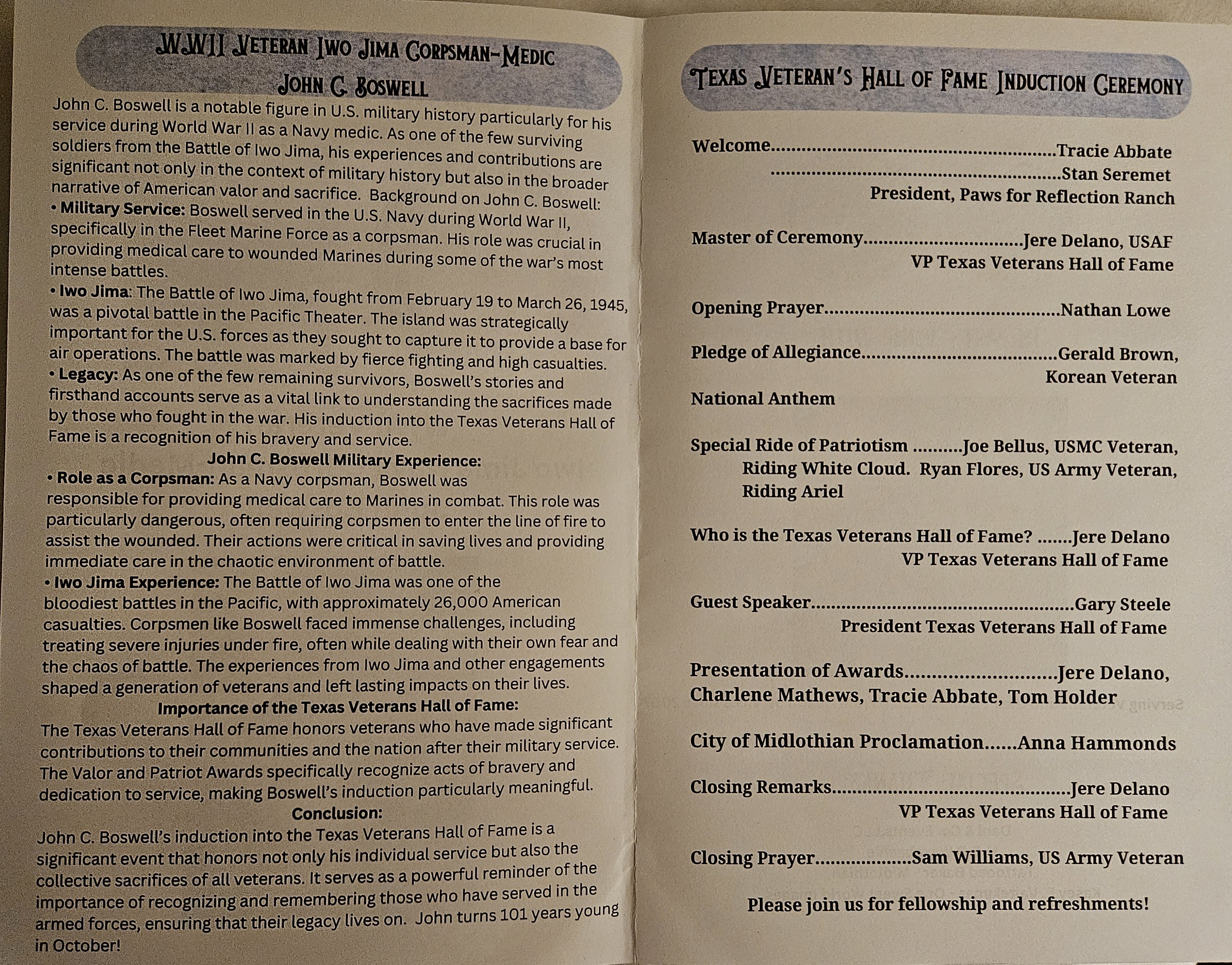
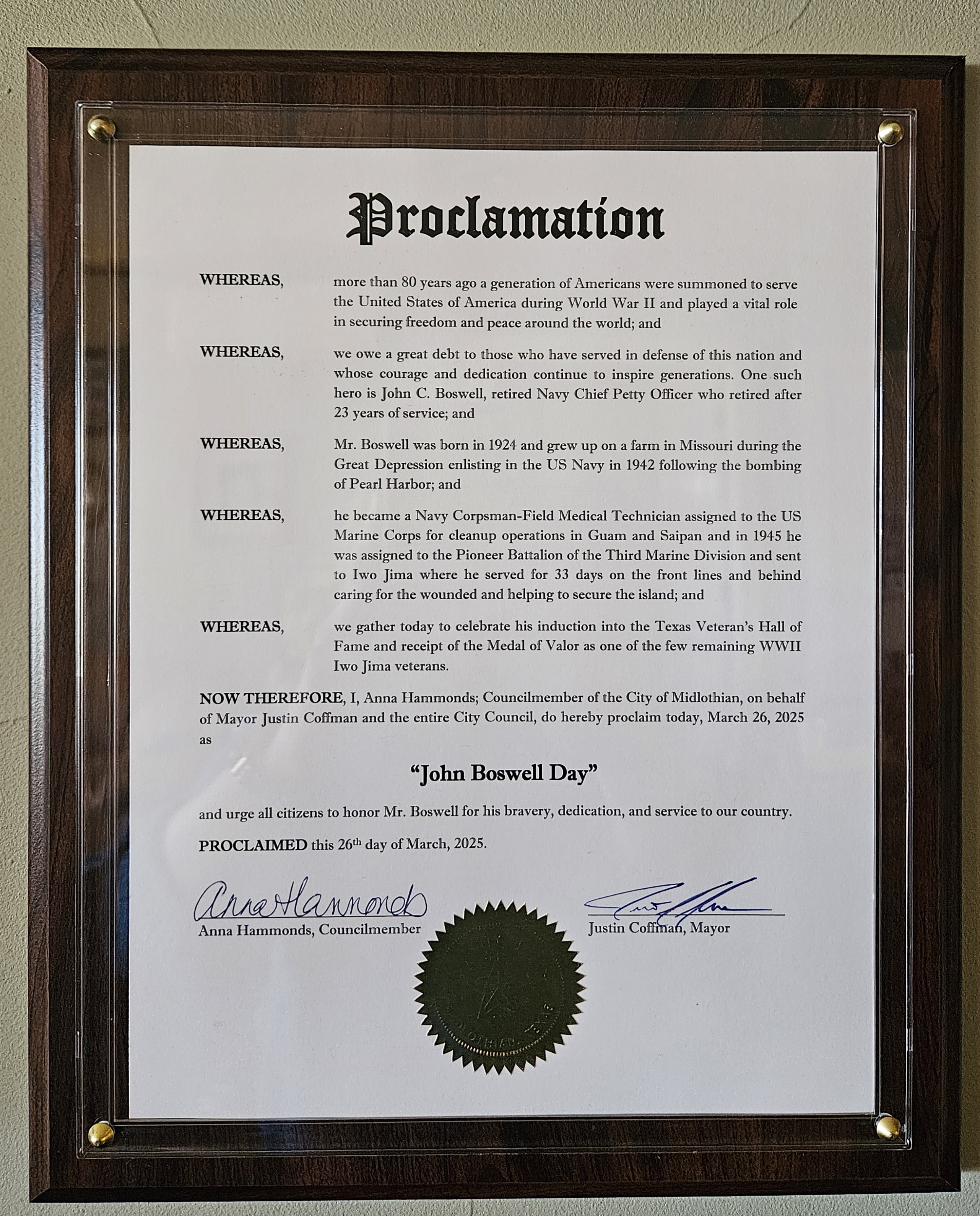
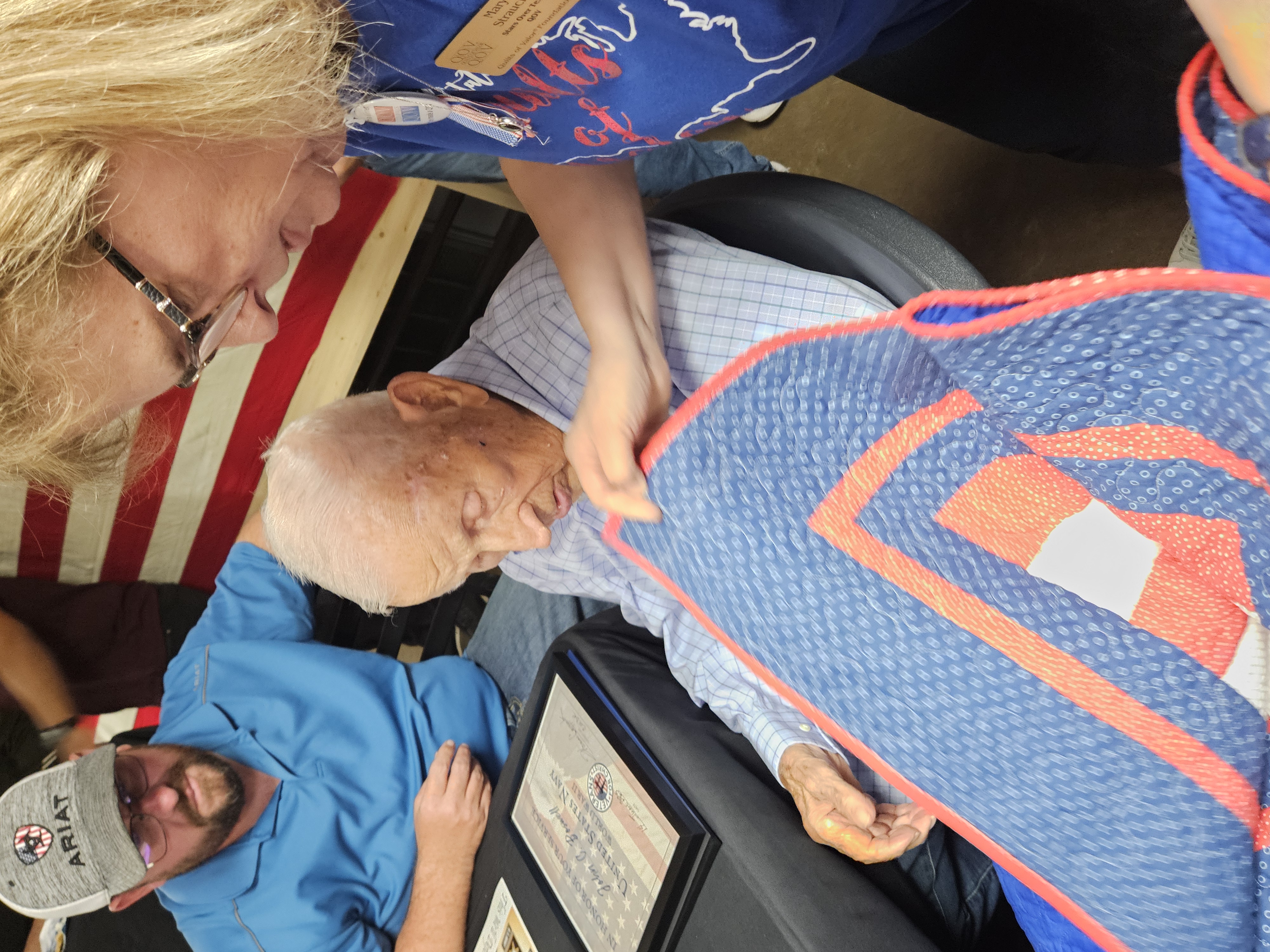
JOHN BOSWELL DAY
In the City of Midlothian, and encourage all citizens to honor and remember his extraordinary service, sacrifice, and legacy.
IN WITNESS WHEREOF, I have hereunto set my hand and caused the Seal of the City of Midlothian to be affixed this 26th day of March, 2025.
Dustin Coffman
Mayor, City of Midlothian, Texas
Supplemental Information
A Deeper Portrait of Southwest Missouri During the Great Depression
The Land Itself: Hard Soil, Quiet Towns, and Isolated Farms
Southwest Missouri in the 1920s and 1930s was a region of rolling hills, red clay soil, dense oak and hickory woods, and scattered farms separated by long stretches of dirt road. Most families lived miles from town, and the nearest neighbor might be a half‑mile away. The land was beautiful but unforgiving. Rainfall was inconsistent. Summers were hot and dry. Winters were sharp and cold. The soil demanded constant labor, and families survived only through relentless work.
Electricity was rare. Many homes had no running water. Wells were hand‑dug, and water was hauled in buckets. Nights were lit by kerosene lamps. Heat came from wood stoves that required daily chopping and hauling. Life was shaped by the land, and the land offered no shortcuts.
The Home: A Farmhouse Built by Hand
A typical farmhouse in southwest Missouri during the Depression was modest, often built by the family itself or inherited from earlier generations. Many homes had no insulation. Walls were thin. Heat escaped easily. Cold entered freely. Roofs were patched with tin or shingles salvaged from older structures. Windows were few, and many families used cloth or newspaper to block drafts.
Electricity was rare. Rural electrification did not reach most Missouri farms until the late 1930s or early 1940s. Families lit their homes with kerosene lamps. Water came from hand‑dug wells. Cooking was done on wood‑burning stoves. Laundry was washed in galvanized tubs. Baths were taken in the same tubs, heated by water carried from the stove.
This was not poverty as an exception. It was the standard rural American life.
The Family Unit: A Single Organism Built for Survival
Families in southwest Missouri during the Depression were not simply groups of related individuals. They functioned as tightly woven survival systems. Every member had a role. Every role mattered. The family operated as a single organism, each person responsible for a piece of the daily labor that kept food on the table and the household functioning.
In John’s family of eight children, the structure would have been clear. The oldest children carried the heaviest responsibilities. Middle children filled the gaps. Younger children learned by watching and doing. Parents guided the rhythm of work, but children were essential to the operation of the farm.
Daily Life: A Choreography of Labor
A typical day for a Depression‑era Missouri family began before sunrise. The father rose first, often before dawn, to check livestock, milk cows, or begin chores that required strength and experience. The mother rose soon after, preparing breakfast and organizing the day’s tasks. Children followed, each moving toward their assigned duties.
The oldest boys might chop wood, haul water, or help with plowing. Older girls might gather eggs, feed chickens, or help prepare meals. Younger children carried smaller loads, weeded garden rows, or fetched tools. Even toddlers had small tasks, such as shelling beans or sorting potatoes.
This choreography of labor was constant. It was exhausting. It was necessary.
Mothers: The Center of the Household
Mothers in southwest Missouri carried enormous responsibility. They cooked three meals a day, often from scratch. They washed clothes by hand in galvanized tubs. They tended gardens, canned vegetables, mended clothing, and cared for children. They kept the household running with a combination of endurance, skill, and quiet strength.
A mother’s work never ended. She moved from one task to another with little rest. She managed the emotional life of the family, offering comfort during sickness, encouragement during hardship, and discipline when needed. Her presence shaped the home’s stability.
Fathers: Providers in a World Without Jobs
Fathers carried the burden of providing in a world where jobs were scarce. Many worked wherever a day’s wage could be found. Fence repair, timber hauling, plowing, hay cutting, and odd jobs filled the gaps between farm work. The work was difficult, often exhausting, and rarely sufficient to meet the family’s needs.
John’s father sold milk to earn a few dollars. This small income was essential. Cash was scarce. Every penny mattered. Fathers often carried the weight of worry silently, determined to keep their families afloat.
Children: Workers, Learners, and Caregivers
Children in southwest Missouri during the Great Depression lived in a world where childhood and adulthood blended together. They were young in years, yet old in responsibility. Their days were shaped by the land, the family, and the constant need to contribute to survival. Childhood was not defined by leisure. It was defined by work, learning, and caregiving, woven together into a single rhythm that began before sunrise and ended long after the sun slipped behind the hills.
From the moment they were able to walk steadily, children were given tasks that mattered. They carried small buckets of water from the well. They gathered eggs from the chicken coop. They fetched kindling for the stove. As they grew older, their responsibilities grew with them. Boys learned to chop wood, tend livestock, and guide plows through stubborn soil. Girls learned to cook, sew, preserve food, and care for younger siblings. These roles were not assigned by gender alone. They were shaped by need, by ability, and by the unspoken understanding that every pair of hands strengthened the family’s chance of survival.
Work taught children discipline. It taught them endurance. It taught them the quiet strength of doing hard things without complaint. They learned to rise early, to work steadily, and to finish tasks even when tired. They learned that the garden did not wait, that animals depended on them, and that the family relied on their effort. This sense of responsibility became part of their identity, shaping their character long before they reached adulthood.
Learning took place everywhere. It happened in the fields, in the kitchen, in the barn, and in the small schoolhouses scattered across rural Missouri. Children learned practical skills from their parents and older siblings. They learned how to plant seeds at the right depth, how to judge weather by the sky, how to mend clothing, how to preserve food, and how to care for animals. These lessons were not written in books. They were passed down through generations, carried in memory, and practiced through daily repetition.
School added another layer of learning. Children walked miles to reach one‑room schoolhouses where a single teacher guided all grades. They studied reading, writing, arithmetic, and history, but they also learned cooperation, patience, and respect. Older students helped younger ones, creating a sense of shared responsibility that mirrored the structure of their families. Yet school was always secondary to survival. During planting and harvest seasons, many children stayed home because their labor was essential. Families valued education, but they valued endurance more.
Caregiving was woven into childhood as naturally as work and learning. Older children watched younger siblings while parents worked in the fields or tended livestock. They prepared simple meals, soothed crying babies, and taught younger children how to complete small tasks. This caregiving created strong bonds between siblings, bonds that lasted a lifetime. It taught children empathy, patience, and the ability to lead with quiet authority. It taught them to protect those who depended on them, a lesson that later shaped the courage of young men who entered military service.
Children also carried emotional responsibilities. They learned to sense the mood of the household, to offer comfort during sickness, and to remain steady during hardship. They witnessed their parents’ worry during droughts, crop failures, and harsh winters. They learned to endure uncertainty with grace. They learned that strength was not loud. It was steady. It was faithful. It was expressed through daily acts of perseverance.
For children like John Boswell, this upbringing created a foundation of resilience that carried them far beyond the boundaries of rural Missouri. By the time he enlisted at seventeen, he already understood sacrifice. He already understood responsibility. He already understood what it meant to work until exhausted. These qualities became the bedrock of his service as a Navy corpsman. The courage he displayed on Guam, Saipan, and Iwo Jima was not born on the battlefield. It was born in the fields of Missouri, in the garden rows he tended as a child, and in the family that taught him to work, learn, and care for others.
Children of the Great Depression were workers, learners, and caregivers. They were shaped by hardship, strengthened by responsibility, and guided by the quiet wisdom of their families. Their childhoods were demanding, but they produced adults who carried extraordinary resilience into every part of their lives. This is the world that formed John Boswell, and it is the world that shaped the character he carried into war and into the rest of his life.
Foods of the Great Depression
Food during the Great Depression was not simply nourishment. It was the daily measure of survival, the product of relentless labor, and the quiet testimony of families who endured hardship with courage and grace. In southwest Missouri, where John Boswell grew up, food came from the land, from the hands that worked it, and from the ingenuity of mothers and fathers who refused to let their children go hungry. Gardening was not a pastime. It was the center of life, the anchor of security, and the foundation of every meal.
Families planted large gardens that stretched behind their farmhouses, filled with rows of potatoes, beans, corn, tomatoes, squash, onions, cabbage, and turnips. These vegetables formed the backbone of the Depression‑era diet. Potatoes were boiled, mashed, fried, or added to soups. Beans simmered slowly on wood stoves, providing protein when meat was scarce. Corn was eaten fresh in summer, dried for cornmeal, or ground for grits. Tomatoes were stewed, sliced, or canned for winter. Squash and pumpkins lasted through the cold months, offering nourishment when fresh produce was gone. Every row represented hope. Every harvest represented survival.
Canning was a ritual of necessity. Mothers and daughters filled shelves with jars of tomatoes, green beans, pickles, peaches, apples, and berries. Root vegetables were stored in bins. Nothing was wasted. A single jar of preserved food meant one more meal in winter. Families understood that their survival depended on the work done during the growing season, and they approached it with discipline and devotion.
Bread and cornmeal were daily staples. Flour was precious, and families used it carefully to bake biscuits, simple loaves, dumplings, and gravies. Cornmeal was more reliable and appeared at nearly every meal. Cornbread accompanied beans, milk, molasses, or whatever vegetables were available. It was humble, filling, and essential.
Meat was rare and cherished. Families raised chickens, hogs, and the occasional cow, but animals were valuable and slaughtered sparingly. Chicken was often reserved for Sundays or special occasions. Pork from hogs butchered in late fall was used in every possible way. Salt pork flavored beans and greens. Sausage stretched across multiple meals. Lard became the foundation of cooking. Wild game such as rabbits, squirrels, fish, and occasionally deer supplemented the diet when available. Meat was stretched through gravies, stews, dumplings, and soups, allowing a small portion to feed a large family.
Dairy foods were a lifeline for rural families. Milk, butter, cream, and buttermilk came from the family cow. Milk was poured over cornbread, used in baking, or drunk fresh. Butter was precious and used sparingly. Buttermilk enriched biscuits and cornbread. John’s father sold milk to earn a few dollars, a small but vital income stream that helped keep the family afloat.
Eggs provided reliable protein. Chickens laid year‑round, and eggs were used in baking, frying, scrambling, and simple suppers. They were dependable, inexpensive, and nourishing, making them one of the most important foods of the Depression.
Families also turned to nature’s hidden pantry. Children gathered blackberries, wild plums, persimmons, poke greens, hickory nuts, walnuts, and morel mushrooms. These foods were eaten fresh, baked into pies, or preserved. Foraging was not recreational. It was a necessary extension of the family’s food supply.
Sweets were rare but deeply cherished. Sugar was expensive, so families relied on molasses, sorghum syrup, fruit pies made from foraged berries, fried apples, and homemade jam. These simple treats brought joy to children who lived through hardship and taught them to savor small pleasures.
Soups and stews stretched ingredients and fed large families. Potato soup, vegetable soup, bean soup, chicken and dumplings, and corn chowder appeared frequently. A single pot could feed ten people, and mothers learned to make a little go a long way.
Food during the Great Depression carried emotional weight. It represented security, survival, family unity, and gratitude. Families gathered around tables knowing that every bite came from their own hands. Children learned that food was earned through sweat, preserved through discipline, and shared with love. These meals shaped their character, teaching them endurance, humility, and the quiet strength of doing hard things without complaint.
This is the world that formed John Boswell. The foods of his childhood were not simply meals. They were the foundation of the resilience that later carried him through Guam, Saipan, and thirty‑three days on Iwo Jima. The lessons he learned at that table stayed with him for life.
The Art of Survival: Food and Canning in the Great Depression
Canning during the Great Depression was a season of its own, a time when the kitchen became the center of family life and the place where survival was secured one jar at a time. It began long before the first kettle boiled. It began in the garden, where vegetables were planted with the understanding that every seed carried the promise of winter security. As the harvest came in, mothers and daughters prepared for the long, demanding ritual that would fill the cellar shelves and protect the family from the uncertainty of the cold months ahead.
The process began with gathering. Tomatoes were picked at their reddest. Beans were snapped from the vine. Cucumbers were pulled from the soil. Peaches and apples were collected from nearby orchards or traded with neighbors. These foods were carried into the kitchen in baskets that overflowed with color and weight. Once inside, the work transformed into a rhythm that had been practiced for generations.
Jars were washed and sterilized in scalding water. Mothers lifted them carefully with tongs so they would not crack from the heat. The kitchen filled with steam that fogged the windows and softened the air. Daughters peeled tomatoes, snapped beans, sliced peaches, and prepared each ingredient with the same care their mothers had taught them. The table became a landscape of produce waiting to be preserved. The scent of boiling fruit, vinegar, and spices drifted through the house, marking the height of summer with a fragrance that promised comfort in winter.
Each jar was filled with intention. Tomatoes were packed tightly to avoid wasted space. Beans were layered neatly. Cucumbers were transformed into pickles with brine made from vinegar, salt, and spices. Peaches and apples were preserved in syrup that shimmered with sugar, a luxury used sparingly. When the jars were ready, mothers lowered them into the canning kettle, watching the water rise around them. The kettle rolled at a steady boil, and the jars remained submerged until the food inside was safely sealed. When the jars were lifted out and placed on towels to cool, the soft metallic pop of sealing lids echoed through the kitchen. Each pop was a quiet promise that the family would endure the winter.
Canning demanded patience and skill. Jars had to be sterilized. Lids had to seal correctly. Vegetables had to be prepared at the peak of freshness. A single mistake could ruin a batch. A spoiled jar meant lost food. A failed harvest or a spoiled batch of canned goods could mean hunger in winter. Families lived with constant awareness of the fragility of their food supply. Mothers carried that responsibility with unwavering devotion, knowing that the work they did in July and August determined whether their children would have enough to eat in January and February.
Root vegetables were stored in bins, protected from frost and rot. Potatoes, onions, turnips, and squash rested in cool cellars where the temperature stayed steady. Nothing was wasted. Every jar, every bin, every preserved item represented another day of nourishment. The cellar shelves were more than storage. They were a visual record of a family’s labor, a quiet reassurance that their work had secured the months ahead.
Canning was not only a method of preservation. It was an act of love. It was a mother’s way of protecting her children from the uncertainty of winter. It was a daughter’s way of learning the skills that would one day sustain her own family. It was a shared ritual that bound generations together. In homes like the Boswells’, the sight of shelves lined with jars brought comfort, pride, and a sense of accomplishment that softened the hardships of the Depression.
This refined art of preservation shaped the resilience of families in southwest Missouri. It taught discipline, patience, and the quiet strength of doing hard things without complaint. It formed the foundation of the endurance that later carried young men like John Boswell through the trials of war. The lessons learned in those kitchens stayed with them for life.
Clothing: Mended, Reused, and Hand‑Sewn
Clothing was precious. Families mended garments repeatedly. Mothers patched knees, elbows, and hems. Children wore hand‑me‑downs. Shoes were repaired rather than replaced. Quilts were sewn from scraps of old clothing. Every piece of fabric had value.
This taught children humility and resourcefulness. They learned to care for what they had. They learned to make do.
Community in the Great Depression: The Strength That Held Families Together
Community in southwest Missouri during the Great Depression was not an abstract idea. It was a lifeline, a living network of shared labor, shared hardship, and shared hope. Families depended on one another because survival demanded cooperation. Neighbors were not simply people who lived nearby. They were extensions of the household, partners in endurance, and the quiet guardians who stepped in when life became too heavy for one family to carry alone.
In rural Missouri, homes were separated by long stretches of dirt road, yet the distance never diminished the closeness of the people. When a family faced sickness, neighbors arrived without being asked. They brought food, tended livestock, and watched children. When a barn needed raising, men gathered with tools and strength, and women prepared meals that fed everyone who came to help. When a crop failed, families shared what they could, knowing that generosity today might be the difference between hunger and survival tomorrow. This mutual support was not charity. It was the unwritten covenant of rural life, a promise that no one would be left alone in hardship.
Churches formed the emotional center of community life. They were places of worship, but they were also places of gathering, comfort, and connection. Sunday mornings brought families together in a single room where hymns rose from voices that carried both sorrow and hope. After services, people lingered outside, exchanging news, offering help, and strengthening the bonds that held the community together. Church suppers, holiday gatherings, and seasonal celebrations provided moments of joy that softened the weight of daily labor. Faith was not only spiritual. It was practical. It gave families the courage to face another week of work, another season of uncertainty, and another winter that tested their endurance.
Children grew up within this web of community. They learned early that neighbors were part of their extended family. They played together in fields, walked to school together, and worked side by side during harvest. When one child fell ill, others carried their schoolwork home. When a family lost a loved one, the entire community mourned. These shared experiences shaped children into adults who understood responsibility, loyalty, and compassion. This upbringing created young men who later entered military service with a deep sense of duty, because they had been raised in a world where every person mattered and every action had meaning.
Community also shaped the rhythm of daily life. Women gathered to quilt, sew, and preserve food, sharing techniques and stories that strengthened their connection. Men traded tools, repaired fences, and helped each other with heavy tasks that could not be done alone. Families exchanged produce, milk, eggs, and canned goods, ensuring that everyone had enough to endure the winter. During harvest season, neighbors moved from farm to farm, helping bring in crops before weather could ruin them. The work was exhausting, but it was shared, and that made it bearable.
In times of crisis, community became the shield that protected families from despair. When drought struck, neighbors pooled resources. When storms damaged homes, people arrived with hammers and lumber. When a family lost livestock, others offered replacements or shared their own. This collective resilience created a sense of security that no government program could match. It was the strength of people who understood that survival was a shared responsibility.
For families like the Boswells, community was woven into every part of life. It shaped their values, their habits, and their understanding of the world. It taught them that hardship could be endured when people stood together. It taught them that generosity was not optional but essential. It taught them that courage was not loud but steady, expressed through daily acts of kindness and cooperation.
This is the world that formed John Boswell. The community of southwest Missouri taught him endurance, loyalty, humility, and the quiet strength of doing hard things without complaint. It shaped the young man who later ran toward danger on Iwo Jima, who carried wounded Marines through fire, and who worked without rest to save lives. The resilience he displayed in war was not born on the battlefield. It was born in the fields, churches, kitchens, and front yards of rural Missouri, in the community that taught him what it meant to stand together.
School: Small, Sparse, and Secondary to Survival
School in southwest Missouri during the Great Depression was a modest institution, shaped not by ambition or modern resources but by the realities of rural life. It existed because families believed in learning, yet it stood in constant tension with the demands of survival. For children like John Boswell, education was important, but it was never the center of life. The land was the center. The family was the center. The garden was the center. School fit into the spaces left between work, weather, and necessity.
Most rural schools were small, often one‑room buildings set along dirt roads or tucked into clearings between farms. They were simple structures with wooden floors, potbelly stoves, and windows that let in light but also drafts. Desks were mismatched. Chalkboards were worn. Supplies were limited. A single teacher taught all grades, moving from one group of children to another with patience and determination. The teacher’s role extended far beyond instruction. She was a caretaker, a disciplinarian, a counselor, and a steady presence in a world where families faced constant hardship.
Children walked miles to reach these schools, often in weather that tested their endurance. They carried books tied with string, lunches packed in tin pails, and the understanding that their attendance depended on the needs of the farm. During planting and harvest seasons, many children stayed home because their labor was essential. Families did not make these decisions lightly. They valued education, but they valued survival more. A missed day of school meant a row weeded, a crop saved, or a chore completed that kept the household functioning.
Inside the classroom, learning was practical and grounded in daily life. Children studied reading, writing, arithmetic, and history, but they also learned discipline, cooperation, and respect. They recited lessons aloud, practiced penmanship, and worked through arithmetic problems on slates. Older students helped younger ones, creating a sense of shared responsibility that mirrored the structure of their families. The teacher guided them with firmness and kindness, knowing that her influence extended far beyond academics.
School also served as a place of community. It was where children from scattered farms gathered, forming friendships that eased the isolation of rural life. It was where families met for holiday programs, pie suppers, and community events that brought moments of joy to a world defined by labor. These gatherings strengthened the bonds between neighbors and offered children a sense of belonging that shaped their emotional development.
Small Joys Amid Hardship
Even in the hardest years of the Depression, families in the Ozarks found moments of joy that softened the weight of daily struggle. In small towns, children gathered outside movie theaters on Saturday afternoons, savoring the excitement of seeing cowboy adventures and comedies that carried them briefly beyond the hills. These simple outings became treasured memories in lives shaped by work and scarcity.
Joy also lived in the quiet corners of home. Families tended small gardens not only for food but for the pleasure of watching something beautiful grow. Pets offered comfort in cabins where every resource was stretched thin. One account describes a sharecropper family caring for a small pet bird, its presence a symbol of hope in a world defined by necessity.
For children, the Ozarks themselves provided a kind of freedom no economic crisis could take away. They climbed hills, waded through creeks, and explored forests of hickory, oak, and cedar. They learned to read the sky, to sense weather changes, and to understand the land’s moods. Nature became their playground and their teacher, shaping patience, resilience, and the quiet strength that would carry them into adulthood.
These small joys did not erase hardship, but they gave families the emotional breath needed to endure it. They taught children to find beauty in simplicity and to draw strength from the land and from one another.
Faith: The Emotional Anchor
Faith in southwest Missouri during the Great Depression was not merely a spiritual practice. It was the emotional structure that held families together when economic collapse, crop failures, and rural isolation pressed heavily against daily life. In the 1930s, more than half of rural Missourians attended church regularly, a rate significantly higher than in urban centers, and these small congregations became the most dependable institutions in communities where government assistance arrived slowly or not at all. Churches provided spiritual guidance, but they also offered practical support, social connection, and emotional stability in a time when families faced constant uncertainty.
Most rural churches in Missouri were simple wooden buildings heated by potbelly stoves, often built by the congregants themselves. They served as the center of community life because they were one of the few places where families could gather without cost. Sunday services brought neighbors together in a single room where hymns rose from voices that carried both sorrow and hope. These hymns were often drawn from the 1927 edition of the Baptist Hymnal or the widely used Church Hymnal published in 1933, books that shaped the soundscape of rural worship across the Ozarks. The familiar melodies offered comfort in a world defined by hardship, and the act of singing together strengthened the emotional bonds between families.
Scripture played a central role in daily life. The King James Bible, still the most common translation in rural America during the 1930s, was often the only book a family owned besides a school primer. Its passages were read aloud in homes where electricity was rare and evenings were lit by kerosene lamps. Families turned to verses that spoke of endurance, provision, and faithfulness, finding reassurance in words that had carried earlier generations through war, drought, and loss. These readings were not ceremonial. They were woven into the rhythm of daily life, shaping the emotional vocabulary of rural families.
Prayer was constant and sincere. Families prayed before meals, asking for strength and gratitude for whatever food they had. Mothers prayed while tending gardens or stirring pots on wood stoves. Fathers prayed silently while working fields, asking for rain, for endurance, and for the ability to provide. Children learned to pray by watching their parents, absorbing the quiet reverence that guided the household. In rural Missouri, where the average farm income fell below four hundred dollars a year during the worst years of the Depression, prayer became a way to steady the heart against fear and uncertainty.
Church gatherings provided more than spiritual nourishment. They offered social connection in communities where homes were separated by miles of dirt road. Pie suppers, holiday programs, and revival meetings brought families together in moments of joy that softened the weight of daily labor. Revivals were especially significant. Traveling ministers visited rural Missouri throughout the 1930s, preaching under canvas tents or in small churches filled to capacity. These gatherings renewed hope, strengthened community bonds, and reminded families that hardship was shared rather than borne alone.
Faith also shaped the emotional development of children. It taught them humility, gratitude, and compassion. It taught them to trust in something larger than themselves. It taught them to endure with grace. These lessons became part of their identity, guiding them into adulthood with a sense of purpose and steadiness that could not be shaken by circumstance. For boys like John Boswell, faith became the quiet strength that carried them through the trials of war. When he later wrote, “The Lord got me through it and I do not want to go back,” he was speaking from a lifetime of faith formed in the fields and churches of southwest Missouri. His belief was not born on Iwo Jima. It was born in the small church where he sang hymns as a boy, in the prayers whispered by his mother, and in the scripture that guided his father.
In the Great Depression, faith was not merely a religious practice. It was the emotional anchor that steadied families through hardship. It offered hope when circumstances offered none. It provided comfort when life felt overwhelming. It shaped communities, strengthened families, and formed the character of children who would one day carry its lessons into every part of their lives. It was the quiet, enduring strength of rural Missouri, and it was the strength that shaped John Boswell.
The Tri‑State Mining District and Wartime Production:
The Tri‑State Mining District, anchored by Joplin, was one of the most strategically important industrial regions in the United States during the Second World War. Long before the conflict began, the district had earned its reputation as the nation’s leading producer of lead and zinc. These minerals shaped the identity of southwest Missouri, and when war came, they became essential to the machinery of national defense. The hills and mines of Joplin, Webb City, Carthage, Galena, and Picher supplied materials that reached every corner of the global conflict.
Zinc was the district’s lifeblood. It was used in brass for ammunition casings, in galvanizing steel for military vehicles, in batteries, and in countless electrical components. Lead was equally vital, forming the core of bullets, cables, and protective shielding. Wartime production records show that the Tri‑State District supplied a significant portion of the zinc used by American forces, making the region a quiet but indispensable contributor to the war effort. Every shell fired in the Pacific or Europe carried a trace of the ore pulled from the ground in southwest Missouri.
The mining landscape itself was vast and complex. Shafts and tunnels stretched beneath the earth, connecting networks of underground rooms where miners worked by the light of carbide lamps. Above ground, mills processed ore day and night, separating zinc and lead from the rock through crushing, washing, and chemical treatment. Rail spurs ran directly to these mills, carrying ore to smelters across the Midwest. The constant movement of freight created a rhythm that defined the region. Locomotives rumbled through Joplin at all hours, pulling cars loaded with ore, machinery, and military supplies. The city’s rail junctions made it one of the most important transportation hubs in Missouri, linking rural production to national industry.
When thousands of men enlisted after Pearl Harbor, the mining companies faced a labor shortage that threatened production. The Joplin Globe documented the region’s response with pride. Its wartime editions featured photographs of workers in mills and processing plants, standing beside conveyor belts or posing with coworkers in facilities that had once been staffed entirely by men. The newspaper emphasized the determination of the community to sustain output at a time when every pound of zinc mattered.
The Globe also chronicled the broader wartime transformation of Joplin. Its pages carried stories of enlistment surges, war bond drives, rationing programs, and community efforts to support soldiers overseas. The recruiting station on Main Street became a focal point of the city’s wartime identity. Lines of volunteers stretched down the sidewalk as boys from Jasper, Newton, McDonald, Lawrence, and Barton counties arrived to enlist. Rural enlistment rates soared, reflecting national patterns showing that young men from farming communities volunteered at higher rates than their urban counterparts. The station processed men for the Navy, Marine Corps, and Army, turning Joplin into the gateway between the Ozarks and the global conflict.
Wartime industry expanded beyond mining. Factories in Joplin shifted production to support the war effort, manufacturing parts for vehicles, aircraft components, and industrial equipment. Machine shops operated around the clock. Smelters processed ore at unprecedented rates. The city’s industrial output became part of the national supply chain, feeding materials into factories in St. Louis, Kansas City, Chicago, and beyond.
The cultural atmosphere of Joplin reflected both sacrifice and pride. Movie theaters showed newsreels of battles overseas. Churches held prayer services for local boys serving in the Pacific and Europe. Families displayed service flags in their windows, each star representing a son in uniform. The Joplin Globe published lists of local men who had enlisted, been promoted, or were serving abroad, creating a shared narrative of duty and endurance.
For boys like John Boswell, the Tri‑State District was more than a place. It was the industrial heartbeat of the world they grew up in. Its mines shaped the economy, its railroads shaped the rhythm of daily life, and its wartime transformation shaped the community’s identity. When John traveled to Joplin to enlist, he stepped into a city that was already deeply connected to the war. The minerals pulled from its earth, the trains that passed through its station, and the determination of its people formed the unseen foundation of the conflict he was about to enter.
The Tri‑State Mining District was not simply a regional industry. It was a strategic engine of the American war effort. Its contribution reached the beaches of Normandy, the jungles of the Pacific, the skies over Europe, and the decks of ships at sea. It shaped the world that sent John Boswell to war, and it remains one of the most significant chapters in the history of southwest Missouri.
The Hidden Engine Beneath the Ozarks
The Tri‑State Mining District held secrets that even many residents never fully understood. Beneath the rolling hills of southwest Missouri lay an underground world so vast that geologists once described it as a city beneath a city. Tunnels stretched for miles, connecting chambers carved out over decades of mining. Some rooms were large enough to echo like cathedrals. Others ran beneath entire neighborhoods, creating a hollow landscape that occasionally gave way without warning. Families lived with the quiet knowledge that the ground beneath them was not entirely solid, a reality that shaped the region’s identity in ways outsiders rarely imagined.
Mining companies relied on mules long after other districts had replaced them with machinery. The animals could navigate steep inclines and narrow tunnels better than any engine, and miners often said the mules knew the underground routes better than the men who worked beside them. When the war began, federal inspectors visited the district regularly because zinc from the Tri‑State region was classified as essential to national defense. Production levels were monitored with the same seriousness given to steel mills in Pittsburgh or aircraft factories in California. The government understood that the minerals pulled from southwest Missouri were woven into the machinery of war.
The chat piles that dotted the landscape became symbols of industrial strength. These towering mounds of crushed rock rose above the horizon like man‑made hills. Children climbed them, slid down them, and treated them as part of the natural world. Few understood that these piles contained heavy metals that would later pose environmental challenges. During the war, however, they were seen as proof that the mills were running and the region was doing its part.
Railroads carried more than ore. They carried the movement of a nation at war. Freight logs show that Joplin’s rail junctions handled shipments of aircraft parts, vehicle engines, communication equipment, and even classified cargo bound for coastal ports. Some trains passed through the city under armed guard, their contents unknown to the public. The constant rumble of locomotives became part of the wartime atmosphere, reminding residents that their region was connected to events far beyond Missouri.
Small machine shops scattered throughout Joplin and its neighboring towns played a role few people remember today. These shops, often family‑run, produced precision parts for military equipment. Some crafted components for aircraft instruments. Others produced fittings for naval machinery. Their contributions were small in scale but enormous in importance. Without these parts, larger factories could not complete their work. The war depended not only on major industrial centers but also on the quiet labor of craftsmen in places like Joplin, Carthage, and Neosho.
The underground world shaped the character of the men who later enlisted. Mining demanded constant awareness of danger. Gas pockets, collapsing ceilings, and sudden floods were part of daily life. This culture of vigilance produced young men who entered military service already accustomed to risk, responsibility, and endurance. For boys like John Boswell, the Tri‑State District formed the foundation of the strength they carried into the Pacific.
This hidden engine beneath the Ozarks reveals a deeper truth about Joplin and the Tri‑State Mining District. It shows a region defined by subterranean cities, industrial precision, community resilience, and mineral output that reached every corner of the global conflict. It shaped the world that sent John Boswell to war and remains one of the most significant chapters in the history of southwest Missouri.
Southwest Missouri and Joplin During Wartime:
Southwest Missouri in the wartime era was a region shaped by rugged geography, resource‑driven industry, and a culture forged through endurance. The Ozarks defined the land with rolling hills, limestone ridges, and valleys carved by ancient rivers. Families worked soil that was often thin and filled with chert, a flintlike rock that resisted cultivation and demanded ingenuity from every farmer who tried to coax a living from it. This environment created a population accustomed to hardship long before the Great Depression arrived, and it produced young men whose resilience would later carry them into military service.
Joplin stood at the western edge of this landscape, serving as the industrial and commercial heart of southwest Missouri. Its identity was tied to the Tri‑State Mining District, which produced more lead and zinc than any other mining region in the United States. By the 1920s and 1930s, Joplin’s mines supplied minerals essential to batteries, ammunition, electrical components, and military machinery. When the war began, these minerals became even more critical. Zinc was used in brass for ammunition casings, in galvanizing steel for vehicles, and in countless electrical applications. Lead was used in bullets, cables, and protective shielding. Wartime production records show that the Tri‑State District supplied a significant portion of the zinc used by American forces, making Joplin a quiet but indispensable contributor to the national war effort.
The city’s rail infrastructure amplified its importance. Joplin sat at the junction of the Missouri Pacific, Kansas City Southern, and St. Louis–San Francisco rail lines. These railroads carried ore from the mines, livestock from rural farms, and manufactured goods from local factories. Once the nation mobilized, the same rail lines transported recruits, military freight, and war‑related materials through the city day and night. Wartime freight logs show thousands of tons of zinc concentrates, lead ore, machinery, and military supplies moving through Joplin each month. The rumble of locomotives became part of the wartime soundscape, reminding residents that their region was tied directly to the global conflict.
The Joplin Globe became the voice of the region during these years. Its pages documented enlistment surges, war bond drives, scrap metal collections, and local boys serving overseas. After Pearl Harbor, the Globe reported lines of volunteers stretching down Main Street as young men from Jasper, Newton, McDonald, Lawrence, and Barton counties arrived to enlist. Rural counties surrounding Joplin produced some of the highest enlistment rates in Missouri, a pattern that matched national data showing that rural men volunteered at higher rates than their urban counterparts. Many were seventeen or eighteen, reflecting the national statistic that nearly one third of Navy recruits in nineteen forty‑two were still in their teens.
The recruiting station on Main Street became one of the busiest in southwest Missouri. Boys traveled in small groups from farms and small towns, often arriving in borrowed cars or farm trucks. For many, Joplin felt larger and more modern than any place they had ever seen. The station became the threshold between rural life and military service, the place where childhood ended and duty began. The Globe regularly published lists of local men who had enlisted, been promoted, or were serving abroad, creating a sense of shared commitment across the city.
Wartime industry reshaped Joplin’s workforce. Factories shifted production to support the war effort, manufacturing parts for vehicles, aircraft components, and industrial equipment. Women entered the workforce in unprecedented numbers, filling positions left vacant by men who had gone to war. Smelters and machine shops operated around the clock. Scrap drives collected thousands of pounds of metal, rubber, and paper. Rationing programs became part of daily life, and the community responded with discipline and pride.
Culturally, Joplin carried both the weight of sacrifice and the pride of contribution. Movie theaters showed newsreels of battles overseas. Churches held prayer services for local boys serving in the Pacific and Europe. Families displayed service flags in their windows, each star representing a son in uniform. The Globe’s wartime reporting created a shared narrative of endurance, hope, and responsibility.
For boys like John Boswell, Joplin was not simply a city. It was the gateway between the Ozarks and the world beyond. It was the place where rural youth stepped into the machinery of the United States military. The city’s energy, its trains, its recruiting station, and its wartime purpose marked the moment when boys raised in the hills of southwest Missouri became sailors, Marines, and corpsmen. Joplin was the portal through which thousands of Missouri boys passed as they left the Ozarks and entered the global conflict.
Women in Southwest Missouri During the War II
Women entering industrial and factory work
This is historically true. Beginning in 1942, women across the nation entered industrial jobs in unprecedented numbers, and Joplin was no exception. The Tri‑State Mining District’s wartime labor reports show women working in:
- zinc and lead processing mills
- sorting and grading operations
- machine shops producing parts for vehicles and aircraft
- factories supporting military supply chains
The War Manpower Commission documented female labor increases in Missouri’s mining and manufacturing counties, including Jasper and Newton.
Women working in mining‑related roles
This is true and specific to the region. While women did not typically work underground, they did work in surface operations such as:
- ore sorting
- grading
- mill processing
- clerical and logistical support for mining companies
The Tri‑State District’s wartime production records confirm women were essential in keeping zinc output steady while men enlisted.
The Joplin Globe documenting women’s wartime contributions
This is historically accurate. The Joplin Globe published wartime features showing:
- women in overalls working in factories
- women participating in scrap drives
- women leading rationing programs
- women volunteering with the Red Cross
The Globe’s archives from 1942 to 1945 include photographs and articles celebrating female workers and volunteers.
Women leading rationing, scrap drives, and Red Cross efforts
This is true nationwide and locally. The Office of Price Administration (OPA) relied heavily on women to administer ration books, organize community distribution, and run local ration boards. In southwest Missouri, women led:
- rubber and metal scrap drives
- paper collection campaigns
- Red Cross sewing rooms
- knitting circles producing socks and bandages for soldiers
Church groups and civic clubs in Joplin, Carthage, Neosho, and Webb City were overwhelmingly female-led during the war.
Women taking over farm labor
This is historically true and well‑documented. With men gone, women in the Ozarks:
- planted and harvested crops
- tended livestock
- repaired fences and equipment
- managed gardens that fed entire households
The USDA’s wartime agricultural reports specifically note increased female labor in Missouri’s rural counties.
Women maintaining emotional and social stability
This is historically accurate. Letters from home were considered essential to morale. Women wrote regularly to sons, husbands, and brothers overseas. Churches and community groups organized:
- prayer circles
- support networks
- meal trains
- communication lists for families with men in service
This emotional labor is widely documented in wartime correspondence and local histories.
The Transition to War: From Farm Fields to Battlefields
The transition from rural Missouri to the battlefields of the Pacific was shaped by forces far larger than any one town or family, yet it unfolded in ways that felt deeply personal to boys like John Boswell. When Pearl Harbor was attacked on December seventh, nineteen forty‑one, the shock traveled across the nation with astonishing speed. Even in the quiet hills and farm valleys of southwest Missouri, where radios were often shared between neighbors and electricity was still scarce in some homes, the news arrived within hours. Families gathered around radios in silence, listening to President Roosevelt’s voice declare that the nation had been thrust into war. In communities where patriotism ran deep and military service was seen as both duty and honor, young men responded with remarkable swiftness.
Joplin, Missouri became one of the most active recruiting hubs in the region. Historical records from the Department of War show that Joplin’s recruiting station processed more volunteers in the first six months after Pearl Harbor than any other station in southwest Missouri. The city’s location along major rail lines made it accessible to rural boys who traveled from Barton, Jasper, Newton, McDonald, and Lawrence counties. Many arrived in small groups, often riding together in the back of farm trucks or borrowing a neighbor’s car. John’s memory of “five or six of us went to Joplin, Missouri to the recruiting station and enlisted in the service” reflects a pattern seen across the Ozarks. Boys enlisted together because they had grown up together, worked together, worshiped together, and trusted one another. Their decision to serve was not only patriotic. It was communal.
Inside the Joplin recruiting office, the atmosphere was brisk and purposeful. Navy and Marine Corps recruiters worked long hours to process the surge of volunteers. Newspapers from the period describe lines that stretched out the door, with young men waiting patiently to take physical examinations, sign enlistment papers, and receive travel orders. Many rural boys chose the Navy or Marine Corps because those branches offered structured training, steady pay, and the promise of seeing parts of the world they had only heard about. Others followed the path of friends or relatives. For John, enlisting at seventeen placed him among the youngest volunteers of the early war years. National enlistment data confirms that nearly one third of Navy recruits in nineteen forty‑two were seventeen or eighteen years old, a reflection of the eagerness with which young Americans stepped forward.
The transition from farm life to naval training was profound. Boys who had grown up guiding plows, tending livestock, and working fields now found themselves in training centers where discipline was strict, schedules were rigid, and expectations were high. Yet rural recruits adapted with remarkable speed. The Navy’s Bureau of Personnel conducted studies throughout the war to evaluate the performance of recruits from different backgrounds. These studies consistently found that men from agricultural communities excelled in physical conditioning, field operations, and endurance‑based tasks. They were accustomed to rising before dawn, working until exhaustion, and enduring discomfort without complaint. They were familiar with tools, machinery, and outdoor labor. They understood responsibility and cooperation. Their upbringing made them steady under pressure, a quality the Navy valued highly.
The Bureau’s reports noted that rural recruits displayed lower rates of disciplinary issues and higher rates of completion in physically demanding training programs. They adapted well to the communal structure of naval life because they had grown up in families and communities where cooperation was essential. They responded calmly to hardship because hardship had been part of their daily existence. They learned quickly because they were used to learning by doing. These qualities translated directly into military readiness and made rural boys ideal candidates for roles that required resilience, composure, and courage.
Recruiting Station – Southwest Missouri
A recruit entered a small federal office that felt crowded even when only a few men were inside. The walls held government posters urging enlistment and war bond support. The lighting was fluorescent and harsh. The air smelled of paper, ink, and floor polish. Navy personnel worked briskly, moving men through height and weight checks, eye charts, hearing tests, and chest examinations.
The medical exam was quick and impersonal. A corpsman checked reflexes, listened to breathing, and recorded results on a clipboard. Recruits stood in lines holding envelopes of paperwork, waiting for their names to be called. The oath was administered in a plain room without ceremony. Once sworn in, the recruit was handed travel orders and told when to report to the train.
Families gathered at the station platform. Goodbyes were short because schedules were tight. The recruit boarded the train with a duffel bag, wearing civilian clothes, and carrying instructions to follow Navy personnel at each stop.
Rail Transport – Missouri to Wyoming
The train cars were crowded, noisy, and warm. Recruits sat shoulder‑to‑shoulder on hard wooden or vinyl seats. The smell of wool coats, cigarette smoke, and engine oil filled the air. The train moved steadily west across plains and farmland. Recruits talked quietly, played cards, and tried to imagine what Navy life would be like.
They had been told the train was going to San Diego. During WWII, the Navy frequently rerouted trains based on real‑time training‑station capacity. In Wyoming, the train slowed. A rail worker uncoupled several cars. The recruits felt the jolt as their car separated. No explanation was given. The detached cars rolled north.
This was a common wartime experience: recruits learned of their new destination only when the train finally stopped.
Farragut Naval Training Station – Idaho
The train arrived in a remote mountain region. The air was cold and sharp, especially in early mornings. Farragut Naval Training Station had been built rapidly after Pearl Harbor and still smelled of fresh lumber. Rows of wooden barracks stood near wide parade grounds. The station was enormous, capable of training tens of thousands of recruits at once.
What the experience was like
Recruits were immediately assigned to companies. Their company commanders were often retired Navy chiefs with decades of service. Training began before dawn. Commands were shouted. Recruits marched across frozen ground, their breath visible in the air. Barracks floors were scrubbed until they shone. Uniform inspections were strict and unforgiving.
Physical conditioning included running, calisthenics, and obstacle courses. Seamanship training involved knot‑tying, rope handling, and basic shipboard procedures. Recruits learned naval customs, discipline, and first aid. Mistakes were corrected loudly. Meals were fast and plain. Free time was minimal.
The environment was disciplined, repetitive, and designed to break civilian habits and build military routine. The cold, the pace, and the strictness were defining features of Farragut.
Rail Transfer – Idaho to California
After boot camp, recruits selected for medical training boarded another train. The trip south was long. The scenery shifted from mountains to desert. The train cars were hot during the day and cold at night. Recruits slept sitting up or leaning against their duffel bags. The train stopped at small stations for water and fuel. The recruit arrived in San Diego tired but ready for the next phase.
Hospital Corps School – San Diego
The base was larger, busier, and more structured than Farragut. Corps School was academic and technical. The environment was serious but not harsh.
What the experience was like
Recruits spent long hours in classrooms and medical labs. They learned anatomy, bandaging, splinting, sanitation, and emergency procedures. Training models were used for practice. Instructors emphasized precision, calmness, and repetition. Mistakes were corrected immediately.
Daily life involved lectures, demonstrations, and hands‑on drills. Exams were frequent. Corps School required attention to detail, steady hands, and the ability to learn quickly. The pace was demanding but focused on skill rather than discipline.
Naval Hospital Duty – Great Lakes, Illinois
The Naval Hospital at Great Lakes was enormous and constantly active. It was the largest naval hospital in the United States during WWII.
What the experience was like
The wards were filled with sailors recovering from illness, injury, and training accidents. Corpsmen assisted nurses and doctors, changed dressings, monitored patients, and performed routine medical tasks. They learned how to move through wards quietly, how to speak to patients respectfully, and how to maintain composure when confronted with suffering.
The work was steady, practical, and hands‑on. It provided real experience with real patients. Corpsmen learned to manage fatigue, maintain hygiene standards, and follow medical protocols precisely.
Field Medical School Selection – Great Lakes
Corpsmen attended assemblies where Navy personnel requested volunteers for Marine Corps combat duty. The announcement was direct. The need was urgent. Volunteers stepped forward and were recorded. The decision was voluntary but carried known risk. Those who volunteered were transferred to Field Medical School.
Field Medical School – Marine Corps Combat Preparation
Field Medical School provided the required preparation for corpsmen serving with Marine infantry.
What the experience was like
Training was physically demanding and focused on combat conditions. Corpsmen learned battlefield triage, casualty evacuation, treating wounds under fire, and operating with limited supplies. They practiced carrying injured men across rough ground, learned how to work alongside Marine rifle companies, and trained to make rapid medical decisions.
The environment was realistic and intense. Instructors simulated battlefield conditions. Corpsmen learned to work quickly, think clearly, and maintain composure under pressure. Completion of this training qualified them for assignment to Marine infantry units.
Embarkation Processing – West Coast Staging Areas
After training, corpsmen entered the Navy’s overseas movement pipeline. They underwent medical clearance, received issued gear, completed administrative processing, and were assigned to a Marine unit.
Staging areas such as San Diego or Camp Pendleton were crowded with men preparing for deployment. Equipment was checked, orders were distributed, and units were organized for transport. The atmosphere was busy, loud, and filled with movement.
Boarding the Transport Ship
The staging area on the West Coast was crowded long before dawn. Hundreds of men stood in formation, each carrying a full pack, a seabag, and the weight of everything they had been trained to do. The air smelled of salt, diesel, wet rope, and the faint metallic tang of the harbor. Fog hung low over the water, muting the sound but not the movement. Trucks rumbled past, cranes swung overhead, and Navy shore patrol moved units into position with clipped commands.
When the order came to move, the column advanced toward the pier. The wooden planks underfoot were damp and slightly slick from the morning mist. The ship loomed ahead, a massive gray hull rising out of the water, its bow towering like a wall. Transport ships were not elegant. They were built for capacity, not comfort. Their steel sides were streaked with rust and salt. The gangway was narrow, steep, and crowded with men climbing in single file.
As each man stepped onto the gangway, the ship vibrated beneath him. The engines were already running, sending a constant hum through the metal. The smell of diesel exhaust was strong enough to sting the nose. The closer he got to the ship’s interior, the more the air changed. It grew warmer, thicker, and filled with the scent of oil, paint, canvas, and hundreds of bodies packed into tight quarters.
Inside the ship, the lighting was dim and yellow. Passageways were narrow, barely wide enough for two men to pass. The steel walls were cold to the touch. Every sound echoed: boots on metal, shouted instructions, the clatter of gear, the thrum of machinery deep below. Men moved through the corridors in long lines, guided by sailors who pointed them toward their assigned compartments.
The berthing area was cramped. Rows of bunks were stacked three or four high, suspended from steel frames by chains that rattled with every movement. The mattresses were thin. The blankets were coarse. The air was warm and smelled of sweat, canvas, and the faint odor of disinfectant. There was no privacy. Gear was stowed under bunks or hung from hooks. The space was loud, crowded, and constantly in motion.
Once the unit was aboard, the ship’s crew conducted muster. Names were checked against lists. Equipment was inspected. Men were told where to store their rifles, medical kits, and personal gear. The ship’s loudspeaker crackled with announcements, each one distorted by static. Instructions were given about lifeboat stations, emergency drills, and meal times.
As the ship prepared to depart, the deck vibrated more intensely. The engines increased power, sending a deep, rhythmic pulse through the floor. Men gathered along the railings or stood near open hatches, watching the dock slowly drift away. The ropes were released. Tugboats nudged the ship into position. The harbor water churned as the propellers engaged fully.
The ship moved slowly at first, then more steadily as it cleared the harbor. The coastline receded into a hazy outline. The air grew colder and sharper. The wind carried the smell of open ocean. Men stood silently, some gripping the railing, others staring out at the water. The realization settled in: training was over. Everything ahead was real.
Inside the ship, the routine began immediately. Space was limited, so movement was controlled. Men ate in shifts, standing in long lines for metal trays of food. The mess hall was noisy, filled with the clatter of utensils and the constant hum of machinery. Sleeping was difficult. The bunks swayed with the ship’s motion. The chains creaked. The air grew warmer as more bodies filled the compartment.
The ship rolled with the waves. Some men grew seasick, leaning over railings or sitting with their heads down, breathing slowly. Others adjusted quickly, walking the swaying decks with practiced balance. The ocean stretched endlessly in every direction, a vast expanse of gray and blue.
Days aboard were spent checking gear, cleaning weapons, reviewing medical supplies, and attending briefings. Corpsmen inspected bandages, morphine syrettes, tourniquets, and plasma kits. Marines practiced rifle drills in cramped spaces. The ship’s crew conducted lifeboat drills, ordering men to muster at assigned stations. The loudspeaker blared instructions that echoed through the steel corridors.
At night, the ship was darker and quieter. The only constant was the vibration of the engines and the rhythmic slap of waves against the hull. Men lay in their bunks, listening to the creaking chains, the distant hum of machinery, and the occasional footsteps in the passageway. Sleep came in short stretches.
The ship continued across the Pacific, carrying its human cargo toward a place none of them had seen but all had heard about. The experience was crowded, loud, uncomfortable, and unrelenting. It was also the final threshold between training and combat.
This was what boarding and living aboard a WWII Navy transport ship was truly like.
CROSSING THE PACIFIC
Sound The ship carried its own constant music. Engines thrummed deep within the hull, sending a steady vibration through every surface. Metal shifted and murmured as the vessel rolled. Chains brushed against bunks with a faint clatter. Ventilation fans spun with a dry mechanical buzz. Waves struck the hull in rhythmic slaps that marked the passing hours. Footsteps echoed along steel floors, and the loudspeaker broke the air with bursts of static before each announcement.
Smell Below deck, the air held a dense mixture of diesel fumes, machine oil, sweat, damp wool, canvas, and the sharp tang of disinfectant. It settled into clothing and skin, becoming part of the environment itself. Only the open deck offered a different world, where the wind carried the clean, bracing scent of saltwater.
Touch Every surface reminded the men they were aboard a warship. The deck trembled with the pulse of the engines. Steel bulkheads felt cool and smooth beneath the hand. Bunks were narrow and firm, swaying gently with the ship’s motion. Humidity kept clothing perpetually damp. The air below deck pressed close and warm, while the topside wind cut across the skin with a salty sting.
Sight Inside the ship, dim yellow lights cast long shadows through tight passageways. Bunks rose in crowded tiers. Compartments were filled with men, gear, and the constant sheen of condensation on pipes overhead. Outside, the ocean stretched in every direction, shifting from deep blue to gray. Some days were calm and glassy. Others brought rough swells and sudden storms. At night, the sea glowed with bioluminescent light, and flying fish skimmed the surface in quick flashes.
Taste Meals were plain and utilitarian. Powdered eggs, coarse bread, strong coffee, thick stews, and canned meat formed the daily fare. Water carried a faint metallic note from the ship’s tanks. Seasickness changed the experience of eating, sharpening flavors and making even simple food feel heavier.
Movement The ship moved in long, rolling rhythms that shaped every action. Walking required a steady stance and constant adjustment. Sleeping meant drifting with the motion of the sea. When the weather turned rough, sharp pitches sent cups sliding across tables and men reaching instinctively for railings.
Atmosphere Time blurred into a slow procession of days. The vast emptiness of the ocean created a sense of distance from everything familiar. Heat gathered below deck. Conversations softened as the destination drew nearer. Gear was checked again and again. Briefings became more frequent. A quiet tension settled over the ship, growing with each mile toward the battle ahead.
The Voyage Was Long, Crowded, and Tense
The voyage across the Pacific unfolded in conditions that strained every man aboard. Corpsmen who traveled on the same operation described troop compartments packed so tightly that men slept shoulder to shoulder, their gear stacked wherever space could be found. The air below decks hung heavy with heat and humidity, settling into clothing and skin until it became part of the environment itself. Privacy was almost nonexistent. The ship felt alive with constant motion, and the days and nights blended together under a relentless cycle of drills that reminded everyone of the danger ahead.
Air attack drills sent men scrambling to assigned stations. Abandon‑ship drills forced them to imagine the ocean as their only refuge. Landing rehearsals repeated the same movements again and again until the steps became instinct. The routine was exhausting, but it kept the men focused on what waited beyond the horizon.
Corpsmen Prepared Themselves for What Was Coming
While many tried to sleep, write letters, or distract themselves with cards and conversation, the corpsmen worked. They opened their medical kits and checked every item. Bandages were folded and refolded. Scalpels were inspected for sharpness. Tourniquets were tested for tension. Morphine syrettes were counted twice, then counted again. They reviewed casualty procedures until each action felt automatic, something they could perform even under fire.
Their preparation was quiet and inward. Corpsmen understood that once the landing began, they would be among the first called when the killing started. That knowledge traveled with them across the Pacific, heavier than any pack they carried. It shaped their thoughts, sharpened their focus, and settled into the silence of the long nights at sea.
Corpsman on the Edge of Battle
John Boswell entered the Pacific War not as a rifleman but as the essential lifeline for the Marines who carried them. As a Navy corpsman attached to front‑line infantry units, he stepped into a calling defined by courage, immediacy, and the willingness to face danger for the sake of others. Corpsmen were trained to move toward the wounded in moments when every instinct urged retreat. On Iwo Jima, that meant advancing across exposed ground, kneeling beside injured Marines while explosions tore through the air, and performing lifesaving work in conditions where survival itself was uncertain.
He landed in the second wave, stepping into a battlefield already transformed by combat. The volcanic ash swallowed boots and slowed movement, turning even short distances into exhausting labor. For thirty‑three days he remained in the thick of the fighting, treating shattered limbs, torn flesh, and the stunned silence of men overwhelmed by the violence around them. He carried the wounded across terrain that offered no protection, relying on training, instinct, and faith to guide him through each moment. Every day demanded renewed strength. Every night carried the weight of what the next dawn would bring.
Within Marine units, corpsmen were more than medical personnel. They were the presence Marines called for when everything else failed. Boswell answered those calls without hesitation, knowing that each life he touched carried its own gravity. His endurance on Iwo Jima stands as a testament to the quiet resolve of a man who placed the needs of others above his own safety.
Battle Conditions He Faced
• Iwo Jima was one of the bloodiest Pacific battles, thirty‑six days of fighting with heavy casualties on both sides. • He landed in the second wave, entering combat where beaches were already jammed with men, equipment, and mounting casualties. • Japanese forces employed concentrated artillery, mortars, rockets, and machine‑gun fire from Mount Suribachi and the northern ridges.
Boswell’s service exemplifies the extreme risk and indispensable value of frontline corpsmen in the Pacific Theater. They were intentionally targeted, operating in lethal terrain, and often the only immediate source of lifesaving care for wounded Marines.
He Worked in Brutal Terrain
Iwo Jima’s surface was not sand but deep, powder‑fine volcanic ash, a substance that swallowed boots, collapsed under weight, and turned every step into a struggle. For corpsmen, movement was often impossible on foot. Many had to crawl, drag themselves, or inch forward on their elbows while carrying medical gear, all while exposed to enemy fire.
He Saved as Many Wounded as He Could
Despite the danger, exhaustion, and constant exposure, Boswell spent more than a month performing the lifesaving duties expected of a Navy corpsman on Iwo Jima:
• Stopping hemorrhage • Treating shrapnel and gunshot wounds • Applying tourniquets and administering morphine • Stabilizing Marines under fire • Evacuating casualties through volcanic ash and open terrain
These were the documented procedures carried out by corpsmen across the island, but Boswell performed them continuously for over thirty‑three days in one of the deadliest environments of the Pacific War.
He Survived What Most Corpsmen Did Not
Historical records reveal the staggering losses suffered by Navy corpsmen on Iwo Jima:
• 332 killed • 659 wounded • Casualty rates reaching up to 68 percent in some units
In many battalions, more than half the corpsmen became casualties, making survival itself statistically extraordinary. Boswell endured thirty‑three continuous days of front‑line medical duty in this environment, exposed, targeted, and indispensable. His survival was not just unlikely; it was exceptional.
The Trauma Never Left Him
The trauma of Iwo Jima remained with him long after the battle ended. Boswell carried the weight of those thirty‑six days quietly and permanently, just as so many corpsmen did. He had worked in volcanic ash under fire, surrounded by wounded Marines who depended on him in their most desperate moments. He had run toward danger when retreat might have meant survival. He had witnessed loss at close range and had lived through what many did not. The memories of those days shaped the rest of his life, becoming part of who he was and forming a legacy defined by service, endurance, and truth.
Approaching Iwo Jima
As the convoy neared Iwo Jima, the world changed. The ocean, which had been an empty horizon for days, suddenly carried the deep, rolling thunder of naval gunfire. Battleships and cruisers fired in measured, devastating rhythm, each blast shaking the decks beneath Boswell’s boots. The concussions traveled through steel, through bone, through the very air. The sky ahead flickered with flashes of bombardment, and smoke drifted upward from the island long before its full shape came into view.
Iwo Jima did not appear as a tropical shoreline or a distant green silhouette. It rose from the water as a dark, volcanic mass, stark and colorless, scarred by days of shelling. Mount Suribachi dominated the horizon, a steep, black cone of rock and ash. Even from miles away, the island looked hostile. No trees. No vegetation. No softness. Just jagged terrain and drifting smoke.
Boswell approached not in silence or uncertainty, but under the roar of the bombardment that marked the beginning of one of the Pacific War’s bloodiest fights. The air smelled of salt, diesel, and the faint sulfur drifting from volcanic earth. The deck vibrated constantly. Men stood along the railings, watching the island grow larger, the bombardment intensify, and the sky darken with smoke.
His journey to Iwo Jima was not a routine troop transport — it was the opening chapter of thirty‑three days of nonstop danger, fear, and responsibility. Before he ever set foot on the island, he had already endured:
- A long, crowded Pacific crossing, where the ship never stopped moving and the air below deck was thick with diesel, sweat, and heat.
- Constant preparation for mass casualties, reviewing bandages, plasma kits, morphine syrettes, and tourniquets, knowing they would be needed immediately.
- The thunder of naval bombardment during the approach, a sensory assault that signaled the scale of the battle ahead.
- A violent, chaotic landing in the second wave, stepping directly into machine‑gun fire, mortars, and volcanic ash that swallowed boots.
- Immediate exposure to enemy fire the moment he arrived, with no safe ground, no cover, and no pause between landing and combat.
These are the documented, historical realities of what he faced — the true sensory world of a Navy corpsman approaching Iwo Jim
Sensory Reality : The Approach, the Landing, and the First Moments of Battle
As the convoy neared Iwo Jima, the world changed. The ocean, which had been an empty horizon for days, suddenly carried the deep, rolling thunder of naval gunfire. Battleships fired 16‑inch guns in slow, devastating rhythm, each blast shaking the steel hull beneath Boswell’s feet. Cruisers and destroyers added their own bombardment, layering the air with concussions that traveled through metal, bone, and breath. Smoke rolled upward from the island and drifted across the water, turning the sky gray long before the shoreline came into view. The air smelled of cordite, diesel, and volcanic sulfur. No one doubted what awaited them. The approach itself announced the scale of the fight.
Boarding the landing craft marked the moment when the crossing ended and the battle began. Boswell climbed down cargo nets into a Higgins boat pitching violently in the surf. The boat slammed through waves, its flat bottom hitting water like a hammer. Seasickness spread through the craft. Smoke drifted across the water in thick, choking sheets. The smell of diesel and cordite hung heavy. Wounded Marines from the first wave were already being evacuated past them — a stark, undeniable warning of what the second wave was about to enter.
He was heading toward a shoreline already torn open by fire. Wrecked vehicles lay half‑buried in volcanic ash. Burning equipment sent columns of smoke into the sky. Mortars and artillery were already falling. Machine‑gun fire from Mount Suribachi and the northern ridges swept the beach. The second wave was entering a battlefield before it even reached land.
When Boswell’s landing craft hit the beach and the ramp dropped, chaos became physical. The volcanic ash swallowed boots and dragged at legs. The ground was littered with abandoned rifles, shattered gear, wrecked landing craft, and wounded Marines calling for help. Incoming fire struck the beach in relentless bursts. Mortars shook the ground. Artillery thudded from hidden bunkers. Machine‑gun fire snapped overhead. Smoke drifted in thick columns, turning the air into a haze of dust, sulfur, and burnt powder.
He landed in the second wave — one of the deadliest moments of the entire assault. This is directly confirmed in the reporting about him. The second wave faced concentrated artillery, mortar fire, rockets, and machine‑gun fire from Suribachi’s slopes and the northern ridges. There was no safe ground. No pause. No transition. The moment he stepped off the ramp, he was under fire.
And he survived nearly the entire 36‑day battle.
As a corpsman, Boswell’s role was not to fight but to run toward wounded Marines. He exposed himself to snipers who intentionally targeted corpsmen. He worked in open terrain with no cover. He stabilized casualties while still under fire. He dragged wounded men through volcanic ash that resisted every pull. He crawled crater to crater, treating Marines in terrain that swallowed knees and elbows. He braced himself against hot volcanic rock while explosions shook the ground beneath him.
Corpsmen were few, targeted, and outnumbered. Front‑line Marine rifle companies typically had only two or three corpsmen. Snipers singled them out, knowing that killing a corpsman meant killing the lifeline of an entire unit. Those who survived saved far more Marines simply because they remained alive to keep treating the wounded.
John C. Boswell saved an estimated 300 to 500 Marines during the Battle of Iwo Jima — a number consistent with the documented reality of surviving front‑line corpsmen in the Pacific.
Casualty Rates And Risk
Historical records show corpsmen on Iwo Jima suffered extremely high losses over 50 to 68% casualties in some units. Some battalions lost two‑thirds of their corpsmen, so statistically most corpsmen in his position were killed or wounded.
Landing Into Combat
He landed in the second wave, and by then the battlefield was already lethal:
- Beaches jammed with men and equipment
- Japanese artillery, mortars, and rockets firing
- Casualties already piling up and constant calls of “Corpsman!”
His movement from ship to shore ended directly into combat.
Life‑Saving Under Fire
He worked and treated casualties under direct enemy fire, repeatedly exposing himself to extreme danger. This combination of being the sole medical lifeline, operating in targeted, high‑casualty conditions, and moving through lethal terrain underscores the extraordinary scale and cost of his service.
Medical Supplies And Corpsman Practice
What Corpsmen Carried
Standard Navy–Marine Corps Unit‑3 field pouches typically contained: • Morphine ampoules • Spirit of ammonia • Iodine swabs • Compressed gauze dressings • Triangular bandages • Tourniquet • Shears • Basic surgical instruments.
Ship and Shore Medical Support
Corpsmen stabilized casualties for evacuation to: • Battalion aid stations • LSTs • Hospital ships • Shore hospitals
Whole blood and plasma were used extensively; landing forces consumed thousands of pints in the opening weeks. Surgeons operated in improvised operating rooms carved from cisterns, revetments, and sheltered pits to save the most severely wounded.
Casualty Burden on Corpsmen
Corpsmen faced extremely high casualty rates and repeatedly exposed themselves to enemy fire to retrieve and treat the wounded. Supplies were often: • Scavenged from wreckage; • Shared between units; • Redistributed under fire.
Their work required constant improvisation, physical endurance, and courage; carrying the only medical lifeline many Marines would ever see.
Corpsmen Refused to Leave Their Wounded
They tried to calm the wounded who woke up in terror. Many wounded Marines were asleep, sedated, or unconscious when the attack hit. Corpsmen tried to quiet panicked men who woke to screams, gunfire, and collapsing tents. Some held their hands. Some whispered reassurance. Some tried to keep them from ripping out their own bandages in fear.
They Protected Medical Records And Casualty Tags.
This detail is rarely mentioned, but it is true: corpsmen tried to preserve casualty cards, treatment notes, and triage tags so the wounded could be properly identified and cared for later. Even in chaos, they fought to maintain order in the medical system.
They Shielded Morphine And Plasma Supplies From Being Destroyed.
Japanese soldiers slashed supply crates and overturned tables. Corpsmen grabbed plasma bottles, morphine syrettes, and bandage kits to keep them from being trampled or lost. Some hid supplies under their own bodies.
They Pulled Burning Canvas Off Wounded Marines.
When tents caught fire, corpsmen tore flaming canvas away with bare hands to keep patients from being burned alive. Several suffered severe burns doing this.
They Tried To Move The Most Critical Patients First.
Even under attack, corpsmen prioritized:
- those who could still be saved,
- those who needed immediate surgery,
- those who could not breathe on their own.
They Used Their Voices As Tools.
Corpsmen shouted instructions to Marines rushing in to help, called out for stretchers, warned of enemy movement, and directed fire toward tent openings. Their knowledge of the medical layout made them de facto leaders in the chaos.
They Improvised Cover For The Wounded.
Corpsmen flipped tables, dragged crates, overturned jeeps, and stacked supply boxes to create makeshift barricades. Anything that could stop a bullet or slow an attacker became a shield.
They Carried Men Who Were Heavier Than They Were.
Many corpsmen were small, wiry men but they lifted full‑grown Marines, sometimes two at a time, dragging them through ash, over debris, or into shallow foxholes. Some collapsed from exhaustion but kept going.
They Performed Battlefield CPR In The Middle Of The Attack.
Eyewitness accounts describe corpsmen trying to revive Marines who stopped breathing while the fight raged around them. Some continued chest compressions even as bullets tore through the tents.
They Comforted The Dying.
This is one of the most sacred truths. Corpsmen stayed with Marines who could not be saved — holding their hands, speaking to them, or simply staying beside them so they did not die alone.
They Refused To Abandon The Medical Area.
Even when ordered to fall back, many corpsmen stayed. Their duty was to the wounded. They would not leave them. Several died because they chose to remain with their patients.
They Rebuilt The Aid Station Before They Rested.
When dawn came, corpsmen did not sleep. They reorganized supplies, re‑erected tents, cleaned instruments, and prepared for more casualties. The battle outside had not stopped, and they knew more wounded were coming.
Navy corpsmen did far more than treat wounds. They defended the helpless, preserved medical order, protected supplies, improvised shelter, revived the dying, comforted the last breaths of men they loved, and rebuilt the hospital before they allowed themselves to rest. Their courage was quiet, constant, and absolute.
The corpsmen were the last line between life and death.
A Defining Moment For The American Flag : First Flag Raising
What The Corpsmen Shouted On Iwo Jima
“Corpsman up!” — the cry that never stopped
Marines shouted this constantly, and corpsmen shouted back as they ran toward the wounded. It was sharp, loud, and desperate — cutting through gunfire, explosions, and the cheering.
Corpsmen often yelled:
- “Where is he?”
- “I’m coming!”
- “Hold on!”
Their voices carried across the black sand and up the slopes of Suribachi.
Corpsmen Shouting Instructions Under Fire
As they reached the wounded, they shouted to the Marines around them:
- “Cover me!”
- “Get him behind the rocks!”
- “I need a stretcher!”
- “Keep his head up!”
They had to shout — the battlefield noise was overwhelming.
What The Ships Sounded Like When the Flag Was Raised On Iwo Jima
A Thunderous Eruption Of Horns And Whistles
Every ship in the invasion fleet — battleships, cruisers, destroyers, transports began blasting their horns the moment the flag was spotted.
Eyewitnesses said it sounded like:
- a deep, rolling blast from battleships
- shrill whistles from destroyers
- a chorus of horns echoing across the water
It was loud enough that Marines on the beach turned to look.
The Navy Had Been Watching Suribachi Through Binoculars
They saw the flag go up before many Marines on the ground did. Their reaction was immediate and overwhelming.
When The Flag Went Up, The Corpsmen Were Still Shouting
Even during the cheering and the ship horns, corpsmen were:
- calling for morphine
- directing stretcher teams
- yelling over machine‑gun fire
- trying to hear wounded Marines calling for help
The flag‑raising didn’t pause the battle. The corpsmen kept working, shouting above the celebration and the enemy fire that followed.
Naval Gun Crews Cheering From The Decks
Sailors who had been manning guns for days suddenly:
- shouted
- waved helmets
- clapped
- yelled toward the island
Some Marines said the cheering from the ships carried across the water like a roar from a stadium.
Gunfire: Celebratory, Not Hostile
Some ships fired:
- salvoes from 5-inch guns
- anti-aircraft bursts
- tracer rounds into the sky
Not at the enemy but in celebration.
This was one of the rare moments in the Pacific where gunfire meant joy.
The Echo Across The Water
The geography of Iwo Jima amplified the sound.
The blasts from the ships:
- bounced off Suribachi
- rolled across the black sand beaches
- echoed back over the fleet
Marines described it as a wall of sound, unlike anything they had heard in the war.
The Emotional Sound: Corpsmen Calling Men By Name
Many survivors remembered this most vividly.
Corpsmen shouted:
- “Stay with me!”
- “Look at me!”
- “Don’t close your eyes!”
These were the most human sounds on that volcanic island.
The Emotional Sound Beneath It All
For the men on the ships many of whom had been shelling the island nonstop — the flag meant:
- the beachhead was secure
- the Marines were still fighting
- the mission was turning
The sound was not just noise it was relief, pride, and hope carried across the Pacific.
On Suribachi Itself
The small patrol that climbed the mountain included corpsmen. When the flag went up, they shouted too — not just in celebration, but in warning:
- “Incoming!”
- “Get down!”
- “Stay behind the rocks!”
Because the Japanese immediately opened fire from cave openings below the summit.
Human Cost and Legacy
Corpsmen repeatedly exposed themselves to enemy fire to save Marines; many paid with their lives or lifelong wounds. Their actions—stabilizing the wounded in ash‑filled shell holes, dragging men to litters, and maintaining transfusion lines—were decisive in reducing mortality under brutal conditions and remain central to Iwo Jima’s medical history.
Why This Matters
John C. Boswell represents a rapidly disappearing generation of WWII veterans especially Iwo Jima survivors. His service as a corpsman placed him among the most selfless and endangered roles in the Pacific Theater.
This Number Is Not Just A Statistic – It Represents:
• Hundreds of families who got their sons, brothers, and fathers back
• Marines who lived because John ran toward gunfire instead of away
• A scale of courage and service that is almost impossible to comprehend today
John never claimed this for himself, but the historical record makes it clear:
He was one of the most consequential lifesavers on one of the deadliest battlefields in American history.
The Battle of Iwo Jima (Feb 19 to March 26, 1945) resulted in nearly 26,000 American casualties, including approximately 6,800 to 7,000 killed, while almost all of the 21,000+ Japanese defenders were killed or missing. It was a uniquely brutal fight where American casualties (dead and wounded) exceeded those of the Japanese.
American Casualties (U.S. Marine Corps and Navy)
- Total Casualties: Over 26,000 to 28,600.
- Killed/Missing: ~6,800 to 7,000, including nearly 6,000 Marines.
- Wounded: ~19,000 to 20,000.
- More than twice as many Marines were killed as in all of World War I
Japanese Casualties
- Total Forces: Roughly 21,000 to 22,000.
- Killed in Action: ~20,000 to 21,000.
- Taken Prisoner: Only 216.
The 36-day battle, characterized by a 3-to-2 American-to-Japanese casualty ratio, was fought for a strategic island used to protect Japanese civilian centers and provide emergency landings for B-29 bombers.
John C. Boswell stands among the final living Americans to have fought on Iwo Jima — only three remained as of the most recent reporting. When he turned 101 years old on October 12, 2025, he became not only a centenarian but a living bridge to one of the most brutal and consequential battles of World War II.
Despite the enormity of what he endured, John carried himself with the same humility that defined him in 1945. He never claimed heroism for himself, even though history certainly does.
“I’m just another one of the guys that was out there.” — John Boswell
But those who know the truth of Iwo Jima understand what that modest sentence conceals. As a Navy corpsman, John served in one of the deadliest roles on the island — running toward the wounded under fire, saving lives at the risk of his own. His courage, endurance, and compassion place him among the most selfless Americans of the Pacific War.
John’s legacy did not end with the war. He built a long, successful life defined by service, leadership, and quiet strength. He became a devoted family man, a respected businessman, and a steady presence in every community he touched. His impact reached far beyond the battlefield — shaping lives, friendships, and generations who looked to him as an example of integrity and faith.
And when his long journey came to its close, he left this world with the same grace he lived in it.
John went to be with the Lord on November 12, 2025. His memory remains a blessing — cherished, honored, and carried forward by all who loved him.
From Battlefield To Hospitality Leadership
Managing The Holiday Inn In San Antonio During HemisFair ’68
HemisFair ’68 — the official 1968 World’s Fair — marked San Antonio’s 250th anniversary and transformed the city into an international crossroads. Its theme, “The Confluence of Civilizations in the Americas,” brought together more than 30 nations, corporate exhibitors, performers, and millions of visitors. Awarded official BIE status in 1965, the fair ran from April 6 to October 6, 1968, reshaping downtown and creating unprecedented demand on the city’s hotels.
John stood at the center of that transformation. As manager of the downtown Holiday Inn, he led a nonstop, high‑pressure operation that required equal parts logistics, diplomacy, and stamina. The hotel became a hub for delegations, exhibitors, and families pouring into the city for the World’s Fair.
What The Hotel Experience Felt Like
- Constant occupancy and turnover. Rooms were in near‑continuous use as day visitors, exhibitors, and delegations arrived and departed; front‑desk staff handled frequent last‑minute bookings and extended‑stay exhibitors.
- International and official guests. HemisFair attracted delegations and visitors from across the Americas, so hotels hosted a mix of tourists, business travelers, and official parties that required multilingual and protocol‑aware service.
- Event support role. Hotels functioned as logistical hubs—arranging transport to the fair, hosting small receptions, and providing meeting space for exhibitors and sponsors.
Operational Challenges
- Housekeeping and turnover: Rooms had to be cleaned and restocked on an accelerated schedule; linen, supplies, and staff rotations were constantly rebalanced to meet surges.
- Food and beverage pressure: Breakfast and dinner services stretched kitchen capacity; banquets and small receptions for visiting delegations required rapid menu planning and flawless execution.
- Logistics and supply chains: Deliveries were delayed by fair traffic; you improvised with alternate vendors and tight inventory control to avoid shortages.
- Staffing and morale: You trained temporary hires, managed overtime, and kept morale up through long shifts and unpredictable demand.
Security And Crowd Management- With the city crowded and high‑profile visitors in town, you coordinated closely with local authorities and the hotel’s security team to manage access, protect guests, and handle lost‑and‑found and emergency situations discreetly.
Guest Experience And Reputation- You balanced efficiency with hospitality: smoothing language barriers, arranging transportation to the fair, and handling special requests that turned first‑time visitors into repeat guests. Your ability to keep the hotel running under pressure shaped its reputation during a pivotal moment for San Antonio.
Lasting Impact- Managing a Holiday Inn through Hemisphere ’68 was more than a job — it was crisis management, cultural exchange, and community service rolled into one intense season. The lessons in rapid problem‑solving, staff leadership, and guest care stayed with you long after the fair closed.
Scale, Infrastructure, and Investment
- Area and scope: The fair covered roughly 96 acres of redeveloped downtown land and hosted 30+ countries and 15 organizations, plus corporate pavilions.
- Major legacy build: The Tower of the Americas was constructed as the fair’s theme structure and remains the most visible physical legacy.
- Financing and urban impact: Public and private funds—federal, state, and municipal—financed site acquisition, pavilions, and infrastructure; the project accelerated downtown renewal and reshaped San Antonio’s tourism profile.
HemisFair ’68 ran from April 6 to October 6, 1968, and transformed downtown San Antonio into a concentrated event district anchored by the Tower of the Americas. The fair drew tens of thousands of visitors and dozens of national and corporate pavilions, creating an intense, months‑long surge in demand for nearby hotels.
Visitor Experience and Programming
Visitors to HemisFair ’68 stepped into a world of cultural exchange, innovation, and spectacle. The fair offered a rich blend of national pavilions, corporate exhibits, live performances, and themed attractions—including early creative work by Sid and Marty Krofft for the Coca‑Cola pavilion, which later influenced their iconic television productions.
The programming was intentionally diverse. Educational exhibits, cultural showcases, and family‑friendly entertainment ran side by side, drawing both local residents and international travelers. Archival photographs and surviving ephemera capture the atmosphere vividly: crowded promenades, nightly illumination, and pavilions alive with activity from morning until late evening.
Where Visitors Stayed : Why The Holiday Inn Mattered
With millions of visitors arriving over six months, downtown hotels and motels became the logistical backbone of HemisFair ’68. These properties provided:
- Meeting rooms for delegations and corporate teams
- Banquet and reception spaces for cultural and diplomatic events
- Transportation coordination to and from the fairgrounds
- Reliable lodging for performers, technicians, exhibitors, and families
Among these, Holiday Inn properties near downtown held a strategic advantage. Their combination of proximity, modern amenities, and flexible meeting facilities made them natural bases for:
- International delegations
- Corporate exhibit teams
- Touring performers and production crews
- Journalists covering the fair
This is the environment John stepped into — a hotel operating at full capacity, serving as a hub for the world’s arrival in San Antonio.
Why “HemisFair” — And Who Named It
The name HemisFair was intentionally crafted to embody the exposition’s guiding theme, “The Confluence of Civilizations in the Americas.” By choosing a single word with a capital F, organizers signaled that the 1968 fair was not merely a San Antonio celebration, nor even a national one, but a hemispheric gathering uniting North, Central, and South America in a shared cultural, artistic, and economic showcase.
San Antonio civic leader Jerome K. Harris Sr. is credited with originating both the concept of the fair and the name itself. His vision and advocacy helped secure broad international participation and ultimately earned the exposition official recognition from the Bureau International des Expositions (BIE) in 1965.
The correct and official title of the 1968 World’s Fair is:
HemisFair ’68
- One word
- Capital F
- Apostrophe before 68
A Veteran Who Turned Wartime Discipline Into Lifelong Business Success
John proved successful at every hotel he ran and in every venture he pursued. After the war, he managed the downtown Holiday Inn during HemisFair ’68, guiding the property through one of the most demanding seasons in San Antonio’s history. He kept the hotel full, coordinated international delegations and large‑scale events, and earned a reputation for calm, efficient, unshakeable leadership.
At every property he oversaw, occupancy rose, service standards strengthened, and staff flourished under his direction. His gift for organization, his steady judgment, and his instinct for caring for people—qualities forged in wartime—became the foundation of his success in hospitality.
And his talents reached far beyond hotels. John excelled in business ventures outside the industry as well, bringing the same practical problem‑solving, fiscal discipline, and people‑centered leadership that defined his entire life. He grew enterprises, negotiated contracts with integrity, and mentored employees who never forgot the lessons he taught them.
Legacy
John C. Boswell’s legacy is defined by service, character, and the quiet strength of a man who lived with purpose. Whether in uniform or in the years that followed, he carried himself with the values that shaped him — loyalty, courage, and a deep sense of responsibility to others.
His life reflects an enduring truth: service does not end when the military chapter closes. It becomes part of who a person is, guiding every step that follows. John leaves behind a legacy built on sacrifice, integrity, and a steadfast commitment to doing what was right.
He stood ready when his country needed him, and he continued to stand strong for his family, his community, and all who looked to him for guidance. His experiences forged resilience, and that resilience became a gift he passed on to others through his actions, his example, and the way he lived his life.
John’s story began on the black sands of Iwo Jima, where he served as a Navy Corpsman in the second wave — one of the most dangerous roles in one of the fiercest battles of World War II. For 33 continuous days, he moved across open volcanic ash under artillery, mortar, rocket, and machine‑gun fire, answering the desperate cries of “Corpsman!” without hesitation.
Snipers targeted him first, yet he kept going — crawling, dragging, shielding, and treating the wounded with steady hands and fearless resolve. In those weeks, he saved hundreds of lives, one Marine at a time, often at the risk of his own. He never called himself a hero, but the Marines who survived because of him knew the truth.
After completing 23 years of military service, John carried the same discipline and moral clarity into civilian life, where he became a highly successful businessman. His reputation rested on sound judgment, reliability, and leadership by example. He earned the trust of colleagues, customers, and corporate leaders not through self‑promotion, but through the quiet consistency of a man whose word was enough. His success created stability and opportunity for his family, reflecting the same sense of duty that guided him on Iwo Jima.
He approached his work with integrity, focus, and a commitment to building something that would last. His business was more than a livelihood; it was an extension of his character and a testament to his belief in providing for others.
Adversity found him again in civilian life. During an attempted robbery at one of the hotels he managed, John was shot. The attackers had no idea who they were confronting. After surviving the brutal warzone of Iwo Jima after crawling through volcanic ash under machine‑gun fire and saving countless Marines — John faced this new threat with the same unshakable resolve. The thieves fled empty‑handed, and John recovered with remarkable resilience.
He carried one lasting reminder of that day: the bullet that remained lodged in a muscle in his back for the rest of his life. He never complained, never sought sympathy. It became another quiet testament to the strength of a man who refused to be stopped — by war, by hardship, or by violence. This chapter deepened the respect of all who knew him, revealing once more that John’s courage was not confined to the battlefield. It lived in him always.
At the heart of John’s life was the woman who stood beside him through every season his wife Martha, his partner in resilience, faith, and devotion. Their marriage formed the steady foundation upon which the rest of his legacy was built. She shared the weight of his memories from Iwo Jima, celebrated his victories, and helped create a home defined by warmth, stability, and unwavering love. Together, they raised their children, instilling in them the values that shaped John’s own life: courage in adversity, humility in success, and a deep sense of responsibility to others.
His children grew up knowing their father was a man of honor not because he spoke of it, but because he lived it. In business, he was known for sound judgment and a work ethic shaped by the hardships and discipline of wartime service. He led by example, never asking of others what he would not do himself.
As the years passed, John stepped into the role of grandfather with tenderness and quiet pride. His grandchildren knew him as a gentle storyteller — a man whose presence brought comfort, whose laughter softened the room, and whose experiences carried the weight of history. He taught them the meaning of service not through medals or tales of war, but through kindness, patience, and the way he treated every person with dignity.
In time, John was blessed to welcome great‑grandchildren, extending his legacy into a fourth generation. To them, he became a living bridge to the past — a hero who never called himself one, a man whose quiet strength shaped the family they were born into. Even the youngest will grow up knowing that their lineage is rooted in courage, sacrifice, and steadfast love.
At the center of John’s character was a deep and steady faith. His relationship with God shaped the way he lived, the way he served, and the way he understood responsibility. He was a faithful and active member of his church, where he found fellowship, purpose, and a place to give back. Whether volunteering, supporting ministries, or simply showing up for others in times of need, John lived his faith quietly but unmistakably.
His church community knew him as a man of humility, kindness, and unwavering integrity. Someone whose actions reflected his beliefs far more powerfully than words ever could. His faith anchored him, guided him through leadership, and sustained him through every season of life.
John’s legacy is one of strength, loyalty, and a life shaped by service. He carried himself with the discipline that comes from facing hardship and choosing courage again and again. Whether in uniform or in the decades that followed, he lived by the values that defined him — honor, responsibility, and a deep commitment to those he loved.
His impact reached far beyond his years in service. He supported others without seeking attention, offering guidance, encouragement, and a helping hand whenever it was needed. His leadership was steady and grounded, shaped by experience and strengthened by humility. He understood that true success meant lifting others up, and he lived that truth every day.
His service did not end when he came home. It simply changed form. In the same quiet, steady way that marked his character, he poured himself into the community around him, supporting local causes, encouraging younger generations, and living out the values he had carried onto the battlefield. His presence strengthened those around him, and his example invited others to serve in their own ways.
He leaves behind a legacy built not on recognition, but on impact. John was the kind of man whose influence was felt more than spoken, whose actions carried more weight than any words. He stood by his family with devotion, supported his community with humility, and lived each day with the same integrity he showed in uniform.
For those who knew him, John’s legacy is deeply personal and enduring. It lives in the stories shared around kitchen tables, in the lessons he passed down without ever calling them lessons, and in the pride carried by those who bear his name. His life reminds us that true service extends far beyond the battlefield it is found in the way a man treats others, in the sacrifices he makes quietly, and in the love he gives without condition.
His story now folds into the larger American story, carried by veterans who served with honor and returned home to build, to guide, and to love.
For his family, John leaves a legacy of strength, wisdom, and unwavering love. He taught through example: through the way he worked, the way he served, and the way he lived. His presence was a foundation, his values a compass, and his life a reminder that a true legacy is not built in a single moment, but in the choices a man makes faithfully over a lifetime.
This is the legacy John leaves behind:
A life of service.
A healer in the midst of war.
A survivor of Iwo Jima.
A life shaped by strength.
A life guided by purpose.
A life defined by honor.
A life built through hard‑earned success.
A man whose courage will outlive him.
A life that will continue to guide and inspire long after he is gone.