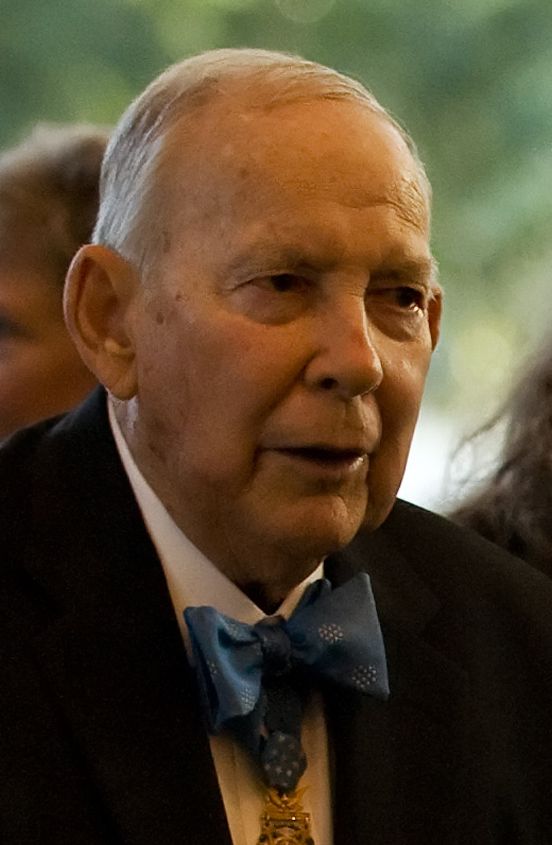
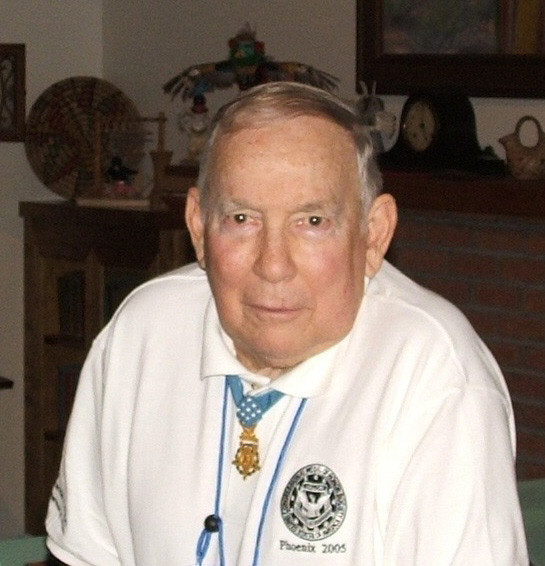
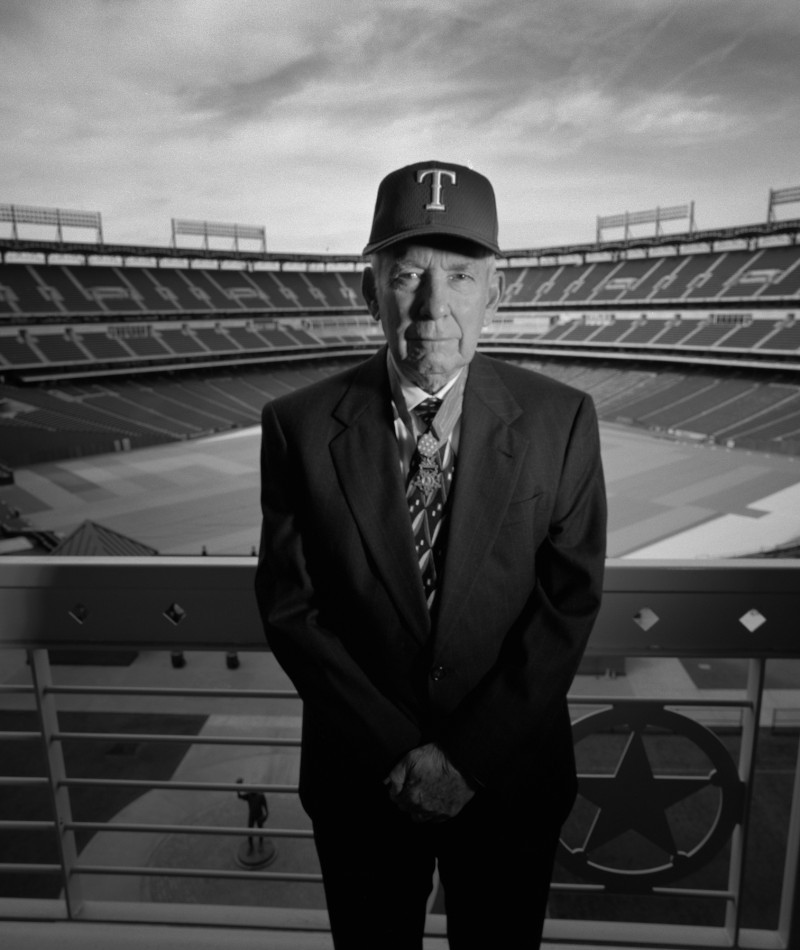


I am an ordinary guy. —Col. James L. Stone
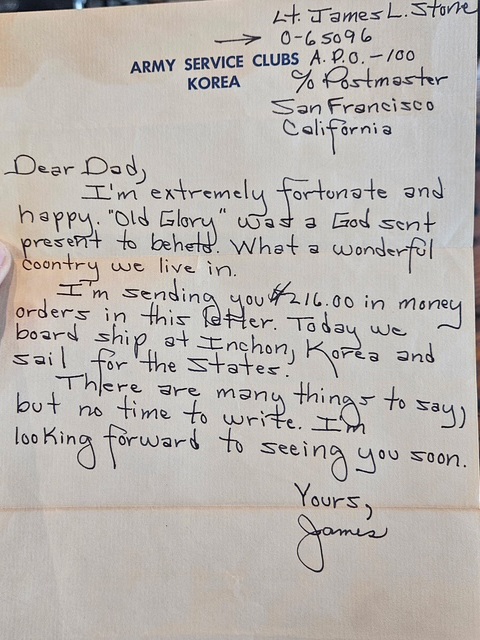
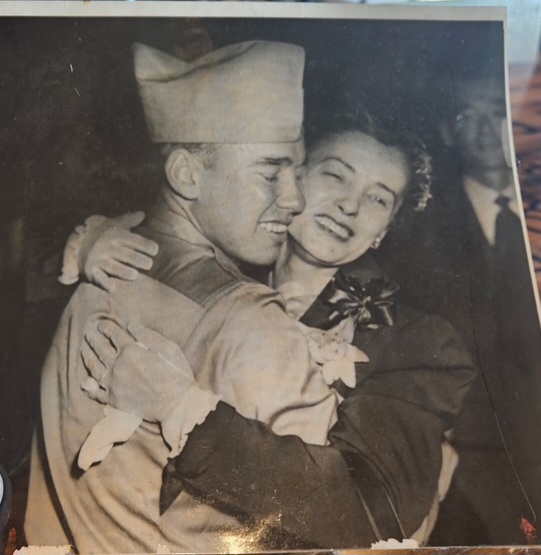
“The first thing I did was look up to that American flag. Oh, what a great relief, a great wonderful feeling to see that American flag again. That’s all you wanted to do was to sit up there and look at it.” It was ‘like being reborn.’”
—Col. James L. Stone
(1922-2012)
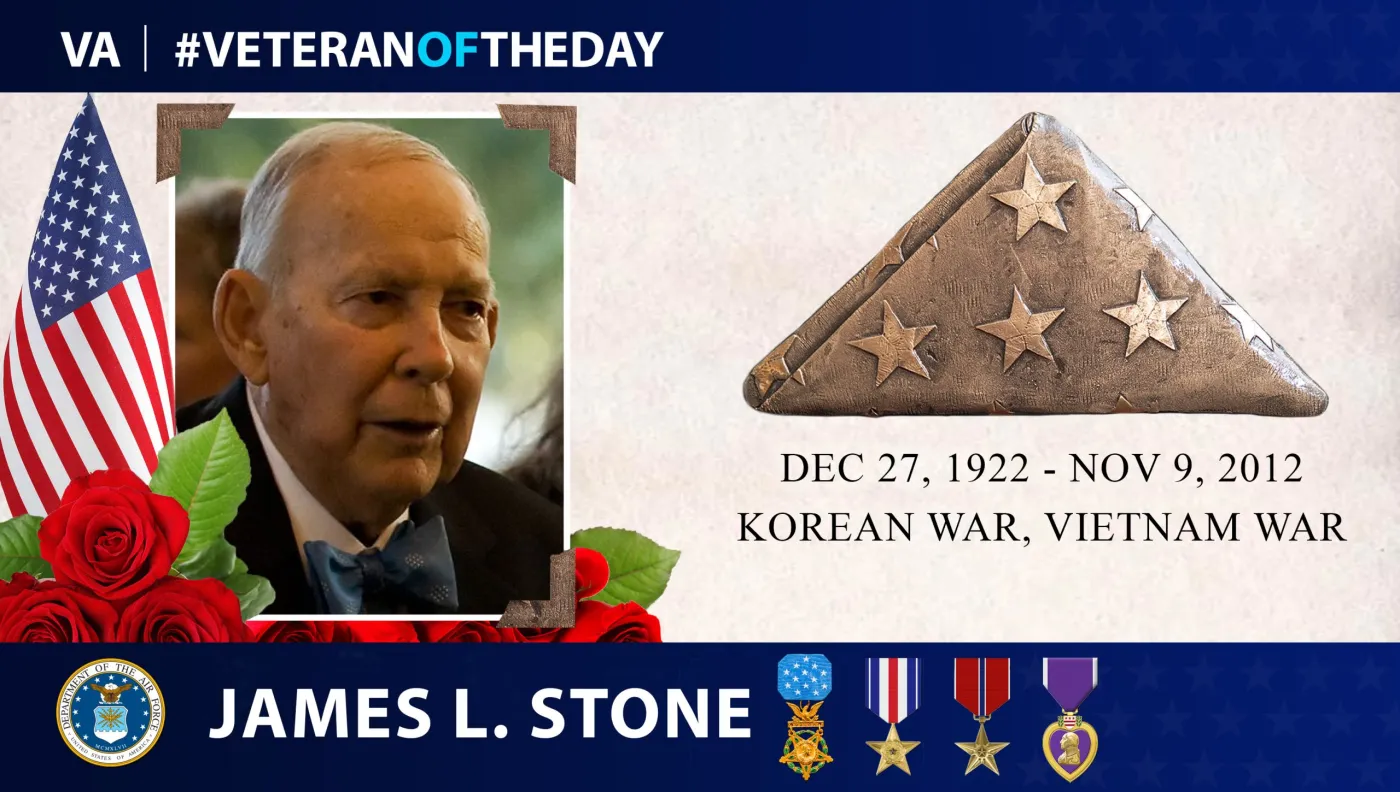
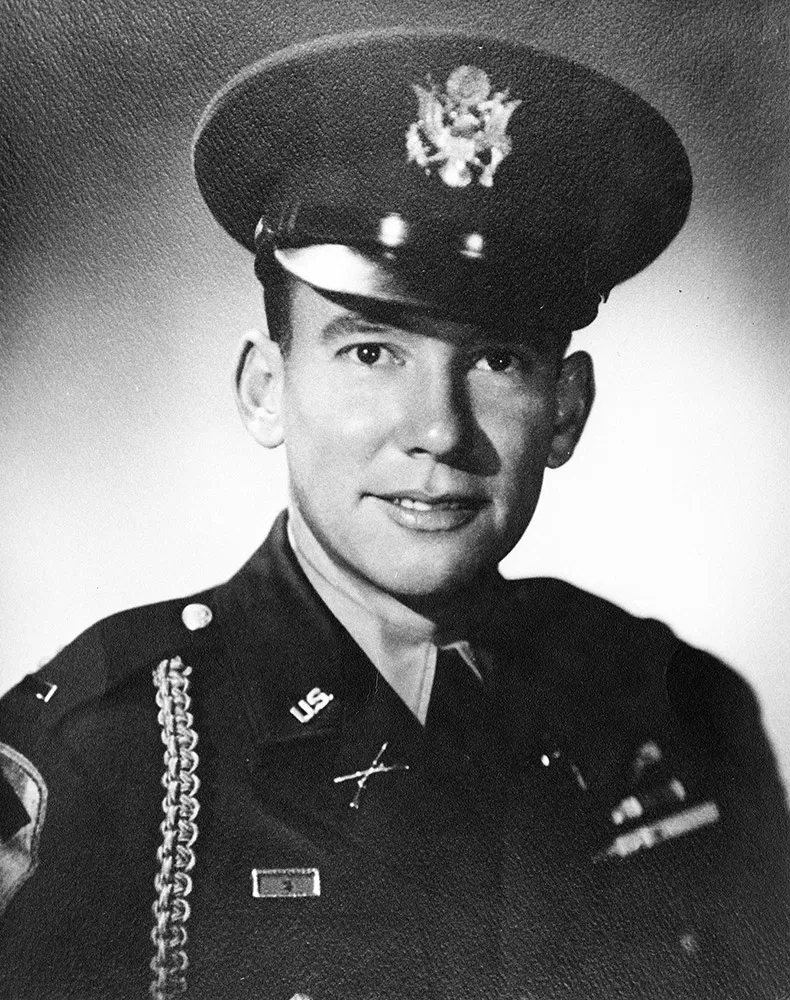
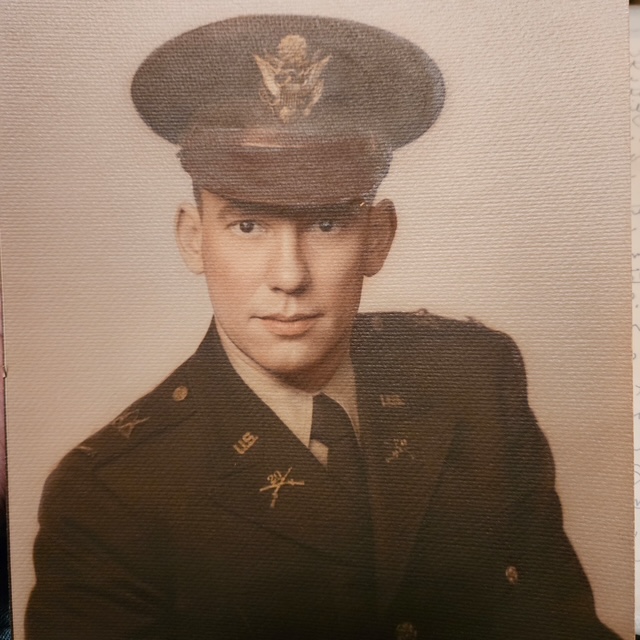
Colonel James Lamar Stone, Medal of Honor recipient, was born on December 27, 1922, in Pine Bluff, Arkansas. He was the son of State and Idell Stone. The son of firefighter Lamar L. Stone and Idell Stone. He grew up in Hot Springs (Garland County) and graduated from the University of Arkansas (UA) in Fayetteville (Washington County). He majored in chemistry because math and zoology didn’t hold his attention.
In 1947, he was called up for service but the draft board said they didn’t need him so they sent him home. He joined the Army Reserve Officers’ Training Corps (ROTC)summer camp at Fort Hood in Killeen and made straight A’s. After earning his bachelor’s degree in 1947, he accepted a position with General Electric in Houston. In 1948 Stone was called to active duty and assigned to train at Fort Ord, California.
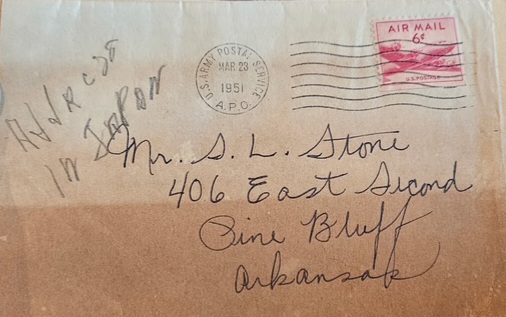
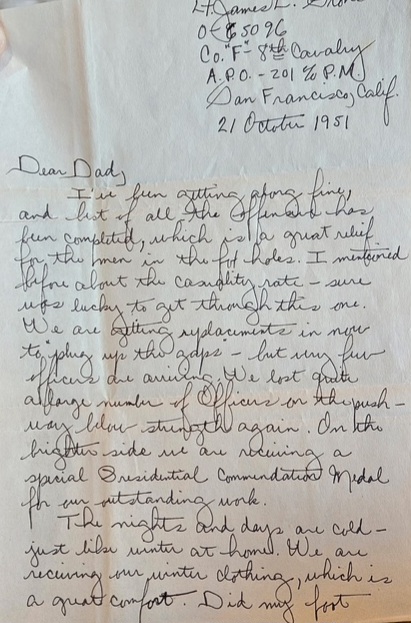
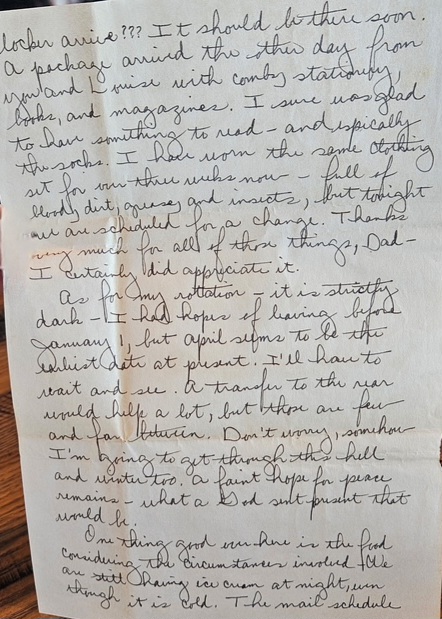
First Lieutenant Stone was deployed to Korea as a member of Company E, Second Battalion, Eighth Cavalry Regiment, First Cavalry Division, in March 1951. For the next nine months, he alternated as a platoon leader for Companies E and G because casualties were so high for frontline junior officers at the time.
He spent most of his time, however, with Company E and developed a bond with them. Stone was credited for pulling two wounded men to safety after an attack on an enemy machine gun. He received a Silver Star for his actions.
Lt. Stone was sent to Pusan and then deployed further to Chuncheon. At 2pm November 21, 1951, Lieutenant Stone was leading his platoon of about fifty men on a hilltop outpost above the Imjin River, near Sakogae, North Korea. From this location, Stone’s unit could view Chinese movements along their front. At 9pm the Chinese began firing some white phosphorus shells to mark the American location and then firing off an artillery barrage.
This was followed by a huge firework display. The Chinese always preceded an attack by shooting off fireworks so Lt Stone knew a heavy assault would be next. The Chinese attacked with a battalion, 1000 soldiers, moving up the hill toward Stone’s location. In a few minutes, the outnumbered Americans were in a desperate fight. Standing erect, Stone issued orders in the face of enemy fire. He also moved in the direction of a malfunctioned defense flamethrower whose operator had been killed.
Stone repaired the flamethrower and gave it to another soldier. One situation that frustrated Stone was when he had to show one of the soldiers how to load his M-1 rifle. Stone couldn’t believe he didn’t know how but Sloan quickly made the adjustment so the soldier could fight.
The enemy continued to attack numerous times, and the fighting lasted through the night. When Chinese reinforcements arrived after midnight, their total numbers were estimated to be up to 800 men. During one of the assaults, the injured Stone moved with a light machine gun from one location to another and fired at Chinese advances in two directions. Toward the end of the struggle, the Americans fought the enemy in hand-to-hand combat in the trenches.
The Chinese killed half of Stone’s platoon. All of the 7or8 survivors had been wounded 2 to 3 times. Stone ordered the survivors to retreat and that he would provide cover but none of the men would retreat or surrender.
Much of the fighting was hand-to-hand combat. Lt Stone noticed that his men would come up close to the enemy and grab their gun out of their hands.
During the ordeal, he continued to encourage and direct the depleted platoon and kept fighting with his carbine, despite having been shot in both knees and Stone’s platoon spent more than three hours repelling assault after assault.
When the time came to retreat, Stone stayed behind to cover those who were left as the remaining platoon members fled. The Chinese eventually swept over the position just before dawn. According to his Medal of Honor citation, Stone’s “voice could still be heard faintly urging his men to carry on until he lost consciousness.” Through the neck. It was interesting that one of his soldiers covered the neck wound with nothing more than a band-aid.
Stone thought he survived because of his lieutenant bars.
By the end of the fight, 24 of the 48 platoon members had died, and 16 more were wounded. Nearly 550 of the roughly 800 Chinese forces who attacked had died.
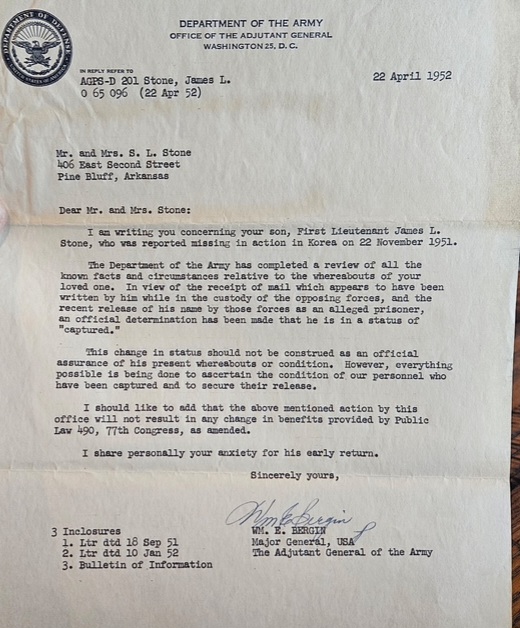
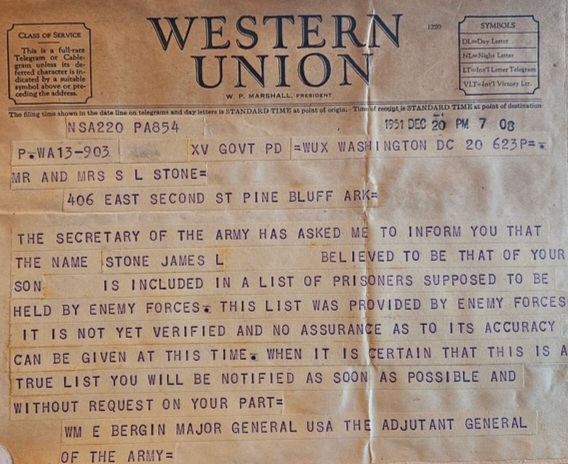
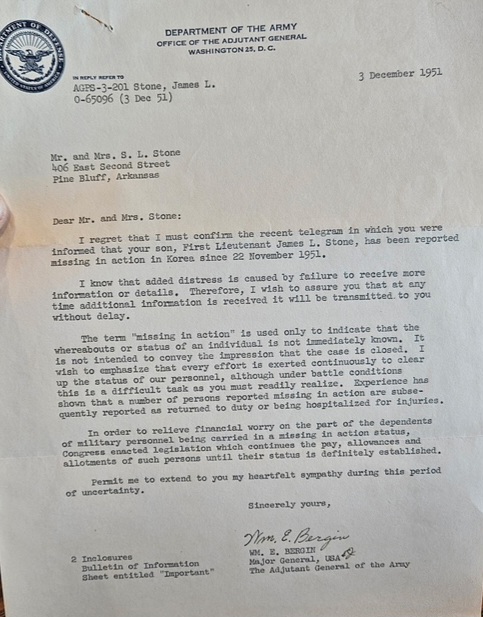
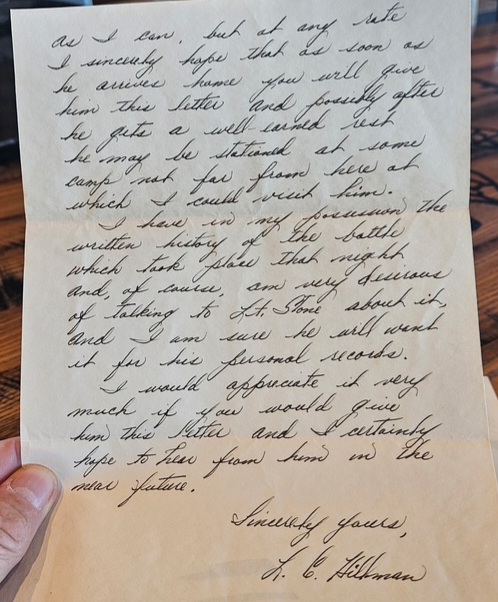
When U.S. soldiers recaptured the hill the next day, they realized seven men, including Stone, were missing. One surviving soldier had been found but he was shell shocked so we didn’t get much information from him. An unconscious Stone had been carried away on a stretcher by Chinese forces.
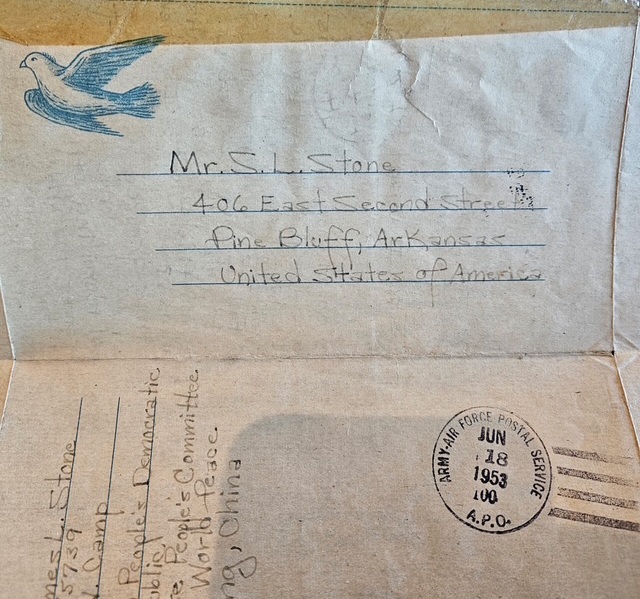
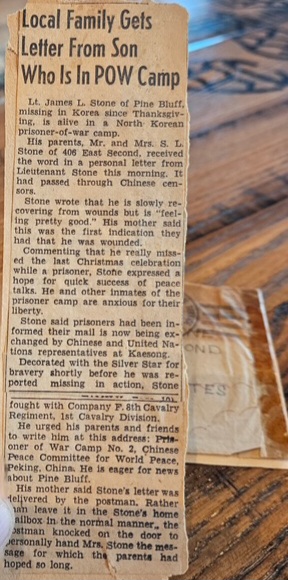
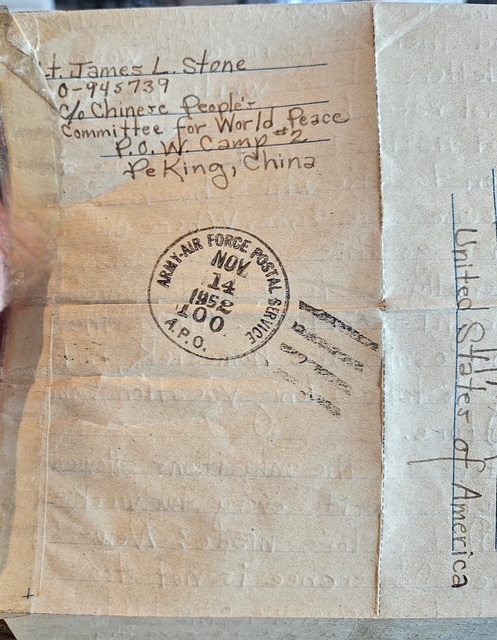
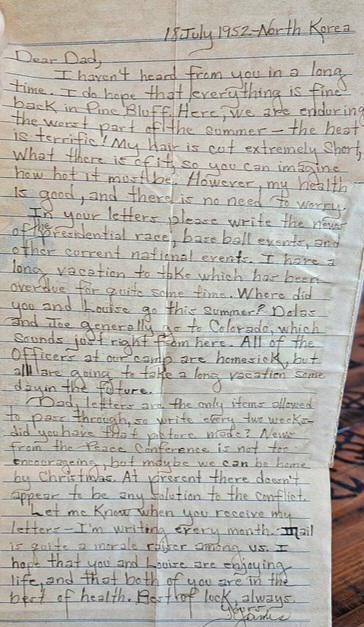
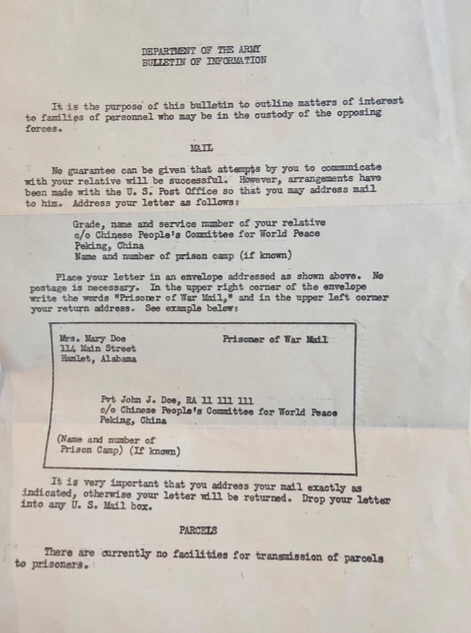
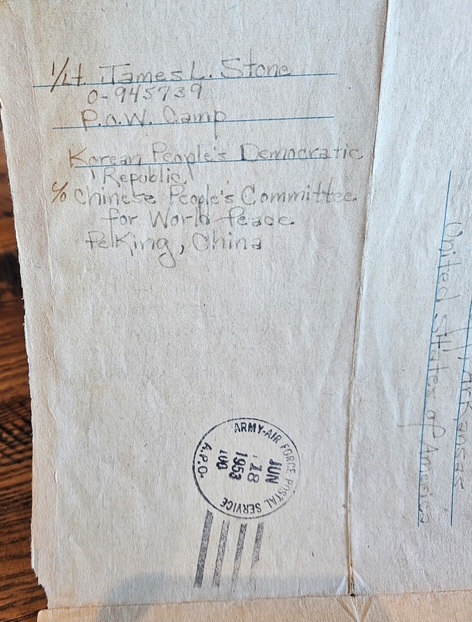
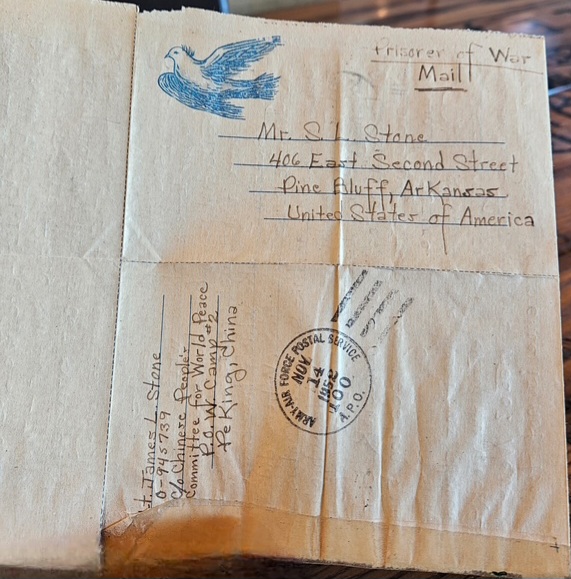
Lieutenant Stone spent twenty-two months as a prisoner of war. His time at the Pyoktong Officers Camp No. 2 on the Yalu River near the Manchurian border was harsh. The Chinese provided their prisoners little food and no medical care in an environment where disease was rampant.
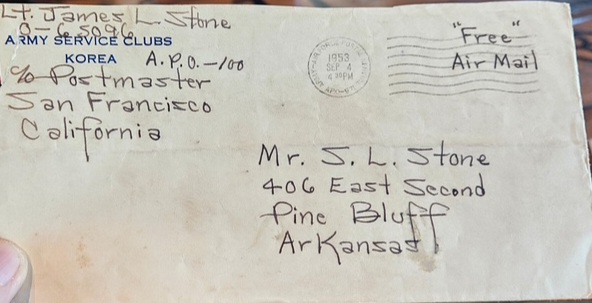
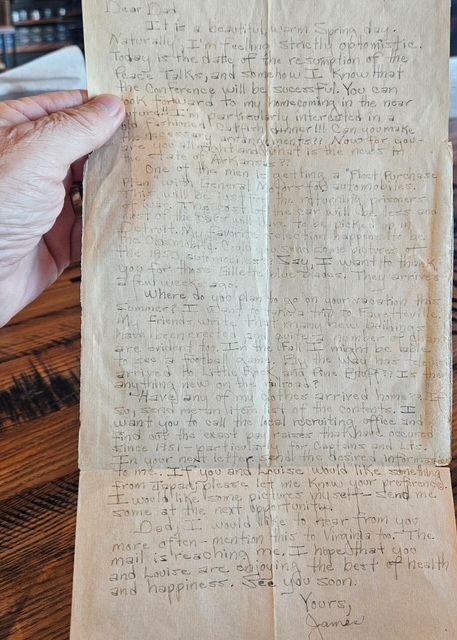
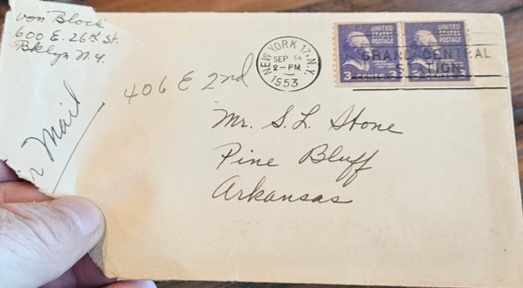
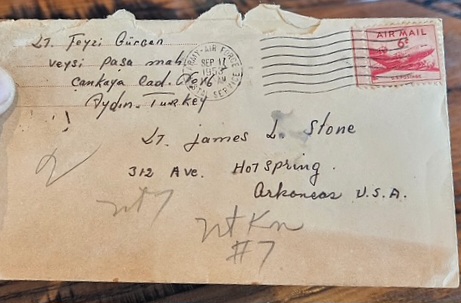
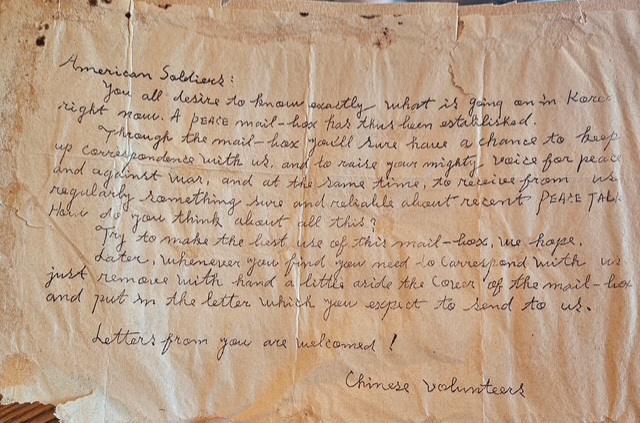
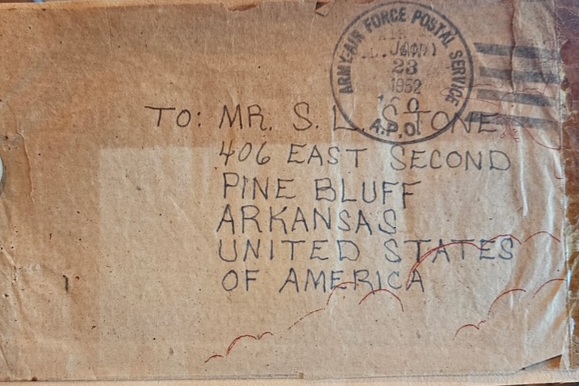
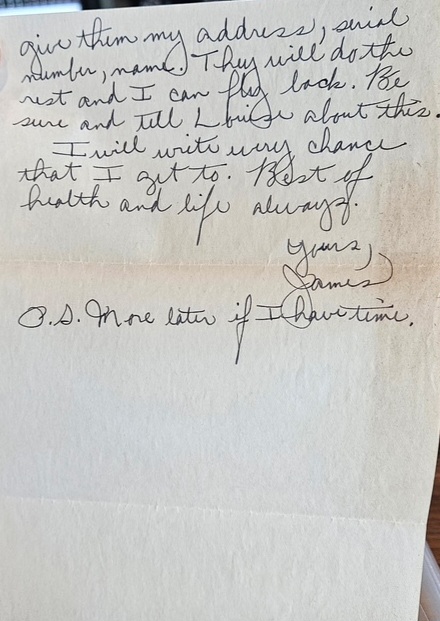
Stone mentioned that the men were only given one bowl of rice a day. As a result of the meager rations, food was their primary point of concern. Stone remarked that the need for food became even more important than thinking of their wives or families. A number of Stone’s letters reached members of his family and provided information that he was still alive.
The Chinese continued to fight and would not agree to a peace treaty. They would not agree to the 38th parallel as the diving line. Russian Premier Joseph Stalin wanted the Chinese to continue but a sudden heart attack and his death changed the direction of the peace talks. President Eisenhower wanted the 38th parallel and threatened to advance to that line if the North Koreans didn’t agree.
So US troops were pulled from the main line and a mock amphibious landing was set up. The North Koreans pulled troops from their line in response which weakened their position allowing Eisenhower to move troops up 20 miles.
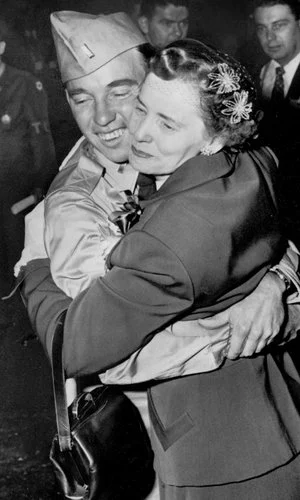
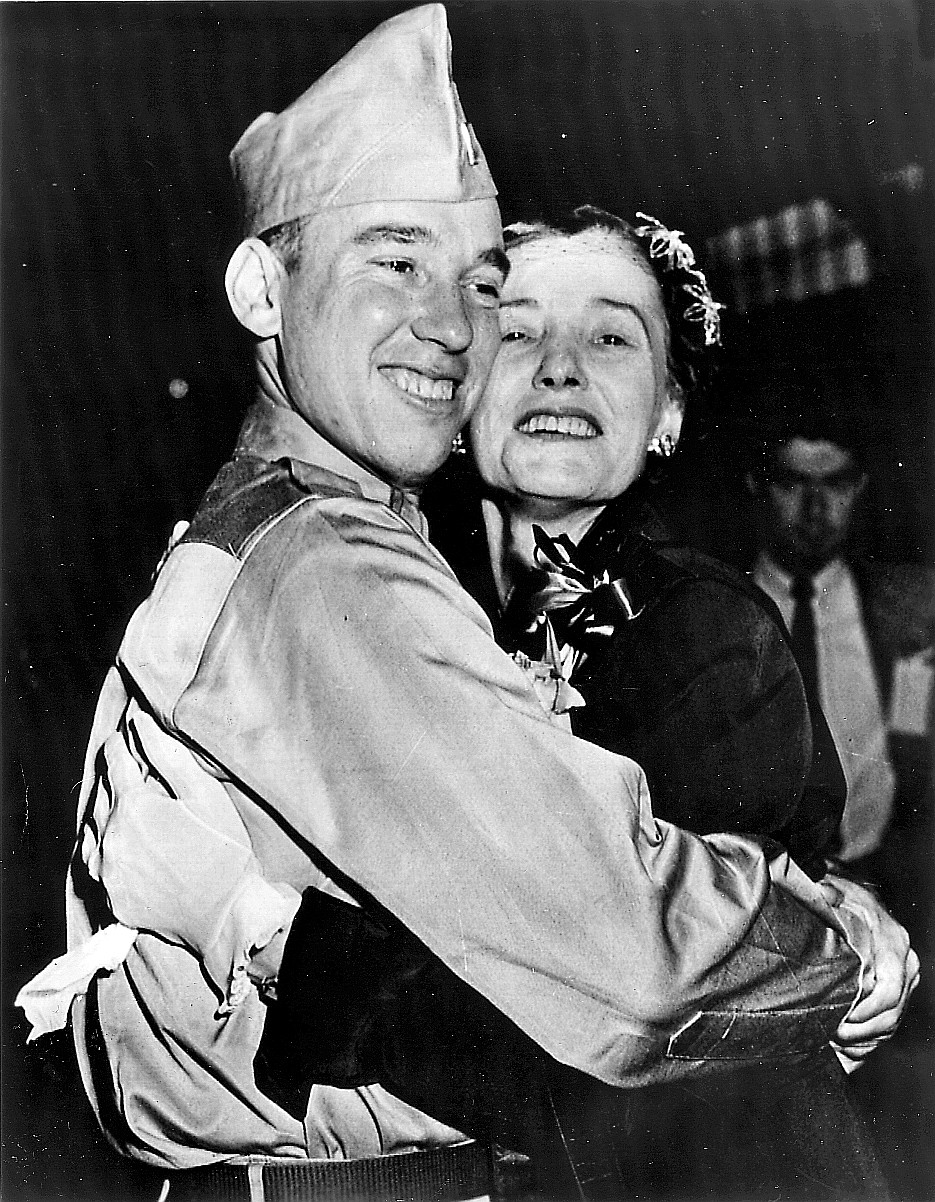
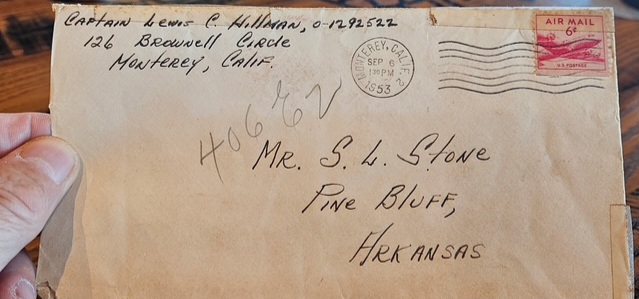
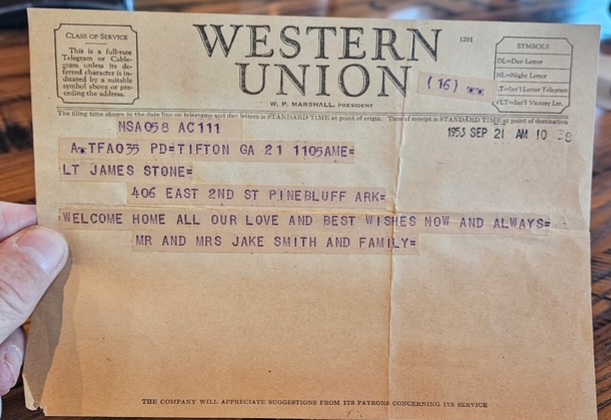
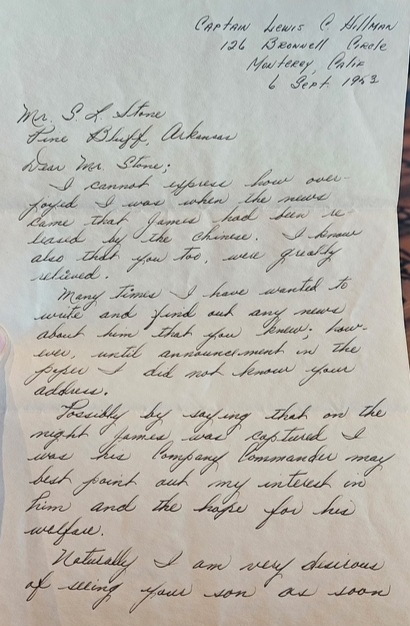
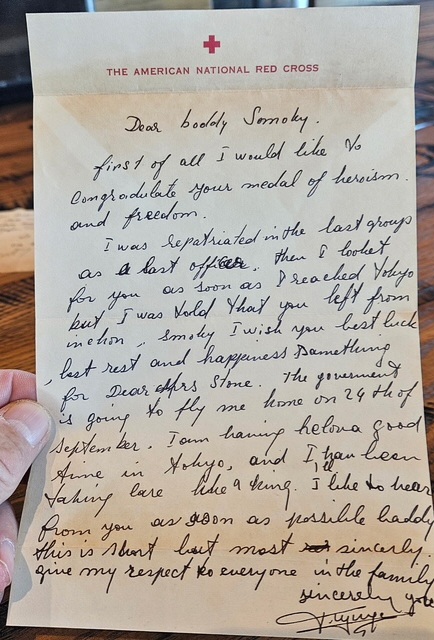
September 1953, five weeks after the war ended, the Chinese freed Stone as part of a prisoner exchange referred to as the “Big Switch.” The first sight of the American flag flying high on a flag pole after his release, James Stone later said was “like being reborn.”
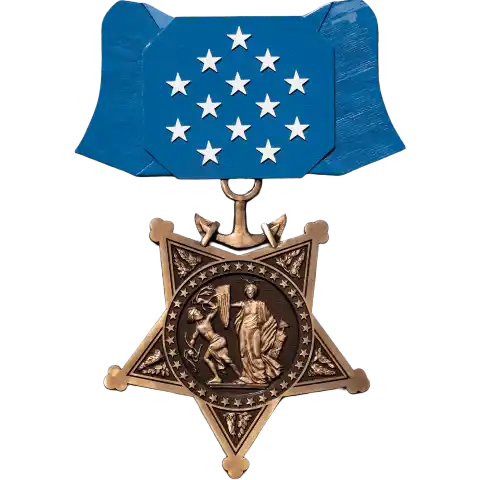
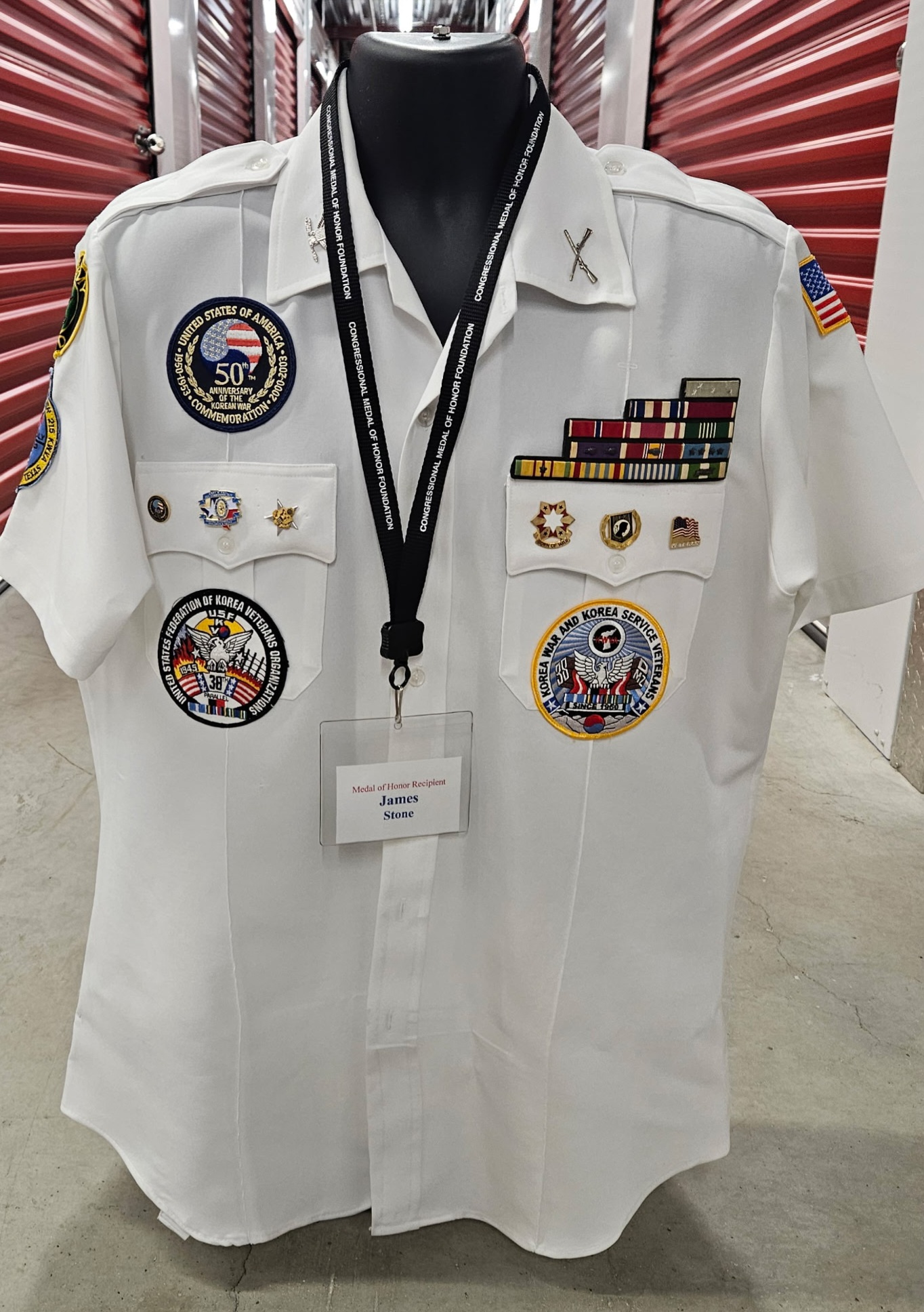
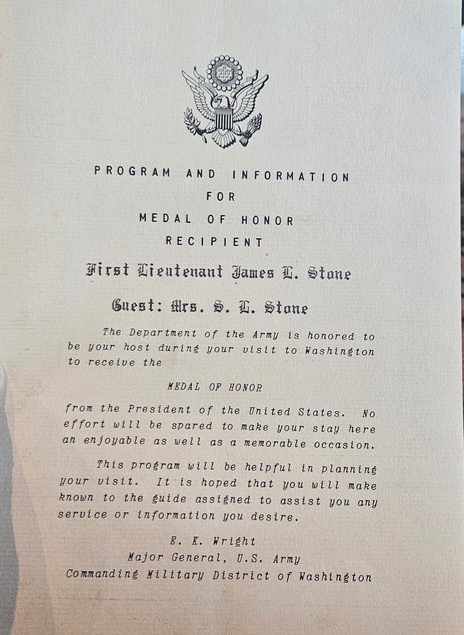
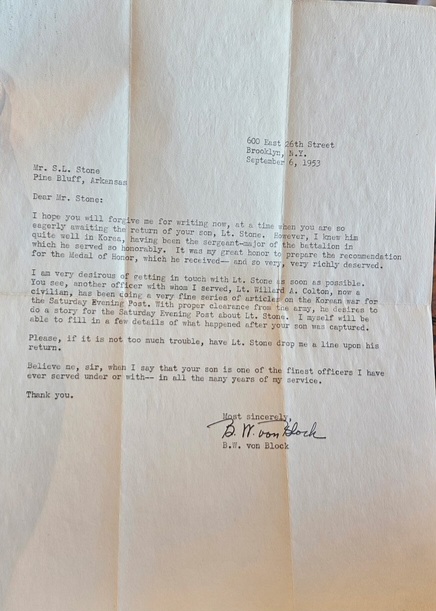
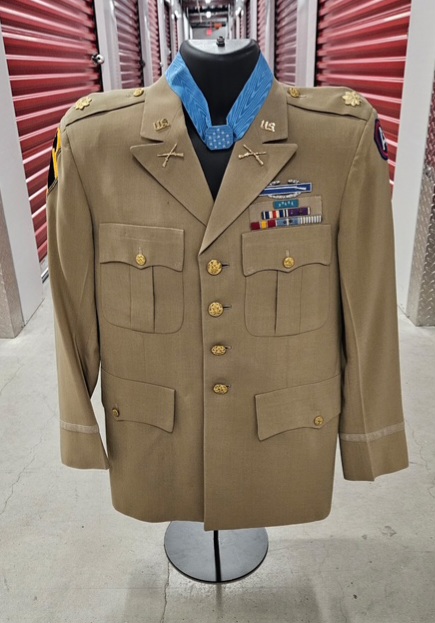
Stone was released in early September 1953 during a prisoner exchange after the war ended. Shortly after that release, Stone learned he would receive the Medal of Honor for leading that brave, but hopeless, last-ditch effort. He said he felt it was his platoon that deserved it.
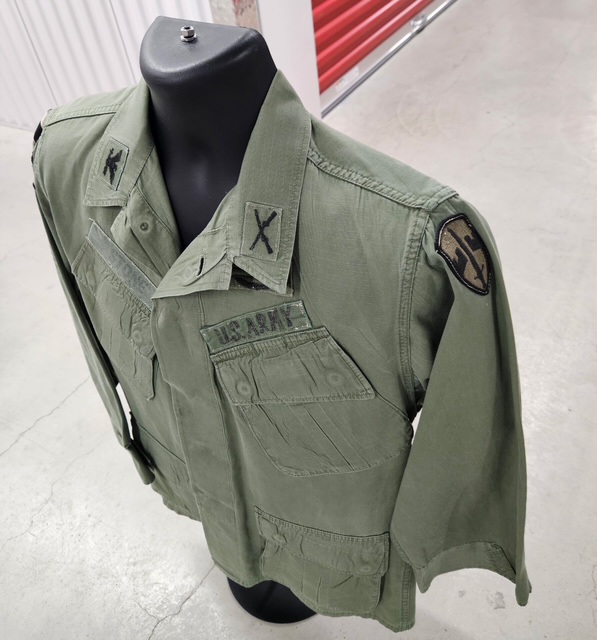
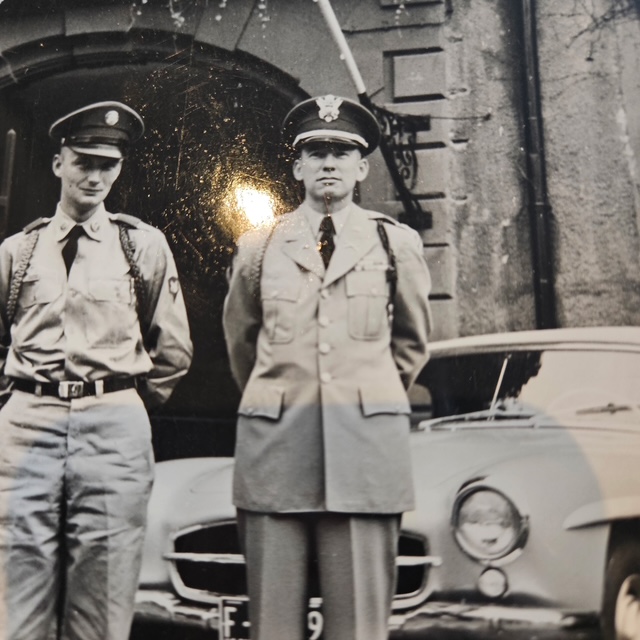
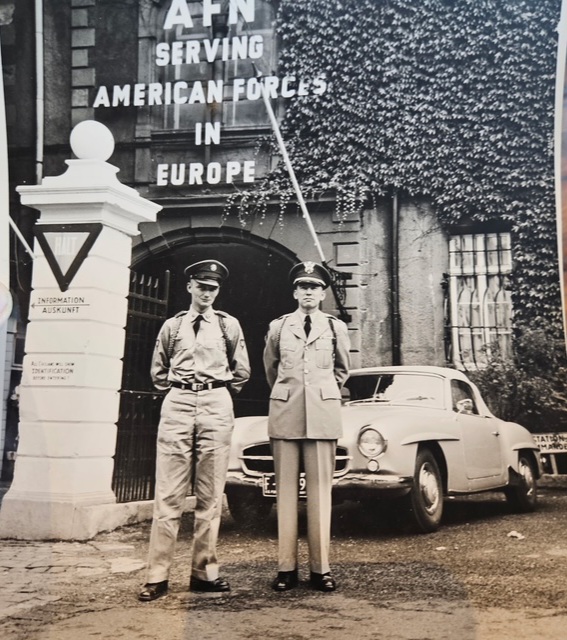
Stone remained in the Army after returning to the United States. He served for a period of time in Germany before moving to the Fort Worth area to administer several ROTC units in the 1960s.
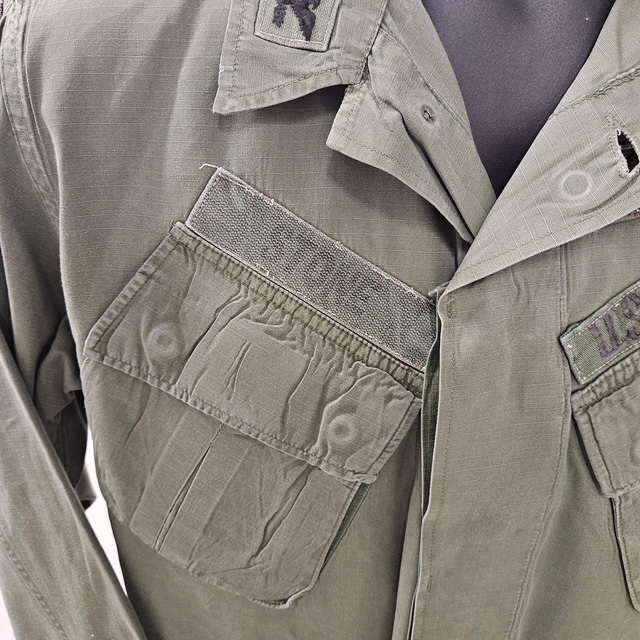
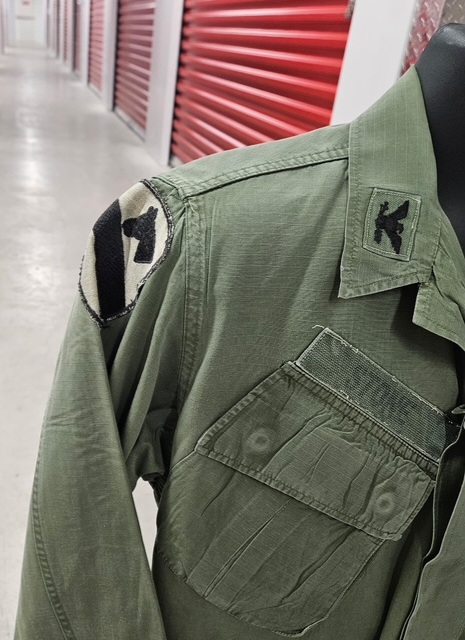
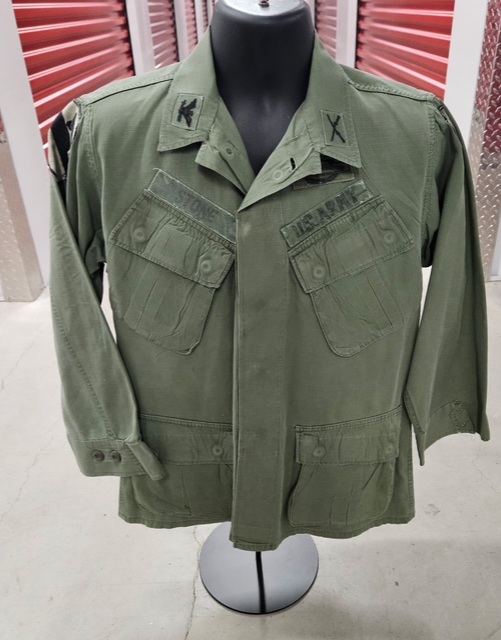
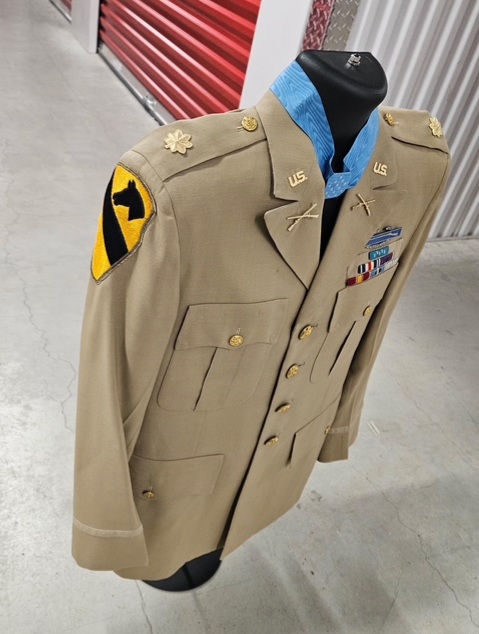
He served a tour of duty in Vietnam in 1971 as an advisor. He retired from the Army as a Colonel after almost 30 years of service, and a couple of years or so after that, he and his wife Mary Lou chose to make Arlington their home.
Mary Lou stated, “Colonel James L. Stone would be so humble about his service in Korea I didn’t realize I was marrying a Medal of Honor recipient.” Mary Lou learned about his Medal after their wedding.
During retirement, year after year, he attended Veterans Day ceremonies at the Dallas-Fort Worth National Cemetery. He was an active member of a Dallas-Fort Worth Area Korean War Veterans Association. For a time he helped in a home-building business started by his son, James Lamar Stone, Jr. He was an avid baseball fan and enjoyed attending Texas Rangers games, as well as his grandson Stewart’s Little League games.
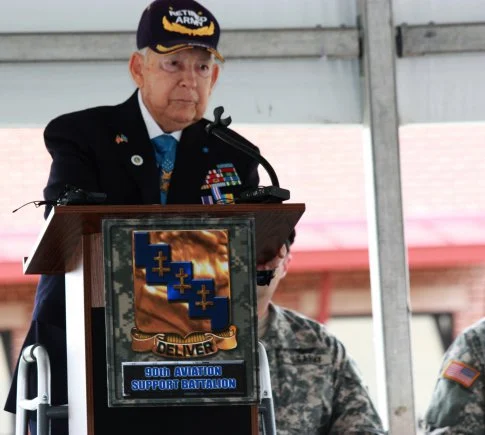
On November 6, 2011, Stone was the guest of honor as members of the 90th Aviation Support Battalion (ASB) officially dedicated their new facility in his name—the Col. James L. Stone Army Reserve Center, Fort Worth, Texas. Stone attended as many of the 90th ASB unit events as he could, even during his last days, when he was fighting the cancer that took his life. In particular, he loved the opportunity to visit with the young soldiers. He would often say, “You know, a Colonel is just not a Colonel unless he’s around soldiers.”
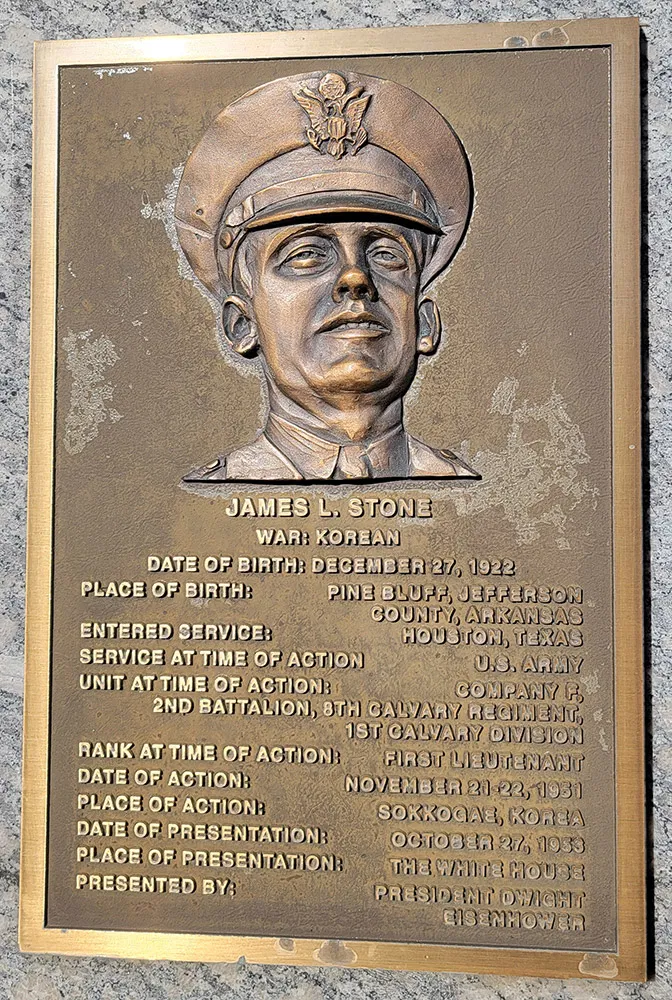
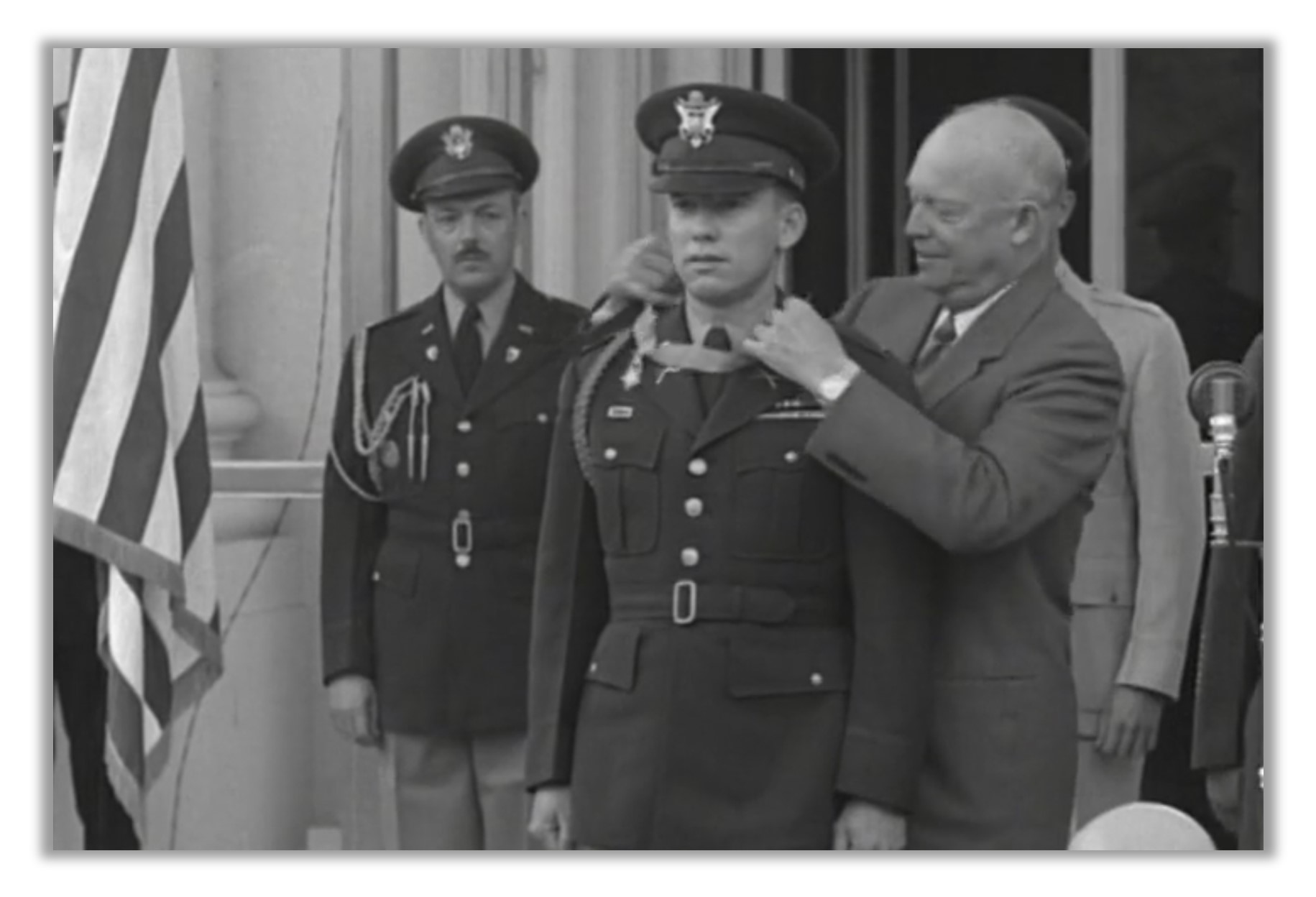
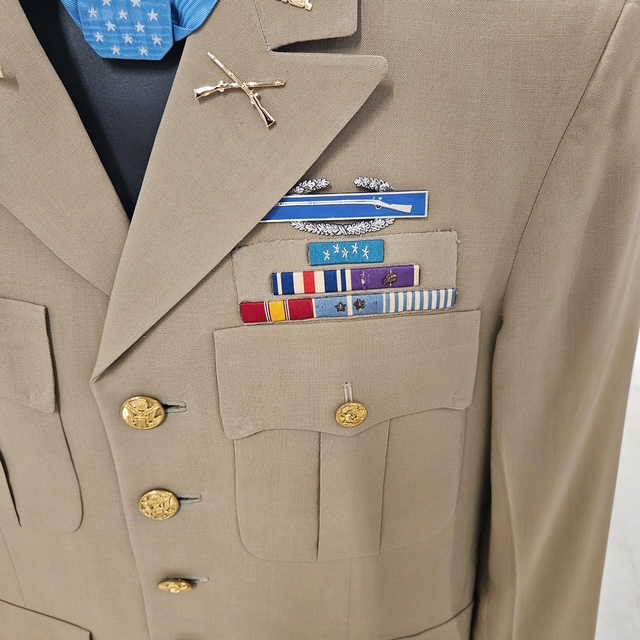
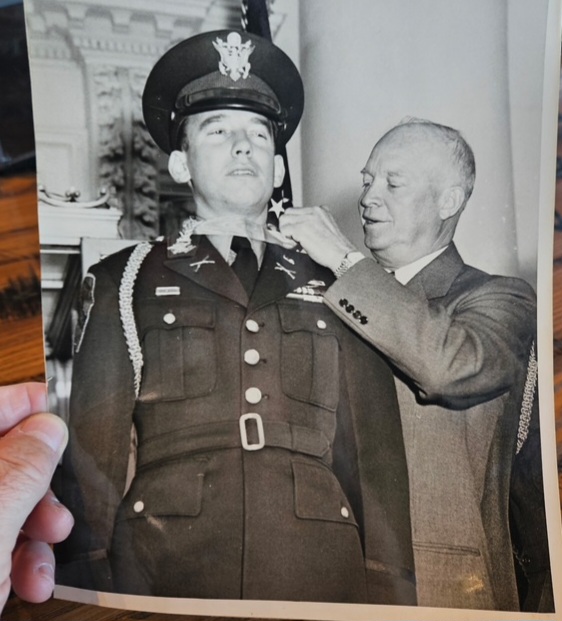
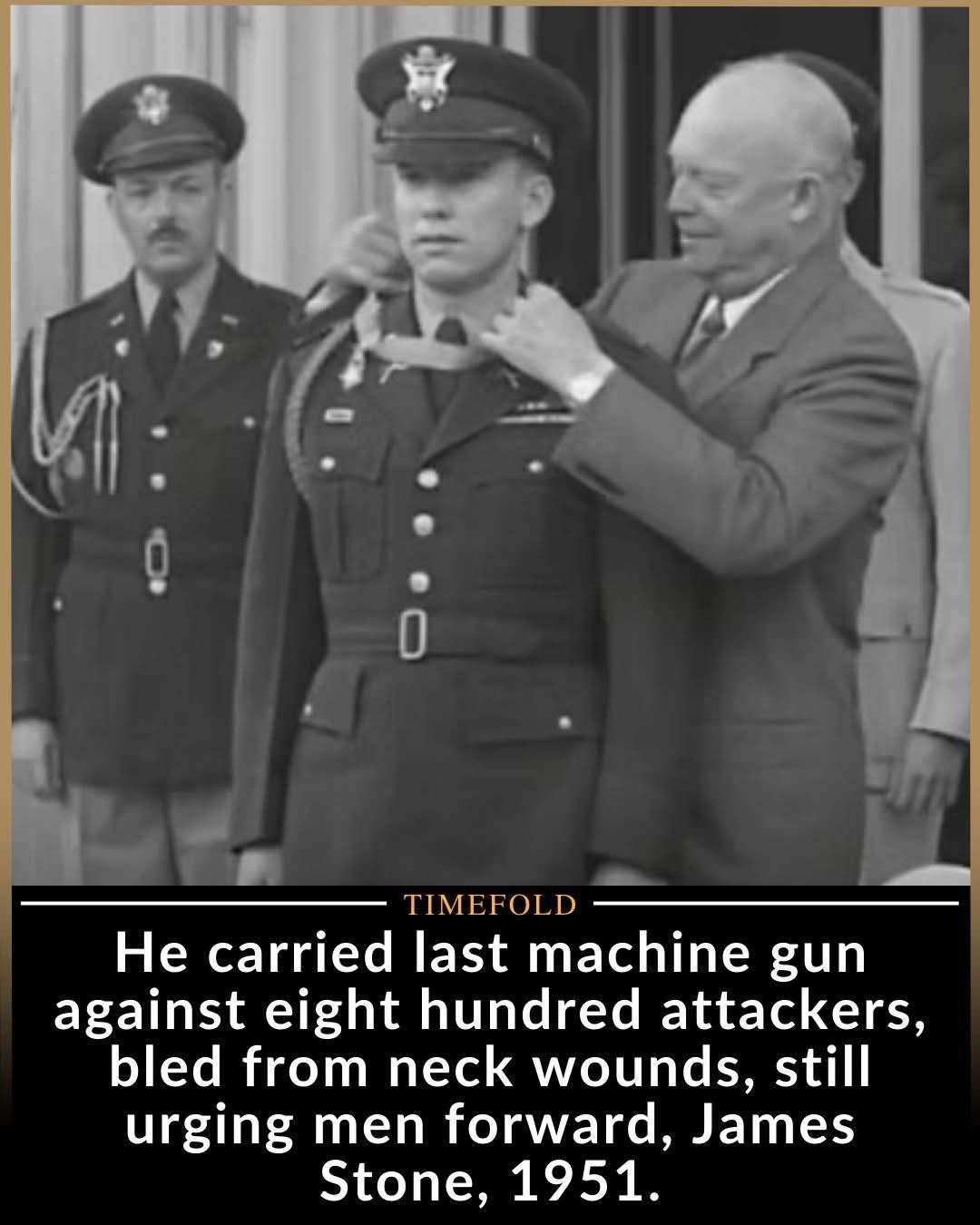
Stone’s Medal of Honor was officially approved on October 20, 1953 and presented to him a week later. At a ceremony in the White House on October 27, President Dwight Eisenhower presented Medals of Honor to Stone and six others. Stone earned the Silver Star for pulling two wounded men to safety after an attack on an enemy machine gun.
Stone reached the rank of colonel and served in the Vietnam War before retiring from the Army in 1976.
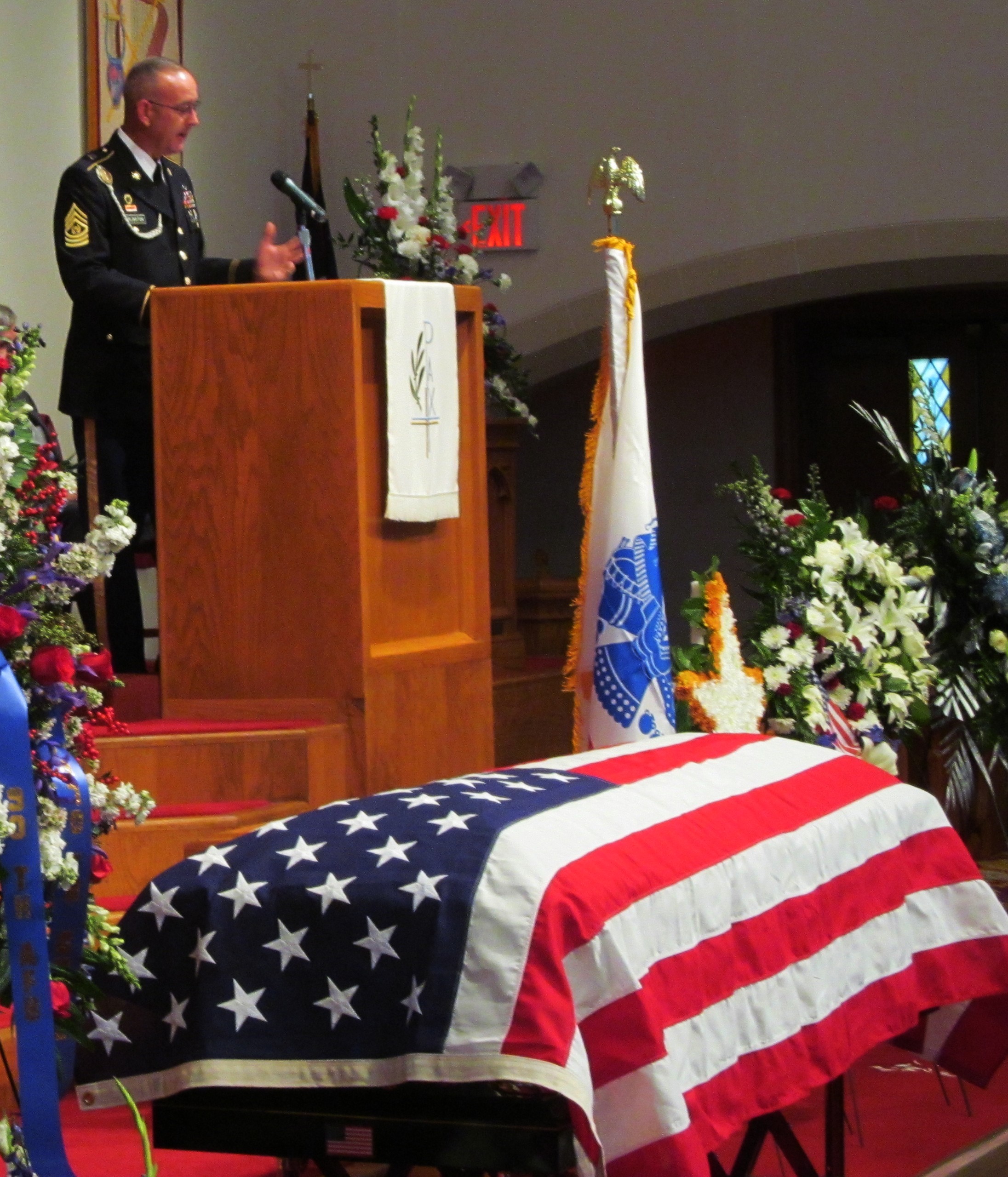
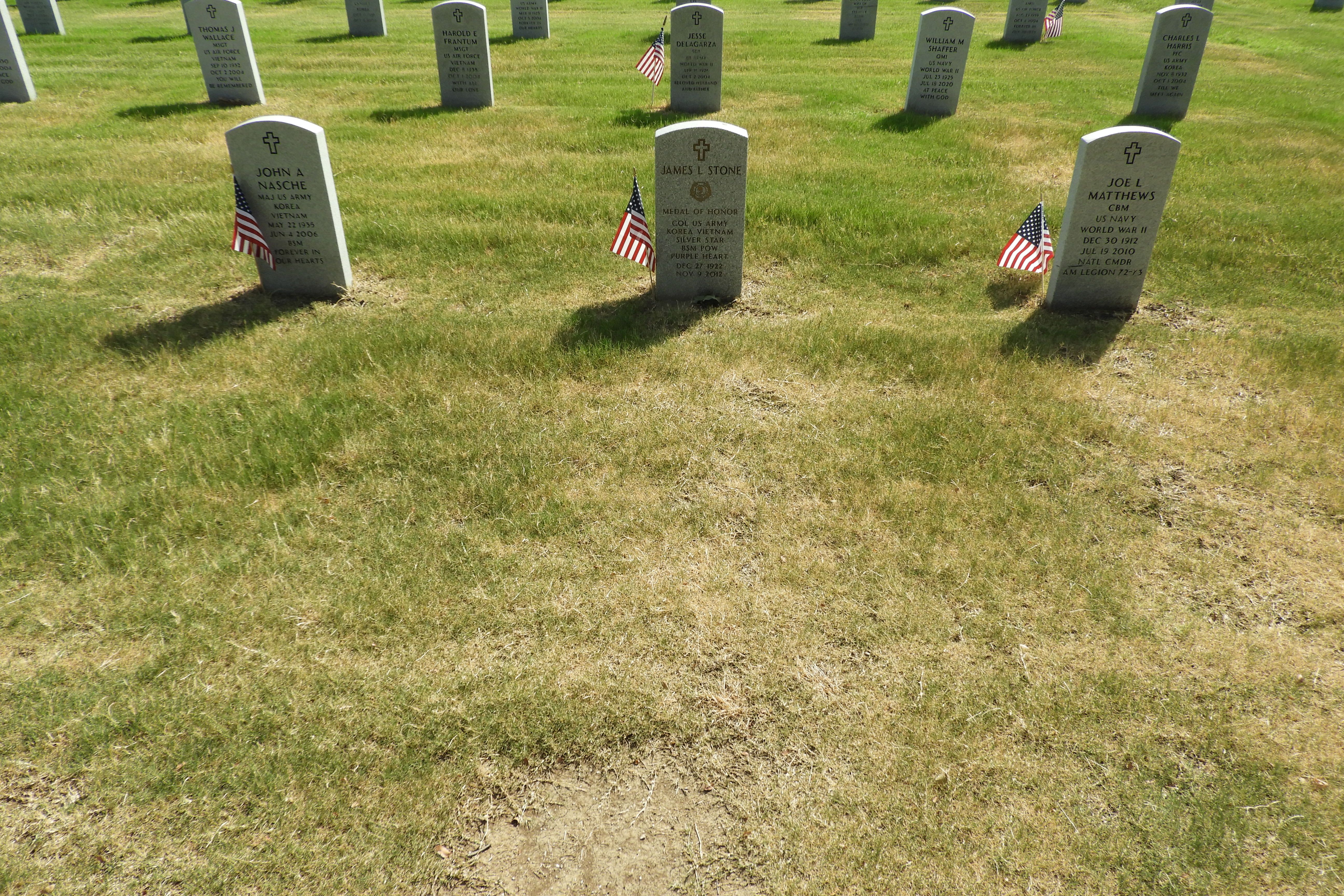
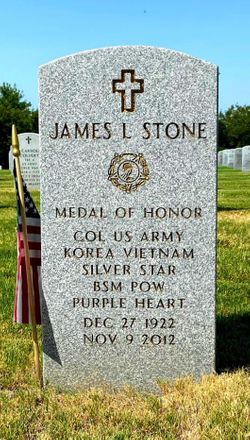
He died November 9, 2012, in his Arlington home. His funeral was at the First United Methodist Church of Arlington on November 14. He was laid to rest with full military honors at the Dallas-Fort Worth National Cemetery, the first Medal of Honor recipient to be buried there.
Medal of Honor Citation (November 21 & 22, 1951)
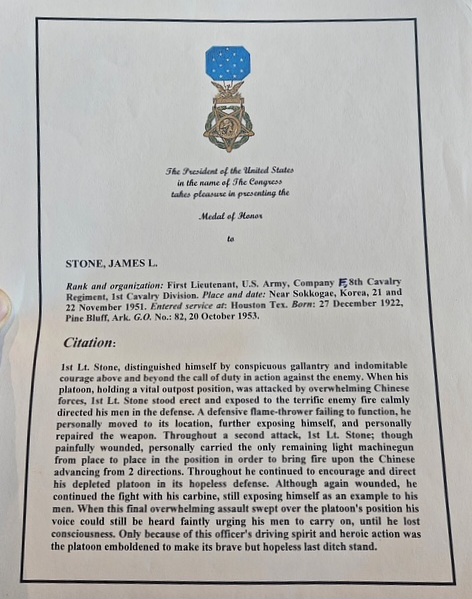
First Lieutenant Stone’s official Medal of Honor citation reads:
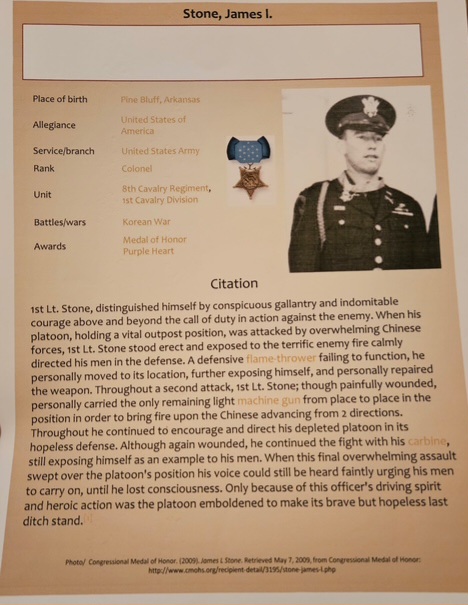
1st Lt. Stone, distinguished himself by conspicuous gallantry and indomitable courage above and beyond the call of duty in action against the enemy. When his platoon, holding a vital outpost position, was attacked by overwhelming Chinese forces, 1st Lt. Stone stood erect and exposed to the terrific enemy fire calmly directed his men in the defense.
A defensive flame-thrower failing to function, he personally moved to its location, further exposing himself, and personally repaired the weapon. Throughout a second attack, 1st Lt. Stone, though painfully wounded, personally carried the only remaining light machine gun from place to place in the position in order to bring fire upon the Chinese advancing from 2 directions. Throughout he continued to encourage and direct his depleted platoon in its hopeless defense.
Although again wounded, he continued the fight with his carbine, still exposing himself as an example to his men. When this final overwhelming assault swept over the platoon’s position his voice could still be heard faintly urging his men to carry on, until he lost consciousness. Only because of this officer’s driving spirit and heroic action was the platoon emboldened to make its brave but hopeless last ditch stand.
Legion of Merit (September 1970 – August 1971)
Vietnam War
The President of the United States of America, authorized by Act of Congress, 20 July 1942, takes pleasure in presenting the Legion of Merit to Colonel (Infantry) James Lamar Stone (ASN: 0-65096), United States Army, for exceptionally meritorious conduct in the performance of outstanding services during the period September 1970 to August 1971, while serving as Senior Advisor to the National Noncommissioned Officer Academy, Training Center Division, Training Directorate, United States Military Assistance Command, Vietnam.
Colonel Stone rendered exceptional organizational expertise and supervisory skill to the training advisory effort and greatly contributed to the mission accomplishment of the Noncommissioned Officer Academy. He effectively accomplished the planning and coordination of programs of instruction at the Noncommissioned Officer Academy to meet the varied training requirements throughout the Republic of Vietnam. His extensive staff and training experience enabled him to supervise and guide the detailed planning of training assistance provided to the Khmer Republic.
By developing comprehensive plans and programs, he fostered a highly efficient and superbly motivated Student Brigade, well qualified to provide Noncommissioned Officers to the Army of the Republic of Vietnam.
Colonel Stone’s professional competence and outstanding achievements were in keeping with the highest traditions of the military service and reflect great credit upon himself and the military service.
Prisoner of War (November 22, 1951 – September 2, 1953)
First Lieutenant (Infantry) James Lamar Stone (ASN: 0-65096), United States Army, was captured by the Communist Forces in Korea on 22 November 1951 and was interned as a Prisoner of War until his release on 2 September 1953.
Silver Star (October 9, 1951)
Korean War
Headquarters, 1st Cavalry Division, General Orders No. 335 (1951)
The President of the United States of America, authorized by Act of Congress July 9, 1918, takes pleasure in presenting the Silver Star to First Lieutenant (Infantry) James Lamar Stone (ASN: 0-65096), United States Army, for gallantry in action against while serving with Company F, 2d Battalion, 8th Cavalry Regiment, 1st Cavalry Division, in action against the enemy on 9 October 1951 near Homang-ni, Korea.
When Company F was assigned the mission of assaulting heavily fortified enemy positions manned by a numerically superior enemy force, the unit was pinned down by an overwhelming volume of small arms, automatic weapons, mortar and artillery fire. Lieutenant Stone, with complete disregard for his own safety, rushed to the head of his platoon, and, demonstrating a remarkable degree of intrepid leadership, led his men in a charge against the enemy positions which served to relieve pressure on the company and caused a large number of hostile casualties.
Leaping on the wall of an enemy trench, waving and shouting to his men to follow him, Lieutenant Stone killed and wounded several of the enemy soldiers. As a result of his gallantry and selfless devotion to duty, the hostile forces suffered very heavy casualties, and the way was eased for the company to continue in the fight and eventually to successfully achieve its assigned mission.
Lieutenant Stone’s gallantry and heroism reflect the highest credit on himself and the military service.
Bronze Star Medal (December 5, 1970 – March 15, 1971)
Vietnam War
The President of the United States of America, authorized by Executive Order 11046, 24 August 1962, takes pleasure in presenting the Bronze Star Medal to Colonel (Infantry) James Lamar Stone (ASN: 0-65096), United States Army, for meritorious achievement in connection with military operations against a hostile force during the period 5 December 1970 to 15 March 1971, while serving as Senior Advisor to the Republic of Vietnam Armed Forces National Noncommissioned Officers Academy, Training Center Division, Training Directorate, Headquarters, United States Military Assistance Command, Vietnam.
Colonel Stone was most effective in developing a new, comprehensive Program of Instruction for the Academy. His Program of Instruction received considerable praise from Academy officials, and it was approved and forwarded to Central Training Command. To substantiate his study and recommendations, more practical work, crew-drilled and “hands-on-equipment” experience were incorporated into training with crew-served weapons and other equipment.
His professionalism and genuine concern for improving the quality of Vietnamese training have contributed materially to Vietnamese combat effectiveness. Colonel Stone’s outstanding achievement was in keeping with the highest traditions of military service and reflects great credit upon himself and the military service.
War Hero Remembered as Soldiers’ Friend
By Sgt. 1st Class Phillip Eugene – May 5, 2013
Medal of Honor recipient retired Col. James Lamar Stone ignored hospice caretakers’ advice, and attended a Change of Responsibility Ceremony to see his friend Command Sgt. Maj. Jeffrey Darlington transfer his noncommissioned officer duties as the outgoing senior enlisted leader of the 90th Aviation Support Battalion.
Less than a month later, Stone’s family asked Darlington to eulogize the Korean War hero, who retired from the Army with more than 30 years of service, after he died from prostate cancer at age 89 in Arlington, Texas, Nov. 9, 2012.
The two men forged a friendship after they met at a Veterans Day event at the VFW National Cemetery in Dallas in 2009. At the event, Darlington was among representatives of all the military services, but he was the only Soldier in uniform. He said he felt a tap on his shoulder, he turned around and there was Stone with the Medal of Honor around his neck.
According to Darlington, Stone said, “Young man, I want you to stay by my side for the day because I’m surrounded by all these other services, and I like seeing somebody in the Army uniform.”
As their friendship progressed, Stone shared his combat experience and wisdom with Darlington who developed an appreciation for Stone as a leader. At the time, the 90th Aviation Battalion operated from a temporary location in Grand Prairie Texas while a new Army Reserve Center was being built. Darlington suggested naming the new facility after Stone, who also served a tour of duty in Vietnam in 1971.
“I thought it would be a great way to put younger Soldiers in touch with our past, and to connect the past with the present,” said Darlington, currently the 800th Logistics Support Brigade’s senior enlisted leader. “We ended up getting the approval after a lengthy process, and we had the building dedicated in Col. Stone’s honor. It’s now called the Col. James L. Stone Army Reserve Center, Fort Worth, Texas.”
In the eulogy, Darlington said Stone’s humble nature struck him the first time they met.
When he asked Stone for permission to name the building in his honor, Darlington told the congregation that Stone thought long and hard then replied, “‘Now surely young man you can find someone more deserving than me.'”
During the Korean War, Stone was a 28-year-old first lieutenant when Chinese troops attacked his platoon on a hilltop near Sokkogae the night of Nov. 21, 1951. According to his Medal of Honor citation, Stone moved to the location of a flamethrower that had malfunctioned and repaired it while under fire. A bullet struck him, but Stone picked up the platoon’s only working machine gun and shot back at the attackers who advanced from two directions. When the attack ended half of his 48-man platoon had been killed, and most of the survivors were wounded.
Chinese troops captured Stone, and they held him prisoner for 20 months in North Korea. Five weeks after the War ended, they released him in a prisoner exchange.
President Dwight Eisenhower presented Stone with the Medal of Honor on October 27, 1953.
Stone was terminally ill during the last two years of his life, but he attended as many 90th ASB unit events as he could. He frequently called the battalion inquiring about unit activities, and he enjoyed interacting with Soldiers.
Darlington said he suspected that the colonel’s time with the Soldiers helped keep his mind off his illness.
Stone left his home for the last time to attend the COR ceremony.
Endnote
Terrain: A Bare, Wind‑Scoured Outpost Above the Imjin River
Stone’s platoon occupied a forward hilltop outpost overlooking the Imjin River valley.
- It was a relief position taken over that morning.
- It was a “vital outpost”, meaning it sat ahead of the main defensive line.
What this means in practical terms:
- The hill was exposed on all sides, with no tree cover.
- The slopes were steep, rocky, and broken by narrow draws — perfect for enemy infiltration.
- The platoon had only hours to re‑establish fighting positions.
- The outpost was not designed to withstand a major assault, only to give early warning.
This was a hill meant for observation, not survival.
Weather: Freezing, Windy, and Miserable
Late November in that sector of Korea typically brought:
- Sub‑freezing nighttime temperatures
- Biting wind across exposed ridgelines
- Frozen ground that made digging nearly impossible
- Condensation freezing inside weapons, causing jams
Cold weather was a silent enemy:
- Wounded men bled faster in the cold.
- Hands went numb, slowing reloads.
- Machine guns and carbines stiffened.
- Flamethrowers — like the one Stone personally repaired — often failed in freezing conditions.
Defensive Preparation: Minimal and Rushed
Because Stone’s platoon had only arrived that morning:
- Fighting positions were shallow.
- Barbed wire was limited or nonexistent.
- Claymore mines did not yet exist; trip flares and grenades were the only early‑warning tools.
- Communication lines were thin and easily cut.
- Ammunition was distributed for routine defense, not a battalion‑level assault.
They were essentially sitting on a hilltop with little more than rifles, a few machine guns, grenades, and courage.
The Opening Barrage: 9:00 PM
The Chinese began with:
- Mortars
- Artillery
- Small‑arms probing fire
Effects on the hill:
- Sandbag walls collapsed.
- Foxholes caved in.
- The platoon’s perimeter was shredded.
- Several men were wounded before the infantry even arrived.
- Communication with Company E was disrupted.
This barrage was not harassment — it was preparation for a full‑scale assault.
First Assault: A Full Chinese Battalion (400+ Men)
The first wave hit shortly after the barrage lifted:
- Chinese troops advanced uphill, in the dark, using bugles and whistles to coordinate.
- They attacked from multiple directions, exploiting every draw and fold in the terrain.
- They used grenades, burp guns, and satchel charges to break into positions.
- Stone moved fully exposed to direct fire and repositioned his men.
The defenders were now fighting:
- At night
- In freezing wind
- Against a force 8–10 times their size
Second Assault: A Second Battalion Joins (Total ~800 Enemy)
Just after midnight, a second battalion joined the attack.
This changed everything:
- The platoon was now outnumbered 16 to 1.
- Ammunition was running dangerously low.
- Machine‑gun crews were killed or wounded.
- The flamethrower jammed — Stone personally repaired it under fire.
The hilltop was becoming a killing ground, lit by flares, explosions, and burning brush
Close‑Quarters Combat: The Line Collapses
As the Chinese closed in:
- Fighting became hand‑to‑hand.
- Grenades were thrown at point‑blank range.
- Stone was wounded three times — leg, neck, and additional wounds.
Despite this:
- He carried the last working light machine gun from position to position.
- He continued to encourage and direct his men.
- His voice could still be heard even as the final assault swept over them.
The hilltop was now:
- Choked with smoke
- Littered with bodies
- Echoing with explosions and screams
- Lit by muzzle flashes and flares
- Frozen underfoot, slick with blood and ice
Final Moments: Overrun, No Surrender
When the Chinese finally overran the position:
- Nearly every man was killed or wounded.
- Not a single soldier surrendered.
- Stone ordered the walking wounded to withdraw.
- He stayed with the severely wounded to cover their escape.
- He lost consciousness as the Chinese swarmed the hill.
He and six survivors were captured just before dawn.
A frozen, exposed hilltop — shallow defenses, cut off, outnumbered 16 to 1, under artillery, mortars, and two battalions of infantry — ending in hand‑to‑hand combat and total loss of the position.
This was one of the most desperate small‑unit stands of the Korean War.
Military Courses:
Bachelor of Science Degree – Zoology
Infantry Officer Advanced Course
Combat Intelligence Course
USA Civil Disturbance and Race Relations Course
USA Command and General Staff Course
Legacy
Colonel James Lamar Stone lived a life defined not by the medals he earned, but by the humility with which he carried them. To the world, he was a Medal of Honor recipient, a soldier who stood against impossible odds on a frozen Korean hillside. But to those who truly knew him — his beloved wife Mary‑Joe, his children, his family, his friends, and the community that cherished him — he was something even greater: a gentle, steady, humble man who lived every day with quiet courage and unwavering devotion.
From his earliest years, Stone embodied the values of the family who raised him: integrity, responsibility, faith, and the belief that a person’s character mattered more than any rank or recognition. These values guided him into the Army and shaped the leader he became — a man who never asked of his soldiers anything he would not do himself.
But the true heart of his life was Mary‑Joe, the woman who stood beside him through every chapter. She was his anchor, his confidante, and the steady presence who understood the weight he carried from Korea and the long months of captivity that followed. Their marriage was a partnership built on devotion, respect, and a quiet, enduring love. Mary‑Joe saw the man behind the uniform — the one who laughed softly, listened deeply, and carried his burdens without complaint.
Together, they raised children who adored him, children who saw in him not the war hero the world celebrated, but the humble father who knelt to tie their shoes, who listened to their stories, who taught them kindness by living it. He passed on the values he lived by: service, compassion, humility, and the belief that strength is most powerful when it is gentle.
Stone’s friends knew him as a man of warmth and loyalty. He was the kind of friend who showed up quietly, consistently, and without fanfare. He never spoke of his heroism unless asked, and even then, he deflected praise toward the men who fought beside him. His humility was not an act — it was the essence of who he was.
His community embraced him as one of their own. He attended local events, supported veterans, encouraged young people, and carried himself with the grace of a man who believed service did not end with retirement. He never sought recognition; he simply lived in a way that inspired it. The community honored him not only for what he had done, but for who he was — a man whose presence made others stand a little taller.
Yet the defining moment of his military legacy — the night of November 21–22, 1951 — remains inseparable from the man he was. On that frozen hill near Sokkogae, Korea, Stone led 48 men against two Chinese battalions. Outnumbered sixteen to one, wounded three times, and fighting in the dark against overwhelming odds, he refused to abandon his soldiers. He repaired weapons under fire, carried the last working machine gun from position to position, and encouraged his men until the final assault swept over the crest. He stayed with the severely wounded, choosing their lives over his own safety.
But even this extraordinary act of valor was only one chapter in a much larger story — a story of a man who lived every day with the same quiet courage he showed in battle.
Colonel James Lamar Stone’s legacy lives on in the heart of Mary‑Joe, who shared his journey with grace; in the lives of his children, who carry his values forward; in the memories of his friends, who were shaped by his loyalty; and in the community that honors him as a symbol of humility, strength, and service.
He was a soldier, a husband, a father, a friend, and a pillar of his community.
Above all, he was a humble man — and in every role, he lived with honor.