
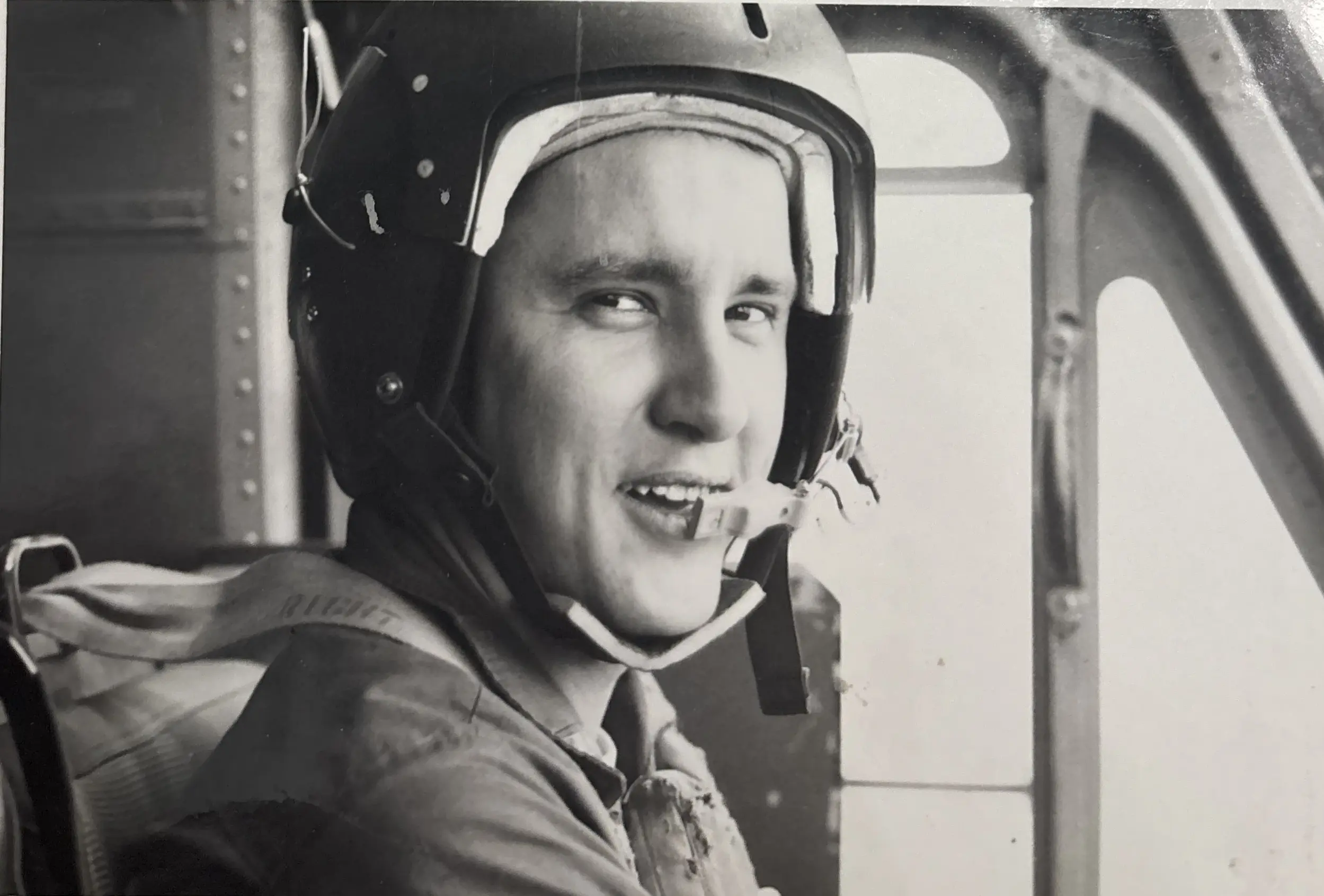
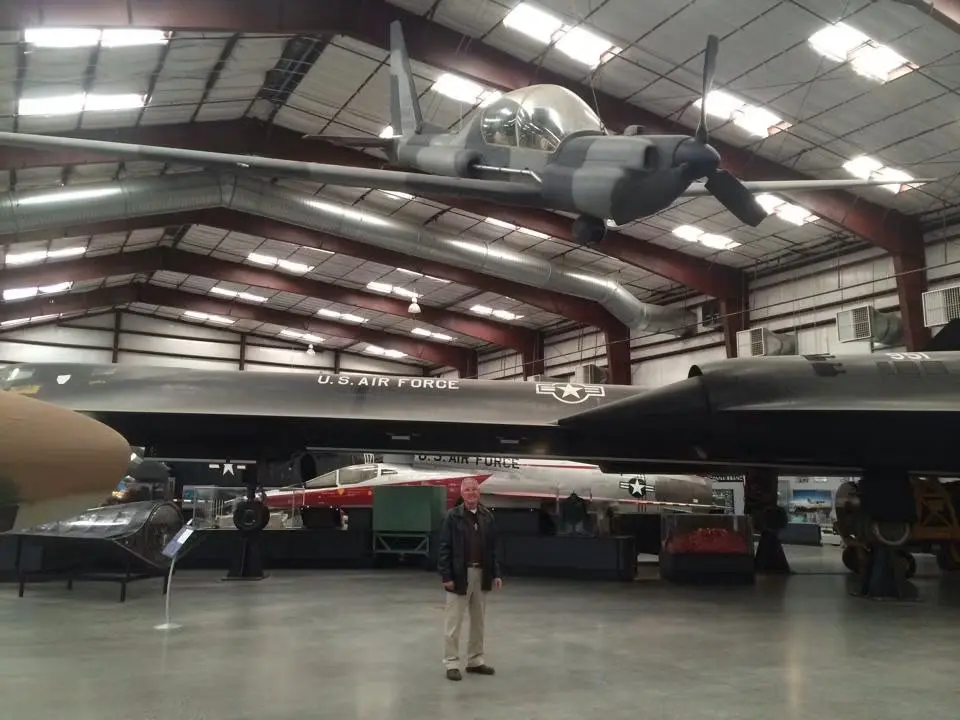
James Joseph “Jim” Burke was born on August 15, 1946. His childhood unfolded across Kingston, Pennsylvania, Upstate New York, Ithaca, and finally Detroit, where he grew up as the youngest child of Sophie Theresa Burke. He attended parochial school through fifth grade, public school through eighth, and then Catholic high school. He teased his sisters, Mary Ann and Rita, with a lighthearted joy that stayed with him throughout his life.
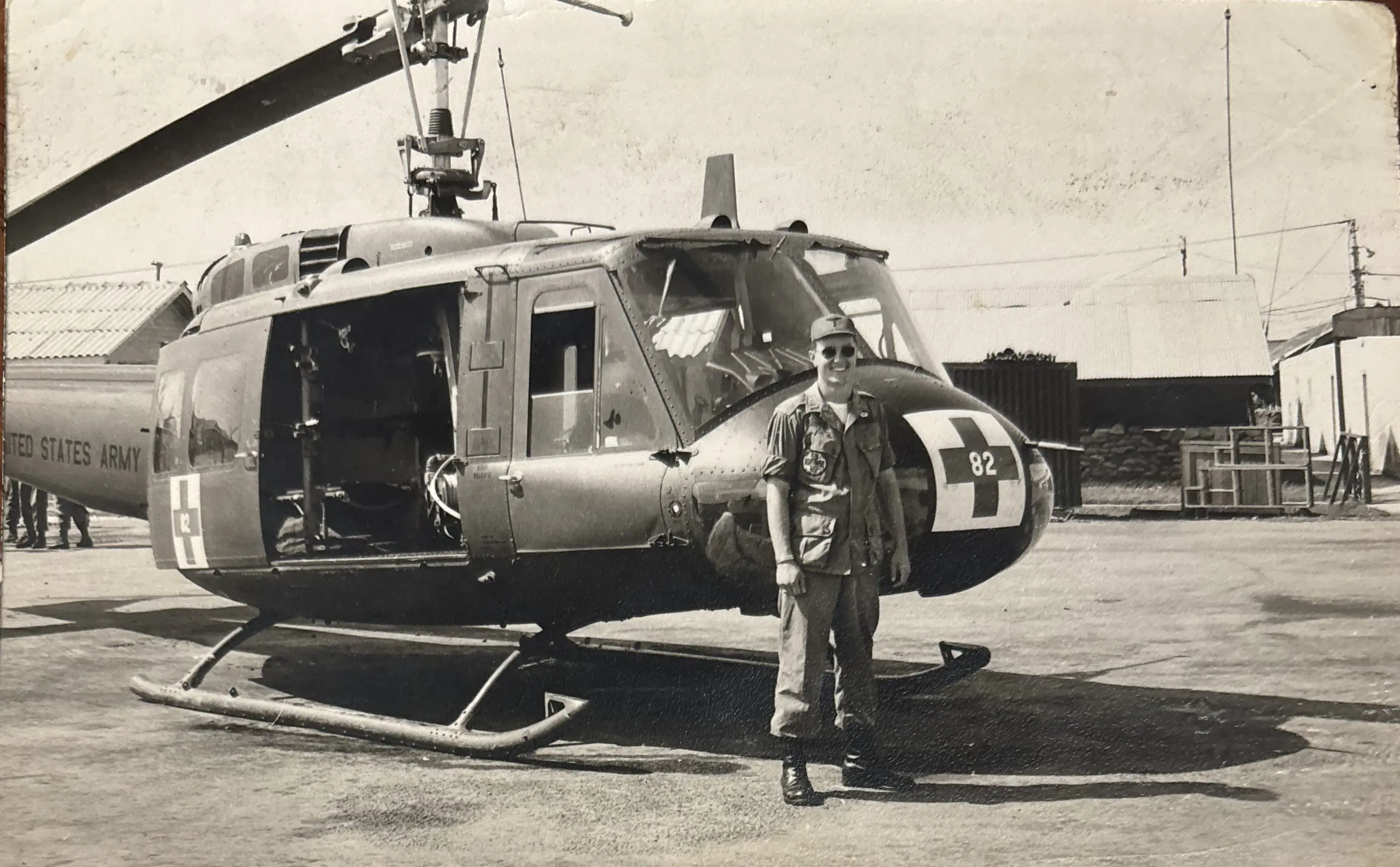
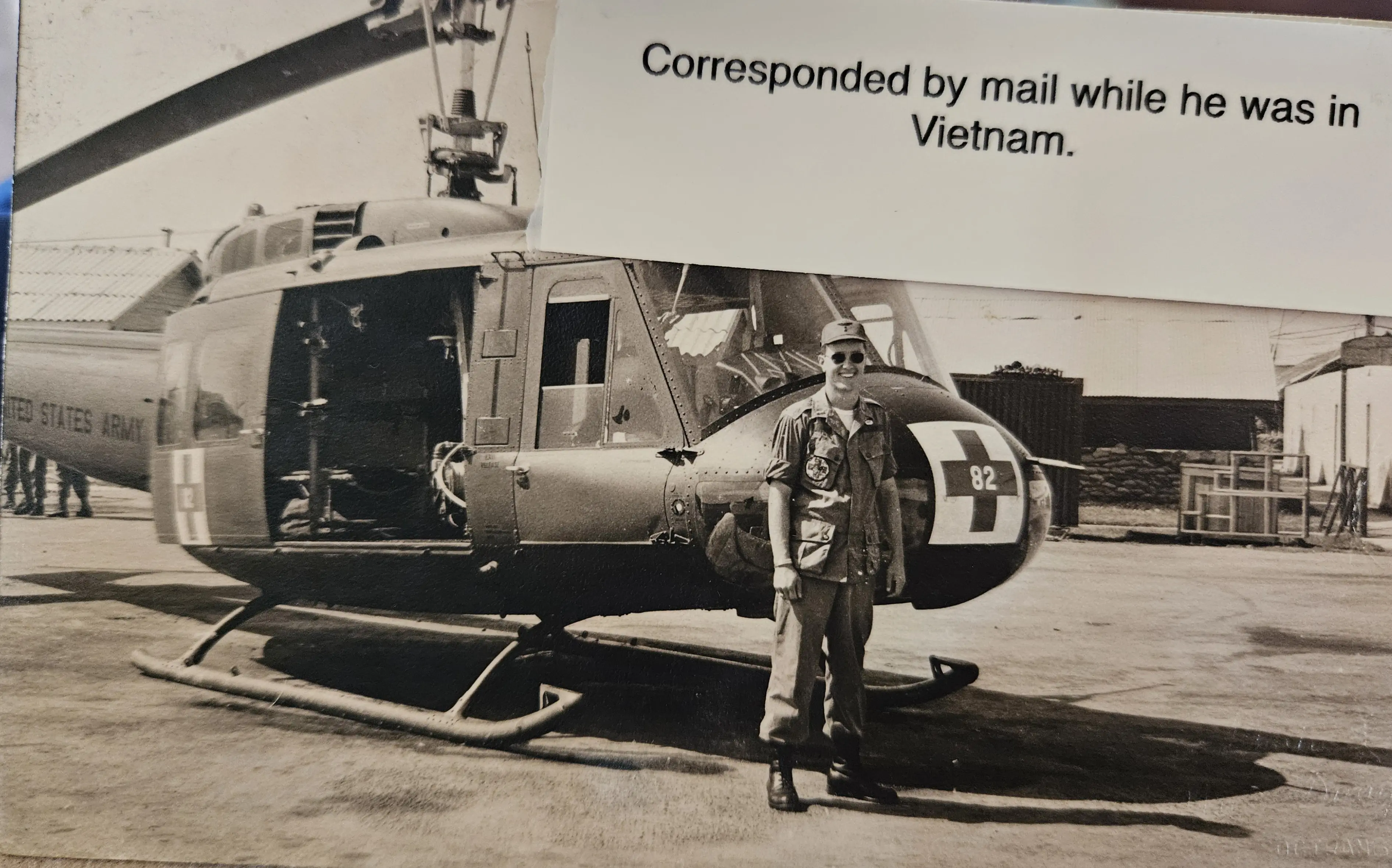
At seventeen and a half, Jim left high school and enlisted in the United States Army as an Airborne Unassigned Paratrooper, Light Infantry. He completed Parachute Rigger School, returned to Fort Benning, and soon applied for flight school as the Vietnam War escalated. He completed training in 1966 and deployed to Vietnam as a Dust Off pilot with the 82nd Medical Detachment Helicopter Ambulance.
His first tour, from 1966 to 1967, placed him in the Mekong Delta, where he witnessed the war’s brutality from his first mission onward. He picked up an ARVN soldier who had stepped on a land mine, saw vapor trails rising from a Viet Cong fighter lying dead in black pajamas, and flew into villages devastated by Viet Cong attacks. He survived an enemy fighter who emptied an AK‑47 at him, the rounds missing only by chance. He flew countless night missions, corkscrewing into landing zones under fire. He learned to identify smoke colors and radio smoke color. His Dust Off work placed him alongside the 121st and 336th Assault Helicopter Companies, flying into areas officially off limits, skirting Cambodia and Laotian borders approaching zones near North Vietnam. He flew cover for C‑123 aircraft spraying Agent Orange over the U Minh Forest, retrieved wounded under antiaircraft fire, and flew 1122 Dust Off hours, including 350 at night. He picked up enemy wounded and prisoners retrieved by Chinese Nungs. He learned Vietnamese customs, took language classes, and ate in local homes, remembering that leaving a little food on the plate signaled appreciation. He rescued a SEAL team hidden in ten‑foot grass, witnessed a trawler being sunk off the Vietnamese coast, and learned of Lockheed test pilot Quint Burden’s five‑hour‑forty‑minute flight.
Jim turned twenty‑one during his first tour. He learned to compartmentalize what was taking place. Sleeping in ten‑minute intervals, and remain hyper aware. “I could walk into a bar and there could be sixty people in there and I could tell you what they were doing, what they were drinking.”
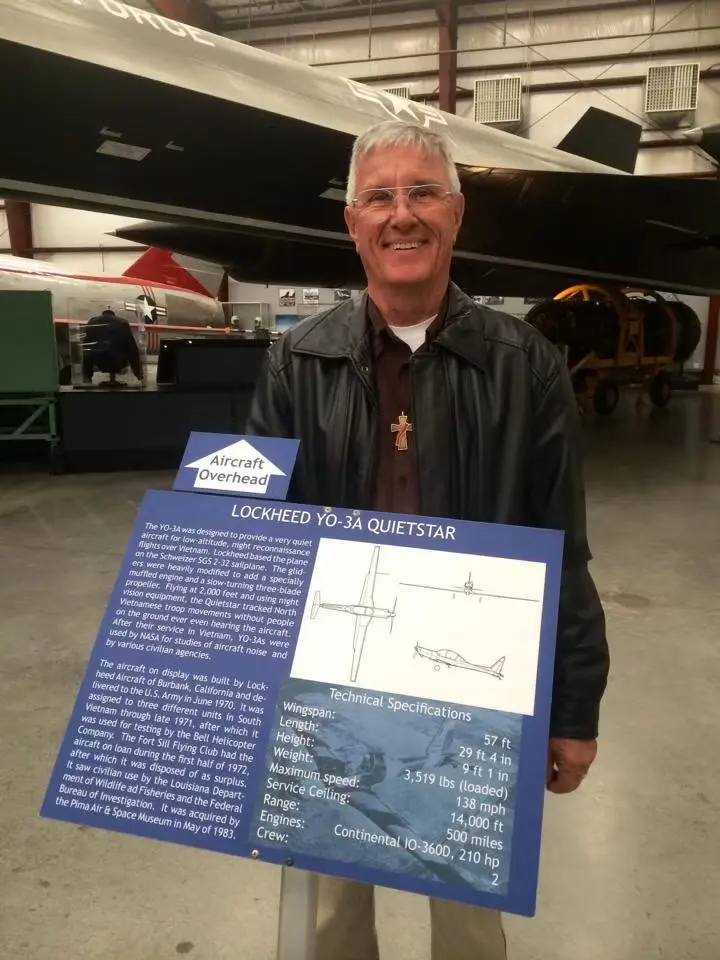
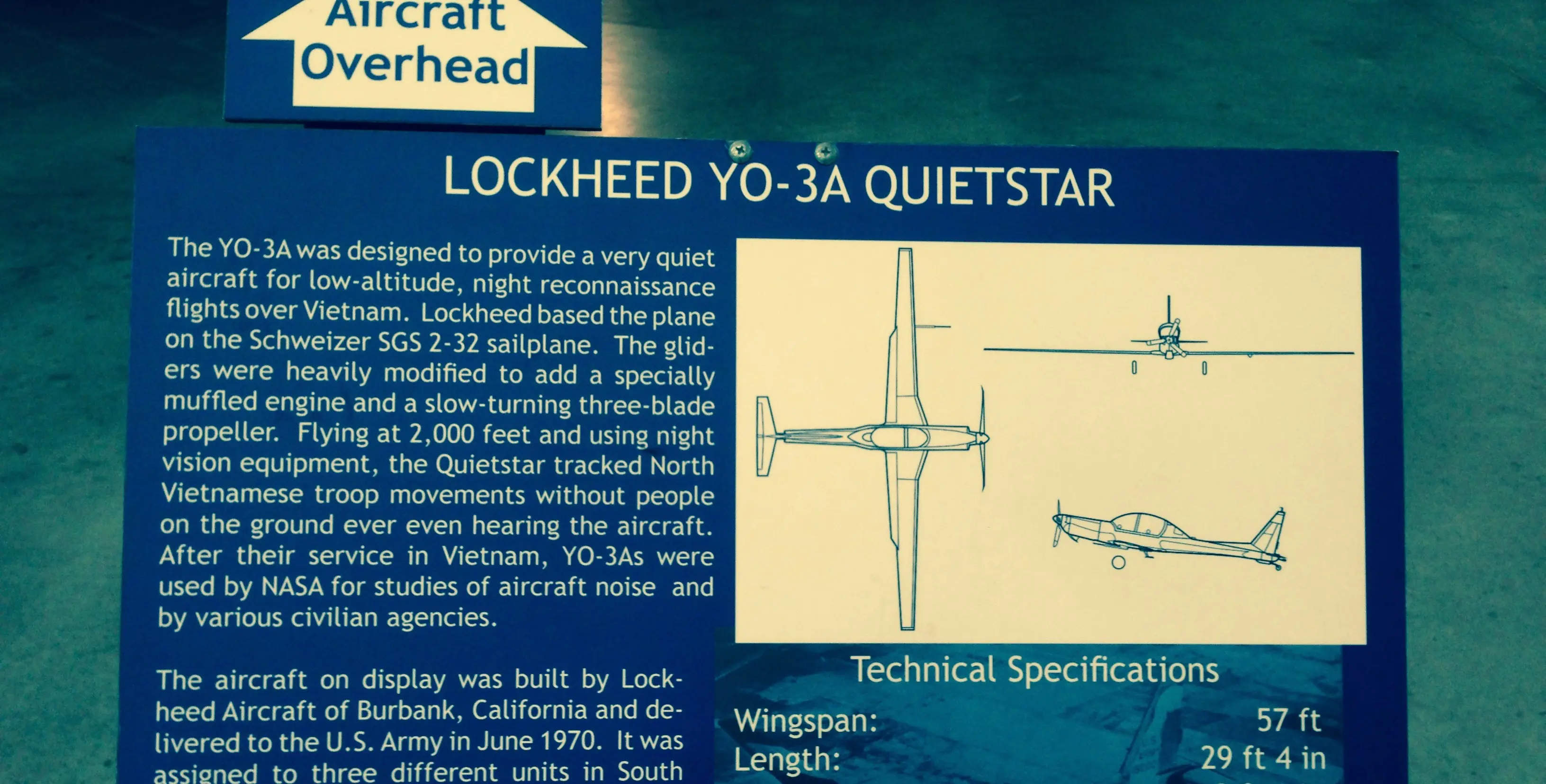
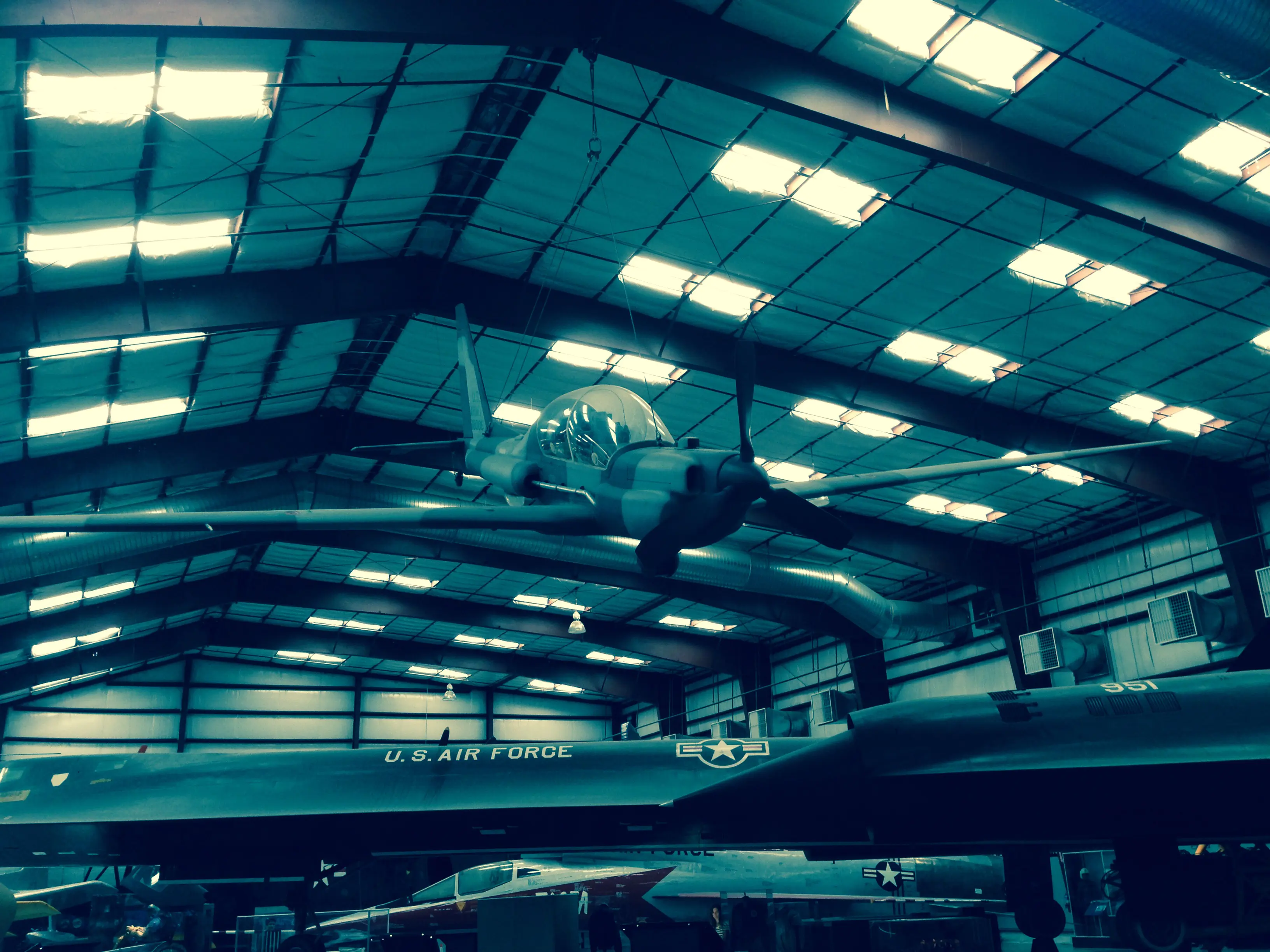
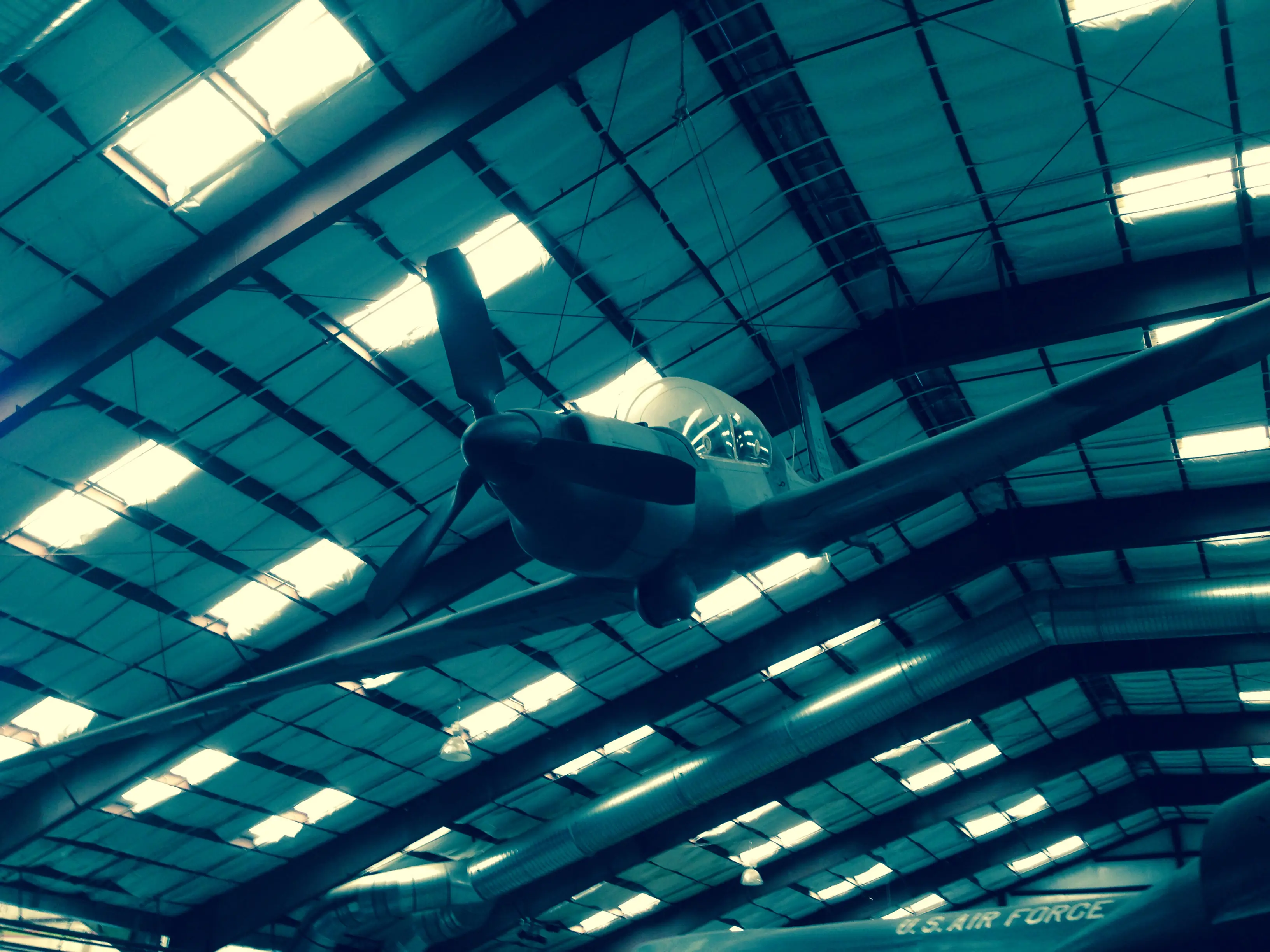
His second tour, from 1970 to 1971, introduced the YO‑3A Quiet Star, a silent night surveillance aircraft built on a Schweizer sailplane frame. He flew at seventy knots and fifteen hundred feet, calling artillery onto enemy camps. Cockpit temperatures reached over 90 degrees. He witnessed a trawler being sunk off the Vietnamese coast, and learned of Lockheed test pilot Quint Burden’s five‑hour‑forty‑minute flight. His own aircraft was restricted to 3 ½ flights because of the restrictions of the fuel overflow system. His own aircraft lost fuel through an overflow system. Engineers warned that blowing the canopy could shear off the tail. “They never tested it in flight.”
After Vietnam, Jim became a helicopter instructor at Fort Wolters, logging seven hundred fifty instructor hours. There he met Mary, the shy young woman who would become his wife. Their first date was at a Dairy Queen. Her father, Hector, came to respect Jim deeply after Jim prayed with him in a hospital chapel following Mary’s sister, Dora’s motorcycle accident. “Her father gave me a picture of her and I still have it.” They married on October 12, 1968, at Our Lady of Lourdes Catholic Church in Mineral Wells, celebrating their fiftieth anniversary there decades later.
After Vietnam, Jim entered the Army’s fixed‑wing pipeline at Fort Stewart, where helicopter instinct gave way to the anticipatory control required for fixed‑wing aircraft. From Stewart he moved to Fort Rucker, the Army’s aviation nerve center, where he mastered instrument flying and cross‑country navigation. His next transition took him to Fort Ord, where he trained on the YO‑3A Quiet Star.
That next chapter unfolded at Randolph Air Force Base, one of the premier aviation hubs in the United States. Randolph’s runways were alive with trainers, transports, liaison aircraft, and multi‑engine platforms, and Jim flew an unusually wide portfolio of them. He flew U‑21s, T‑42s, T‑41s, O‑1s, and multiple variants of the U‑8, carrying generals, GS‑9 officials, planners, and inspectors across the United States, Canada, Mexico, and South America. Through all of it, he and Mary were raising their children, building a home that anchored his service and gave meaning to every hour he spent in the sky.
After Randolph, he and Mary began the next major chapter of their life overseas. Their first tour in Germany began in February 1976 near Erlensee and the Air Base Fliegerhorst, known as the Flying Horse. He flew with a VIP unit and later transferred to the 173rd Assault Helicopter Company. He flew U‑21s and Hueys, becoming deeply comfortable with instrument flight in Germany’s challenging weather. Many of the VIP passengers he carried preferred flying closer to the ground rather than in the clouds, and his instrument proficiency made him a trusted pilot in conditions that demanded precision.
Germany became a family chapter as well. He and Mary were raising their children, and their daughter Laura attended a German kindergarten. They grew close to their Hausmeister, who took them strawberry picking and helped them feel at home. Their son Anthony was born in 1977, and the family embraced local traditions, visiting farmers’ markets on Saturdays for fresh vegetables, fruit, and baking potatoes. Their friends, John and Elfrieda Gieder, with John serving as the tower chief at Fliegerhorst, remain close to this day.
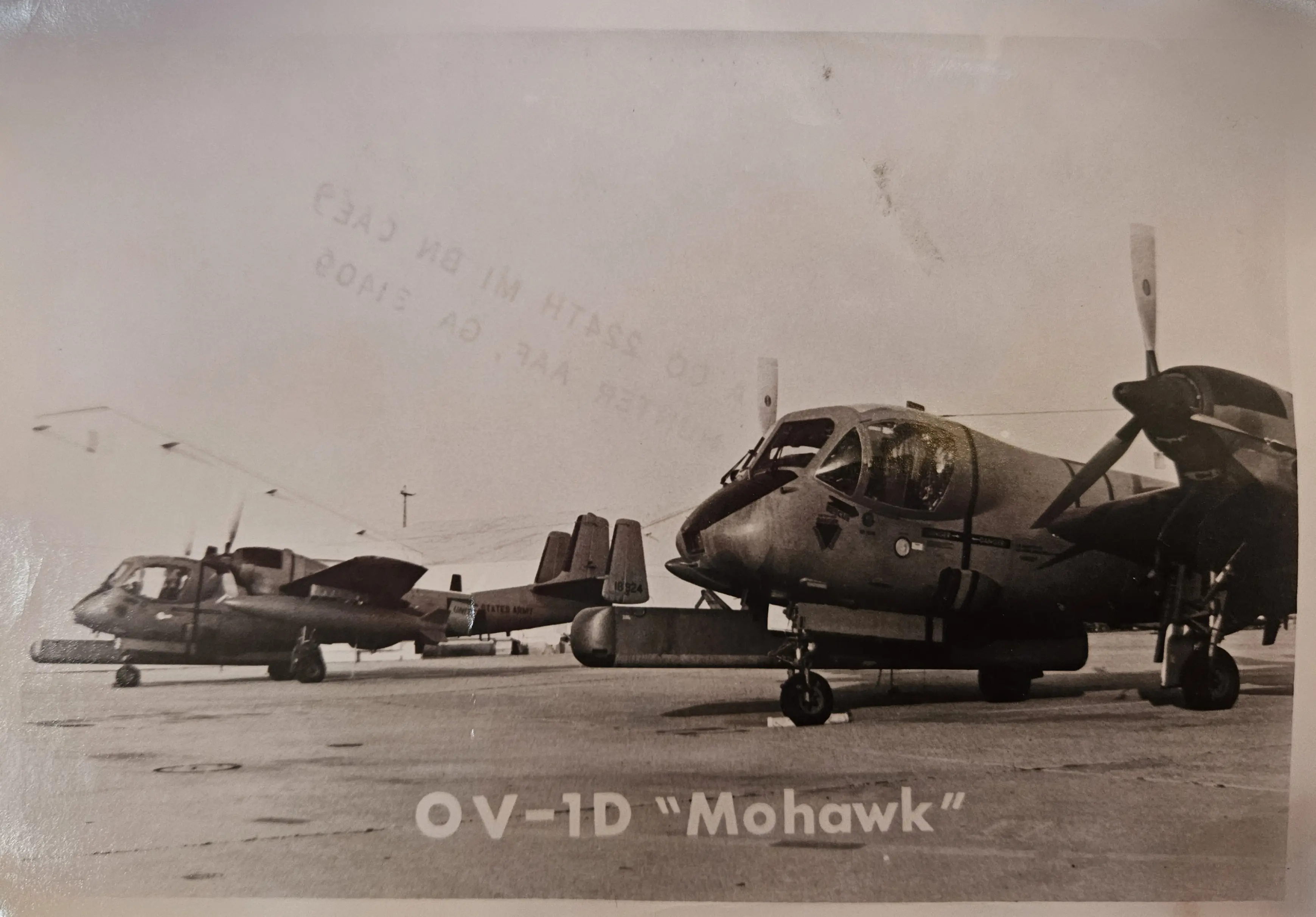
His second Germany tour carried him into the heart of the Cold War. He flew OV‑1 Mohawks and C‑12 Hurons along the Belgian and Czechoslovak borders, gathering SLAR radar signatures. He worked with auxiliary power units and inertial navigation systems, identifying radar returns down to ten‑digit coordinates. He and Mary traveled throughout Belgium and France, visiting Sainte‑Mère‑Église, where the 82nd and 101st Airborne landed on D‑Day. They hunted with German Jägers, completing the required course and earning permission to take one species of game. He harvested a Corsicana Mouflon ram and was occasionally asked to take an Abnormal, an animal with unusual horns. Germany became a place of friendship, culture, and memory. He and Mary lived there three years during the first tour and four years during the second, building a life that blended military duty with family stability.
He returned to Arizona in 1986, served at Fort Huachuca, retired, worked in Civil Service OSAC, and ran his own pilot‑for‑hire business. In 2002 he was recalled to active duty, flying RC‑12 triangulation missions and training younger pilots.
In the latter part of retirement, years later, he opened a gunsmithing business, restoring firearms that included a pre‑1964 Winchester Model 94.
Jim cherished his family, his wife Mary, their two children Laura and Anthony, and four granddaughters, Emily, Haley, Clara, and Maddie. His Catholic faith remained central. He believed in teaching his children and grandchildren to talk with God and have a relationship with Jesus.
During his first tour, one of his lasting memories came from visits to a unit whose uniforms were laundered by Catholic nuns. He spoke with them about the long history in Vietnam. The region’s history was often misunderstood or untaught, and these conversations stayed with him for the rest of his life. They deepened his belief that people must learn the truth of history and tradition for themselves. As he said, “You have to research for yourself. That’s why I like books. You have to know what’s going on.”
James Joseph “Jim” Burke hoped to be remembered as someone “always happy,” a man who teased his siblings, loved chocolate ice cream, and never forgot that Dust Off crews fought to make the South Vietnamese free. His military career spanned nearly thirty‑four years. His life spanned continents, wars, aircraft, and eras. Through it all, he remained steady, humble, and faithful, a man who flew into danger so others could live, and who built a family that carries his legacy forward with love and gratitude.
Supplemental Information
Entering the United States Army at Seventeen and a Half in 1964: The Reality of Airborne Light Infantry Induction
In 1964 the United States Army remained shaped by the veterans of two major wars. The men who trained new recruits had fought in Europe, the Pacific, and Korea, and their instruction reflected the hard lessons of those campaigns. For a seventeen‑and‑a‑half‑year‑old who left school and enlisted, the Army was not simply a job. It was an immediate immersion into a disciplined world that demanded obedience, endurance, and emotional steadiness from the first moment of arrival.
The National and Military Climate of 1964: American strategic policy remained anchored in the realities of the Cold War. The Soviet Union stood as the primary adversary, and the Army trained with the expectation that conflict could erupt anywhere. The Vietnam conflict was already intensifying. American advisors were in combat zones, helicopter units were expanding, and the Army was quietly preparing airborne and aviation personnel for Southeast Asia. The Gulf of Tonkin incident would occur later that year, but even before it, the direction of American involvement was unmistakable. Young men understood that enlistment meant stepping into a world moving toward war. A seventeen‑and‑a‑half‑year‑old entering the Army in 1964 joined an institution preparing for a major conflict. Because he was only seventeen and a half, his entry into the Army necessitated the formal signature of his parents. Once the signature was given, the Army treated the recruit exactly like any other soldier. There were no allowances for youth. A seventeen‑year‑old was expected to carry the same weight, meet the same standards, and endure the same discipline as older recruits. The Army’s goal was to transform civilians into soldiers quickly and decisively, and the process left no room for hesitation.
Within the psychological and emotional landscape of a new recruit, the Army required an immediate immersion into a disciplined world that demanded rapid maturity, endurance, and steadiness from the first moment of arrival. Recruits learned to compartmentalize emotion, to sleep whenever possible, sometimes ten minutes at a time, and to accept that orders were absolute. They learned that fear was managed through training and discipline, and that their lives depended on the men beside them.
This foundation explains why Jim later said he did not have nightmares. He had learned early to separate emotion from action. Compartmentalization was not a coping mechanism acquired later in life; it was a survival skill taught from the beginning.
Fort Knox: Basic Training with the M1 Garand
Fort Knox stands in the rolling hills of north central Kentucky, spread across Hardin, Meade, and Bullitt counties. The installation lies south of Louisville and west of Elizabethtown, occupying more than one hundred thousand acres of hardwood forest, open training fields, and armored maneuver terrain. Its location was chosen for strategic reasons: the land offered isolation, vast training space, and proximity to major rail lines that could move troops and equipment quickly. By the time Jim Burke arrived in 1964, Fort Knox had already been a cornerstone of American military training for nearly half a century.
The post began in 1918 as the Camp Knox Maneuver Area, named for Major General Henry Knox, the first Secretary of War under President George Washington. In the 1930s it became Fort Knox, the permanent home of the U.S. Army’s Armored Force. Generations of tankers trained there for combat in World War II, Korea, and later conflicts. The installation’s identity was shaped by armored warfare, but it also became one of the Army’s major basic training centers. Tens of thousands of recruits passed through its gates each year, shaped by instructors who had fought in the great wars of the mid‑twentieth century.
This was the institution Jim entered in an installation built by war, run by combat veterans, and designed to forge soldiers capable of enduring hardship and performing under pressure.
When Jim stepped off the bus at Fort Knox, he entered a training system still commanded by men who had fought in World War II and Korea. These instructors had survived the hedgerows of Normandy, the frozen mountains of Korea, and the island campaigns of the Pacific. Their instruction style reflected the hardness of those experiences. They trained recruits the way they themselves had been trained: loudly, directly, and without compromise. Basic training at Fort Knox was not an introduction to military life; it was a complete immersion into a disciplined world designed to break down civilian habits and rebuild recruits into soldiers capable of functioning under stress.
The centerpiece of this transformation was the M1 Garand. Although newer rifles such as the M14 were entering service, the Army in 1964 still relied heavily on the Garand for initial training because it demanded strength, discipline, and respect. The rifle weighed just over ten pounds and fired the powerful .30‑06 cartridge. It was the same weapon carried by American soldiers at Omaha Beach, Bastogne, and the Pusan Perimeter. Recruits learned to field strip it, clean carbon from every surface, maintain the gas system, load the en‑bloc clip without injury, and fire it accurately despite its recoil. The Garand was not simply a tool. It was a constant companion. Recruits marched with it, slept near it, cleaned it daily, and learned to trust it.
Life at Fort Knox revolved around discipline. Recruits lived in long, open‑bay barracks lined with metal bunks, where every bed, footlocker, and inch of floor space was subject to inspection. A loose blanket corner or a speck of dust on a locker hinge could result in corrective training. Drill sergeants , many of them combat veterans, enforced standards with intensity. Their voices carried across the parade fields. Their corrections were immediate. Their expectations were absolute. They taught recruits to respond instantly, move decisively, and maintain discipline under pressure.
Days began before dawn. Recruits formed up in the dark for roll call, then moved into physical training that included long runs, calisthenics, bayonet drills, and obstacle courses. Weapons instruction followed, along with drill and ceremony, field exercises, and barracks maintenance. Evenings brought inspections, where uniforms, boots, bunks, and rifles were examined with exacting precision. Recruits learned to make beds with hospital corners, polish boots until they reflected light, and maintain uniforms to a standard that left no room for error.
Field training at Fort Knox emphasized practical soldiering skills. Recruits learned movement under fire, low crawling and high crawling, reacting to ambush, establishing defensive positions, digging fighting holes, camouflage and concealment, night operations, and land navigation. They operated in mud, heat, rain, and darkness. They learned to maintain equipment, conserve ammunition, and function as part of a squad. The Army believed that hardship built unity, endurance, and discipline.
Basic training also demanded rapid psychological adjustment. Recruits learned to compartmentalize emotions, follow orders without hesitation, trust the men beside them, and sleep whenever possible, sometimes ten minutes at a time. The Army taught that hesitation could cost lives. Recruits learned to act decisively, even when tired, stressed, or uncertain. This early conditioning explains why Jim later said he did not have nightmares. Compartmentalization was taught from the beginning.
The historical context of 1964 made Fort Knox training even more significant. The Army was quietly preparing for Vietnam. Helicopter units were expanding. Dust Off medical evacuation units were forming. Airborne and aviation personnel were in high demand. Jungle warfare doctrine was being updated. Advisors were already in combat zones. Basic training was designed to produce soldiers capable of functioning in harsh environments, responding instantly to orders, and enduring physical and psychological stress— skills essential for the rapidly escalating conflict in Southeast Asia.
Jim’s mastery of discipline, weapons handling, and physical endurance at Fort Knox formed the foundation for everything he would later face: Dust Off missions under fire, night extractions, flying into ambush zones, surviving AK‑47 bursts, and conducting reconnaissance over hostile terrain. Fort Knox was where the transformation began, and where the Army forged the discipline that would carry him through two tours in Vietnam and a career spanning nearly thirty‑four years.
Fort Gordon: Advanced Individual Training
Fort Gordon lies in the pine forests of eastern Georgia, just outside Augusta, a region of rolling hills, red clay soil, and humid summers that test a soldier’s endurance as much as any drill sergeant’s voice. Established in 1941 as Camp Gordon, the installation trained infantry divisions for World War II, including units that fought in North Africa, Italy, and France. After the war it became a permanent post, and by the early 1960s it was one of the Army’s principal centers for Advanced Individual Training. Although Fort Gordon would later become synonymous with the Signal Corps, in 1964 it still carried the identity of an infantry training base shaped by the lessons of two major wars.
When Jim Burke arrived at Fort Gordon after completing basic training at Fort Knox, he entered a place where the Army refined the raw discipline learned in basic and transformed recruits into functioning infantry soldiers. The training was structured, demanding, and rooted in the combat experience of instructors who had fought in World War II and Korea. Their approach was not theoretical. It was shaped by the realities of hedgerow fighting, frozen mountain warfare, and close‑quarters engagements in villages and rice paddies. They taught recruits what they themselves had needed to survive.
Daily life at Fort Gordon revolved around mastering the fundamentals of infantry operations. Recruits learned tactical movement, patrolling, and the principles of small‑unit maneuver. They practiced crossing danger areas, reacting to ambushes, and establishing defensive positions. Fieldcraft was emphasized: how to move silently, how to use terrain for cover, how to camouflage equipment, and how to read the ground for signs of enemy presence. The training fields were often muddy, hot, and unforgiving. Georgia’s humidity clung to uniforms, and the red clay stained boots and fatigues no matter how often they were cleaned.
Weapons training intensified at Fort Gordon. Recruits fired live ammunition under supervision, learning the seriousness of every round. They practiced marksmanship, learned to clear malfunctions, and drilled on the safe handling of weapons in close proximity to other soldiers. The Army believed that familiarity with weapons was not enough; recruits had to demonstrate competence under stress. Live‑fire exercises were designed to teach respect for the rifle, awareness of surroundings, and the ability to remain calm when noise, heat, and confusion pressed in from all sides.
Fort Gordon also taught soldiers how to live in the field. Recruits dug fighting positions, learned to maintain equipment in rain and mud, and practiced operating in darkness. Night training was common. Soldiers learned to navigate terrain with limited visibility, to move quietly, and to maintain formation without relying on sight. They learned to read maps, use compasses, and trust the noncommissioned officers who guided them. The Army understood that future combat would not occur in ideal conditions, and Fort Gordon prepared soldiers for that reality.
The discipline learned at Fort Knox was reinforced and expanded. Orders were expected to be followed instantly. Mistakes were corrected immediately. Recruits learned to work as part of a squad, to trust the men beside them, and to understand that survival depended on unity and precision. The instructors demanded endurance, attention to detail, and mental resilience. They taught recruits to push through fatigue, heat, and discomfort, because combat would demand the same.
The historical context of 1964 made Fort Gordon’s training even more significant. The Vietnam conflict was escalating. Helicopter operations were expanding. Advisors were already in combat zones, and the Army was quietly preparing infantry and aviation personnel for jungle warfare. Although Fort Gordon was not a jungle training center, its instruction emphasized adaptability with how to operate in woodland terrain, open fields, and improvised environments. Soldiers learned to respond to unexpected situations, to adjust quickly, and to maintain discipline even when conditions changed without warning.
For Jim, Fort Gordon provided structure and purpose. He had moved frequently as a child, living in Pennsylvania, New York, and Michigan before entering the Army. The regimented environment of Fort Gordon offered stability. It gave him a clear role, a defined mission, and a sense of belonging within a larger institution. The training he received there tactical movement, weapons handling, fieldcraft, and small‑unit operations formed the bridge between basic training and the airborne world he would soon enter at Fort Benning.
Fort Gordon was where the Army refined him. It was where discipline became skill, where physical endurance became tactical competence, and where the foundation was laid for everything he would later face in Vietnam: flying into ambush zones, extracting wounded soldiers under fire, navigating hostile terrain, and making split‑second decisions that saved lives. The lessons of Fort Gordon stayed with him throughout his career, shaping the soldier, aviator, and leader he became.
The Parachute’s Journey and the Making of the Airborne Soldier : 1940 to the Modern Era
The story of the U.S. Army parachute is inseparable from the story of the riggers who pack it and the paratroopers who trust it. It began in 1940 at Fort Benning, where the Parachute Test Platoon proved that mass airborne assault was possible. The earliest parachutes were simple round silk canopies “fragile and prone to stretching” packed by volunteers with no formal training. Malfunctions were common, and the Army quickly realized that airborne operations required specialists whose sole duty was to ensure that parachutes opened correctly. In 1941, the Quartermaster Corps established the first structured rigger training program, marking the birth of a profession defined by precision, responsibility, and accountability.
World War II validated the system. Riggers packed parachutes for every major airborne operation—Sicily, Salerno, Normandy, Holland, and the Rhineland and supported complex resupply missions that delivered ammunition, rations, medical supplies, vehicles, and artillery behind enemy lines. After each operation, malfunction reports were collected and analyzed, feeding directly into the school’s curriculum. Silk gave way to nylon. Stitching patterns strengthened. Suspension lines improved. Canopy geometry refined. The rigger’s signature on a packing card became a promise that the parachute would open as intended.
After the war, parachutes transitioned fully to nylon, which was stronger, more durable, and less affected by moisture. Cold weather and high winds in Korea exposed weaknesses in existing designs, prompting reinforcement of stress points and improved venting systems. Rigger training became formalized, with manuals, diagrams, and standardized inspection procedures. The profession gained its own MOS identity, and riggers became recognized technical specialists whose work sat at the intersection of supply, engineering, and combat operations.
By the mid‑1960s, when Jim Burke entered rigger school, parachutes had become more reliable and technically sophisticated. Personnel parachutes remained round, but their materials were stronger, their lines more durable, and their deployment systems more controlled. Cargo parachutes evolved dramatically, with multi‑canopy systems capable of delivering heavier loads with greater stability. Vietnam accelerated innovation. Helicopter operations required emergency extraction systems, and Special Forces demanded high‑altitude parachutes capable of stable deployment at extreme elevations. Early steerable canopies appeared, marking the beginning of modern parachute design.
From the 1970s onward, parachute technology expanded rapidly. Ram‑air canopies became standard for special operations, offering full steering capability and glide performance. Cargo parachutes evolved into precision airdrop systems capable of delivering loads with GPS‑guided accuracy. Materials improved again, incorporating advanced nylon blends, Kevlar reinforcement, and high‑strength hardware. Yet despite these advances, the core principles remained unchanged: canopy inflation must be staged and controlled; suspension lines must distribute load evenly; deployment must follow a precise aerodynamic sequence; and riggers must pack with absolute precision.
The physics of parachute deployment has remained constant across all eras. When a jumper exits an aircraft, the pilot chute catches air and creates drag, extracting the deployment bag and allowing the suspension lines to stretch to full extension. Line stretch stabilizes the canopy’s position relative to airflow. Only then does the canopy unfold, transitioning from a collapsed bundle into an expanding aerodynamic surface. Internal pressure builds, the gores inflate symmetrically, and the parachute becomes a drag device capable of arresting descent. Opening shock—the moment the canopy fully inflates—is regulated through fold geometry, line stow tension, and disciplined deployment bag closure. Riggers learned these forces intuitively; their hands understood the physics long before they could articulate it.
Suspension lines evolved from natural fibers in World War II to nylon in the postwar era, and eventually to advanced synthetic blends capable of withstanding extreme loads. Cargo parachutes evolved even more dramatically, becoming essential for resupplying remote units in Vietnam and later forming the backbone of modern precision airdrop systems.
The culture of riggers has remained remarkably consistent across eight decades. It began in World War II, when riggers were required to jump with the parachutes they packed—a tradition that created a culture of accountability unmatched in any other specialty. “You jump it, you pack it.” A rigger’s signature is a promise. Precision is the standard. Trust is earned through flawless workmanship. Modern riggers work with advanced materials and modern systems, yet their ethos is identical to the men who packed silk canopies in 1941.
This tradition fed directly into the making of the paratrooper. Airborne training at Fort Benning was designed with one purpose: to produce soldiers who could step into the sky without hesitation and land ready to fight. Physical conditioning began before sunrise and was relentless, forging psychological resilience as much as strength. Ground Week taught the fundamentals of airborne movement—Parachute Landing Falls, aircraft exit procedures, body position during descent, and emergency actions—lessons born from wartime experience where improper exits caused collisions, entanglements, and fatal injuries.
The 34‑foot tower served as the first test of nerves, exposing hesitation instantly. The 250‑foot towers, developed from the original 1941 structures, dominated the skyline and taught canopy control, drift compensation, wind awareness, and rapid decision making under exposure. Mastery of these towers meant readiness for real jumps.
Jump Week was the culmination of training. Soldiers boarded C‑130s or C‑123s knowing that every step of their preparation had led to the moment when the green light illuminated and they stepped into the sky. Five successful jumps earned the coveted silver wings. Airborne Induction was more than training; it was a rite of passage that forged discipline, confidence, and identity. It connected soldiers to the legacy of airborne forces who had jumped into Europe, the Pacific, Korea, and Vietnam, and it linked every new paratrooper including Jim Burke to the moment in 1940 when the Parachute Test Platoon proved that American soldiers could take to the sky and fight as a new kind of warrior.
Across all eras, jump heights reflected doctrine shaped by combat. World War II training jumps ranged from 1,200 to 1,500 feet, while combat jumps were typically 800 to 1,000 feet, with emergency jumps as low as 300 to 500 feet under fire. Korea maintained training jumps at 1,200 to 1,250 feet but adjusted combat jumps to 600 to 800 feet due to weather. By the 1960s, Jim Burke’s jumps were the classic airborne height of 1,250 feet, unchanged since World War II for safe mass‑exit operations. Night jumps were conducted at 1,000 feet, and combat jumps rare in Vietnam remained between 800 and 1,000 feet. Special Forces began testing high‑altitude systems, but these were not part of standard Airborne School. Modern static‑line jumps remain at 1,250 feet, while HALO and HAHO operations reach 25,000 feet or more.
The parachute’s journey from fragile silk to modern precision remains a testament to the riggers’ discipline, the engineers’ ingenuity, and the paratroopers’ courage. It is a lineage defined by war, refined by physics, and sustained by a culture of responsibility that has never wavered. The parachute Jim Burke learned to pack in the mid‑1960s was part of this living tradition, shaped by decades of battlefield lessons and carried forward by the hands of those who understood that lives depended on their workmanship
The Time Required to Pack and Inspect a Parachute
The complete assembly of a personnel parachute in Jim Burke’s era required forty‑five minutes to one hour for a single rigger. This duration reflected the technical demands of the equipment and the precision expected of the men who prepared it.
The canopy was first laid out and examined in detail. Riggers smoothed the fabric to evaluate its condition, aligned the panels to preserve the canopy’s geometry, and checked each suspension line to ensure its calibrated length remained correct. This initial preparation often consumed fifteen minutes because the canopy had to be perfectly aligned before any folding could begin.
The folding sequence required another twenty minutes or more. Riggers followed a researched pattern developed through formal testing, designed to control how the canopy would extract from the deployment bag and enter the slipstream. Each fold had to be exact so the canopy would unfurl in a smooth, predictable progression. Any misalignment could affect inflation, so the sequence was restarted if the geometry was not precise.
Stowing the suspension lines added roughly ten minutes. These lines were engineered to maintain the canopy’s shape under load, and their stowage governed the timing of release during deployment. Riggers placed each stow with measured tension to ensure the lines released in the correct order, preserving inflation stability.
Closing the deployment bag and packing the pilot chute required an additional five to ten minutes. The deployment bag regulated extraction, and its locking stows had to be secured with consistent resistance. The pilot chute, designed to generate immediate drag, was packed so it would deploy without delay and extract the main canopy cleanly.
Inspection was the final safeguard. A qualified inspector examined the canopy folds, line stows, locking stows, pilot chute placement, closing loops, and ripcord pins to confirm that the parachute would perform as designed. This evaluation added another ten minutes or more, and the inspector’s signature represented formal accountability for the equipment’s readiness.
Taken together, the process required forty‑five minutes to one hour, a duration shaped by engineering, doctrine, and the seriousness of the responsibility. One’s like Jim worked within this disciplined rhythm, preparing equipment whose performance depended entirely on the precision of their hands and the technical standards of their profession. From Jim’s perspective, the sequence never felt excessively long; it was simply the measured cadence of a job done correctly.
The 82nd Medical Detachment Helicopter Ambulance
The 82nd Medical Detachment, the Dust Off unit that carried Jim Burke into the Mekong Delta, began its lineage during World War II. In December 1943, the United States Army constituted the 82nd Malaria Control Unit at Camp Ellis, Illinois, a formation created to combat tropical diseases that threatened entire divisions in the Pacific. It evolved into the 82nd Malaria Composite Unit in 1944 and the 82nd Malaria Control Detachment in 1945, serving until its deactivation in Korea in March 1946.
After the war, the Army shifted the unit’s medical role. In 1950 it became the 82nd Shock Detachment, activated at Letterman Army Hospital in 1951, and inactivated again in 1952. These redesignations reflected changing medical priorities, but the decisive transformation came in 1954 when the Army Medical Department embraced the lessons of helicopter evacuation learned in Korea.
In September 1954, at Brooke Army Medical Center in Fort Sam Houston, Texas, the 82nd was activated as the 82nd Medical Detachment (Helicopter Ambulance). This marked the beginning of its Dust Off identity. Helicopters had proven that rapid evacuation dramatically increased survival rates, and the 82nd became one of the earliest units dedicated to aeromedical evacuation, helping shape the doctrine that would define medical aviation for decades.
- Over the next decade, the 82nd refined its capabilities through major field exercises.
- During Exercise Rocky Shoals in 1958, it became the first helicopter ambulance unit to qualify on a Navy aircraft carrier.
- Additional exercises such as King Cole, Big Thrust, Iron Dragon, and Desert Thrust tested evacuation under armored, desert, and large‑scale troop movement conditions.
By the early 1960s, the 82nd had become one of the Army’s most experienced helicopter ambulance units. Its pilots and medics were trained to land under fire, navigate without lights, extract casualties from jungle terrain, and coordinate with infantry, artillery, and riverine forces. These skills would become essential in Vietnam.
In October 1964, the 82nd deployed to Vietnam. It was initially collocated with the 57th Medical Detachment at Soc Trang, a strategic base in the Mekong Delta surrounded by rice paddies, canals, and jungle. Helicopter evacuation was indispensable in this terrain. The 82nd later moved to Binh Thuy, expanding its coverage across III Corps and IV Corps Tactical Zones. This operational footprint matches precisely the areas where Jim Burke flew Dust Off missions.
The 82nd’s mission in Vietnam was aeromedical evacuation. Its UH1 Huey helicopters flew into landing zones under direct enemy fire, often without lights and guided only by tracers or radio calls. The unit evacuated American, ARVN, and allied casualties, retrieved wounded civilians, and transported enemy combatants who required medical care. It supported riverine operations, covered troop insertions, responded to mass casualty events, and operated near the Cambodian border. It flew night missions, emergency extractions, and long‑range evacuations to field hospitals such as Dong Tam. Jim’s experiences reflect the documented operational reality of the 82nd.
Actions of the 82nd Medical Detachment in Vietnam
- Flying UH1 Huey helicopters marked with red crosses into active firefights to retrieve the wounded.
- Landing in hot zones under machine gun, mortar, and sniper fire.
- Evacuating casualties within minutes, preserving the Golden Hour and dramatically increasing survival rates.
- Conducting night missions guided only by radio calls, tracer fire, or flares.
- Extracting wounded from rice paddies, canals, jungle clearings, and triple canopy terrain.
- Supporting riverine forces, Special Forces teams, SEALs, and MACV advisors.
- Transporting wounded civilians caught in crossfire.
- Evacuating enemy wounded in accordance with medical ethics and Geneva Convention standards.
- Operating near the Cambodian border where conventional units could not reach.
- Flying in monsoon conditions, heavy winds, and low visibility.
- Delivering casualties to field hospitals such as Dong Tam, Can Tho, and Saigon.
- Maintaining round‑the‑clock readiness, often flying sixteen hours in a single day.
- The 82nd earned two Presidential Unit Citations, one Valorous Unit Award, and four Meritorious Unit Citations.
- Chief Warrant Officer Michael J. Novosel, flying under the call sign Dust Off 88, received the Medal of Honor for evacuating twenty nine wounded ARVN soldiers under fire on October 2, 1969.
The 82nd stood down in Vietnam in 1971 and returned to the United States, relocating to Fort Riley, Kansas. Its detachment structure was dissolved, but its lineage was preserved. In 1994, the Army reorganized the lineage into a full Medical Company (Air Ambulance) equipped with UH60A Black Hawk helicopters, ensuring that the history, honors, and identity of the 82nd continued into the modern era.
- The Vietnam‑era 82nd Medical Detachment no longer exists as a detachment.
- Its lineage continues today in the Army’s modern air ambulance system.
- The unit’s heritage, awards, and Dust Off legacy remain formally recognized.
From malaria control in World War II, to shock treatment in the early Cold War, to helicopter evacuation in Korea, to Dust Off heroism in Vietnam, the 82nd Medical Detachment became one of the most storied medical aviation units in American military history. It was into this lineage that Jim Burke stepped when he arrived at Ton Son Nhut in 1966 and was assigned to the 82nd at Soc Trang. The unit’s history, its doctrine, its courage, and its mission formed the foundation of every flight he made, every life he carried, and every moment he remembered.
Vietnam 1966–1967 : The Crucible of Dust Off, 82nd Medical Detachment Helicopter Ambulance
Vietnam in 1966 and 1967 was a landscape defined by extremes: violent monsoon seasons, dense triple‑canopy jungle, sudden ambushes, and the constant movement of American and allied forces across contested terrain. It was a war fought in rice paddies, river deltas, mountain ridges, and narrow valleys where visibility vanished and the enemy could strike from any direction. In this environment, the 82nd Medical Detachment (Helicopter Ambulance) became one of the most indispensable units in the theater. Their mission—Dust Off—was the most dangerous humanitarian duty of the war, and the medic stood at its center.
The UH‑1 Huey helicopter ambulance was the lifeline of the battlefield. Its arrival marked the difference between life and death. The Huey’s speed, agility, and ability to land in tight clearings allowed medics to reach wounded soldiers within minutes. This capability revolutionized battlefield medicine. A wounded soldier in Vietnam reached a surgical hospital within thirty‑five minutes, a transformation that cut the American fatality rate nearly in half compared to World War II. The medic’s work inside that helicopter—performed under fire, in turbulence, and in chaos—was often the decisive factor in survival.
Dust Off’s world was defined by constant danger, absolute commitment, and unbroken trust. Every mission was a crucible, and every flight carried the weight of lives hanging in the balance.
The Dust Off Ethos “No Conditions Refusal”
Dust Off crews lived by a creed unmatched anywhere else in the Vietnam War: they accepted every mission, under any conditions, without exception. This ethos was not aspirational; it was lived daily in the most violent period of the conflict. When a call for help came, Dust Off launched—whether the landing zone was secure or still under enemy occupation, whether the air was thick with gunfire or shrouded in monsoon rain, whether the mission required flying at night without lights or hovering motionless above jungle canopy to lower a hoist into a firefight.
The Huey ambulance offered no protection. Its thin aluminum skin could not stop bullets. The medic and crew chief worked fully exposed in the open cabin. Pilots flew low and slow—the exact profile most vulnerable to enemy fire—because altitude and speed could mean the difference between survival and death for the wounded. Yet the ethos never changed. Dust Off flew because someone needed them.
Ground troops understood this intimately. In rice paddies, jungle clearings, ambush sites, and burning landing zones, they knew one truth: if they called Dust Off, Dust Off would come. That trust was earned through sacrifice.
The Cost of Courage
The cost of Dust Off’s courage was staggering. Dust Off crews suffered some of the highest casualty rates of any non‑infantry unit in Vietnam. More than eighty helicopter ambulance crewmen—pilots, medics, and crew chiefs—were killed in action. Over two hundred Dust Off personnel were killed or wounded during the war. Hundreds of Dust Off helicopters were struck by enemy fire, many repeatedly, and dozens were shot down during rescue missions. Dust Off pilots had a seven‑times higher chance of being wounded than other aviation units, and Dust Off medics faced one of the highest casualty exposures of any medical personnel in American military history.
These numbers reflect the reality of flying into the teeth of enemy fire. Dust Off crews were targeted precisely because they flew into active combat zones where infantry units were already pinned down. Their courage was not symbolic, it was measurable in blood and sacrifice.
121st & 336th Aviation Companies
The 121st and 336th Aviation Companies emerged from two different phases of the Army’s growing reliance on helicopters in Vietnam, yet their missions converged across the Mekong Delta and placed them beside Dust Off crews like Jim Burke. Their histories form a unified record of how air mobility evolved in IV Corps and how aviation units shaped the ground war in a region where roads, canals, and rice paddies demanded a new way of fighting.
The 121st Assault Helicopter Company began as the 93rd Transportation Company, one of the earliest helicopter units sent to Vietnam. The 93rd arrived at Soc Trang Airfield in January 1962, flying the first generation of air‑mobile aircraft during the experimental stage of helicopter warfare. When the Army redesignated the 93rd as the 121st Aviation Company in June 1963, the unit shifted from transportation duties to full air assault operations. It became one of the Delta’s earliest and most active assault helicopter companies, flying UH‑1 Hueys under the call signs White Tiger, Blue Tiger, and Viking. The 121st served under the 13th Combat Aviation Battalion, the aviation headquarters for IV Corps, and carried out air assault, troop lift, armed escort, and emergency extraction missions across Soc Trang, Can Tho, Vinh Long, Bac Lieu, Ca Mau, and the U Minh Forest. Its aircraft opened landing zones, supported advisor teams, and escorted infantry into terrain where ground movement was impossible. The company remained in continuous combat service until its deactivation in 1972.
The 336th Aviation Company entered the war during the next phase of aviation expansion. Activated in 1965, it deployed to Vietnam as an Airmobile Light company equipped with UH‑1 Hueys. Although not designated an assault helicopter company, the 336th performed missions that complemented and reinforced the work of the 121st. It provided troop lift, resupply, command and control, and reinforcement for infantry operations throughout IV Corps. Its aircraft operated in the same battlespace as the 121st, supporting large multi‑company missions that required coordinated lift, control, and rapid response. The 336th flew through the same canal networks, rice paddies, and riverine corridors that defined Delta operations, joining missions that demanded close cooperation between aviation companies and Dust Off crews. Its presence expanded the reach of the First Aviation Brigade and strengthened the battalion‑level operations that shaped the air war in the southern theater.
Together, the 121st and 336th formed part of the aviation network that made the Mekong Delta the most helicopter‑dependent region of Vietnam. Their aircraft moved through terrain where infantry units relied on air mobility for insertion, extraction, and reinforcement. Their missions intersected with those of the 82nd Medical Detachment, whose Dust Off crews depended on assault and airmobile units to open landing zones, provide escort, and coordinate emergency evacuation. The histories of the 121st and 336th reflect the transformation of helicopter warfare from early experimentation to full operational maturity, and they define the environment in which Jim Burke flew.
Both units were deactivated after the war. Their lineages do not continue in today’s active Army aviation companies, yet their legacy endures in the documented missions of the First Aviation Brigade and in the memories of the pilots, crew chiefs, and medics who served beside them. Their histories form a single, unified backdrop to Jim’s own, creating a coherent record of courage, coordination, and endurance in the Mekong Delta.
The Crucible Factor — Why 1966–1967 Was the Breaking Point
The crucible factor refers to the convergence of conditions that made Dust Off operations during this period uniquely dangerous and historically significant. Combat operations intensified dramatically as American forces launched major campaigns such as Attleboro, Cedar Falls, and Junction City. These operations produced constant calls for evacuation, often in areas where landing zones were improvised under fire, carved out by artillery or infantry in the middle of battle.
The monsoon cycle created near‑zero visibility and violent turbulence. Rain fell in sheets so dense that pilots could not see their own rotor tips. Yet Dust Off flew anyway. Night operations were conducted without lights, guided only by instinct, experience, and the faint glow of the horizon. Flying “black” was extraordinarily dangerous; pilots risked striking trees, misjudging altitude, or crashing into unseen terrain. Still, they launched because wounded soldiers could not wait until dawn.
Hoist missions were the most perilous. When landing was impossible, medics were lowered into firefights through triple‑canopy jungle, stabilized the wounded, and ascended under fire. Hovering above the canopy required perfect coordination; the aircraft was a stationary target, and enemy forces concentrated fire on the hovering Huey. Gunship escorts were often unavailable, leaving Dust Off alone, unarmed, and exposed.
The human factor was equally significant. Dust Off crews were exhausted, overworked, and often flying multiple missions per day. They slept in short intervals, ate when they could, and lived with the knowledge that every mission might be their last. Yet their resolve never faltered. In this crucible, Dust Off’s reputation was forged. It was here—in the worst conditions of the war—that their ethos became legend.
The Medic— Lifeline Between Wounding and Survival
The Dust Off medic was the first medical professional a wounded soldier encountered. His work determined whether the casualty reached the hospital alive. He stabilized hemorrhage, opened airways, decompressed chests, splinted shattered limbs, treated shock, and performed rapid triage in a cabin filled with blood, smoke, sweat, and fear. He improvised constantly, using whatever equipment he had. He treated Americans, ARVN soldiers, civilians, and even wounded enemy combatants—because Dust Off’s creed was universal: So Others May Live.
The medic worked in conditions that defied imagination. The cabin shook from enemy rounds striking the fuselage. The floor was slick with blood. The air was thick with cordite, sweat, and hydraulic fumes. The wounded cried out, or lay silent, or clung to consciousness while the medic’s hands moved with practiced speed. Every second mattered. Every decision carried weight. Every life depended on the medic’s calm in chaos.
The Impact — Lives Saved Through Relentless Resolve
Dust Off’s sacrifice produced one of the most dramatic medical outcomes in American military history. Over nine hundred thousand wounded soldiers were evacuated by helicopter during the Vietnam War. Dust Off crews alone evacuated more than four hundred thousand casualties, often under fire. The average time from wounding to hospital care dropped to thirty‑five minutes, compared to hours or days in earlier wars. This rapid evacuation cut the American fatality rate nearly in half compared to World War II.
Dust Off’s courage was not theoretical—it was written in lives saved.
The crucible of Vietnam 1966–1967 forged Dust Off into one of the most extraordinary humanitarian forces in American military history. Their courage was quiet, constant, and unbroken. Their work saved lives in every corner of the battlefield. Their ethos—“No Conditions Refusal”—became the moral engine of the 82nd Medical Detachment and shaped the identity of every medic who served within it.
Their creed remains unchanged: So Others May Live.
Jim Burke flew Dust Off missions across IV Corps during 1966–1967, a region that was both the agricultural heart of South Vietnam and one of the most violently contested areas of the entire war. IV Corps encompassed the Mekong Delta, a vast, water‑bound world of rice paddies, canals, mangrove swamps, and isolated hamlets where more than six million civilians lived. It produced over half of South Vietnam’s rice, making it strategically indispensable. Yet it was also deeply infiltrated by Viet Cong forces. By 1966, U.S. intelligence estimated that one‑third of all Viet Cong main force battalions operated in or moved through IV Corps, using the Delta’s waterways and vegetation as natural concealment.
This was the world Jim flew through every day.
His missions carried him from the flatlands north of Saigon to the peninsula that reached toward the South China Sea, and westward to the Cambodian border, a frontier so porous that MACV reports documented continuous enemy movement through the Parrot’s Beak and Fishhook regions. These infiltration routes fed manpower and supplies directly into the Delta. Jim flew along these corridors, often at altitudes under 200 feet, because the Huey ambulance needed proximity to land quickly. Flying that low placed him within range of AK‑47 fire, RPD machine guns, and RPG‑2 ambushes, which were common along canal banks and tree lines.
The Mekong Delta had the highest concentration of waterways in Vietnam, and riverine ambushes were a signature Viet Cong tactic. U.S. Navy Mobile Riverine Force records show that over 40% of engagements in the Delta occurred within 300 meters of a canal or river. Jim flew directly into these zones, often while firefights were still underway. And he saw the war’s human cost more directly than almost any other American serviceman.
Jim witnessed villages attacked minutes before his arrival. In one hamlet, Viet Cong forces forced children into a pit and executed them using a method consistent with documented VC terror doctrine. Captured directives from 1966 instructed units to “neutralize” families who aided South Vietnamese authorities. CORDS reporting from IV Corps recorded hundreds of civilian assassinations in 1966–1967, many targeting village chiefs, teachers, and families suspected of cooperating with the government. Jim flew into the aftermath of these attacks, seeing the victims before ground forces could secure the area.
In another incident, Jim saw the aftermath of a pregnant woman dragged off a bus, cut open, and her eight‑month‑old baby removed. This brutality was part of a broader pattern of coercion used to destabilize rural governance. IV Corps had more reported VC atrocities against civilians than any other region except I Corps, according to MACV Civil Operations data. Jim did not engage in combat, but he flew directly into the aftermath of these attacks, confronting scenes that infantry units often arrived too late to witness.
Jim’s missions were constant and varied. He evacuated Americans who had been in the water for long periods frequently as a result of ambushes on riverine patrols, overturned boats, or helicopter crashes into the Delta’s waterways. The Mekong’s currents were unpredictable, and soldiers thrown into the water were vulnerable to drowning, hypothermia, or enemy fire. Jim retrieved them under conditions where minutes determined survival.
He also evacuated South Vietnamese soldiers ARVN, Regional Forces, and Popular Forces who fought close to home and bore the brunt of Viet Cong reprisals. Many of these troops operated in hamlets where government control was tenuous. Jim treated them with the same urgency and care as American casualties. And when enemy combatants were wounded, he evacuated them as well, because Dust Off’s creed, So Others May Live, applied universally. Jim stabilized all wounded, regardless of uniform or allegiance, in the cramped, exposed cabin of the Huey while the aircraft absorbed enemy fire.
Many of Jim’s missions ended at Dong Tam Field Hospital, one of the most distinctive medical facilities in IV Corps. Dong Tam was constructed by dredging over one million cubic yards of river sand from the My Tho River, creating an artificial landmass capable of supporting a major U.S. base. The hospital operated under constant pressure, receiving casualties from riverine operations, ambushes, and village assaults throughout the region. Its location allowed rapid access by helicopter, and Jim often flew directly from the scene of an attack to its landing pad. The sand foundation shifted under monsoon rains, requiring continuous engineering maintenance. Dong Tam became a lifeline for the Delta, a place where the chaos of the battlefield met the discipline of military medicine.
Flying throughout IV Corps meant confronting every dimension of the war: tactical urgency, humanitarian crisis, and moral weight. Jim saw the conflict not through strategic briefings but through the faces of the wounded, the devastation of villages, and the urgency of rescue. He flew into areas where the Viet Cong blended with civilians, where river currents concealed danger, and where the line between battlefield and village was often indistinguishable. His missions formed a continuous thread of courage and compassion across a landscape marked by fear, violence, and uncertainty.
In this environment, Jim’s role became more than technical; it became profoundly human. He was the first point of mercy after brutality, the first moment of hope after terror, and the final chance for survival in a region where life and death were separated by minutes. What Jim witnessed in IV Corps was not abstract history, it was the raw, unfiltered reality of the Mekong Delta, seen from the open doors of a Dust Off Huey.
Inside Dong Tam Field Hospital — The Raw Reality of IV Corps
Dong Tam Field Hospital stood at the center of one of the most violent, strategically fragile, and geographically challenging regions of the Vietnam War. Located along the My Tho River in IV Corps, it was built on land that did not exist before the conflict, an artificial base carved out of the Mekong Delta by dredging over one million cubic yards of river sand. The Delta’s natural terrain was waterlogged, unstable, and incapable of supporting heavy structures, forcing U.S. Army engineers and Navy Seabees to create their own ground. The hospital’s foundation shifted under monsoon rains, river tides, and the weight of war, requiring constant reinforcement and drainage work simply to keep the facility standing.
IV Corps was home to more than six million civilians, living in a labyrinth of canals, rice paddies, and hamlets. It produced over half of South Vietnam’s rice, making it indispensable to the national economy and a prime target for Viet Cong taxation, recruitment, and terror. By 1966, U.S. intelligence estimated that one‑third of all Viet Cong main force battalions operated in or moved through the Delta, using waterways and vegetation as natural concealment. The region generated a continuous flow of casualties from ambushes, riverine engagements, booby traps, mines, and village attacks. Dong Tam became the final link in the chain of survival for thousands of soldiers and civilians.
The landing pad outside the hospital was rarely silent. Helicopters arrived in waves Dust Off medevacs, riverine craft evacuations, and aircraft carrying casualties from firefights along canals and tree lines. The Mekong Delta’s battlespace produced trauma at a relentless pace. During peak operations in 1967, medical logs recorded days where over 100 casualties passed through the facility. Wounded often arrived within minutes of injury, increasing survival rates but overwhelming staff with the sheer volume and severity of trauma.
Inside Dong Tam, the wounds treated reflected the Delta’s brutal realities. Casualties arrived with injuries from AK‑47 rounds, RPD machine‑gun bursts, RPG‑2 explosions, mines, grenades, punji stakes, and close‑range executions. Many were soaked from river water, covered in mud, or burned from fuel explosions in confined river channels. Others were civilians, children, elders, pregnant women victims of Viet Cong terror tactics documented extensively in MACV and CORDS reports. IV Corps recorded more civilian assassinations and terror incidents than any region except I Corps, making Dong Tam a center not only for military trauma but for humanitarian crisis.
The triage area was the beating heart of the hospital. Surgeons and medics worked under conditions that resembled continuous mass‑casualty events. Airway management, hemorrhage control, chest decompression, and stabilization occurred simultaneously across multiple patients. Orderlies cut away uniforms, irrigated wounds, and prepared casualties for surgery. The air carried the smell of antiseptic, hydraulic fluid, sweat, blood, river mud, and burned fabric, a mixture that became the signature of the hospital.
Dong Tam’s surgical teams operated at a pace few civilian hospitals could match. Surgeons performed emergency thoracotomies, abdominal explorations, vascular repairs, amputations, burn debridement, and pediatric trauma care. During peak fighting, surgeons documented 24‑hour cycles with no break, performing 15–20 major procedures in a single shift. The hospital’s proximity to combat zones meant that many patients arrived in critical condition but still salvageable, a stark contrast to earlier wars where evacuation delays proved fatal. The combination of Dust Off speed and Dong Tam’s surgical capacity dramatically reduced mortality rates in IV Corps.
Enemy combatants were treated as well. Viet Cong and North Vietnamese soldiers wounded in firefights were brought in under guard and received the same medical care as allied forces. This was required by medical ethics and the Geneva Conventions. Their presence added tension to an already strained environment, especially when civilian victims of VC terror were being treated only yards away.
Behind the surgical wing stood Dong Tam’s morgue, the quietest and heaviest room in IV Corps. It was small, improvised, and never large enough. During mass‑casualty events, bodies arrived faster than they could be processed. Refrigeration units struggled in the Delta’s humidity and frequent power outages. When generators failed, morgue attendants worked quickly to preserve remains using ice flown in from My Tho or Saigon. The morgue processed American soldiers, South Vietnamese troops, civilians, and enemy combatants with solemn precision.
Dong Tam’s challenges extended beyond medicine. The hospital’s location on dredged sand created constant engineering problems. Floors shifted during monsoon seasons. Drainage systems clogged under heavy rains. Power outages forced surgeons to work under emergency generators. Supply lines along the My Tho River were vulnerable to ambush, requiring armed convoys to deliver blood, IV fluids, antibiotics, surgical instruments, fuel, and refrigeration parts. Every shipment was a risk. Every delay threatened patient survival.
The hospital existed within a defensive perimeter because it sat inside an active combat zone. Infantry companies, military police, engineers, and riverine patrol units guarded the base. Watchtowers, perimeter wire, illumination flares, and artillery batteries protected the hospital from mortar and rocket attacks. MACV reports documented multiple attempts by Viet Cong units to probe Dong Tam’s defenses, seeking to disrupt medical operations and destabilize the region. The hospital was not a sanctuary, it was a target.
Dong Tam anchored a broader medical network designed specifically for the Mekong Delta’s water‑dominated battlespace. Navy riverine patrol boats carried wounded from ambushes along canals. Floating aid stations on converted barges stabilized casualties before helicopter evacuation. ARVN medical posts treated local wounded until Dust Off arrived. The Delta produced unique trauma drowning complications, hypothermia, burns from fuel explosions, and blast injuries from mines detonated under boats. Dong Tam became the central node for treating these wounds.
Inside the hospital, the war was stripped of abstraction. It was seen in the faces of wounded soldiers, the grief of families waiting outside, the exhaustion of surgeons who had not slept, the tension of treating enemy combatants beside civilian victims, and the constant arrival of helicopters carrying the next wave of trauma. Dong Tam was a place where the full human cost of IV Corps became visible, undeniable, and unforgettable.
Dong Tam Field Hospital saved thousands of lives. It stabilized an entire military region. It confronted the violence of the Mekong Delta with discipline, urgency, and compassion. It operated under conditions no other U.S. hospital faced unstable ground, riverine warfare, terror‑driven civilian casualties, and constant enemy threat. It was not simply a medical facility. It was the beating heart of IV Corps, a lifeline woven through the most contested and vulnerable terrain of the Mekong Delta.
The Three‑War Minefield Encircling Soc Trang
Soc Trang Airfield stood on ground shaped by three different wars and three different occupying armies, each leaving behind its own layer of danger. During World War II, Japanese forces occupied southern Vietnam and fortified key areas of the Mekong Delta. They laid mines along canal banks, footpaths, and supply routes to protect their garrisons and deny access to resistance groups. When the war ended, many of these mines remained buried in the shifting soil of the Delta.
The First Indochina War brought the French back into the region. Soc Trang became a staging point and defensive outpost as French forces fought the Viet Minh. The French added their own minefields around depots, artillery positions, and the early landing strips that preceded the modern airfield. These mines were often hastily emplaced and incompletely mapped. When France withdrew in 1954, the minefields were left behind, absorbed into the landscape and inherited by the new South Vietnamese government.
The arrival of American forces in the early 1960s added a third layer. As helicopter units established operations at Soc Trang, the United States reinforced the perimeter with mines to protect fuel bladders, ammunition stores, and aircraft revetments from Viet Cong sapper attacks. These American minefields were documented, but they were laid on top of older Japanese and French mines whose exact locations had long been lost to time, flooding, and vegetation.
By the time Jim Burke arrived in 1966, the perimeter of Soc Trang Airfield contained mines from three eras of conflict. The terrain had shifted through decades of monsoon seasons, canal erosion, and rice paddy expansion, making clearance nearly impossible. Pilots, crew chiefs, and maintenance personnel moved only along marked paths, aware that the ground beyond them carried the silent hazards of three wars layered one upon another. The minefields were not a rumor or a legend. They were a historical reality, a physical reminder of how long the Mekong Delta had been contested and how deeply its soil held the memory of conflict.
Soc Trang’s Mine‑Ringed Perimeter
Soc Trang’s minefields were not only the legacy of three occupying armies. They were shaped by the geography of the Mekong Delta, the behavior of local populations, and the long history of conflict that had unfolded across the region. These factors created one of the most complex and enduring perimeter hazards in southern Vietnam.
The soil of the Mekong Delta preserved mines far longer than in other regions. The ground around Soc Trang consisted of clay, silt, and river sediment that compacted tightly around buried metal. This slowed corrosion and kept mines functional for decades. Mines laid in the 1940s remained dangerous in the 1960s, a rare phenomenon that made the area uniquely hazardous.
Seasonal flooding further complicated the landscape. Each monsoon season lifted soil, shifted canal banks, and carried mines short distances. A mine placed in one location during the Japanese occupation could be found in a different location during the French war or the American war. This movement made accurate mapping impossible and meant that even cleared areas could become dangerous again.
The Viet Minh and later the Viet Cong reused old mines whenever possible. They recovered Japanese mines and repurposed them. They dug up French mines and used them as booby traps. They occasionally moved American mines to create false safe lanes. Their actions added unpredictability to a perimeter already shaped by decades of conflict.
During the First Indochina War, the French fortified Soc Trang heavily because it was a major rice‑producing area. They placed mines around rice tax stations and defensive positions. Many of these mines were never removed when France withdrew in 1954, leaving behind hazards that the South Vietnamese government inherited without complete documentation.
Japanese forces had also left their mark. They stored ammunition in concealed pits near Soc Trang during the Second World War and mined the approaches to these caches. When the war ended, the caches were abandoned, but the mines remained. These sites were not documented by the French or the Americans, adding another layer of danger.
When American engineers fortified Soc Trang in the early 1960s, they often used existing French defensive works. Old trenches and berms provided convenient places to lay new mines. This created layered minefields where American mines sat directly above older French mines. The result was a perimeter that could not be fully cleared because its deepest layers were decades old and unmapped.
South Vietnamese forces added their own defensive measures. ARVN units placed tripwire‑activated grenades, punji pits, and improvised mines in areas that already contained older Japanese and French mines. This created a fourth layer of hazards that blended with the earlier ones.
Local farmers understood the danger long before modern forces arrived. Villagers avoided certain fields for generations and passed down oral warnings about forbidden ground. These warnings often corresponded to areas containing Japanese or French mines. American forces learned to respect these local cautions, which were often more reliable than old military maps.
The minefields influenced how the Americans built the base itself. Because the perimeter was dangerous, engineers constructed helicopter pads inward, closer to the center of the compound. This is why Soc Trang’s revetments were unusually tight and compact. It was safer to cluster aircraft than to expand outward into mined terrain. Aerial photographs from the era show this inward‑focused design clearly.
The minefields did not disappear after the war. When the new government took control in 1975, it inherited the same layered hazards. Some mines were cleared, but many remained. Even decades later, unexploded mines were occasionally found near old French and American defensive lines, a reminder of how deeply the soil of Soc Trang held the memory of conflict.
Cambodian Border Infiltration Routes — The Delta’s Open Door to War
To the west, IV Corps bordered Cambodia, a frontier that was not a boundary in any meaningful military sense. It was porous, unregulated, and exploited continuously by Viet Cong and North Vietnamese forces. Rather than a fixed line, the border functioned as a fluid zone of canals, footpaths, and concealed waterways that allowed enemy units to move freely between the two countries without detection.
Two geographic protrusions were especially critical to the insurgency:
The Parrot’s Beak
The Fishhook
MACV intelligence reporting from 1966–1967 documented uninterrupted enemy movement through these corridors. Supplies, weapons, medical stores, and personnel flowed into the Mekong Delta through routes that U.S. and ARVN forces could not legally cross. This strategic asymmetry meant:
- enemy battalions could strike villages in IV Corps and withdraw into Cambodia before pursuit was possible
- riverine ambush teams could disappear into border canals that blended seamlessly into Cambodian waterways
- terror squads could move between hamlets without leaving a traceable trail
- main force units could regroup, rearm, and reorganize beyond the reach of allied forces
These infiltration routes fed the Delta’s violence. They sustained the Viet Cong’s operational tempo, enabled continuous pressure on rural communities, and supported ambush operations that destabilized local governance. Every attack, every reprisal, every riverine engagement produced casualties that ultimately flowed into Dong Tam Field Hospital.
The Cambodian frontier was not simply a geographic feature, it was a strategic artery that kept the Delta’s conflict alive.
Civilian Terror Patterns — The Delta’s Human Catastrophe
IV Corps endured more civilian assassinations, mutilations, and terror incidents than any region except I Corps. The Viet Cong’s strategy in the Mekong Delta relied on coercion and fear as deliberate instruments of control. Their objective was to break rural authority, punish dissent, and ensure that hamlets remained vulnerable, intimidated, and compliant. This campaign was systematic, not sporadic, and its effects reached every corner of the Delta.
Village chiefs, teachers, hamlet officials, and local police were among the most frequent targets. CORDS reporting from 1966–1967 documented hundreds of assassinations carried out to dismantle local governance and eliminate anyone who might resist Viet Cong influence. Families who cooperated with ARVN or U.S. forces faced reprisals that were both brutal and public. Captured directives instructed units to “neutralize” such families, a term that encompassed executions, forced disappearances, mutilations, and the burning of homes. These acts were designed to send unmistakable warnings to surrounding communities.
Entire hamlets were sometimes attacked to punish cooperation with government forces. These assaults produced clusters of casualties — children, elders, pregnant women — who arrived at Dong Tam Field Hospital in groups, often within minutes of one another. In some cases, victims were left in public places after mutilation, a calculated tactic meant to terrorize neighboring villages and reinforce the consequences of defiance. Young boys were taken from their homes and forced into service as porters or scouts; families who resisted faced violent retaliation. Women suspected of aiding government forces were subjected to severe reprisals, including forced mutilation and execution.
These patterns were not isolated incidents. They formed a consistent, documented system of terror across IV Corps and accounted for a significant portion of Dong Tam’s civilian caseload. The hospital treated children shot at close range, elders beaten or mutilated, women injured during reprisals, families burned in hut fires, and civilians caught in crossfire during ambushes. In this environment, Dong Tam became a humanitarian refuge as much as a military hospital, confronting the full human cost of a region where civilians suffered as profoundly as soldiers.
The Unified Reality of IV Corps
The Mobile Riverine Force, the Cambodian infiltration routes, and the Viet Cong’s terror campaign were not separate threads of the Delta’s conflict. They were interlocking forces that shaped the violence of IV Corps with relentless precision.
The Mobile Riverine Force fought a war conducted almost entirely on water, confronting ambushes, mines, and confined‑space explosions along the Delta’s canals and rivers. The Cambodian border served as an open artery for the insurgency, allowing enemy units to strike villages and withdraw across a frontier they knew could not be legally pursued. Terror controlled the population, ensuring that rural communities remained destabilized, fearful, and susceptible to Viet Cong influence. And Dong Tam Field Hospital absorbed the human consequences of all three treating the wounded from riverine engagements, border‑enabled attacks, and the terror inflicted on civilians.
Together, these forces formed the full, raw historical reality of IV Corps: a region where geography, insurgency, and civilian suffering converged into one of the most complex and devastating theaters of the Vietnam War.
The Dust Off Casualty Chain — The Lifeline of IV Corps
In IV Corps, the Dust Off casualty chain formed the single most important thread connecting the battlefield to survival. It began at the moment of injury often in a rice paddy, a canal, a hamlet courtyard, or the narrow deck of a riverine patrol boat and moved through a sequence of actions that had to unfold with absolute speed and precision. The Mekong Delta’s geography made this chain both essential and extraordinarily difficult. Casualties rarely fell on open ground. They fell in water, in mud, in dense vegetation, or in villages still under threat. Every rescue began under conditions shaped by the Delta’s terrain and the insurgency’s tactics.
Point‑of‑injury care was often minimal. Medics, Navy corpsmen, ARVN aid men, or village volunteers worked under fire, applying tourniquets, clearing airways, or dragging wounded men from canals where drowning was as immediate a danger as enemy fire. In many cases, the first minutes determined whether a casualty lived long enough for Dust Off to arrive. The Delta’s humidity, heat, and water contamination accelerated shock and infection, making rapid evacuation essential.
Dust Off helicopters flew low often under two hundred feet because the Huey ambulance needed proximity to land quickly. This placed crews directly within the envelope of small‑arms fire, machine‑gun bursts, and RPG ambushes that were common along canal banks and tree lines. The aircraft descended into landing zones that were rarely secure, sometimes still under fire, sometimes barely large enough to accommodate the rotor arc. Extraction was a race against time: medics lifted casualties aboard, stabilized them in the open cabin, and began interventions that transformed the helicopter into a flying emergency room. Airway management, hemorrhage control, chest decompression, and IV fluid administration occurred while the aircraft absorbed enemy fire or maneuvered through monsoon storms.
The flight to Dong Tam Field Hospital was the critical middle link. The Huey’s speed compressed the geography of IV Corps, turning what would have been fatal delays into survivable intervals. The hospital’s proximity to active combat zones meant that casualties often arrived within minutes of injury, a medical advantage unmatched in earlier wars. The Dust Off chain delivered wounded men and civilians directly into the hands of surgeons who were already preparing for the next wave of trauma.
At Dong Tam, the chain shifted from urgency to triage. Casualties were assessed the moment they entered the hospital, sorted according to the severity of their wounds, and directed toward immediate surgery or stabilization. The triage process was not theoretical; it was applied under pressure, with lives hanging on every decision. Surgeons and medics worked in a continuous cycle, performing thoracotomies, abdominal explorations, vascular repairs, amputations, burn treatment, and pediatric trauma care. The hospital’s surgical wing operated at a tempo few civilian institutions could match, often performing dozens of major procedures in a single day.
For the most severe cases, the chain extended beyond Dong Tam. Once stabilized, casualties were flown to higher‑echelon hospitals in Saigon or Can Tho, or transferred to the USS Sanctuary or USS Repose, the hospital ships stationed offshore. These ships provided advanced surgical capability, long‑term recovery wards, and specialized treatment unavailable in the Delta. The Dust Off chain thus stretched from the battlefield to the river, from the river to Dong Tam, and from Dong Tam to the broader medical network that sustained the American and South Vietnamese forces.
The chain also carried civilians children wounded in hamlet attacks, elders beaten or mutilated during reprisals, women injured in terror operations, families burned in hut fires, and villagers caught in crossfire during ambushes. Their presence underscored the humanitarian dimension of Dust Off. The chain did not distinguish between soldier and civilian, ally and enemy. It carried all who could be saved.
In IV Corps, the Dust Off casualty chain was more than a medical system. It was the lifeline of the Mekong Delta, the mechanism through which survival became possible in a region defined by ambush, terror, and the relentless pressure of insurgency. It connected the violence of the battlefield to the discipline of surgery, the chaos of riverine warfare to the order of triage, and the suffering of civilians to the compassion of medical care. It was the thread that held together the human fabric of IV Corps, a region where geography, insurgency, and civilian trauma converged into one of the most demanding theaters of the Vietnam War.
The Dust Off Ethos — The Creed That Never Bent
The Dust Off ethos in Vietnam was one of the most uncompromising humanitarian commitments in American military history. It rested on a single principle: no conditions refusal. Dust Off crews accepted every mission, under any circumstances, without exception. This was not a slogan or an aspirational ideal. It was a lived reality, upheld day after day in a war where danger was constant and the need for rescue never ceased.
Dust Off flew because someone needed them, and that truth overrode every other consideration. They launched into unsecured landing zones where enemy forces still occupied the perimeter, descended into active firefights with rounds striking the aircraft as it approached, and flew through monsoon storms that turned the sky into violent sheets of rain. They conducted night operations without lights, guided only by instinct and the faint glow of the horizon, and they flew without gunship escort when time was too critical to wait. Their aircraft were thin‑skinned, unarmored, and vulnerable, yet they entered areas where enemy fire was deliberate and sustained. In the Mekong Delta, they hovered motionless over canals and tree lines during hoist extractions, presenting stationary targets to Viet Cong units who understood exactly how exposed the helicopter was.
The ethos demanded that they go anyway.
Dust Off crews suffered some of the highest casualty rates of any non‑infantry unit in Vietnam. Pilots were shot down, medics were wounded while treating casualties, and crew chiefs worked exposed in open cabins as enemy fire tore through the aircraft. The Huey ambulance flew low and slow, the exact profile most vulnerable to small‑arms fire because rapid extraction required proximity to the ground. Every mission carried risk, and every crew understood that the next call might be the one that did not return. Yet the creed never changed. The mission was life, and the cost was accepted.
This ethos shaped the entire medical evacuation chain in IV Corps. It meant that wounded soldiers in rice paddies, canals, hamlets, and riverine ambush zones knew that rescue would come. It meant that civilians injured in terror attacks, children shot at close range, elders beaten or mutilated, women harmed during reprisals could be reached before their injuries became fatal. It meant that ARVN troops fighting close to home, Regional and Popular Forces defending their villages, and even enemy combatants wounded in battle would be evacuated and treated. Dust Off did not distinguish between uniforms. The creed applied universally.
The Dust Off ethos also defined the relationship between the battlefield and Dong Tam Field Hospital. The hospital’s proximity to combat zones allowed casualties to arrive within minutes of injury, dramatically increasing survival rates. Surgeons at Dong Tam often began operating on men who had been wounded less than half an hour earlier, an unprecedented interval in military history. This speed was possible only because Dust Off refused to decline missions, even when conditions made flying nearly impossible.
Ground troops understood this intimately. In the mud, the jungle, the canals, and the shattered remnants of ambush sites, they knew one truth: if they called Dust Off, Dust Off would come. That trust was earned not through rhetoric but through sacrifice through missions flown into danger that no other aviation unit would accept, through rescues conducted under fire, through the unbroken resolve of crews who placed the lives of others above their own.
The Dust Off ethos was not merely a component of the war. It was a moral force within it. It stood in stark contrast to the terror that gripped IV Corps, the ambushes along the waterways, and the brutality inflicted on civilians. Dust Off represented the opposite impulse: the refusal to abandon the wounded, the insistence that life mattered even in the most violent corners of the Mekong Delta.
In the end, the ethos became one of the defining legacies of the Vietnam War. It saved tens of thousands of lives. It shaped the identity of every medic, pilot, and crew chief who served within the medical evacuation system. And it left a record written not in slogans or citations, but in the survival of those who lived because Dust Off answered the call.
It remains one of the most extraordinary humanitarian commitments ever carried out in war.
From North of Saigon to the Peninsula — The Full Reach of the Delta Air War
The phrase “from north of Saigon to the peninsula” describes one of the most consequential corridors of the Vietnam War, a vast operational arc stretching from the outskirts of Saigon down through the Mekong Delta to the Ca Mau Peninsula, the southernmost point of South Vietnam. It was a region defined by water, insurgency, and the constant movement of people, supplies, and violence. Dust Off crews, riverine forces, and IV Corps units operated across this entire expanse, confronting a battlespace that changed character with every mile.
North of Saigon, the terrain began as a patchwork of plantations, villages, and road networks that fed into the capital. As aircraft moved southward, the land dissolved into the Delta’s labyrinth, a world of canals, rice paddies, and waterways that stretched for hundreds of miles. The deeper one flew into IV Corps, the more the geography dictated the war. Roads disappeared. Rivers became highways. Hamlets clung to elevated ground. And the insurgency blended into the landscape with a fluidity that made detection nearly impossible.
The corridor extended all the way to the Ca Mau Peninsula, a region so saturated with water that it was often described as “floating land.” Here, the Delta opened into a maze of tidal flats, mangrove forests, and narrow waterways that shifted with the seasons. It was one of the most difficult environments for aviation in the entire war. Dust Off crews flew over terrain where there were no roads, no clear landing zones, and no stable ground. Extraction often required hovering over canals or touching down on narrow dikes barely wide enough to support the aircraft’s skids.
This entire expanse from the northern approaches to Saigon down to the peninsula formed the operational reach of IV Corps medical evacuation. Dust Off crews responded to casualties across all of it. They flew into ambushes near My Tho, firefights along the Bassac River, terror‑stricken hamlets in Kien Hoa Province, and riverine engagements deep in the mangrove swamps near Ca Mau. The geography changed, but the danger did not. Every mile carried its own risks: small‑arms fire from tree lines, RPG ambushes along canals, monsoon storms rolling in from the Gulf of Thailand, and landing zones that were never secure.
The corridor also intersected with the Cambodian infiltration routes. Enemy units moved through the Parrot’s Beak and the Fishhook, then flowed southward into the Delta, striking villages and withdrawing before pursuit was possible. Dust Off crews often flew missions that began north of Saigon, crossed into the Delta, and ended at Dong Tam Field Hospital, a testament to the scale of the region and the reach of the medical evacuation system.
From north of Saigon to the peninsula, the war was a continuum. It was not divided by provinces or boundaries. It was shaped by geography, insurgency, and the unbroken humanitarian commitment of the crews who flew into its most dangerous corners. This corridor formed the spine of IV Corps operations, a vast, shifting landscape where Dust Off answered every call, no matter how far, no matter how remote, and no matter how perilous the conditions.
Call Sign 87 — Jim’s Identity in the Delta Air War
In the Mekong Delta, call signs carried meaning far beyond radio procedure. They identified the pilot and crew who answered the most dangerous requests in IV Corps. They were spoken by wounded men, by medics under fire, and by advisors who knew that survival depended on minutes. Among these identifiers, Call Sign 87 became one of the most trusted in the region and it belonged to Jim.
Jim flew as Dust Off 87, a designation recognized for its reliability and for the refusal to leave casualties behind. His Huey was unarmored and vulnerable, yet it entered landing zones that were never secure. He flew low because the terrain required it, slow because the wounded demanded it, and often without escort because gunships could not reach the extraction point in time. His missions extended across the full length of the Delta from north of Saigon to the Ca Mau Peninsula through terrain that shifted constantly from structured farmland to waterways, rice paddies, and mangrove forests.
North of Saigon, the landscape remained organized and familiar. As Jim flew southward, it gave way to canals, tidal flats, and dense vegetation. Roads disappeared. Movement depended on rivers and waterways. Hamlets stood on raised ground. Insurgent forces used the terrain to conceal their positions. Jim flew into all of its plantations north of the capital, the canal systems around My Tho, the ambush zones of Kien Hoa, and the mangrove swamps near Ca Mau.
Jim’s call sign embodied the Dust Off creed of no‑conditions refusal, the uncompromising promise that every casualty would be reached regardless of circumstance. When the radio called for 87, he launched without hesitation. He descended into landing zones still under fire, touching down on dikes, canal banks, or narrow clearings where no aircraft was meant to land. He evacuated wounded enemy combatants with the same urgency he gave his own men, because the mission was rescue, not judgment. And when a request seemed impossible when weather, terrain, or enemy fire made the odds untenable he attempted it anyway. In IV Corps, Jim’s call sign became shorthand for the certainty that help was coming, even when the situation defied reason.
He flew into hamlets still under attack, hovered over canals for hoist extractions, and landed on narrow dikes that barely supported the aircraft’s skids. He flew at night without lights. He flew through monsoon storms from the Gulf of Thailand. He flew into the Parrot’s Beak and Fishhook corridors when casualties resulted from cross‑border ambushes. He flew into villages struck by terror tactics where civilians required evacuation as urgently as soldiers.
Jim’s casualty loads reflected the full range of trauma seen in IV Corps: blast injuries from riverine combat, gunshot wounds from ambushes, burns from fuel explosions, drowning complications, injuries from terror reprisals, and catastrophic wounds from mines and booby traps. Many survived because Call Sign 87 reached them quickly.
Ground troops spoke of Jim’s call sign with respect. In the Delta’s mud and water, soldiers understood that if 87 was on the radio, evacuation was coming. That confidence came from missions flown under fire, landings made in difficult terrain, and the consistent willingness of the pilot to place the wounded first.
Jim delivered casualties to Dong Tam Field Hospital, where surgeons often began treatment within minutes of arrival. The speed of his extractions improved survival rates, a fact reflected in IV Corps medical records and remembered by medics who transferred patients to the hospital’s triage line.
In the end, Call Sign 87 became more than an identifier. It became Jim’s legacy, a record of service defined by the Dust Off ethos and by the belief that every life mattered in the Mekong Delta.
It remains one of the most respected Dust Off call signs of the Vietnam War.
Vietnam War Helicopter Pilot Training
The Vietnam War forced the United States Army to build the largest helicopter training system ever created. The Army trained more than 40,000 helicopter pilots during the war, the largest rotary‑wing training effort in history. No other conflict required such rapid, disciplined production of aviators, and no other nation has ever matched the scale or intensity of this system. It produced the pilots who flew the UH‑1 Huey into every corner of Vietnam, including the Mekong Delta where Jim served as Dust Off 87.
The training pipeline began with Warrant Officer Candidate School (WOCS) or Officer Candidate School (OCS), an eight- to ten‑week indoctrination phase that transformed civilians into military aviators. Candidates learned military discipline, weapons handling, physical conditioning, map reading, and basic survival skills. This foundation prepared them for flight training but did not yet place them in the cockpit.
Primary flight training occurred at Fort Wolters, Texas, the largest helicopter school in the world. Over sixteen weeks, students flew the TH‑55A Osage or earlier H‑23 Raven across more than one hundred remote “stage fields” spread throughout North Texas. The Army enforced strict hour requirements: nine hours of dual instruction followed by a first solo at the ten‑hour mark, a defining milestone of Vietnam‑era aviation. By graduation, students accumulated roughly sixty to seventy hours of flight time, mastering hovering, auto rotations, slope landings, confined‑area approaches, and basic navigation. Fort Wolters produced safe pilots, but not yet combat pilots.
Advanced flight training took place at Fort Rucker, Alabama, the home of Army Aviation. Over another sixteen weeks, pilots transitioned to the UH‑1 Huey and learned instrument flight, night flight, formation operations, tactical approaches, terrain masking, emergency auto rotations, and cross‑country navigation. This phase added eighty to one hundred or more hours of flight time. Combined with Wolters, pilots deployed to Vietnam with approximately 140 to 170+ hours of total flight experience — a historical minimum that remained consistent throughout the war.
Many pilots also completed Survival, Evasion, Resistance, Escape (SERE) training, which ranged from two to five weeks depending on the year. This instruction covered survival in jungle, swamp, and mountainous terrain; evasion techniques; resistance to interrogation; escape strategies; and emergency medical skills. Dust Off pilots often received enhanced survival and instrument training because their missions required flying alone, at low altitude, and into hostile zones under all conditions.
Dust Off pilots were not trained in a separate school, but their role demanded additional preparation. They received extra night‑flight hours, extra instrument hours, additional emergency procedure drills, hoist training for jungle and canal extractions, and confined‑area landing practice for rice paddies, dikes, and hamlets. They trained with medical personnel on casualty loading and in‑flight care. Their mission required flying in monsoon storms, blackout nights, narrow canals, tight hamlets, and landing zones that were never secure.
Once in Vietnam, pilots accumulated flight hours at a pace unmatched in any other conflict. Most flew one hundred to one hundred twenty hours per month, often exceeding one thousand hours in a single year. Dust Off pilots flew the most, routinely reaching twelve hundred to fifteen hundred hours per year, with some surpassing two thousand hours during a single tour. Medevac missions often lasted fourteen to eighteen hours per day during heavy operations. No aviation specialty in the war had a higher operational tempo.
The training system built for Vietnam reshaped Army Aviation permanently. It established the helicopter as the Army’s primary tactical aircraft, solidified the Warrant Officer Flight Corps, and cemented Fort Rucker as the long‑term headquarters of Army Aviation. Dust Off became the model for modern medevac doctrine, and the UH‑1 Huey became the most iconic helicopter in military history.
These are the unified historical marks of Vietnam War helicopter pilot training: eight to ten weeks of military indoctrination; sixteen weeks at Fort Wolters; sixteen weeks at Fort Rucker; a ten‑hour solo requirement; a pre‑deployment total of roughly 140 to 170+ flight hours; additional survival and instrument training for medevac pilots; combat flying at one hundred to one hundred twenty hours per month; Dust Off flying at twelve hundred to fifteen hundred or more hours per year; and a wartime output of more than forty thousand trained aviators.
This is the system that produced Jim and every Dust Off pilot who carried the call sign that became their identity in the Delta air war.
Jim’s Operational Environment
Jim’s 1,122 Dust Off hours including 350 flown at night place him squarely within the most demanding aviation conditions of the Mekong Delta. His experience reflects the documented realities of IV Corps: violent monsoon weather, hostile tracer fire, and the extreme fatigue inherent to continuous medevac operations.
The Mekong Delta’s monsoon system was a seasonal atmospheric engine that reshaped every flight decision. It formed at the intersection of South China Sea storm fronts, Gulf of Thailand moisture bands, convection currents rising from the Mekong Basin, and tidal humidity from the lower estuary. These forces produced storms that developed in minutes, collapsed ceilings to twenty or fifty feet, erased the horizon, and generated vertical shear strong enough to lift or drop a Huey without warning. Crosswinds pushed aircraft sideways, and rain reduced windscreen visibility to inches. Army Aviation Weather Reports from 1966 to 1971 describe these conditions as the most hazardous in Vietnam.
Gunships frequently grounded themselves, artillery spotters refused to fly, and transport helicopters waited for breaks in the weather. Dust Off crews did not. Casualties dictated the mission, and medevac aircraft launched even when the sky was unsafe for every other aviation role. Jim flew by working around storm cells rather than through them, using river lines as navigational corridors, canal grids as directional guides, and the reflective surfaces of flooded paddies for orientation when the horizon disappeared. Faint glows from distant hamlets and the darker silhouettes of mangrove stands provided the only visual cues in a sky stripped of definition. The Delta’s waterways became the map when the atmosphere erased everything else.
The UH‑1 Huey, though reliable, had limitations in monsoon conditions. It lacked de‑icing capability, rotor efficiency dropped in saturated air, and heavy rain affected turbine responsiveness. Water ingestion altered engine behavior, cockpit visibility degraded instantly, and the instrument panel basic by modern standards offered only essential guidance. Jim flew through these constraints because Dust Off missions were governed by urgency, not weather.
The memory of green tracers rising and turning white is historically exact. Viet Cong and North Vietnamese forces used Soviet‑pattern ammunition with tracer compounds that burned green at ignition. As the tracer burned, its chemical composition changed, its temperature increased, and its visible spectrum shifted. To a pilot flying low, the round appeared to transition from green to white as it approached, a phenomenon documented in U.S. Army ordnance analysis reports. Dust Off pilots interpreted tracer color instantly: green meant enemy fire was active; white meant the rounds had the range and were closing distance. Jim responded as medevac procedure required — lights off, altitude and airspeed adjusted, darkness used as concealment, instruments and horizon glow guiding the aircraft. Dust Off Hueys drew fire because they flew low, slow, predictable routes into active engagements without escort.
Jim’s fragmented sleep — ten or fifteen minutes at a time — reflects the operational structure of medevac detachments. Dust Off units used a three‑tier readiness cycle: First Up for immediate launch, Second Up for rapid response if the first crew was committed, and Third Up for rest, food, or brief sleep. Pilots slept fully clothed, boots on, radios nearby, ready to sprint to the aircraft when the alert sounded. During heavy operations, “Third Up” could last only minutes before becoming “Second Up” again. Army medical and operational records show that medevac pilots frequently flew fourteen to eighteen hours per day, with reaction time, decision‑making, and physical endurance degrading under sustained fatigue. Yet Dust Off crews continued to launch because casualties depended on immediate evacuation. Unlike other aviation units, Dust Off had no stand‑down days, no weather‑based cancellations, and no predictable mission windows. Casualties arrived at all hours, and medevac crews responded at all hours.
Jim’s operational experience of monsoon navigation, tracer recognition, and extreme fatigue aligns with the meteorological systems of IV Corps, the physics of tracer ammunition, the Dust Off rotation structure, and the documented flight tempo of medevac pilots. His 1,122 hours, his 350 night hours, his encounters with green‑to‑white tracers, and his fragmented sleep reflect the true, precise conditions under which Dust Off crews served. His record is not an outlier; it is a historically accurate example of the extraordinary demands placed on medevac pilots in the Mekong Delta air war.
YO‑3A Quiet Star
The Lockheed YO‑3A Quiet Star was the culmination of a classified acoustic‑research lineage that began years before Vietnam, originating in the QT‑2 Quiet Thruster a Skunk Works experiment that proved silent flight was possible but lacked the endurance, sensor sophistication, and structural resilience required for combat. The Army Night Vision Laboratory partnered with Lockheed to transform that experimental platform into a purpose‑built reconnaissance aircraft capable of operating in the most acoustically sensitive environments of the war. The resulting YO‑3A began with the Schweizer sailplane lineage, chosen for its naturally quiet aerodynamic profile and its ability to maintain stable flight at extremely low speeds. Engineers strengthened the wing spars, fuselage frame, and landing‑gear mounts to withstand military use while preserving the laminar‑flow wing that maintained smooth airflow across nearly seventy percent of its chord an extraordinarily high figure that allowed slow flight without generating the low‑frequency rumble typical of reconnaissance aircraft.
Its acoustic suppression system was unprecedented. Engineers studied propeller‑tip vortices, exhaust‑pulse harmonics, airframe vibration paths, boundary‑layer turbulence, and low‑frequency resonance to eliminate every detectable sound source. The long, multi‑stage muffler running nearly the length of the fuselage broke exhaust pulses into smaller, less detectable waves, and the six‑bladed propeller was engineered so its tips never approached transonic speeds, removing the sharp acoustic crack produced by conventional propellers. Vibration isolation was equally meticulous. The engine sat on rubberized dampening blocks, metallic isolators, and multi‑stage absorbers that prevented vibration from traveling into the airframe, and even the aircraft’s skin panels were mounted on isolators to prevent resonance. This level of vibration control allowed the YO‑3A to remain acoustically invisible even at low altitude, where vibration‑borne noise is most easily detected.
Its sensor suite was among the most advanced of the era. The low‑light television system amplified ambient light thousands of times, revealing movement invisible to the naked eye, while the infrared system detected body heat, engine warmth, recently traveled paths, and concealed encampments beneath canopy. These systems were mounted on vibration‑isolated platforms to prevent image distortion, and the cockpit itself was engineered for silent operation: padded switches, insulated instrument mounts, and a noise‑reduced ventilation system ensured that the aircraft gathered intelligence without ever revealing its presence. Even the fuel‑injection system was tuned to minimize combustion noise, and the exhaust routing was shaped to avoid harmonic buildup inside the fuselage. The Quiet Star was not simply a reconnaissance aircraft, it was the only aircraft of the war designed from the first bolt to the last rivet to be unheard, a machine whose silence was engineered as carefully as its flight.
Operational Deployment
The YO‑3A was deployed to Vietnam in extremely limited numbers; only eleven aircraft were ever built, and only a handful of pilots were trained to fly them. Jim was among this elite group. The aircraft operated primarily in IV Corps, where the flat terrain and dense jungle made silent reconnaissance essential.
The YO‑3A’s missions were coordinated with:
- SEAL teams,
- long‑range reconnaissance patrols,
- artillery units,
- and intelligence analysts.
The aircraft’s ability to loiter silently over enemy territory allowed it to gather intelligence that no other platform could obtain. It tracked infiltration routes, monitored enemy movement, and provided real‑time intelligence for ground operations.
Combat Reality
Flying the YO‑3A was one of the most dangerous assignments in Vietnam. The aircraft’s slow speed made it vulnerable to small‑arms fire, anti‑aircraft guns, and ground observation. Pilots flew without lights, guided only by inertial navigation and the faint glow of their instruments. Cockpit temperatures reached 130 degrees, and missions often lasted hours.
Jim flew these missions over the Cambodian border, near the Three Sisters, a triple‑peaked mountain formation that served as a critical navigational landmark. The terrain around the Three Sisters was dense jungle, elephant grass ten feet high, swampy lowlands, and hidden camps. It was one of the most active infiltration corridors of the war.
The YO‑3A remains one of the least‑known aircraft of the Vietnam War, but among pilots, intelligence officers, and special operations veterans, it is remembered as:
- the quietest aircraft ever flown in combat,
- a technological marvel decades ahead of its time,
- a symbol of the secret war fought at night.
Jim’s service in the YO‑3A places him among a small group of aviators who flew missions few others could endure alone, in darkness, over enemy territory, guided only by instruments, sensors, and the faint outline of the Three Sisters rising from the border.
THE THREE SISTERS
A Geological Anomaly in the Mekong Basin
The Mekong Delta is geologically young, built by thousands of years of river sediment. Natural mountains are almost nonexistent. The Three Sisters is one of the Delta’s only exposed rock formations, a remnant of Triassic‑age sandstone and iron‑rich laterite from an ancient uplift that predates the Delta by tens of millions of years. Its sharp rise, three distinct peaks, and resistance to erosion explain why it remained visible even during catastrophic monsoon flooding.
Little‑known geological facts:
- Laterite at the site contains hematite nodules that create faint magnetic disturbances.
- Sandstone layers preserve fossilized plant impressions from a prehistoric forest.
- French hydrological reports noted the Sisters acted as a flood splitter, dividing monsoon waters into separate basins.
A Pre‑Colonial Frontier Marker
Long before colonial borders, the Three Sisters served as a natural frontier between Khmer forest communities and Vietnamese lowland settlers. Khmer oral tradition called the peaks Pichey Poun — “the three sentinels” — guardians for travelers entering the forest interior. Vietnamese communities used the formation to separate cultivated paddies from upland hunting grounds.
Little‑known cultural facts:
- Khmer hunters used the mountain’s shadow to estimate time beneath dense canopy.
- Vietnamese settlers believed the Sisters marked the limit of tiger migration routes.
- Archaeological surveys found pre‑Angkorian pottery fragments, evidence of early trade movement.
A French Triangulation Point
When French surveyors mapped Cochinchina in the late 19th century, the Delta’s flatness left them few reliable elevation anchors. The Three Sisters became a primary triangulation point for border demarcation, river‑course plotting, artillery grid development, and early aviation charts. French military maps from 1883, 1893, and 1907 mark the formation as Trois Soeurs.
Little‑known colonial facts:
- French artillery units tested optical rangefinders using the Sisters.
- Telegraph survey teams used it as a baseline calibration point.
- Early aviators flying Breguet and Farman aircraft used it as a mandatory visual checkpoint.
Jim flew over a landmark embedded in military cartography for nearly a century — a fact almost no American aviator knew.
A Smuggling Corridor Turned Insurgent Route
The dry ridges around the Three Sisters formed a natural corridor used by smugglers during the colonial era. Salt, cloth, opium, and metal tools moved along footpaths that remained passable even in monsoon season. In the 1950s and 1960s, Viet Cong and NVA units repurposed these same routes for infiltration and logistics.
Little‑known smuggling facts:
- French customs officers recorded smugglers using trained dogs to carry contraband.
- Several footpaths originated as ancient elephant trails.
- Early VC mapping relied on charcoal sketch notebooks, later recovered in captured caches.
A Concealed Network of Supply Pits
The border zone near the Three Sisters contained hidden supply pits used by VC and NVA units. Dug into the earth, lined with bamboo, roofed with palm fronds, and camouflaged with fresh foliage, these caches stored rice, medical kits, ammunition, bicycle parts, radio batteries, and documents.
Little‑known supply‑pit facts:
- Some pits had double false floors to hide deeper storage.
- Others used buried clay jars to cool rice and medicine.
- Several contained French‑era weapons, showing long‑term clandestine use.
Because the border was politically sensitive, U.S. ground forces could not always pursue enemy units across it, making silent aerial reconnaissance essential.
An Acoustic Blind Zone
Dense vegetation around the Three Sisters absorbed and diffused sound, creating an acoustic environment where approaching aircraft were unusually difficult to detect. Even loud platforms were muted here, but the YO‑3A — already nearly silent — became effectively invisible.
Little‑known acoustic facts:
- The mountain’s shape created micro‑valleys where rotor noise dissipated.
- Villagers noted that gunfire sounded muffled near the base.
- VC listening posts avoided the area because sound behaved unpredictably.
A Corridor for Night Couriers
MACV intelligence reported that courier teams used the Three Sisters region to carry messages between Cambodian sanctuaries and Delta command cells. They traveled at night along footpaths skirting the mountain’s base. Their predictable movement patterns allowed the YO‑3A to track them but only because the aircraft produced no audible signature.
Little‑known courier facts:
- Couriers carried coded cloth strips instead of paper to avoid noise and water damage.
- Many wore bamboo sandals that left almost no footprint.
- VC units used decoy walkers to mislead ground trackers — a tactic exposed only by silent aerial reconnaissance.
Jim’s missions directly supported interdiction of these courier routes.
A Zone of Magnetic Irregularity
The iron‑rich laterite beneath the Three Sisters produced pockets of magnetic interference that disrupted compasses, radio bearings, and early navigation equipment. Pilots learned to trust the mountain’s silhouette more than their instruments.
Little‑known navigation facts:
- French survey logs recorded needle drift of up to four degrees.
- ARVN pilots reported radio static bursts when flying low over the formation.
- Special Forces teams used the Sisters as a manual compass check.
Jim’s reliance on the mountain was not habit — it was necessity.
A Night Beacon for Reconnaissance
Even with advanced sensors, pilots needed fixed terrain features to validate readings. The Three Sisters provided a stable visual cue, a known coordinate, and a reference point for aligning sensor sweeps. Its silhouette remained visible even when cloud cover hid the moon, canopy erased ground detail, river reflections distorted perception, or inertial navigation drifted.
Little‑known reconnaissance facts:
- The Sisters generated a thermal contrast detectable even on overcast nights.
- YO‑3A crews used it to reset drift calculations during long missions.
- It served as a boundary marker for classified sensor‑drop zones.
A Stage for Covert Operations
The region around the Three Sisters hosted SEAL reconnaissance, LRRP patrols, cross‑border intelligence missions, and clandestine observation posts. Many remain sparsely documented or classified. The terrain’s concealment made it ideal for small teams operating deep in enemy territory.
Little‑known covert facts:
- SEAL teams used natural rock fissures as observation hides.
- LRRP patrols discovered unmapped animal trails ideal for silent movement.
- CIA‑supported units used the Sisters as a handoff point for cross‑border intelligence transfers.
A Landmark of the Secret War
The Three Sisters was never famous, yet for the men who flew over it or moved beneath its shadow, it defined the hidden war along the Cambodian border. It anchored navigation, concealed movement, shaped infiltration routes, and silently witnessed some of the most dangerous operations of the Vietnam conflict.
THE NUNGS AND THE YO‑3A — A SINGLE HIDDEN WAR IN IV CORPS
The men Americans came to know as Chinese Nungs were never an improvised militia or a convenient auxiliary force. They were the inheritors of a disciplined martial tradition that began long before the United States entered Vietnam. “They were the inheritors of a disciplined martial tradition that began long before the United States entered Vietnam.” Their story stretched from the French colonial era through the First Indochina War and into the American conflict, where they became indispensable partners to U.S. Special Forces and the backbone of the elite Mike Force battalions.
Their lineage began in the rugged borderlands of Yunnan and northern Indochina, where ethnic Chinese and Tai‑Dam communities had long histories of soldiering. The French quickly recognized their value and recruited them into specialized commando units such as the GCMA, formations built for deep reconnaissance, ambush, and irregular warfare. These units operated behind Viet Minh lines in terrain where independence, stealth, and discipline were essential. As your text notes, “They were known for their ability to move silently, track enemy fighters through dense jungle, and operate in environments where conventional troops faltered.”
When the French withdrew after Dien Bien Phu, many Nungs refused to remain under communist control. They followed their officers south and eventually entered the orbit of American Special Forces. By the time they encountered U.S. advisors, they were already second‑generation professional fighters, hardened by decades of conflict and intimately familiar with the terrain of Southeast Asia.
Their relationship with U.S. Special Forces was built on shared danger and mutual respect. The Green Berets trained them in American weapons, demolitions, radios, and small‑unit tactics, while the Nungs taught Americans how to track enemy fighters by signs invisible to most eyes and how to navigate terrain where a single misstep could mean death. In remote CIDG camps across the Mekong Delta, they lived and fought beside American advisors, enduring the same hardships and defending the same perimeters. When a camp came under attack, the Nungs held the line until reinforcements arrived. When intelligence required a living prisoner, Special Forces sent the Nungs, because—as your document states—“They were the best at it.”
Their captures fed the intelligence pipeline that guided aviation missions, artillery strikes, and interdiction operations across IV Corps. The information they brought back shaped the missions they flew, revealing where the enemy was moving, where supply caches were hidden, and where silent reconnaissance could make the greatest impact.
To understand their effectiveness, it helps to recognize several defining traits:
- Their discipline was absolute, enforced internally and often more severely than American military justice.
- Their families lived near CIDG camps, creating stability and cohesion.
- Their preferred weapons reflected experience: CAR‑15s, M79s, and BARs inherited from the French era.
- The Viet Cong feared them, describing them as dangerous, disciplined, and relentless.
Their role expanded further when they became the backbone of the Mike Forces, the mobile strike battalions deployed wherever the situation was most dangerous or urgent. These operations were rapid, violent, and precise, often conducted deep inside enemy territory in places where the Viet Cong felt secure—the U Minh Forest, the Plain of Reeds, the canal networks, and the Cambodian border sanctuaries. The Nungs excelled in these environments. Their missions included reinforcing camps under siege, conducting deep reconnaissance, intercepting infiltration groups, and executing rapid assaults into VC strongholds. They secured landing zones for helicopter extractions and rescued isolated American advisors cut off by enemy movement.
Among their most dangerous tasks were prisoner‑snatch operations. These were not large assaults but small, silent teams moving through terrain where the enemy felt safe. As your document describes, “They approached targets from unexpected angles, struck with precision, and withdrew before the enemy could react.” Every prisoner they brought back alive provided infiltration routes, unit identification, supply cache locations, names of local VC cadre, and upcoming operations—intelligence that shaped the flights of Quiet Star crews and others who depended on its silent reconnaissance.
They operated in the same terrain as Jim and flew over the U Minh Forest, the Plain of Reeds, the canal networks, and the Cambodian border sanctuaries. As your document states, “Their ground intelligence and Jim’s aerial reconnaissance formed a complete picture of enemy movement.” Together, they formed two halves of the same hidden war.
Above this terrain, Jim flew the YO‑3A Quiet Star, one of the most unusual aircraft of the Vietnam War. It was not a fighter or a gunship but a silent, night‑only reconnaissance platform designed to locate enemy movement without being detected. In IV Corps, it became the aerial counterpart to the Nungs. The YO‑3A found the enemy at night; the Nungs went in by day.
The aircraft was built on a glider airframe and modified with a near‑silent muffled engine, infrared sensors, night‑vision equipment, and a low‑speed flight profile that allowed it to loiter quietly over enemy territory. At night, when humidity thickened the air and sound carried differently, the YO‑3A could fly so quietly that enemy forces never knew it was overhead. Jim flew missions over the U Minh Forest, the Plain of Reeds, the Cambodian infiltration corridors, the Three Sisters region, and the Delta’s labyrinth of canals—precisely the terrain where the Nungs patrolled and fought.
The YO‑3A’s flight routes were shaped by intelligence gathered on the ground, often by Nung teams. The aircraft flew over supply routes hidden under mangrove canopy, nighttime troop movements along canals, border crossings used by infiltration groups, and forest sanctuaries where enemy units camped. The Nungs saw the terrain from below; Someone like Jim saw it from above. Both perspectives were necessary. Neither could replace the other.
The intelligence cycle they formed was simple and exact:
- YO‑3A located movement at night.
- Special Forces interpreted the data.
- Nungs struck by day.
- Prisoners revealed new targets.
- YO‑3A returned to confirm them.
This closed loop defined IV Corps operations.
The U Minh Forest was one of the most dangerous regions in the Delta. Its canopy swallowed sound and light, sheltering entrenched VC formations and anti‑aircraft guns capable of tearing through helicopters. They flew over this forest at night, detecting movement invisible during the day. When the YO‑3A identified a new camp or infiltration group, Special Forces sent Nung teams into the forest at dawn. The forest became a shared battlefield one above, one below.
The YO‑3A and the Nungs were not separate stories. They were two halves of the same operational truth. The Nungs moved silently through the jungle, capturing prisoners, gathering intelligence, and striking enemy units. The YO‑3A moved silently through the night sky, locating enemy movement, confirming targets, and guiding Special Forces operations. Together, they formed a unified system—the silent eye above and the silent hand below—fighting a war few Americans ever saw.
C‑Rations
C‑Rations were more than a food supply; they were a defining part of daily life for American forces in Vietnam. They shaped morale, nutrition, logistics, and even the culture of units operating far from regular support. Officially known as the Meal, Combat, Individual, they originated in World War II and evolved through Korea into the version Jim encountered in Vietnam. Their purpose remained constant: a self‑contained, shelf‑stable meal that could endure tropical heat, monsoon humidity, and the rough handling of combat operations.
Each meal came packed in steel cans and included a main entrée, a dessert or fruit item, crackers or bread, a small tin of peanut butter or cheese spread, instant coffee with sugar and creamer, and small essentials such as matches, toilet paper, and a spoon. Until 1972, cigarettes were included as well. The entrées ranged from beef stew and spaghetti with meatballs to turkey loaf, beans and franks, chopped ham and eggs, and the notorious ham and lima beans. Some were tolerable; others were remembered with a mix of humor and dread.
Troops recall C‑Rations vividly because they were a constant presence. They were often the only food available during extended operations, shaping morale and becoming part of the informal economy of the field. Soldiers traded items according to preference — fruit cocktail was coveted, pound cake was treasured, beans and franks were dependable, and ham and lima beans could be bartered away instantly. This small economy existed across the theater, from infantry companies to aviation units, riverine forces, SEAL teams, artillery batteries, and Dust Off crews.
In IV Corps, where Jim served, C‑Rations carried particular importance. Fresh food spoiled quickly in the Delta’s humidity, resupply was unpredictable, and helicopter crews frequently ate on the move. Night operations left no time for heated meals, and the demands of flying in darkness meant that pilots often consumed cold C‑Rats straight from the can between missions. In regions near the Cambodian border, especially around the Three Sisters, C‑Rations were often the only reliable sustenance. The terrain was too dangerous for hot chow, infiltration corridors made resupply hazardous, and silent reconnaissance missions like Jim’s YO‑3A flights required long hours without interruption.
A few realities defined their role in the Delta:
- C‑Rats were the only food that survived the humidity and constant movement.
- They allowed crews to eat during rapid turnarounds between night missions.
- They provided predictable calories when every other aspect of the environment was unstable.
Nutritionally, C‑Rations delivered high calories but were heavy in salt, fat, and preservatives. They were not ideal for long‑term health, yet they kept troops functioning in conditions where fresh food was impossible. Veterans remember them with a mixture of frustration, nostalgia, and humor. They became part of the rhythm of the war — present in the aircraft, on the border, in the rain, in the mud, and in the quiet intervals between missions.
For Jim, the simple statement “Rations were mainly C‑Rats” is historically true, but behind that line lies the lived reality of combat sustenance in Vietnam: a world where food was not merely nourishment but a reflection of the conditions, constraints, and culture of the men who served.
DAILY LIFE IN THE Mekong DELTA
Water — The Constant Battle Against Dehydration and Contamination
Water was both essential and dangerous. In the Mekong Delta, potable water was never taken for granted. The region’s rivers, canals, and paddies were contaminated with:
- agricultural runoff,
- human waste,
- animal waste,
- decaying vegetation,
- and bacterial blooms during monsoon season.
Crews relied on chlorinated water cans, iodine tablets, and occasionally powdered drink mixes to mask the chemical taste. The heat inside the aircraft, especially in the YO‑3A’s greenhouse‑like cockpit, caused rapid dehydration. Pilots often drank before missions, knowing they would lose fluid faster than they could replace it.
Uniforms — Fabric That Fought the Climate and the War
The standard uniform was the OG‑107 jungle fatigue, made of cotton poplin that dried quickly but offered little protection against insects or humidity. In the Delta’s climate, uniforms were:
- soaked with sweat within minutes,
- stiff with salt by midday,
- faded by sun and monsoon rain,
- and often patched repeatedly.
Pilots frequently cut out liners, shortened sleeves, or tailored pockets for maps, pens, and survival gear. The uniform was not just clothing; it was a tool adapted to the environment.
Boots were the Panama‑sole jungle boot, designed to shed mud and water. They were excellent in the field but slippery on wet metal aircraft surfaces. Many aviators wore them until the soles separated from the uppers, a common failure in Delta humidity.
Gear — The Practical, the Improvised, and the Essential
Aviation gear in Vietnam was a mixture of issued equipment and personal improvisation. Pilots carried:
- flight helmets with integrated radios,
- survival vests with signal mirrors and flares,
- maps sealed in plastic to protect them from humidity,
- insect repellent,
- a knife or multi‑tool,
- and sometimes a personal sidearm.
Reconnaissance pilots like Jim also carried:
- infrared sensor controls,
- LLTV monitors,
- inertial navigation readouts,
- and mission logs.
Across all aviation communities in Vietnam — Dust Off, gunships, fixed‑wing reconnaissance, FACs, and transport crews — pilots often kept small personal tokens in the cockpit. Carrying personal tokens was common across Vietnam aviation, and the practice was especially pronounced in aircraft that flew isolated or high‑risk missions — including the YO‑3A, Dust Off, and FAC platforms.
Insects — The Unseen Enemy
The Mekong Delta was one of the most insect‑dense environments in the world. Mosquitoes were relentless, especially at dusk and dawn. They carried malaria, dengue, and Japanese encephalitis. Repellent helped, but sweat washed it away quickly.
Other insects were equally troublesome:
- red ants that dropped from trees and bit through fabric,
- flying beetles drawn to cockpit lights during pre‑flight checks,
- gnats that swarmed around sweat and open wounds,
- centipedes hiding in boots or gear,
- spiders in hooch corners,
- wasps nesting under aircraft steps.
Pilots learned to shake out boots, inspect helmets, and keep gear off the ground. Insects were not a nuisance, they were a daily hazard.
Climate — The Delta’s Unforgiving Environment
The Mekong Delta’s climate shaped every aspect of life. It was:
- hot, with temperatures regularly exceeding 100 degrees,
- humid, often above 90 percent,
- wet, with monsoon rains that flooded entire provinces,
- muddy, turning roads and fields into impassable terrain,
- glare‑filled, with sunlight reflecting off water and metal,
- storm‑ridden, with sudden squalls that grounded aircraft.
For aviators, the climate meant:
- sweat‑soaked uniforms,
- fogged instruments,
- slippery aircraft surfaces,
- dehydration risk,
- and cockpit heat that could reach 130 degrees.
Night brought relief from the sun but introduced new dangers: low visibility, cloud cover, and the disorienting darkness of the Delta’s flat terrain.
The Smell and Texture of Daily Life
Veterans often remember Vietnam not by what they saw, but by what they smelled. The air carried the sharp bite of aviation fuel and the sweet‑chemical trace of hydraulic fluid that clung to flight lines and maintenance areas. Sweat mixed with mildew in clothing that never fully dried, and wet canvas released its own heavy odor after days of monsoon saturation. Burning trash drifted across bases at dusk, mingling with the sour scent of jungle rot rising from the ground after rain. Even the weather had a signature: the metallic tang of monsoon storms that settled on skin and equipment alike. These smells formed the constant backdrop of daily life, a sensory landscape that accompanied every mission Jim flew, every night he spent in the Delta, and every quiet moment between sorties. They became part of the memory of the war itself — persistent, unmistakable, and inseparable from the experience of serving in Vietnam.
THE LIVED REALITY OF VIETNAM
Daily life in Vietnam was not defined by battles alone but by the thousand small details that shaped every hour. The Mekong Delta imposed its own rhythm, its own demands, and its own quiet hardships. Men like Jim lived inside an environment that was as relentless as the war itself.
Food — The Texture of Sustenance in a War Zone
Food was never simply food. It was a negotiation with climate, logistics, and circumstance. C‑Rations formed the backbone of sustenance, but they were only part of the story. Hot chow, when available, was a fleeting luxury: powdered eggs mixed with chlorinated water, toast made from shelf‑stable bread, chipped beef on toast, coffee strong enough to mask iodine. The smell of diesel stoves mingled with burning trash, wet rice, and fish sauce drifting from nearby villages. Pilots ate quickly, often standing, knowing missions could launch at any moment.
Improvisation became a culinary art. Men heated ration cans on engine blocks, mixed crackers with peanut butter to create makeshift energy bars, and traded meals like currency. Fruit cocktail was prized; pound cake was gold; ham and lima beans were universally despised. Food became a shared language of humor, frustration, and survival.
Hooch Life — The Human Shelter Against an Inhuman Climate
A hooch was more than a structure; it was a fragile refuge carved out of plywood, sandbags, and corrugated metal. The Delta’s humidity invaded everything. Clothing never fully dried. Boots remained damp. Metal roofs amplified monsoon rain into a deafening roar. Heat built up inside during the day, turning hooches into ovens.
Yet men personalized their spaces. Pin‑up photos, letters from home, small radios tuned to AFVN, mosquito coils burning in corners, helmets resting on footlockers. These touches transformed a temporary shelter into something resembling a home. At night, the hooch became a chamber of sound: insects droning, distant artillery, helicopters thumping overhead, occasional mortar fire, and the quiet murmur of men talking in the dark. Sleep was never guaranteed, but camaraderie softened the edges of exhaustion.
Base Routines — The Discipline of Survival
Life on a Delta base followed a rhythm shaped by heat, mission tempo, and unpredictability. Men woke before sunrise, when the air was marginally cooler. They shaved with cold water, checked gear still damp from the previous day, drank chlorinated water or instant coffee, and scanned the flight schedule. Pilots inspected fuel levels, hydraulic lines, radios, navigation equipment, and survival gear.
By midday, the heat was oppressive. Ground crews worked shirtless, covered in sweat and hydraulic mist. Pilots returned from flights drenched, grabbing quick meals before launching again. Evening brought briefings, maintenance checks, letters home, and attempts to cool off in hooches. Night missions dominated the hours after sunset, especially for silent reconnaissance pilots like Jim.
The routine was constantly interrupted by mortar attacks, sudden mission calls, medevac emergencies, monsoon storms, and intelligence updates. No day was ever typical. The war imposed its own schedule.
Medical Realities — The Hidden War on the Body
The Mekong Delta was medically unforgiving. Heat exhaustion was common. Pilots flying in sealed cockpits, especially Jim in the YO‑3A faced temperatures exceeding 130 degrees. Dehydration was a constant threat. The humidity caused fungal infections, jungle rot, heat rash, and persistent skin irritation. Cuts and scrapes became infected easily.
Mosquitoes carried malaria and dengue fever. Preventative medication helped but caused side effects. Men slept under nets when possible, but nets tore easily and insects found their way inside. Cobras, kraits, and vipers were common. Insects caused allergic reactions, painful bites, and infections. Medical teams treated everything from snakebite to tropical ulcers.
Psychological strain was ever‑present. Night missions, constant danger, and isolation created tension that settled into the bones. Pilots slept lightly, listening for alarms or mortar fire. The quiet moments between missions were filled with a different kind of weight: the knowledge that silence did not mean safety.
The Sensory Landscape — What Vietnam Felt Like
Vietnam was remembered not only by sight but by smell and texture. Aviation fuel, hydraulic fluid, sweat, mildew, wet canvas, burning trash, jungle rot, and the metallic tang of monsoon rain formed the sensory backdrop of every mission. The Delta’s air was thick, heavy, and alive. The ground was soft, wet, and unpredictable. The sky was either blinding with glare or black as ink.
This sensory world shaped the men who lived inside it. It became part of their memory, part of their identity, part of the story that followed them home.
The Quiet Moments — Humanity Inside the War
Amid the chaos, there were moments of stillness. A letter from home read slowly. A cigarette shared between missions. A joke told in the shade of a hooch. A brief pause before takeoff when the world seemed to hold its breath. These moments mattered. They anchored men to themselves, reminding them of life beyond the war.
They lived inside all of this the heat, the insects, the hooches, the food improvisation, the medical realities, the sensory landscape, and the quiet moments that made the war human.
THE HUMAN TEXTURE OF VIETNAM
Mail — The Emotional Lifeline of the War
Mail was the single most important thread connecting men to the world beyond Vietnam. Letters arrived unpredictably, carried by supply convoys, helicopters, or postal clerks who sorted envelopes in stifling heat. A letter could take days or weeks, and sometimes arrived in bundles after long silence. Men opened them slowly, savoring each word, reading and rereading until the paper softened at the folds.
Mail shaped morale more than any official briefing. A letter from home steadied nerves before a night mission. A photograph tucked into a pocket became a private anchor during long hours in the cockpit. Even the absence of mail carried weight; silence from home felt heavier than the monsoon clouds pressing down on the Delta.
Outgoing mail was written in hooches lit by bare bulbs or flashlights, the paper damp from humidity, the ink smudged by sweat. Men wrote honestly, or they wrote lightly, depending on what they wanted to shield their families from. The act of writing was a ritual, a moment of stillness in a world that rarely allowed it.
Superstition — The Quiet Rituals of Survival
Superstition threaded through daily life with a subtle but persistent presence. Men carried small charms: a coin, a patch, a ribbon, a lucky pen, a photograph folded into a flight suit pocket. Some pilots wore the same undershirt for every mission. Others touched the aircraft’s fuselage before climbing aboard, a gesture as old as aviation itself.
Certain numbers were avoided. Certain phrases were never spoken before takeoff. A pilot who survived a close call might adopt a new ritual, a way of acknowledging the thin line between survival and loss. These habits were not frivolous; they were psychological armor in a war where logic alone could not explain who lived and who did not.
Night aviators, especially those flying alone like Jim, often developed private routines before missions: a moment of silence, a glance at the sky, a touch of the instrument panel. These rituals steadied the mind before entering the darkness.
Downtime — The Rare, Fragile Moments of Rest
Downtime in Vietnam was never truly restful. It was simply the absence of immediate danger. Men filled these moments with small acts of normalcy: playing cards, listening to AFVN radio, writing letters, repairing gear, or sitting outside hooches watching the sky shift from blue to gold to black.
Some bases had makeshift clubs where men drank warm beer or soda, the cans sweating in the humidity. Others had improvised volleyball courts or ping‑pong tables. Pilots sometimes gathered to talk about aircraft quirks, missions, or home conversations that drifted between humor and gravity.
Sleep was the most precious form of downtime, but it was fragile. Mortar fire, monsoon storms, insects, and sudden mission calls shattered rest without warning. Men learned to sleep lightly, waking instantly at the sound of a radio or distant explosion.
Downtime was not leisure; it was recovery. It allowed men to gather themselves before the next mission demanded everything again.
ARVN Interactions — The Complex Reality of Allied Forces
American aviators interacted regularly with ARVN units, especially in IV Corps where joint operations were common. These interactions were shaped by language barriers, cultural differences, and the shared urgency of the war.
ARVN soldiers often guarded airfields, assisted with perimeter security, or coordinated intelligence with American units. Pilots saw them at briefings, checkpoints, and village outposts. Some ARVN troops were seasoned fighters with deep knowledge of the terrain; others were young conscripts facing the same fear and uncertainty as their American counterparts.
Communication relied on gestures, simple English phrases, and the universal language of shared danger. Cigarettes, canned fruit, and coffee were traded freely. Respect grew quietly, built on observation rather than words. ARVN soldiers understood the land intimately, its waterways, its hidden trails, its shifting moods and their presence shaped the rhythm of Delta operations.
The Silent Machine and the Men Who Mastered It
The YO‑3A Quiet Star was the quietest combat aircraft ever built, a machine engineered to defeat the physics of sound and flown by men who understood that silence could be a weapon. Its history is rarely told in full because much of its development grew from classified acoustic research, experimental surveillance programs, and battlefield requirements that never entered conventional aviation narratives. In IV Corps, the YO‑3A became the silent eye above the silent hand: Nung reconnaissance teams, Advisor–Scout partnerships, and Special Forces elements who moved through the Delta without being seen.
The aircraft’s lineage began before Vietnam, in Lockheed’s early acoustic research programs. Engineers were already experimenting with noise suppression for surveillance aircraft intended for border monitoring and nuclear facility security. The Vietnam War gave these experiments a battlefield purpose. By 1965, the Army faced a critical intelligence gap: the enemy owned the night. Viet Cong and North Vietnamese units moved supplies, infiltrators, and entire formations under darkness, using silence as their shield. Conventional aircraft were too loud; their engines warned the enemy from miles away. The Army needed an aircraft that could fly low, slow, and unheard. This requirement led directly to the YO‑3A.
Lockheed’s QT‑2PC “Prize Crew” became the first silent combat aircraft used in Vietnam. Its success convinced the Army to issue a 1968 specification demanding acoustic invisibility: the aircraft had to be undetectable by human hearing, by bamboo listening posts, and by primitive acoustic triangulation devices. No aircraft in the world met this requirement. Lockheed was contracted to build a purpose‑designed silent aircraft based on QT‑2PC lessons. The result was the YO‑3A Quiet Star.
Silence began with the airframe. Lockheed selected the Schweizer SGS 2‑32 sailplane because gliders produce minimal aerodynamic noise, maintain stability at low speeds, and generate lift efficiently. But the YO‑3A was not a sailplane with an engine; it was a re‑engineered glider built for combat. Its long, high‑aspect‑ratio wings allowed stable flight at 55–70 knots, speeds where most aircraft would stall. The fuselage was lined with acoustic insulation, vibration‑absorbing materials, and baffled chambers that swallowed noise before it could escape. Even the cockpit walls and instrument panel were insulated to prevent internal noise from leaking into the night air.
The cockpit was a narrow, deep acoustic capsule. The pilot sat in a reclined posture of roughly twenty degrees, legs extended into a narrow tunnel, feet on low‑mounted rudder pedals, and head positioned beneath the highest point of the canopy. The cockpit width at the shoulders was approximately thirty‑six inches; the canopy height above the pilot was forty‑eight to fifty inches. The seat base measured seventeen to eighteen inches across, with a leg tunnel only twelve to fourteen inches wide. Acoustic foam, vibration‑dampening composites, and double‑sealed canopy rails created an interior designed not for comfort, but for acoustic invisibility.
The engine was buried deep inside the fuselage, mounted on isolation blocks and surrounded by a multi‑stage muffler system composed of baffled chambers, expansion cavities, perforated tubes, and sound‑absorbing composites. This system broke up exhaust pulses until they were no longer audible. The propeller was driven through a 3.33:1 reduction gearbox, slowing its rotation to near‑inaudible speeds. Each gearbox was hand‑balanced and acoustically tuned to eliminate harmonic resonance. The propeller blades were long and narrow, designed for quiet thrust rather than speed, and their tips never approached the velocities that create audible turbulence. Every surface of the aircraft was shaped to maintain laminar airflow, eliminating the whistle and rush that betray most aircraft at night.
Core Engineering Truths of the YO‑3A
- Silence began with the airframe, preserving laminar flow and minimizing wake turbulence.
- The propeller was tuned for quiet thrust through reduction gearing and narrow blades.
- The engine was buried and muffled, with vibration isolation preventing acoustic resonance.
- Sensors were integrated without protrusions, preserving aerodynamic silence.
- The cockpit was an acoustic capsule, preventing internal noise from escaping.
- The aircraft was flown like a glider, not a conventional reconnaissance plane.
The sensor suite was equally advanced. The YO‑3A carried stabilized optics, infrared sensors, and low‑light television systems capable of detecting movement invisible to the naked eye. The infrared system could detect body heat under thin foliage. The low‑light television could track sampans moving through canals or infiltration groups navigating border corridors. The stabilized optics were mounted on a gyroscopic unit originally developed for missile guidance, allowing clear imagery at low speeds and during shallow turns. All systems were integrated without external protrusions to preserve aerodynamic silence.
The sensors revealed what helicopters and OV‑1 Mohawks could not: foot movement at distances where silence was essential, heat signatures under mangrove shadows, and camps hidden beneath foliage. The sensors did not simply record; they shaped how the aircraft was flown. Pilots adjusted altitude, angle, and speed according to what the sensors revealed, maintaining silence while preserving visibility.
Flight Techniques Required for Acoustic Invisibility
- Quiet speeds between 55 and 70 knots.
- Shallow banks to prevent airflow disruption.
- Minimal throttle changes to avoid acoustic spikes.
- Altitude adjustments based on humidity and temperature.
- Glider discipline, allowing the aircraft to float rather than force its movement.
The YO‑3A was so quiet that friendly forces often did not know it was overhead. Ground troops reported a whisper, a shadow, or nothing at all. Enemy gunners could not hear it, track it, or predict its path. The YO‑3A suffered no combat losses in Vietnam, a fact rarely mentioned in public histories.
The aircraft’s intelligence fed directly into Special Forces operations. Night reconnaissance identified movement, mapped infiltration routes, located camps, and tracked sampans. At dawn, Nung teams and Advisor–Scout partnerships moved in to confirm what the sensors revealed. This closed loop — silent eye above, silent hand below — became one of the most effective intelligence systems of the war.
The YO‑3A was the last true silent combat aircraft ever built. Modern stealth aircraft hide from radar; the Quiet Star hid from human hearing. It remains unique in aviation history.
Sustaining the Silent Eye
Maintenance, Crew Coordination, and Mission Profiles of the YO‑3A Quiet Star
The YO‑3A Quiet Star was the quietest combat aircraft ever built, but its silence depended on more than engineering. It required maintenance practices closer to laboratory procedure than field repair, crew coordination that operated in darkness and near‑total quiet, and mission profiles shaped by the aircraft’s unique ability to observe without being heard. The YO‑3A was not simply flown; it was sustained, interpreted, and directed by men who understood that silence was both a tool and a responsibility.
The aircraft’s maintenance began with its acoustic systems. The muffler assembly — a labyrinth of baffled chambers, perforated tubes, and composite insulation — had to remain perfectly aligned. Any dent or compression could create audible noise detectable from the ground. Technicians inspected the muffler after every mission, checking for heat stress, vibration wear, and seal integrity. The reduction gearbox, hand‑balanced at Lockheed, required resonance checks using acoustic probes. Even a faint vibration meant grounding the aircraft until corrected. The wings demanded glider‑level care; their laminar‑flow surfaces had to remain perfectly smooth. A rough patch the size of a fingernail could disrupt airflow and create aerodynamic noise. The cockpit insulation was inspected for compression damage, ensuring that internal noise — instrument hum, pilot movement, sensor vibration — remained trapped inside the aircraft.
Several truths defined YO‑3A maintenance:
- Silence had to be preserved daily, not assumed.
- Acoustic systems required laboratory precision, even in a combat zone.
- Laminar‑flow wings demanded glider‑level care, unusual for Army aviation.
- Gearbox tuning was hand‑crafted, not mechanical routine.
- Cockpit insulation was part of the aircraft’s weapon system, not comfort.
The YO‑3A’s effectiveness depended on the technicians who treated it not as an aircraft, but as an acoustic instrument.
Crew coordination inside the YO‑3A was equally unique. The aircraft carried two men: the pilot positioned behind and an observer in front. They operated in darkness, in silence, and in a cockpit designed to suppress sound. Communication had to be minimal, precise, and often nonverbal. The observer managed the sensor suite infrared, low‑light television, and stabilized optics interpreting movement invisible to the naked eye. The pilot flew according to the observer’s cues, adjusting altitude, angle, and speed to maintain silence while preserving visibility. The aircraft became an extension of the observer’s vision and the pilot’s control.
The observer directed altitude changes to improve infrared contrast, speed adjustments to stabilize low‑light imagery, and shallow turns to maintain sensor lock. The pilot responded with glider‑level finesse, shaping the aircraft’s movement to match the observer’s needs. Their coordination allowed the YO‑3A to detect infiltration routes, track sampans, and identify camps hidden beneath foliage. Without perfect teamwork, the aircraft’s silence would have been wasted.
The YO‑3A’s mission profiles reflected its unique capabilities. It did not patrol broadly; it hunted specific movement, guided Special Forces operations, and mapped infiltration routes in darkness. The aircraft flew along canal networks, tree lines, border paths, mangrove edges, and rice paddy boundaries, detecting heat signatures of small groups moving under cover. It tracked sampans slipping through canals, using low‑light television to follow faint reflections off water. It identified temporary bivouacs, supply caches, and small encampments by detecting heat beneath thin foliage. These discoveries shaped Mike Force operations and CIDG patrol routes.
The YO‑3A also performed pre‑assault reconnaissance. Before Nung strike teams or Advisor–Scout Partnerships moved in, the aircraft confirmed guard positions, movement patterns, escape routes, and environmental conditions. After firefights or ambushes, it flew over the area to determine enemy withdrawal routes and regrouping points. Along the Cambodian border, it monitored nighttime crossings that helicopters and Mohawks could not detect. Over time, these missions built a picture of enemy behavior when they moved, where they rested, how they used terrain, and which routes they preferred.
Several mission truths defined the YO‑3A’s role:
- It revealed movement invisible to conventional aircraft, especially under canopy.
- It guided Special Forces operations, shaping ground action with silent intelligence.
- It tracked sampans and infiltration groups, often for miles.
- It identified camps hidden beneath foliage, altering operational plans.
- It monitored border crossings, providing intelligence unavailable by other means.
- It built behavioral patterns, allowing commanders to anticipate enemy actions.
The YO‑3A was the silent eye of IV Corps, sustained by meticulous maintenance, directed by two men working in darkness, and employed in missions that relied on silence as much as vision. Each sortie depended not only on engineering, but on the hands that kept the aircraft quiet, the observer who interpreted the night, and the operational discipline that turned silence into intelligence.
Rebuilding Silence
The Transport, Disassembly, and Difficult Assembly of the YO‑3A Quiet Star in Vietnam
The YO‑3A Quiet Star entered Vietnam in a manner as unusual as the aircraft itself. Its long wingspan, fragile laminar‑flow surfaces, and acoustically engineered components made conventional transport impossible. The aircraft could not be ferried across the Pacific, and it could not be shipped intact. To reach the battlefield, the YO‑3A had to be taken apart, moved in pieces, and rebuilt with a level of precision rarely seen in wartime aviation. Reassembly was not simply mechanical work; it was the restoration of an instrument designed to defeat sound itself.
The aircraft was fully disassembled before transport. Its 57‑foot wings were removed and crated separately, each wrapped in protective materials to preserve the smooth laminar‑flow surfaces essential to silent flight. The horizontal stabilizer was detached. The propeller and its reduction gearbox — hand‑balanced at Lockheed — were packed in vibration‑protected containers. The muffler assemblies, the heart of the aircraft’s acoustic system, were boxed individually to prevent compression or misalignment. Even cockpit components were secured internally to protect the acoustic insulation lining the fuselage.
Several factors made disassembly mandatory:
- The wings were too long for standard cargo loading.
- Laminar‑flow surfaces were vulnerable to abrasion or pressure.
- Acoustic insulation could not be compressed without degrading performance.
- The reduction gearbox required vibration isolation during transport.
- The muffler system was sensitive to even minor structural stress.
The disassembled aircraft was loaded into C‑141 Starlifter cargo aircraft, and later C‑5 Galaxy transports when available. The fuselage traveled alone in the cargo bay; wings, mufflers, gearbox, and stabilizers traveled in separate crates. The YO‑3A arrived in Vietnam not as an aircraft, but as a collection of precision‑engineered parts awaiting reassembly.
Reassembly in Vietnam was exceptionally difficult. The YO‑3A’s silence depended on tolerances far tighter than those of conventional Army aircraft. Its glider‑derived wings demanded exact rigging; its acoustic systems required millimeter‑level alignment; and its vibration‑isolated components had to be restored to factory precision in a combat zone.
Why Assembly Was So Difficult
Laminar‑flow wings required flawless surfaces.
- Even dust, fingerprints, or micro‑abrasions could disrupt airflow and create aerodynamic noise. Technicians handled the wings with glider‑level care, using soft cloths, non‑abrasive solutions, and protective gloves.
Acoustic insulation was fragile.
- The fuselage interior contained sound‑absorbing materials that could not be compressed or distorted. Any deformation allowed internal noise — instrument hum, pilot movement, sensor vibration — to escape into the night air.
The reduction gearbox demanded hand tuning.
- Each gearbox had been individually balanced at Lockheed. Reinstallation required vibration isolation checks using acoustic probes. Even faint harmonic irregularities meant grounding the aircraft.
The muffler system required exact alignment.
- Its labyrinth of chambers and perforated tubes had to be restored precisely. Misalignment of even a single chamber altered the aircraft’s acoustic signature.
Sensor mounts required vibration isolation.
- The infrared and low‑light systems had to be stabilized to prevent blur at low speeds. Their mounts could not transmit vibration from the airframe.
Structural tolerances were tighter than typical Army aircraft.
- The YO‑3A’s glider heritage meant that even small deviations affected performance.
Assembly required:
- Wing rigging to restore aerodynamic silence.
- Muffler alignment to preserve acoustic suppression.
- Gearbox tuning to eliminate vibration resonance.
- Cockpit insulation inspection to prevent internal noise leakage.
- Sensor stabilization to ensure clear imagery at low speeds.
- Structural verification to confirm airframe integrity after transport.
- Acoustic sealing of joints and access panels, ensuring no vibration paths existed.
- Precise torque settings on fasteners, preventing harmonic transfer through the airframe.
Once assembled, the YO‑3A underwent acoustic calibration, a process almost never mentioned in public histories. Technicians tested propeller resonance, muffler performance, vibration isolation, and sensor stabilization. The aircraft was flown in daylight for structural verification, at dusk for sensor alignment, and at night for acoustic confirmation. Only after passing these tests was the YO‑3A cleared for operational use.
Acoustic calibration included:
- Propeller resonance testing, ensuring blade rotation produced no detectable noise.
- Muffler performance checks, verifying exhaust pulses were fully suppressed.
- Vibration isolation tests, confirming the engine mounts prevented harmonic transfer.
- Sensor stabilization trials, ensuring imagery remained clear at low speeds.
- Laminar‑flow verification, confirming the wings produced silent aerodynamic lift.
- Nighttime acoustic range tests, measuring detectability from the ground under varying humidity and temperature.
- Low‑RPM noise mapping, ensuring the aircraft’s signature remained below human hearing thresholds.
The difficulty of assembly was not mechanical; it was acoustic. Every component had to be restored to a state where silence could be guaranteed. The YO‑3A’s effectiveness depended on the precision of its reconstruction. The aircraft that Jim flew was not simply delivered; it was rebuilt, re‑tuned, and re‑validated in theater. Its silence was earned through meticulous assembly, a process as demanding as the missions it would later fly.
The Listening Enemy, the U Minh Battlespace, Mission Dangers, and the Lived Reality of Silent Flight
The U Minh Forest was the darkest battlespace in IV Corps, a region where terrain, silence, and enemy discipline combined into an environment unmatched anywhere else in Vietnam. It stretched across the lower Mekong Delta as a dense and ancient mangrove expanse. Its canopy absorbed daylight, its waterways wound through tangled roots in disorienting patterns, and its interior sheltered Viet Cong formations who possessed an intimate understanding of every concealed trail and firing position. Pilots called it the Black Forest because it consumed sound, light, and orientation, creating a domain where aircraft entered at risk and departed only through skill and restraint.
The forest’s threats were immediate and deliberate. Anti‑aircraft guns, small‑arms positions, and camouflaged fighting sites were arranged with precision inside the mangrove. Among these weapons were pom‑pom anti‑aircraft guns, rapid‑fire autocannons capable of throwing up dense curtains of explosive rounds. Their crews were experienced and patient, firing into darkness with the expectation that any aircraft overhead was a target. In this environment, a single miscalculation could place an aircraft within reach of weapons designed to destroy it before it could react.
Flying the YO‑3A Quiet Star over the U Minh demanded absolute discipline. The aircraft’s acoustic stealth prevented detection, but it offered no protection against environmental hazards. Missions required flying low and slow at night, often just above the treetops, with no natural horizon and no engine noise to provide cues. Pilots relied entirely on instruments and the tactile behavior of the airframe to maintain orientation. The infrared sensor required continuous attention, creating the risk of fixation as crews balanced observation with safe flight. Humidity distorted infrared imagery and altered aerodynamic performance, forcing constant compensation. The YO‑3A carried no armor and no weapons, leaving it vulnerable to blind anti‑aircraft fire rising from tree lines. Silence was its only defense, and survival depended on precision, restraint, and an instinctive understanding of how quiet flight behaved in night air.
Night reconnaissance over the U Minh revealed activity hidden beneath dense foliage. The infrared sensor detected heat signatures that conventional aircraft could not see: small groups resting under cover, supply carriers moving along narrow trails, sampans navigating canals, and temporary bivouacs concealed within mangrove. These observations provided actionable intelligence for Special Forces operations at dawn, mapping movement across terrain that offered no fixed landmarks after dark.
Border corridor missions added further danger. Infiltration routes along the frontier were among the most active in IV Corps, and enemy units anticipated aircraft approaches from predictable angles. Acoustic stealth allowed the Quiet Star to observe without alerting those below, but the narrow geometry of these corridors required precise navigation and constant awareness of terrain.
The Silent War Against a Listening Enemy
The Viet Cong did not know the YO‑3A by name, but they understood that a new kind of aircraft was operating above them, one they could not hear. Their entire nighttime doctrine depended on listening: bamboo‑tube listening posts, acoustic triangulation, and the ability to detect helicopters long before they arrived. When the YO‑3A entered the battlespace, it defeated that doctrine completely.
Enemy countermeasures emerged quickly:
- Expanded listening posts, placed deeper along canal networks and tree lines, hoping to detect any faint disturbance.
- Movement discipline, with units traveling in smaller groups, pausing frequently, and using thicker canopy cover.
- Heat discipline, extinguishing cooking fires earlier, burying embers, and spacing out sleeping positions to reduce infrared signatures.
- Canal concealment, hugging banks, using shadows, and covering cargo with wet foliage to mask heat.
- Blind anti‑aircraft fire, firing into the night along predictable helicopter corridors, hoping to hit an unseen aircraft.
The YO‑3A forced the enemy to adapt. Silence became a weapon that reshaped their behavior, disrupted their movement, and undermined their confidence in the night.
Mission Dangers Unique to the YO‑3A in the U Minh
The YO‑3A was protected by silence, but not by the environment. Its hazards were subtle, cumulative, and unforgiving. Night missions required flying low and slow above the treetops, often with no visual horizon and no engine noise to provide cues. Pilots relied on strict instrument discipline and the tactile feel of the aircraft to maintain stable flight. The infrared sensor demanded constant attention, creating the risk of fixation as pilots balanced the observer’s needs with the aircraft’s safety. Humidity distorted infrared clarity and altered aerodynamic behavior, forcing continuous compensation. The aircraft carried no armor and no weapons, leaving it completely vulnerable to blind anti‑aircraft fire rising from tree lines. Silence was its only protection, and the YO‑3A demanded nerve, restraint, and an instinctive understanding of how quiet flight behaved in night air.
Night Reconnaissance Over Anti‑Aircraft Zones
YO‑3A crews flew directly over areas known to contain anti‑aircraft guns. The aircraft’s acoustic stealth prevented detection, but blind fire still rose from the canopy. Tracers cut upward through the darkness, fired at nothing in particular yet dangerous all the same. The Quiet Star’s survival depended on remaining unheard, maintaining altitude discipline, and trusting that silence would keep it beyond the enemy’s awareness.
Tracking Movement Beneath Canopy
The infrared sensor revealed heat signatures hidden beneath dense foliage. Crews identified small groups resting under cover, supply carriers moving along narrow trails, sampans slipping through canals, and temporary bivouacs concealed within mangrove. These discoveries provided actionable intelligence that shaped Special Forces planning at dawn, revealing patterns of movement invisible to ground units and conventional aircraft.
Border Corridor Missions
The YO‑3A patrolled infiltration corridors along the border where movement was most active. These missions were dangerous because enemy units anticipated aircraft approaches from predictable angles. Acoustic stealth allowed the Quiet Star to observe without alerting those below, but the narrow geometry of border routes required precise navigation and constant awareness of terrain.
Total Darkness Missions
Some nights offered no moonlight and no natural horizon. Over the U Minh, the forest became a featureless void. Pilots flew entirely by instruments and the faint glow of the sensor display, maintaining orientation in conditions where even the treetops disappeared. In this environment, silence and discipline were the only safeguards against disorientation and environmental hazards.
The Psychological Reality of Silent Flight
Flying the YO‑3A imposed a psychological experience unlike anything else in Army aviation. Silence reshaped perception, heightened awareness, and altered the emotional weight of every mission. Inside the cockpit, there was only the faint hum of the reduction gearbox, the soft rush of air over the canopy, and the muted vibration of the airframe. The absence of engine noise created a strange calm, a sensation pilots described as flying inside a whisper. In the darkness of the U Minh, that quiet became absolute. With no horizon and no ambient light, the pilot flew alone in a void, accompanied only by the observer seated in front of him and the Special Forces teams who depended on what the aircraft revealed.
The aircraft’s vulnerability intensified this experience. The YO‑3A carried no armor and no weapons; if detected, one had no means of defense. Silence was his only protection, and the knowledge of that fact shaped every decision he made in the cockpit. The moment the infrared sensor revealed movement a heat signature beneath foliage or a sampan slipping through a canal. The flight shifted from transit to purpose. Each detection carried immediate consequence, linking Jim’s observations to operations unfolding on the ground.
Returning to base at night demanded the same discipline. The YO‑3A approached quietly, floated long after throttle reduction, and touched down with the finesse of a glider. Even landing reinforced the aircraft’s unusual character: it arrived as silently as it had flown. It was understood that this work influenced Nung strike missions, CIDG patrol routes, Mike Force operations, and Special Forces planning. One flew with the awareness that men on the ground depended on what he saw, and that his silent presence in the night sky shaped decisions far beyond the cockpit.
Theaters of Silence
Although only two YO‑3A Quiet Star aircraft served in Vietnam, their missions unfolded in environments shaped by different command structures, terrain behaviors, and nighttime aviation demands. These distinctions rarely appear in official histories, yet they defined how each aircraft operated and how intelligence flowed to the units that depended on it. The Quiet Star in III Corps flew within a predictable framework; the one in IV Corps operated in a world where darkness, water, and canopy erased familiar reference points.
III Corps: Structured Command and Geometric Night Terrain
III Corps reconnaissance operated under II Field Force Vietnam, a headquarters that centralized intelligence requests and distributed them to aviation units. The YO‑3A here supported conventional brigades whose nighttime needs were tied to planned operations rather than spontaneous engagements. Missions often began with brigade intelligence officers seeking confirmation of movement near firebases or along plantation boundaries, reflecting a command environment where information flowed through formal channels and reconnaissance served the rhythm of scheduled operations.
Within this structure, the Quiet Star became an instrument for verifying nighttime probing near artillery registration points. When Jim detected movement in these zones, firebases could adjust defensive fires without revealing their own positions, preserving both accuracy and concealment. The terrain reinforced this disciplined approach. The straight rows of rubber plantations created long, uniform shadow corridors under infrared, forming geometric pathways that the YO‑3A could follow with precision. Jim flew specific headings to detect subtle breaks in these shadows, searching for distortions that signaled enemy movement.
Two realities defined this environment:
- the plantations’ rigid geometry, which produced predictable nighttime shadow lines,
- the command structure, which shaped how reconnaissance requests were generated and how intelligence was used.
Together, these elements created a reconnaissance landscape governed by symmetry, hierarchy, and predictable enemy behavior. The Quiet Star operated in a world where shadow lines, plantation boundaries, and carefully coordinated intelligence requests determined how the aircraft moved through the night, a sharply defined contrast to the fluid, water‑bound irregularity of IV Corps.
IV Corps: Irregular Night War in the Delta and the Black Forest
IV Corps operated under the Delta Military Assistance Command, a structure that depended heavily on Special Forces advisers working with small, irregular units scattered across the waterways and mangrove corridors. This produced a fluid tasking environment for the YO‑3A, where missions often began with quiet requests from teams moving deep inside the Delta rather than from conventional headquarters. Ones flew in a region where the U Minh’s canopy absorbed heat unevenly, creating thermal pockets that could mislead inexperienced observers. They learned to distinguish natural signatures from human presence, a skill required only in IV Corps, where the mangrove forest’s density created a thermal landscape unlike any other in Vietnam.
Night operations demanded patience and silence. During certain Special Forces movements, pilots maintained extended orbits above the canopy, holding position without revealing the aircraft’s presence until coded signals indicated contact or movement on the ground. These silent holds were essential in a region where even the faintest acoustic cue could compromise an insertion. The Delta’s waterways added another layer of complexity. Quiet Star crews mapped nighttime sampan traffic to identify supply corridors, tracing movement along the straight or gently curving lines that defined the Delta’s water‑bound terrain. These patterns revealed infiltration routes invisible to ground units and allowed Special Forces teams to anticipate enemy movement long before contact occurred.
The combination of canopy, water, and irregular warfare shaped every aspect of the reconnaissance work. IV Corps demanded a pilot who could interpret thermal anomalies, hold silent overwatch for extended periods, and read the Delta’s movement patterns with precision. Missions reflected the unique character of a region where darkness, silence, and shifting terrain defined the terms of engagement.
The Listening Enemy: Region‑Specific Adaptations
The Viet Cong’s dependence on sound as their primary form of nighttime detection was universal, yet the methods they used varied sharply by region. In III Corps, units operating near plantation districts exploited the acoustic properties of metal containers and other hollow objects to amplify distant vibrations. These improvised resonators helped them monitor predictable helicopter corridors where Dust Off and gunship traffic often followed the same firebreaks through the rubber. In IV Corps, the Delta’s waterways shaped a different approach. Small teams positioned themselves along canal surfaces where sound traveled farther at night, allowing them to detect movement that remained invisible beneath the dense U Minh canopy. These waterborne listening posts took advantage of the Delta’s open channels, using the stillness of the surface to identify rotor signatures long before aircraft became visible. Together, these adaptations reveal how the enemy adjusted their listening techniques to the terrain, exploiting the acoustic character of plantations and waterways to track aircraft operating in darkness.
Reality Of IV Corps Experience
Pilot’s flew in IV Corps, where silence shaped every aspect of his work. The U Minh Forest offered no horizon, no ambient light, and no visual reference points. In its deepest sections, the canopy absorbed moonlight entirely, leaving the cockpit suspended in a void where the aircraft’s sensors became the only reliable source of orientation. They navigated by the faint glow of infrared imagery and instrument readings, guiding the YO‑3A through terrain that erased all conventional cues.
The aircraft also played a quiet role in Special Forces operations. During certain insertions, the YO‑3A orbited silently above the landing zone, providing unseen overwatch while teams moved into position. The aircraft’s lack of acoustic signature allowed it to monitor the perimeter without alerting nearby enemy units, giving ground forces a margin of security that conventional aircraft could not provide. This silent presence was one of the YO‑3A’s most valuable contributions in IV Corps, where nighttime engagements often unfolded in terrain that concealed movement until the moment of contact.
Dust Off, the YO‑3A, and the Geometry of IV Corps
In IV Corps, the Mekong Delta’s dikes and canals formed the hidden geometry beneath every mission, whether rescuing the wounded as a Dust Off pilot or guiding the silent YO‑3A across the night sky. The Delta offered almost no natural structure; land and water traded places with the seasons, and vast stretches dissolved into flooded paddies where elevation disappeared. The dikes, built over generations to manage rice cultivation, became the only reliable framework in terrain that otherwise shifted underfoot. Their narrow crowns provided the rare combination of height, continuity, and stability, often serving as the only dry ground for miles. Dust Off crews learned to read these lines as lifelines. In emergencies a Huey could balance a single skid on a dike long enough for medics to reach the wounded when a full landing was impossible. At night, enemy units used the same elevated paths to move unseen, threading the Delta along routes that remained passable even in monsoon saturation. Infrared reconnaissance from the YO‑3A revealed these movements with remarkable clarity, allowing night rescue crews to identify dependable pickup points and anticipate enemy patterns. The dikes were not simply features of the landscape; they were the essential structure that shaped how Dust Off saved lives and how the YO‑3A gathered intelligence in the most complex terrain of the Vietnam War.
The canals carried an equally decisive role. Originally dug to regulate flood levels and irrigate rice fields, they evolved into the Delta’s primary transportation network, more dependable than roads and more predictable than footpaths. Their straight or gently curving lines created movement patterns the YO‑3A could interpret with precision: sampans traveling in single file, clusters of heat signatures gathering at junctions, and steady flows of traffic tracing waterborne routes that guided nighttime infiltration. These signatures revealed corridors invisible to ground units, mapping enemy movement across terrain that offered no fixed landmarks after dark. For Dust Off, the canals became workable landing zones when solid ground was scarce. Medevac crews hovered above the water to drop medics, retrieve casualties, or stabilize the aircraft at water level when the banks were too unstable to support a skid. Pilots read the canal surface as if it were an instrument, using ripples to judge wind direction, reflections to gauge hover stability, and subtle changes in water movement to warn of unsafe approach angles. These techniques belonged entirely to IV Corps, where the waterways dictated how a helicopter could safely operate at night.
Together, the dikes and canals formed the Delta’s underlying framework, shaping the movement of friend and enemy alike and giving structure to a region where silence, darkness, and shifting water defined the terms of survival.
The Delta’s Movement Routes and Their Impact on Night Operations
In IV Corps, the canals formed the Delta’s primary movement network, carrying sampans faster than any footpath could support. Their steady flow created patterns that the YO‑3A could read with remarkable clarity: single‑file traffic moving along narrow channels, clusters of heat signatures gathering at junctions, and movement tracing the straight or gently curving lines that defined the region’s waterborne routes. Jim used these signatures to identify infiltration corridors invisible to ground units, mapping enemy movement in real time across terrain that offered no reliable landmarks after dark.
These same waterways shaped Dust Off’s rescue practices. With few solid landing zones available, medevac crews often relied on canals for nighttime extractions, hovering above the water to drop medics, retrieve casualties, or stabilize the aircraft at water level when the banks were too unstable to support a skid. Pilots read the canal surface as if it were an instrument panel: ripples revealed wind direction, reflections indicated hover stability, and subtle changes in water movement warned of unsafe approach angles. This technique belonged entirely to IV Corps, where the Delta’s waterways dictated how a helicopter could safely operate at night.
Together, these realities defined the operational environment Jim observed from the YO‑3A. The canals served as both the enemy’s movement corridors and Dust Off’s improvised landing zones, creating a nighttime landscape where water governed navigation, rescue, and reconnaissance alike.
The Hidden Geometry Beneath the U Minh Forest
Even inside the U Minh’s Black Forest, where the mangrove canopy erased the horizon and swallowed all ambient light, a concealed grid lay beneath the darkness. Canals cut through the mangrove in straight or gently curving lines, forming a waterborne architecture that only the YO‑3A could see clearly at night. Under infrared, these channels appeared as cool linear signatures, anchoring navigation when the forest offered no visual reference. They also revealed movement: sampans slipping along the waterways, heat signatures clustering at junctions, and traffic tracing the predictable curves of the Delta’s man‑made routes. In a region where darkness dissolved the landscape, these canals became Jim’s orientation points, allowing him to maintain situational awareness even when the U Minh erased the world outside the cockpit.
Enemy Use of Dikes and Canals — The Silent War Beneath the Quiet Star
The Viet Cong adapted to this same geometry in ways specific to IV Corps. Dikes provided elevated, silent footpaths across flooded paddies, allowing units to move without splashing and without revealing their presence. Canals offered rapid sampan routes for nighttime transport, enabling teams to shift positions quickly under cover of darkness. Dike junctions became natural ambush sites, where elevated ground and intersecting paths created tactical advantage. Canal banks served as waterborne listening posts, places where nighttime sound traveled farther and where small teams could detect aircraft movement long before any visual cue appeared. These behaviors belonged to the Delta alone, shaped by its terrain and detectable only through the kind of silent reconnaissance the YO‑3A provided.
What Jim Saw From the YO‑3A — The Combined Geometry
From the Quiet Star’s cockpit, the Delta’s hidden architecture emerged as a coherent pattern. Warm ridges marked the dikes, cool channels revealed the canals, clusters of heat signatures exposed movement, and the junctions where these features intersected stood out as the most tactically significant points in IV Corps. The temperature differences between earth and water, the movement rhythms along dike crests, the behavior of sampans at canal junctions, and the subtle signs of listening posts positioned on elevated ground created a readable landscape that could not be interpreted from the surface. The YO‑3A’s silent vantage point transformed the Delta’s shifting terrain into an intelligible map of nighttime activity.
The intelligence gathered from these observations shaped rescue routes for Dust Off crews and guided Special Forces operations across the Delta. Silent reconnaissance revealed where movement concentrated, where danger accumulated, and where safe approaches remained. In IV Corps, the geometry of dikes and canals defined the war after dark, and the ability to interpret that geometry became indispensable to the men who depended on what the Quiet Star saw.
Catholic Nuns in Vietnam
During his first Vietnam tour, Jim visited a unit whose uniforms were laundered by Catholic nuns. Their presence reflected centuries of Catholic history in Vietnam, beginning with seventeenth‑century Jesuit missionaries such as Alexandre de Rhodes, whose work helped establish quốc ngữ, the Latin‑based Vietnamese writing system. Over time, French and Portuguese missionary societies expanded Catholic institutions, and by the late nineteenth century religious orders such as the Lovers of the Holy Cross, the Sisters of St. Paul de Chartres, and the Daughters of Charity operated hospitals, schools, and orphanages across the country.
These nuns had lived through every major foreign regime: French colonial rule, Japanese occupation during World War II, the First Indochina War, and the period of American involvement. Their communities endured shortages, displacement, bombardment, and political pressure while continuing humanitarian work. Many assisted ARVN units and American advisers with medical care, food preparation, and laundry.
Jim spoke with them about Vietnam’s long history of foreign powers and asked which occupying force had treated the Vietnamese people best. The nuns did not offer a simple answer. Drawing on decades of lived experience, they explained that each era brought its own hardships and uncertainties. Their perspective matched documented Catholic accounts: no foreign regime provided lasting stability.
For Jim, the conversation offered a rare, firsthand view of Vietnam’s past through women who had witnessed famine, occupation, revolution, and war. It revealed the country not only as a battlefield but as a place shaped by centuries of endurance, faith, and the quiet, steadfast work of religious orders.
Across Many Wings: Jim’s Evolution as a Fixed‑Wing Aviator
Jim’s fixed‑wing career unfolded across a remarkably diverse fleet of Army aircraft, each one representing a different era of aviation, a different mission, and a different level of difficulty. Together they formed a complete arc of his professional life, from basic trainers to advanced reconnaissance platforms and long‑range transports. Every aircraft carried its own personality, its own demands, and its own expectations of the pilot. The result was a career shaped across many wings, each one contributing to the aviator he became.
His earliest fixed‑wing training began in the T‑21, a simple and steady aircraft derived from civilian trainers of the 1950s and early 1960s. It generated very mild G-forces, usually between 1.0 and 1.5, and allowed him to focus on the fundamentals of fixed‑wing flight. The cockpit was uncomplicated, with basic instruments arranged for training. Flying it felt calm and steady, a place where he could shift from helicopter instinct to fixed‑wing discipline. These aircraft were part of the Army’s post‑Korean War effort to standardize fixed‑wing instruction, and surviving examples now rest in small museums and private collections.
The T‑41 Mescalero, built beginning in 1964, was the military version of the Cessna 172, the most produced aircraft in aviation history. It was light, responsive, and honest. It reflected the pilot’s touch through its controls and rewarded smooth flying. G-forces ranged from 1.0 to 1.7 in normal maneuvers. Jim used it for liaison missions and short administrative flights. The aircraft offered clean lift on takeoff and gentle landings, making it ideal for routine transport. Historically, the T‑41 played a major role in expanding Army aviation during the Vietnam era, serving as both a liaison aircraft and an initial screening platform for new pilots. Thousands remain in flight today.
The O‑1 Bird Dog, built beginning in 1950, demanded more finesse. It served in Korea and Vietnam as a forward air control and observation aircraft. It flew slowly, turned tightly, and responded instantly to small adjustments. G-forces ranged from 1.0 to 2.0, but could rise slightly higher in tight observation turns. The cockpit was narrow, with large windows that provided exceptional visibility. Flying it felt intimate, almost conversational. Historically, the Bird Dog became one of the most decorated aircraft of the Vietnam War, guiding artillery, marking targets, and locating enemy positions. Many O‑1s remain airworthy today, prized by collectors and museums.
The T‑42 Cochise, built beginning in 1965, introduced Jim to the discipline of twin‑engine flight. It was significantly more demanding than the light trainers. The aircraft produced moderate G-forces, typically between 1.5 and 2.0 in steep turns. Difficulty came from asymmetric thrust. When one engine was reduced or simulated as failed, the aircraft pulled strongly to one side. Jim had to counter with coordinated rudder and precise control inputs. The cockpit felt professional, with dual‑engine gauges and a more complex instrument layout. Historically, the T‑42 was central to Cold War multi‑engine training, preparing pilots for larger transports and intelligence aircraft. Several remain airworthy in civilian hands.
The U‑8 Seminole, built beginning in 1956, expanded his world in a way no trainer could. It was a military adaptation of the Beechcraft Twin Bonanza, larger, faster, and built for range. G-forces ranged from 1.0 to 2.0 depending on maneuvering. The cockpit was arranged for long‑distance travel, with dual‑engine instruments and navigation radios suited for cross‑country and international flights. Jim transported generals, GS‑9 officials, planners, and inspectors to conferences, command visits, and diplomatic engagements across North America, Mexico, Canada, and South America. Historically, the U‑8 became one of the Army’s most important Cold War liaison aircraft, connecting distant bases and supporting high‑level planning. Several U‑8s still exist, and a few remain airworthy.
The OV‑1 Mohawk, built beginning in 1959, was one of the most demanding aircraft Jim ever flew. It was a twin‑engine turboprop designed for battlefield surveillance and reconnaissance. It carried side‑looking airborne radar, infrared sensors, and cameras. The Mohawk generated between 2.0 and 3.0GS in tactical turns. It accelerated rapidly and reacted quickly to control inputs. The cockpit was narrow, with side‑by‑side seating and military‑grade sensor displays. Historically, the Mohawk served in Vietnam, Germany, Korea, and other Cold War theaters. It was the first Army aircraft equipped with advanced radar and infrared systems. Several Mohawks remain airworthy today.
The C‑12 Huron, built beginning in 1974, represented the modern era of military transport. It was the military version of the Beechcraft King Air. It was smooth, balanced, and reliable. G-forces ranged from 1.0 to 2.0 in normal operations. The cockpit was professional and modern, with dual‑engine instruments and later digital avionics. Flying it felt controlled and refined. Historically, the C‑12 became one of the most important military transports of the late twentieth century, serving not only the Army but also the Air Force, Navy, Marine Corps, and multiple federal agencies. It remains in active service today.
The YO‑3A Quiet Star, built between 1970 and 1972, stood alone. Only 11 were produced. It was designed for silent night reconnaissance in Vietnam. It used a reduction gearbox, a muffled exhaust system, and long glider‑like wings to minimize noise. G-forces were extremely low, usually between 1.0 and 1.3, because it flew slow, steady patterns at night. Flying it required gentle control inputs, steady hands, and absolute smoothness. Historically, the YO‑3A was the quietest military aircraft ever built. After Vietnam, NASA used it for acoustic research. Two YO‑3As remain airworthy today.
The Huey, formally designated the UH‑1 Iroquois, was one of the most defining aircraft of Jim’s aviation life. Built beginning in 1956, it became the signature helicopter of the Vietnam War and remained central to Army aviation for decades. It produced moderate G-forces, typically between 1.0 and 2.5 depending on maneuvering, and responded instantly to collective and cyclic inputs. The aircraft’s two‑bladed rotor system created the unmistakable “whop‑whop” sound that became synonymous with rescue, transport, and combat operations. The cockpit demanded constant attention, with engine and transmission gauges arranged for rapid interpretation. The Huey was stable, reliable, and forgiving, yet capable of rapid descents, tight landings, and precise hovering. Jim flew Hueys extensively in Vietnam as a Dust Off pilot, where the aircraft’s responsiveness and lift capability made it ideal for medical evacuation under fire. He later flew Hueys in Germany for VIP missions and with the 173rd Assault Helicopter Company, where instrument flying in poor European weather became a routine part of his work. Many Hueys remain airworthy today, preserved by veterans, museums, and civilian operators.
The RC‑12, a reconnaissance variant of the C‑12 Huron, represented one of the most technically demanding phases of Jim’s aviation career. Built beginning in 1974, the RC‑12 was equipped with advanced intelligence‑gathering systems designed for triangulation, signal interception, and electronic surveillance. It produced moderate G forces, typically between 1.0 and 2.0, but the true difficulty lay not in maneuvering, but in the precision required to operate its mission systems.
The cockpit combined the familiar layout of the C‑12 with additional consoles for electronic intelligence equipment. Jim flew triangulation missions that required exact headings, stable airspeed, and precise timing to capture and locate signals across wide areas. The aircraft’s inertial navigation system and mission equipment demanded disciplined flying and constant situational awareness. He trained younger pilots in these procedures, teaching them how to maintain accuracy under pressure and how to interpret the aircraft’s electronic readouts. The RC‑12 remains in active service today, continuing the mission profile Jim helped refine.
Together these aircraft formed a complete portrait of Jim’s fixed‑wing career. The trainers taught stability and finesse. The observation aircraft taught precision and patience. The transports taught professionalism and long‑range discipline. The Mohawk taught tactical mastery. The Quiet Star taught silence and absolute control. The C‑12 carried him into the modern era of military aviation. It was a life lived across many wings, each one shaping the pilot he became.
Fliegerhorst: The Luftwaffe’s Winged Horse and America’s Cold War Airfield
Jim’s first Germany tour began in 1976 at Erlensee Air Base, officially known as Fliegerhorst Kaserne, an installation whose aviation lineage reached back to the early years of the Luftwaffe. The German term Fliegerhorst means “airman’s aerie,” but the base became widely known as the Flying Horse because of the emblem carried by the Luftwaffe unit originally stationed there: a stylized winged horse, a Pegasus‑inspired insignia symbolizing speed, vigilance, and airborne mobility. When American forces captured the airfield in 1945, the emblem remained visible on several wartime structures, and U.S. aviators adopted the nickname. It endured through the Cold War, becoming one of the most recognizable identifiers of the installation.
Constructed in 1936–1937 as part of Germany’s rearmament program, Fliegerhorst supported fighter and reconnaissance units whose aircraft operated from its long runway and semicircular hangars designed for rapid turnaround. The airfield was bombed repeatedly during the Second World War and captured by American forces in 1945. U.S. Army engineers rebuilt and modernized the installation through the 1950s and 1960s, reinforcing the runway, upgrading the control tower, and converting Luftwaffe workshops into American maintenance facilities. By the time Jim arrived, Fliegerhorst had become one of the most reliable aviation platforms in U.S. Army Europe.
The base served as home to the 503rd Aviation Battalion, elements of V Corps, and several reconnaissance and transport units. Its aircraft roster included U‑21s, Hueys, Mohawks, and liaison aircraft, all operating under constant Cold War readiness. Because of its proximity to the East German border, Fliegerhorst played a significant role in NATO surveillance, supporting missions that monitored Warsaw Pact activity and maintained rapid‑response capability. Pilots from across Europe came to the base to train in instrument flight, low‑visibility approaches, and IFR procedures, especially during Germany’s harsh winters. The control tower, operated jointly by German civilian controllers and U.S. Army personnel, coordinated dense European air traffic with precision. Jim’s friend John Gieger, the tower chief, oversaw these operations and became a steady presence in Jim’s flying life.
Fliegerhorst’s location near Hanau gave the installation a distinctive cultural character. Hanau itself had been home to an SS signals training unit during the Second World War, and remnants of those wartime structures remained visible around the town long after the war. American families lived in nearby housing areas—New Argonner, Pioneer, and Hutier Kaserne—creating a large U.S. community that blended with local German life. Jim and Mary’s Hausmeister introduced them to German traditions, from strawberry picking to Saturday markets, helping them feel at home in a landscape shaped by both wartime history and Cold War duty.
Fliegerhorst remained one of the most important Army aviation bases in Europe until its closure in 2007. Many of its original Luftwaffe‑era buildings still stand today, preserved as part of the region’s layered military heritage. The Flying Horse remains the emblem most closely associated with the installation’s long aviation history.
Fort Huachuca and OSAC: The Intelligence Airfield of the American Southwest
Fort Huachuca entered Jim’s life in 1986, but its story began more than a century earlier. Established on 3 March 1877 as Camp Huachuca, the post was created to secure the southern Arizona frontier during the Apache Wars. Its elevation, reliable water sources, and commanding view of the San Pedro Valley made it an ideal defensive position. By 1882, it became a permanent Army installation, later home to the Buffalo Soldiers of the 10th Cavalry, whose long service shaped the early identity of the fort.
The post’s modern era began in 1954, when the Army reactivated Fort Huachuca as the headquarters of the Electronic Proving Ground, transforming it from a frontier outpost into a national center for signals intelligence, electronic warfare, and communications testing. The wide desert airspace, stable climate, and high altitude created perfect conditions for evaluating radar systems, antennas, surveillance equipment, and emerging electronic technologies. Through the 1960s and 1970s, the installation expanded into the Army’s principal hub for intelligence development, hosting the Army Security Agency’s test programs, surveillance and target‑acquisition schools, and advanced communications research.
This technical transformation required aviation support. Sensitive equipment, classified materials, and specialized personnel had to move quickly between Fort Huachuca and other military and federal facilities across the Southwest. Ground transport was too slow for the pace of Cold War intelligence work. The installation needed aircraft capable of long‑range courier missions, instrument‑rated flight, and reliable performance in high‑density‑altitude conditions.
From this requirement emerged OSAC — Operational Support Air Command, a Civil Service aviation directorate created to provide the airlift backbone for Fort Huachuca’s intelligence and communications mission. OSAC was not a combat aviation unit and therefore does not appear in formal Army lineage documents. It was a technical support organization staffed by civilian pilots whose work was essential to the installation’s daily operations.
OSAC flew aircraft such as the A‑21, a platform well suited to the desert’s altitude and long cross‑country routes. Its missions included transporting engineers and analysts to test ranges, carrying classified materials between intelligence centers, supporting Electronic Proving Ground evaluations, and maintaining aviation links with federal agencies. Pilots operated in a demanding environment shaped by rapid temperature changes, monsoon storms, and the rugged terrain surrounding the Huachuca Mountains. The work required precision, discretion, and the same disciplined instrument flying Jim had practiced in Europe.
By the time Jim arrived in 1986, Fort Huachuca had become the Army’s central node for intelligence development, and OSAC was one of the quiet engines that kept its programs moving. His Civil Service role placed him at the intersection of aviation and technical operations, continuing the pattern of dependable, mission critical service that had defined his Cold War career. The desert airfield, with its clear mornings and sudden storms, offered a new landscape but the same professional demands: reliability, accuracy, and the steady competence required to support the Army’s most sensitive work.
Legacy
Jim’s legacy began in his youth, long before he carried responsibility or wore a uniform. He grew up as the youngest child in a family that moved through Kingston, Upstate New York, Ithaca, and Detroit. Those early moves taught him how to adapt, how to find steadiness in unfamiliar places, and how to carry himself with a calm that never left him. His mother, Sophie Theresa Burke, prayed for him through every chapter of his life, and her devotion became the quiet foundation he carried into adulthood. His sisters, Mary Ann and Marita, remembered him as the brother who made them laugh, who teased them with affection, and who carried a warmth that stayed with him even when the world grew harder. In their memories he is forever young, already forming the character that would guide him through the most difficult places on earth.
As a young man he stepped into the Army at seventeen and a half, beginning a life of service that carried him across continents and into the heart of war. Vietnam confronted him with realities that changed him forever. He flew over villages shattered in moments. He saw families who had lost everything. He carried wounded men whose courage had been tested beyond endurance. He transported civilians who had survived horrors no human being should ever witness. He landed at field hospitals where the injured arrived faster than the doctors could treat them, and he saw the quiet heroism of those who tried to hold back suffering with limited means and unbroken resolve.
In those years he became known for his quick responses as a Dust Off pilot. When the call came, he lifted off without hesitation, guided by instinct, training, and a deep sense of duty. He flew into places where others paused. He reached men who needed him in minutes rather than hours. His quickness saved lives and his steadiness calmed fear. Later he flew the YO‑3A, an aircraft defined by silence. Its quietness demanded patience, restraint, and a pilot who understood how to move through darkness without disturbing it. In that stillness he learned to trust the faint hum of the engine and the feel of the controls as he carried out missions where silence was protection and precision was survival.
No matter the order placed before him or the challenge set in his path, he met every task with unwavering excellence, just as he did with everything he touched throughout his life.
Across the seas he witnessed other forms of endurance. In Germany he walked through cities still healing from the wounds of a previous war. He saw families rebuilding their lives with patience and determination. In Arizona he worked among men and women who served in intelligence, people who carried burdens they could never speak aloud. These experiences deepened him. They gave him a reverence for peace and a profound respect for the fragility of human life. They shaped the way he raised his children, the way he loved his grandchildren, the way he prayed, and the way he lived.
His faith remained steady through every season. It was quiet, sincere, and lived. He had always been a man of faith and prayer, carrying both with a steadiness that guided every chapter of his life. He believed in speaking to God. He believed in teaching his children and grandchildren to talk with God and to have a relationship with Jesus. His faith guided him through hardship, steadied him in uncertainty, and shaped the way he treated others with patience and humility.
Through all of it, Mary stood beside him. She was his anchor, his constant, the steady link in rearing their children, the presence who helped him carry what he had seen without letting it consume him. Her devotion gave him a place to set down the weight he had carried across oceans and battlefields. Her love allowed him to remain gentle, faithful, and whole. She shaped the heart of their home with grace, patience, and unwavering strength. In her presence he found rest. In her devotion he found purpose. In her steadiness he found peace.
In his retirement Jim found a craft that brought him calm and quiet satisfaction. Gunsmithing became a place where his hands could work without haste and his mind could settle. He enjoyed the precision of it, the way each part fit into a larger design, the way patience restored what had been damaged. He repaired rifles brought in by hunters and families who trusted his skill. He restored heirlooms that carried memories of earlier generations. He solved problems that others could not. In that small workshop he found a sense of order that balanced the weight of what he had witnessed in war, a craft that allowed him to create peace in the quiet hours of his later years.
Their children, Laura and Anthony, grew up knowing that their father’s discipline was a form of care. He taught them how to work, how to pray, how to meet life with dignity, and how to carry themselves with quiet strength. Mary stood with him in every lesson, guiding their home with her own calm authority. Together they raised their children through example, through faith lived daily, through responsibility carried without complaint, through love expressed in constancy rather than words.
His granddaughters, Emily, Haley, Clara, and Maddie, inherited the gentleness behind his humor, the calm behind his strength, and the faith that anchored his life. They knew him as the grandfather whose presence made them feel safe, whose stories carried history without boasting, and whose quiet affection shaped their understanding of family. And Mary, their grandmother, was the luminous center of that world, the one who held the family together with quiet devotion and unwavering love.
Jim’s legacy also lived in the family who raised him. His sisters carried memories of the boy who made them laugh and the man who remained loyal and loving. Mary’s parents, Maria and Hector, came to trust him deeply, seeing in him the same devotion to family that defined their own lives. In every direction his life touched others with steadiness and care.
His life spanned continents, wars, aircraft, and eras, yet his legacy rests in something simple and enduring. It rests in the way he lived. He met every chapter with humility, steadiness, and devotion. He carried the weight of what he witnessed with honor. And because Mary walked beside him, he carried it with peace. His faith guided him through every season, and it remains the quiet thread that binds his story together.
Jim’s legacy is carried forward in the lives of his family, in their faith, their humor, their steadiness, and the quiet strength they learned from him. It endures in his grandchildren, who carry his gentleness and his resolve. It will endure in the great‑grandchildren who will one day enter this world and grow beneath the stories told about him. They will never meet him, yet they will feel the shape of his life in the way their parents speak his name, in the way their family gathers, in the way faith and steadiness are passed from one generation to the next. His legacy will reach them as a quiet inheritance, carried not in possessions but in character.
His presence remains in the way his family lives, in the way they love, and in the way they remember him. At the center of that legacy stands Mary, the woman whose love steadied him, whose faith sustained him, and whose devotion shaped the family that now carries his story forward, generation after generation.